
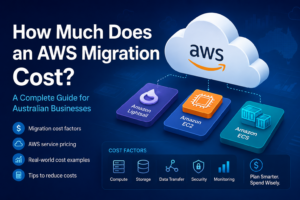
One of the first questions organisations ask when considering a move to Amazon Web Services (AWS) is:
“How much is this going to cost?”
Unfortunately, there is no single answer.
An AWS migration can cost anywhere from a few hundred dollars per month for a small business website to tens or hundreds of thousands of dollars for a complex enterprise application.
The reason for this wide range is that every migration is different. Infrastructure requirements, application complexity, compliance obligations, traffic volumes and internal resources all influence the final cost.
In this guide, we’ll break down the key factors that affect AWS migration pricing, provide realistic cost ranges for Australian businesses and explain how to avoid the most common budgeting mistakes.
What Is an AWS Migration?
An AWS migration involves moving applications, data, systems or infrastructure from an existing environment into Amazon Web Services.
Common migration scenarios include:
- Shared hosting to AWS
- VPS to AWS
- Dedicated servers to AWS
- On-premise servers to AWS
- Legacy applications to AWS
- Microsoft Azure to AWS
- Google Cloud to AWS
Some migrations involve simply moving a website.
Others involve redesigning infrastructure, databases, networking and deployment processes.
The complexity of the migration significantly impacts cost.
Why Businesses Move to AWS
Before discussing pricing, it’s important to understand why organisations migrate in the first place.
Common motivations include:
Improved Reliability
AWS provides highly resilient infrastructure distributed across multiple availability zones and regions.
This reduces the risk of downtime and improves business continuity.
Scalability
Applications can scale automatically as demand increases.
This prevents performance issues during peak traffic periods.
Security
AWS provides extensive security controls, monitoring tools and compliance frameworks.
Reduced Infrastructure Management
Businesses no longer need to maintain physical hardware or manage data centres.
Faster Innovation
Development teams gain access to modern cloud services that accelerate product development and deployment.
Factors That Influence Migration Costs
AWS migration costs can be divided into two categories:
- Migration project costs
- Ongoing AWS operating costs
Both should be considered during planning.
Migration Project Costs
These are one-off costs associated with moving systems into AWS.
Discovery and Assessment
Before migration begins, infrastructure and applications should be reviewed.
This process identifies:
- Current workloads
- Application dependencies
- Databases
- Storage requirements
- Security considerations
- Migration risks
Typical Australian consulting costs:
- Small business: $500 to $2,000
- Medium business: $2,000 to $10,000
- Enterprise: $10,000+
Many businesses skip this step and later encounter unexpected issues.
Infrastructure Design
AWS offers hundreds of services.
Designing the right architecture is critical.
This may include:
- Virtual servers
- Databases
- Storage
- Load balancing
- Networking
- Monitoring
- Security controls
A properly designed environment improves reliability while avoiding unnecessary costs.
Typical design costs:
- Small project: $1,000 to $5,000
- Medium project: $5,000 to $20,000
- Enterprise project: $20,000+
Migration Execution
This is the process of moving systems into AWS.
Tasks may include:
- Server migration
- Database migration
- DNS updates
- SSL configuration
- Security hardening
- Application deployment
- User acceptance testing
Costs vary significantly depending on complexity.
Typical Migration Costs
Simple website migration:
$500 to $3,000
WordPress migration:
$1,000 to $5,000
Business application migration:
$5,000 to $25,000
Custom SaaS platform:
$10,000 to $100,000+
Enterprise application:
$50,000 to $500,000+
Ongoing AWS Hosting Costs
After migration, organisations pay monthly AWS usage fees.
These vary depending on infrastructure design.
AWS Lightsail Costs
Lightsail is often the most cost-effective option for smaller businesses.
Typical monthly costs:
- Small website: $10 to $25
- Business website: $25 to $80
- Application server: $80 to $250
Lightsail provides predictable pricing and simplified management.
For many SMEs, it offers the best balance of cost and performance.
AWS EC2 Costs
EC2 pricing depends on:
- Instance size
- Storage
- Traffic
- Backups
Typical monthly costs:
Small application:
$50 to $200
Medium application:
$200 to $1,000
High traffic platform:
$1,000 to $5,000+
Unlike Lightsail, costs can fluctuate based on usage.
AWS ECS and Fargate Costs
Containerised applications often use ECS and Fargate.
Typical monthly costs:
Small workload:
$50 to $300
Growing SaaS platform:
$300 to $2,000
Enterprise platform:
$2,000 to $20,000+
Although infrastructure costs may be higher, operational efficiencies can reduce overall ownership costs.
Database Costs
Databases are often one of the largest components of AWS bills.
Amazon RDS
Managed databases typically range from:
Small workloads:
$20 to $100/month
Business workloads:
$100 to $500/month
Enterprise workloads:
$500 to $5,000+/month
Managed databases reduce operational overhead and improve reliability.
Storage Costs
AWS storage pricing depends on volume and access patterns.
Typical costs:
Small businesses:
$5 to $50/month
Growing businesses:
$50 to $500/month
Enterprise workloads:
$500 to $10,000+/month
Data growth should always be factored into long-term planning.
Monitoring and Logging Costs
Many businesses overlook monitoring expenses.
Services such as:
- CloudWatch
- Logging
- Metrics
- Alerts
can add additional monthly costs.
Typical spend:
$10 to $500+/month
depending on application scale.
Security Costs
Security investments vary by organisation.
Examples include:
- Web Application Firewalls
- Threat detection
- Vulnerability monitoring
- Backup services
Security costs typically range from:
$20 to several thousand dollars per month.
Common Migration Scenarios
Small Business Website
Current environment:
Shared hosting
Migration target:
AWS Lightsail
Project cost:
$1,000 to $3,000
Monthly AWS costs:
$20 to $100
Growing eCommerce Store
Current environment:
Managed hosting
Migration target:
EC2, RDS and CloudFront
Project cost:
$5,000 to $15,000
Monthly AWS costs:
$150 to $1,000
SaaS Application
Current environment:
Legacy VPS
Migration target:
ECS, Fargate, RDS
Project cost:
$10,000 to $50,000
Monthly AWS costs:
$300 to $5,000+
Enterprise Platform
Current environment:
On-premise infrastructure
Migration target:
Multi-account AWS architecture
Project cost:
$50,000 to $500,000+
Monthly AWS costs:
$2,000 to $50,000+
Hidden Costs Businesses Often Miss
Underestimating Application Complexity
Applications frequently have undocumented dependencies.
These can increase migration timelines.
Staff Training
Internal teams may require AWS training.
This should be factored into project budgets.
Technical Debt
Legacy systems often require remediation before migration.
Performance Optimisation
Cloud environments frequently require tuning after deployment.
Compliance Requirements
Industries such as healthcare, government and finance may require additional controls.
How to Reduce AWS Migration Costs
Start Small
Not every application requires a complex architecture.
Many businesses achieve excellent results using Lightsail or simple EC2 deployments.
Avoid Overengineering
One of the most common mistakes is implementing enterprise-grade solutions for small workloads.
Complexity increases both migration costs and operational overhead.
Optimise Before Migrating
Removing unused systems and outdated infrastructure reduces migration scope.
Use Managed Services
Services such as RDS often reduce long-term support costs.
Work with Experienced Cloud Consultants
Proper architecture decisions made early can save thousands of dollars annually.
Is AWS More Expensive Than Traditional Hosting?
In many cases, yes.
However, comparing AWS solely on hosting costs is misleading.
Businesses are paying for:
- Scalability
- Reliability
- Security
- Flexibility
- Global infrastructure
- Modern cloud services
The real question is not:
“What does hosting cost?”
The better question is:
“What does downtime cost?”
For many organisations, the operational benefits of AWS outweigh the higher infrastructure costs.
Final Thoughts
AWS migration costs vary significantly depending on application complexity, business requirements and long-term goals.
A simple website migration may cost only a few thousand dollars.
A large-scale enterprise transformation may cost hundreds of thousands.
For most Australian SMEs, a realistic AWS migration budget falls between $2,000 and $25,000, with ongoing infrastructure costs ranging from $50 to $1,000 per month depending on workload requirements.
The most successful migrations are not necessarily the cheapest. They are the ones that balance performance, reliability, security and operational simplicity while supporting future growth.
A well-planned AWS migration should be viewed as an investment in business capability rather than simply a hosting expense.