When organisations begin their cloud journey on AWS, one of the first architectural decisions they face is where to host their applications. And that’s how they end up in a position where they are comparing AWS Lightsail vs EC2 vs ECS.
AWS offers multiple compute services that can appear similar at first glance but are designed for very different use cases. Three of the most common options are Amazon Lightsail, Amazon EC2 and Amazon ECS.
While all three can run web applications, APIs, SaaS platforms and business systems, they differ significantly in complexity, scalability, management overhead and cost.
Understanding these differences is critical to selecting the right platform for your application both today and as your business grows.
AWS Lightsail vs EC2 vs ECS
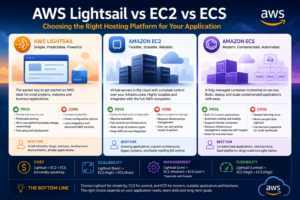
Comparing AWS Lightsail vs EC2 vs ECS, you should think of AWS hosting options as a progression.
At one end is Lightsail, which provides a simplified cloud experience with predictable pricing.
In the middle is EC2, which provides full control over virtual infrastructure.
At the more advanced end is ECS, which focuses on container orchestration and automated application deployment.
Each service serves a specific purpose.
The challenge is determining which aligns with your operational requirements and technical capabilities.
Amazon Lightsail
Amazon Lightsail is AWS’s simplified virtual private server offering.
It was designed for developers and businesses that want the reliability of AWS without needing to understand the full AWS ecosystem.
A Lightsail instance combines:
- Virtual machine
- SSD storage
- Static IP
- Firewall
- DNS management
- Monitoring
into a single monthly package.
This predictable pricing model makes Lightsail attractive for startups and small businesses.
Advantages of Lightsail
Simplicity
Lightsail dramatically reduces complexity.
Instead of navigating dozens of AWS services, administrators can deploy a server in minutes.
This makes it ideal for:
- WordPress websites
- Business applications
- Internal portals
- SaaS MVPs
- Small APIs
- Development environments
Predictable Pricing
Unlike many AWS services where costs fluctuate based on usage, Lightsail bundles resources into fixed monthly plans.
This simplifies budgeting and reduces the risk of unexpected bills.
Fast Deployment
Applications can often be deployed in under an hour.
Teams can focus on application development rather than infrastructure management.
AWS Foundation
Although simplified, Lightsail still runs within AWS infrastructure and benefits from:
- AWS data centres
- Security controls
- Network reliability
- Global availability
Limitations of Lightsail
Limited Scalability
Lightsail can scale vertically by increasing server size, but horizontal scaling is more limited than other AWS services.
Large traffic spikes may require migration to EC2 or container services.
Reduced Service Integration
Lightsail does not integrate as deeply with the broader AWS ecosystem.
Advanced networking, security and automation capabilities are more restricted.
Manual Operations
Most operational tasks remain the responsibility of administrators.
This includes:
- Server maintenance
- Operating system updates
- Scaling decisions
- Capacity planning
Best Use Cases for Lightsail
Lightsail is often ideal for:
- Startup applications
- Small SaaS platforms
- Membership websites
- WordPress hosting
- Client websites
- Internal business systems
- Applications with predictable traffic
For many SMEs, Lightsail represents the best balance between simplicity, cost and performance.
Amazon EC2
Amazon Elastic Compute Cloud (EC2) is the foundation of AWS infrastructure.
Most AWS services ultimately run on EC2 under the hood.
Unlike Lightsail, EC2 provides complete control over virtual infrastructure.
Administrators can select:
- Instance families
- CPU configurations
- Memory allocations
- Storage types
- Networking options
- Security models
This flexibility makes EC2 one of the most widely used cloud services in the world.
Advantages of EC2
Complete Infrastructure Control
EC2 allows organisations to customise every aspect of the environment.
This includes:
- Operating systems
- Networking
- Storage
- Security
- Performance tuning
For organisations with specialised requirements, this level of control is invaluable.
Massive Scalability
EC2 supports both vertical and horizontal scaling.
Instances can be increased in size or distributed across multiple servers using Auto Scaling Groups and Load Balancers.
Broad AWS Integration
EC2 integrates seamlessly with:
- RDS
- CloudWatch
- IAM
- Route 53
- S3
- CloudFront
- Systems Manager
This creates powerful enterprise-grade architectures.
Flexibility
Almost any workload can run on EC2.
Examples include:
- Enterprise applications
- Databases
- APIs
- Data processing
- AI workloads
- ERP systems
Limitations of EC2
Greater Complexity
The flexibility of EC2 comes with additional operational overhead.
Teams must manage:
- Infrastructure
- Security patches
- Scaling
- Monitoring
- Backups
- Availability
Cost Management
EC2 costs can become difficult to predict without proper governance.
Resources that remain running unnecessarily can generate significant expenses.
Operational Burden
Infrastructure teams must invest more time maintaining environments.
For smaller organisations this may create unnecessary complexity.
Best Use Cases for EC2
EC2 is well suited for:
- Enterprise applications
- High traffic websites
- Custom architectures
- Legacy migrations
- Compliance-driven environments
- Workloads requiring extensive customisation
Amazon ECS
Amazon Elastic Container Service (ECS) is AWS’s managed container orchestration platform.
Rather than managing servers directly, teams deploy applications as containers.
Containers package code, dependencies and runtime environments into portable units.
ECS automates:
- Deployment
- Scheduling
- Scaling
- Health monitoring
This significantly reduces operational overhead for modern applications.
ECS Launch Types
ECS supports two primary deployment models.
ECS on EC2
Containers run on EC2 instances managed by your organisation.
This provides greater control but requires infrastructure management.
ECS on Fargate
AWS manages the underlying servers entirely.
Teams simply deploy containers and AWS handles the infrastructure.
This serverless model has become increasingly popular for modern applications.
Advantages of ECS
AWS Lightsail vs EC2 vs ECS: Modern Application Architecture
ECS aligns naturally with containerised applications.
Development teams can deploy consistently across:
- Development
- Testing
- Staging
- Production
environments.
Automated Scaling
ECS can automatically scale applications based on:
- CPU usage
- Memory usage
- Request volume
- Custom metrics
This improves resilience during traffic spikes.
High Availability
Container orchestration improves reliability.
If a container fails, ECS automatically replaces it.
Improved Deployment Workflows
ECS supports:
- Blue-green deployments
- Rolling updates
- CI/CD pipelines
- Automated rollbacks
This reduces deployment risk.
Reduced Infrastructure Management
Particularly with Fargate, teams spend less time managing servers.
This allows developers to focus on delivering business value.
Limitations of ECS
Learning Curve
Container orchestration introduces additional concepts.
Teams must understand:
- Docker
- Container networking
- Task definitions
- Service discovery
- CI/CD pipelines
Operational Complexity
Although infrastructure management decreases, application deployment complexity often increases.
Potential Cost Overhead
For small workloads, ECS may cost more than a simple Lightsail instance.
The operational benefits often justify the cost, but not always.
Best Use Cases for ECS
ECS excels in:
- SaaS platforms
- Microservices
- APIs
- Event-driven systems
- High growth applications
- Enterprise cloud-native environments
Lightsail vs EC2 vs ECS
Deployment Complexity
Lightsail is the simplest.
Applications can often be deployed within minutes.
EC2 requires more infrastructure knowledge.
ECS requires the greatest architectural understanding but provides the most automation.
Scalability
Lightsail offers basic scalability.
EC2 offers extensive scalability with manual control.
ECS provides automated cloud-native scalability.
Cost
For smaller workloads:
Lightsail is generally the cheapest.
For medium workloads:
EC2 often provides excellent cost-performance.
For large-scale cloud-native environments:
ECS can deliver operational efficiencies that outweigh infrastructure costs.
Operational Overhead
Lightsail requires moderate server management.
EC2 requires significant infrastructure management.
ECS minimises infrastructure management but introduces container orchestration responsibilities.
Real-World Recommendation
For many Australian SMEs building custom applications, the best choice is often determined by business maturity rather than technical preference.
A startup launching an MVP may benefit most from Lightsail.
A growing platform requiring greater control may move to EC2.
A mature SaaS platform with multiple services and development teams may benefit from ECS and Fargate.
There is no universally correct answer.
The optimal solution depends on traffic patterns, operational requirements, budget, internal expertise and long-term growth plans.
Final Thoughts
AWS Lightsail, EC2 and ECS are not competing products. They solve different problems.
Lightsail prioritises simplicity and predictable costs.
EC2 prioritises flexibility and infrastructure control.
ECS prioritises automation, scalability and modern cloud-native operations.
Organisations should choose the platform that matches their current stage of growth while considering future scalability requirements.
The best architecture is rarely the most complex. It is the one that provides the required reliability, performance and maintainability while minimising operational burden.
For many organisations, starting simple and evolving as requirements grow remains the most effective cloud strategy.