Most buyers start looking for business IT consulting services at an awkward point in the cycle. Something is already hurting. The AWS bill is hard to explain. Teams are re-entering data across CRM, finance, and operations. A legacy platform still runs the business, but every change takes too long and carries too much risk.
That’s also why generic advice is useless. Decision-makers don’t need another high-level definition of “digital transformation”. They need a practical way to sort problems, scope the engagement, compare vendors, and decide whether a project should be delivered as a migration, a rebuild, an integration program, or a managed service.
In Australia, that decision matters more than it used to. Digital transformation consulting is forecast to achieve the highest CAGR of 8.02% through 2031 within the Australian Management Consulting market, according to Mordor Intelligence’s Australia market outlook. Demand is rising, but so is the number of firms selling overlapping services. Buyers need clearer selection criteria.
Table of Contents
- Understanding Business IT Consulting Services
- The Engagement Roadmap From Problem to Solution
- Key Deliverables You Should Expect
- Choosing Your Consulting Partner A Decision-Maker’s Checklist
- Understanding Costs and Calculating ROI
- Real-World Scenarios Case Study Snapshots
- Defining Your Next Steps
Understanding Business IT Consulting Services
Business IT consulting services are easiest to evaluate when you stop treating them as one category. In practice, most serious engagements sit inside three commercial buckets. Each one solves a different problem, uses different delivery methods, and creates different risks if scoped poorly.
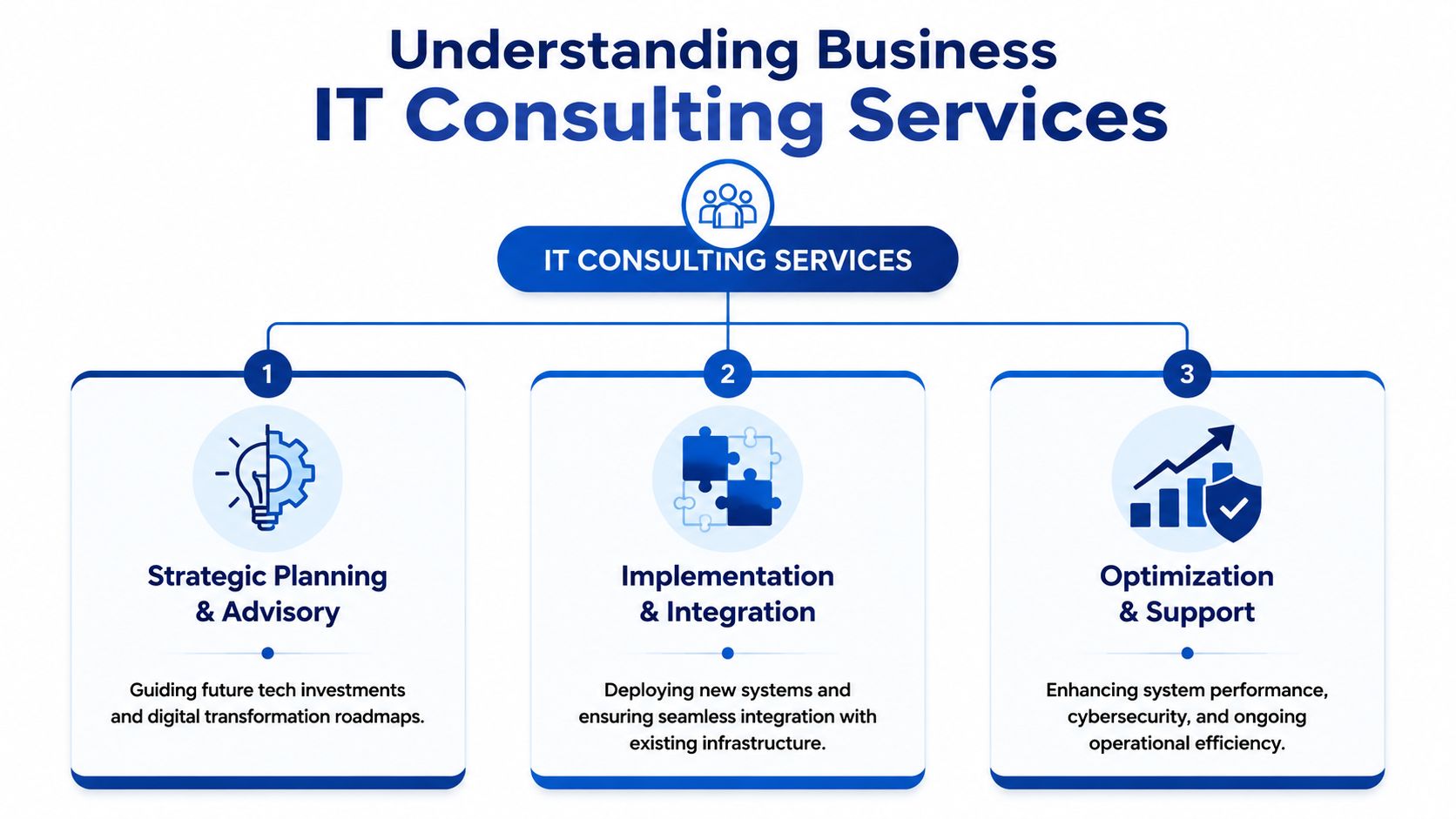
Cloud and infrastructure modernisation
This is the right category when the business problem is reliability, cost control, scalability, or operational risk. The work often includes AWS or Azure architecture, phased migrations, hosting redesign, environment separation, observability, backups, and security controls.
If your team says things like “we can’t safely deploy during business hours” or “nobody fully understands the current environment”, you’re usually dealing with an infrastructure problem before you’re dealing with an application problem.
Typical examples include:
- Cloud migration: Moving workloads off ageing servers or fragile shared hosting into AWS or Azure with clearer governance.
- Infrastructure optimisation: Cleaning up overprovisioned services, reviewing storage patterns, and tightening access controls.
- Managed cloud services: Ongoing monitoring, incident response, patching, and performance tuning after go-live.
Custom application development
Some organisations don’t have an infrastructure problem first. They have a product or workflow problem. Staff are bending spreadsheets around processes that should live in software. Customers are using a portal that no longer fits how the business operates. The existing platform can’t support mobile use, self-service, or new services.
That’s where custom development belongs. This can mean a Progressive Web App, a cross-platform mobile app using Flutter or React Native, a SaaS platform, a member portal, or an internal operations tool.
Practical rule: Build custom software when the process gives your organisation an advantage, or when off-the-shelf tools force too many workarounds.
A mature consulting partner should be able to tell you when not to build. If Shopify, Xero, HubSpot, Salesforce, or a sector-specific platform will solve the problem with sensible configuration, forcing a greenfield build usually creates avoidable cost and technical debt.
Systems integration and automation
This is the category buyers underestimate most. The business already owns systems, but they don’t share data properly. Marketing sees one version of the customer. Finance sees another. Operations run manual exports. Support staff chase records across multiple tools.
Integration work fixes that. It includes API design, documented REST endpoints, CRM integrations, authentication layers, event flows, middleware, and automation between platforms such as Salesforce, HubSpot, Shopify, WordPress, and internal tools.
A quick way to identify the right pillar is to ask where the friction sits:
| Business symptom | Likely consulting pillar |
|---|---|
| Hosting instability, poor deployment confidence, rising cloud complexity | Cloud and infrastructure modernisation |
| Weak portal experience, manual internal processes, product limitations | Custom application development |
| Duplicate records, rekeying, inconsistent reporting, disconnected systems | Systems integration and automation |
For buyers comparing providers, this matters because not every consultancy does all three well. Some are strong at advisory work but weak in engineering. Some can build applications but can’t design a well-designed cloud landing zone. Some can migrate workloads but struggle to integrate surrounding systems. A useful capability benchmark is whether the vendor can speak clearly across architecture, delivery, and support, rather than selling one narrow specialisation as the answer to every problem. A broad example of that service mix can be seen in these cloud, development and integration capabilities.
The Engagement Roadmap From Problem to Solution
Good consulting engagements don’t feel mysterious. They move in phases, and each phase reduces uncertainty before more money is committed. If a vendor jumps from first meeting to implementation quote without structured discovery, the risk lands on you.
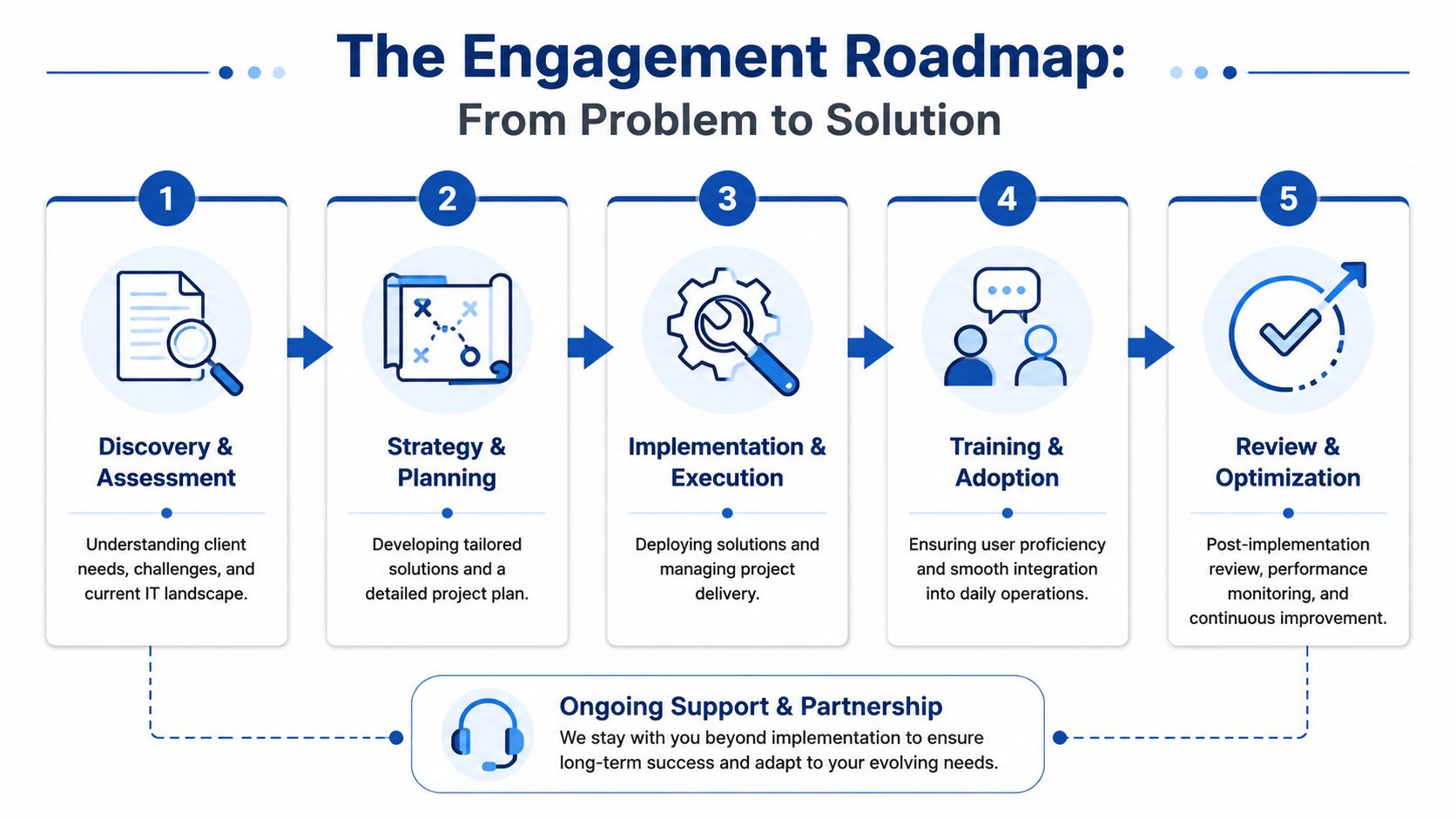
Assess and discover
The first phase establishes what’s broken and what success needs to look like. This usually means stakeholder interviews, current-state architecture review, hosting and application audits, process mapping, risk review, and identification of operational constraints.
In Australian cloud projects, structure matters. Successful AWS cloud migrations align with frameworks such as IRAP by following a structured three-phase approach of Assess, Mobilize, and Migrate, as outlined in SmartOSC’s guide to AWS cloud migration for Australian businesses. That’s a useful benchmark because compliance, network design, and data protection need to be built in early, not added after the fact.
Discovery should leave you with answers to practical questions:
- What are we solving first: Cost control, resilience, compliance, speed of change, or data accuracy.
- What must stay stable: Critical systems, donor platforms, finance processes, customer-facing journeys.
- What can move in phases: Low-risk workloads, non-core integrations, isolated user groups, or a single product area.
Mobilise and plan
Strong consultants earn their fees by turning findings into a delivery plan with priorities, dependencies, budget logic, technical decisions, testing approach, and governance.
The output shouldn’t be a vague roadmap slide. It should be something your internal team can challenge. That often includes a target architecture, migration backlog, release plan, environment strategy, monitoring approach, security controls, and a clear decision on what will be rebuilt, rehosted, retired, or integrated.
Political and cultural change management matter as much as technical design. Teams need business testing at each stage, and cloud enablement capability should be built early rather than after migration.
That principle aligns with AWS public sector guidance on successful cloud modernisation and migration, and it applies well beyond government workloads.
A capable integration partner will also map system boundaries in detail. If your project includes CRM, identity, website, mobile, finance, and reporting, you want explicit ownership of each connection point. That’s the difference between a stable delivery program and an expensive chain of “we assumed the other team was doing that”. Buyers evaluating this kind of work should pay close attention to a vendor’s custom integrations approach across APIs and platform connections.
Migrate build and optimise
The final phase is where architecture becomes operating reality. Depending on the engagement, that can involve cloud migration, application development, integration delivery, data migration, performance tuning, user testing, training, and post-launch optimisation.
Well-run teams don’t treat go-live as the finish line. They stabilise. They monitor. They validate costs, performance, adoption, error rates, and business process outcomes against the assumptions made earlier.
That’s why phased delivery works better than “big bang” cutovers in most environments. You learn from lower-risk changes first, preserve optionality, and avoid tying critical operations to a single weekend launch plan.
Key Deliverables You Should Expect
A consulting engagement shouldn’t end with a polished presentation and a list of recommendations. You should be left with assets your organisation can operate, maintain, and, if necessary, hand to another team later.
Architecture and planning artefacts
For cloud and modernisation projects, tangible deliverables usually start with decision-grade documentation. That includes current-state and target-state architecture diagrams, environment maps, identity and access models, migration runbooks, risk registers, and release plans.
For systems integration work, ownership of data flow design matters. You should expect interface specifications, API documentation, authentication patterns, field mapping, error-handling logic, and process diagrams that show where each system starts and stops.
A practical checklist looks like this:
- Cloud architecture diagram: The target AWS or Azure design, including environments, networking boundaries, major services, and security controls.
- Migration or release plan: Sequenced work packages, dependencies, test gates, rollback approach, and change windows.
- Data and integration documentation: API contracts, mapping rules, webhook events, sync behaviours, and exception handling.
Build outputs and operational assets
If the engagement includes software delivery, “done” should mean the actual working product plus the operational pieces around it. That often includes application source code, deployment pipelines, container images, build instructions, infrastructure-as-code, test artefacts, and technical handover notes.
For a PWA or SaaS platform, that may mean a containerised app in a Docker registry, documented environment variables, CI/CD configuration, and a monitored production environment. For a mobile or cross-platform build, it should include release management steps, backend service configuration, and support guidance for future updates.
A handover isn’t complete if your internal team can’t answer three questions after go-live: how it’s deployed, how it’s monitored, and how incidents are triaged.
Monitoring assets are especially important because many projects fail after launch, not during build. If the vendor can’t show you how errors are captured, performance is observed, and regressions are surfaced, you’re inheriting avoidable support risk. A useful benchmark is whether they can support enterprise application monitoring and debugging practices using tools such as Sentry, New Relic, uptime alerts, and structured incident workflows.
The commercial point is simple. Deliverables aren’t paperwork. They’re what protect the investment after the consultants leave.
Choosing Your Consulting Partner A Decision-Maker’s Checklist
Most failed technology projects don’t fail because the idea was wrong. They fail because the buyer selected a vendor with the wrong delivery model, the wrong technical depth, or the wrong incentives.
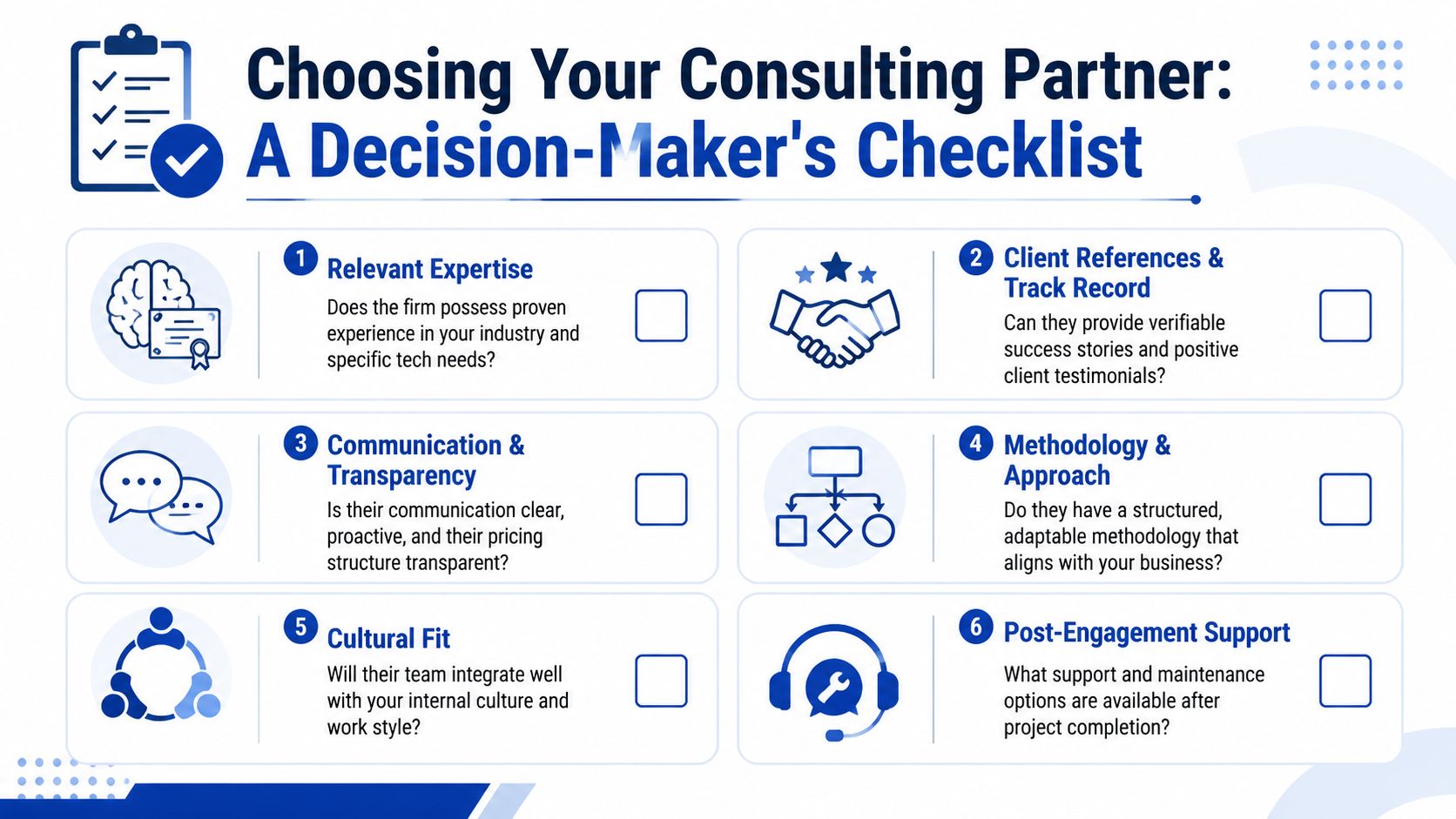
What to test in vendor conversations
Start with evidence that the firm has delivered in your stack and your operating context. If you need AWS migration, ask who designs the landing zone, who handles rollback planning, and who owns post-cutover optimisation. If you need a member platform, ask about identity, payment flows, CRM sync, and support processes after launch.
Cost governance deserves direct scrutiny. A significant challenge for Australian SMEs and NGOs is the cost transparency gap, with 60% of SMEs citing unpredictable cloud spending as a top barrier, as noted in Statista’s outlook for IT consulting and implementation in Australia. A partner that can migrate workloads but can’t explain tagging, cost reviews, usage baselines, and accountability for ongoing spend isn’t solving the full business problem.
Use questions like these:
- Who is doing the engineering: Local senior staff, subcontractors, or a rotating delivery bench.
- How do you manage scope change: Formal backlog and impact review, or ad hoc variation after variation.
- What happens after go-live: Support hours, monitoring, incident ownership, and optimisation cadence.
- How do you handle Australian compliance context: Data residency, operational controls, and documentation fit for local governance.
For cloud-heavy projects, it’s also reasonable to ask whether the firm has formal platform partnerships and local architecture capability. Buyers wanting to compare this area can review what an AWS Partner solution architect in Melbourne model typically looks like and then test vendors against that standard.
Red flags worth taking seriously
Some warnings show up early if you listen carefully.
| Red flag | Why it matters |
|---|---|
| The proposal is polished, but technical staff aren’t in the room | You may be buying sales confidence, not delivery capability |
| The vendor pushes a single platform for every use case | They’re fitting your problem to their offering |
| Pricing is opaque until late in procurement | Budget risk usually gets worse after signature |
| They promise a seamless cutover with little business involvement | That usually means weak testing and poor change planning |
A strong partner doesn’t just sound competent. They make trade-offs visible. They’ll tell you what not to do, where staged delivery is safer, and which assumptions could break the business case.
Understanding Costs and Calculating ROI
Budget conversations are more useful when you separate pricing model from project value. A fixed quote doesn’t automatically mean lower risk, and time-based billing doesn’t automatically mean poor control. What matters is whether the commercial model matches the work.
Which pricing model fits which project
Time and materials suits discovery, complex modernisation, integration programs, and projects where unknowns are still being uncovered. It gives flexibility, but only if the vendor tracks scope, burn, decisions, and next priorities tightly.
Fixed-price delivery works better when requirements are stable, interfaces are known, and acceptance criteria are specific. It’s often appropriate for a contained integration, a defined feature release, or a well-bounded migration stage. It’s a poor fit for vague transformation programs where both sides are still learning.
Retainer or managed service arrangements make sense once the environment is live and the work shifts from implementation to optimisation, monitoring, support, and incremental change.
There’s a reason Australian buyers are leaning into staged work. The Australian management consulting industry saw revenue contract by 3.6% in 2024-25 due to enterprise cost-containment, and that contraction has pushed clients toward phased, measurable cloud migrations rather than monolithic projects, according to IBISWorld’s analysis of the management consulting industry in Australia. That matches what many technology leaders are doing on the ground. Smaller commitments, clearer checkpoints, and more frequent cost reviews.
If you’re benchmarking migration spend specifically, it helps to compare the project against a dedicated AWS migration cost guide for Australia rather than treating cloud work as one broad line item.
How to build the business case
The cleanest ROI cases usually combine four value pools:
- Reduced operating friction through automation, integration, and fewer manual workarounds.
- Lower infrastructure waste through better architecture and cloud cost governance.
- Risk reduction by retiring unsupported systems, improving resilience, and tightening observability.
- Revenue or service enablement through faster releases, better customer experience, or new digital capability.
Don’t build the case on optimistic feature lists. Build it on problems you can already see. Examples include duplicated data entry, delayed reporting, failed deployments, support effort caused by brittle systems, and the cost of keeping legacy platforms alive.
Buyers get better investment decisions when they approve a phase with explicit assumptions, then release the next phase only after those assumptions are tested.
That’s also why ROI should be reviewed after launch, not just before signature. The architecture may be sound, but if adoption is weak or processes don’t change, the commercial outcome will lag.
Real-World Scenarios Case Study Snapshots
The most useful way to judge business IT consulting services is to look at the shape of the problem, not the label on the service.

Enterprise modernisation
A financial services firm is running a monolithic internal platform that’s become expensive to change. Releases are slow, infrastructure knowledge sits with a small number of people, and compliance reviews happen late because the architecture doesn’t make control points obvious.
The right engagement usually starts with an application and infrastructure assessment, then moves into phased migration. Core workloads don’t need to be moved all at once. Lower-risk services can be separated first, observability can be added early, and testing can be tied to each migration stage. That reduces operational risk while giving leadership clearer decision points.
A poor approach here is a full-platform rewrite before stabilisation. A better one is to improve deployment confidence, separate concerns, and modernise around the live system in controlled releases.
NGO platform integration
A not-for-profit often has a different problem. The website, CRM, donation workflows, finance records, and membership system all exist, but they don’t line up. Staff manually reconcile records. Supporters receive inconsistent communications. Reporting takes too long because each team trusts different data.
The engagement usually centres on systems integration and process redesign. APIs, identity, payment events, and data mapping become more important than flashy front-end changes. Sometimes a new portal is needed. Sometimes the biggest win comes from connecting the existing stack properly and documenting who owns each business rule.
The trade-off is that integration work can look less visible than a rebuild, even when it creates more operational value. Decision-makers need to judge the project by reduced manual effort, cleaner data, and more reliable workflows.
Startup launch on a controlled budget
A startup has the opposite constraint. It needs to get to market without building too much too early. The founders want web and mobile reach, but they can’t afford a bloated platform or a long enterprise-style program.
That’s where a lean build can work well. A Progressive Web App or cross-platform application, backed by serverless services and a small set of carefully chosen integrations, can support launch without forcing the company into heavy operational overhead. Feature priorities matter more than technical perfection at this stage.
The best early architecture gives a startup room to learn. It doesn’t lock the team into expensive complexity before the business model is proven.
The common failure pattern is overbuilding. Too many features, too many services, and too much custom infrastructure before users have validated the product.
Defining Your Next Steps
If you’re evaluating business IT consulting services, the first task isn’t picking a vendor. It’s defining the problem in business terms that an engineering team can act on.
Start with a short internal brief. Write down where the friction sits today, who owns the affected process, what systems are involved, and which outcomes matter most. Keep it practical. Slower releases, duplicated work, unreliable reporting, expensive hosting, weak user experience, or unresolved compliance concerns are all valid starting points.
Bring the right people into the first conversation. That usually means an operational owner, a technical lead, and the person who controls budget or procurement. Projects drift when one of those voices is missing early.
Before any discovery call, gather these basics:
- Current pain points: The top operational and technical issues, stated plainly.
- System environment: Core platforms, known integrations, and obvious dependencies.
- Business constraints: Timing, budget boundaries, internal capability, and compliance concerns.
- Success criteria: What would need to improve for the investment to be judged worthwhile.
A strong first meeting should leave you with more clarity, not more jargon. If the consultant can’t translate your problem into a phased path with trade-offs, they probably shouldn’t be trusted with a major technology investment.
If you’re planning a migration, integration program, legacy replacement, or custom platform build, Continuum Solutions can help you scope the problem properly before you commit to delivery. A practical discovery conversation can clarify architecture options, likely risks, and the most sensible phased path for your organisation.