
You’re probably in one of two situations right now. Either your team is planning a new mobile product and wants one codebase across iOS and Android, or you already know you need cross-platform delivery but can’t afford to choose a framework that becomes expensive to maintain after launch.
That’s where most Flutter vs React Native articles fall short. They focus on developer preference, UI syntax, or which framework feels nicer in a demo. CTOs and Product Managers need a different lens. The pertinent question isn’t only how fast you can ship version one. It’s how the app behaves under load, how much effort future upgrades will require, how well it fits your AWS or Azure estate, and what your support burden looks like after the first release.
For Australian organisations, those trade-offs are even sharper. Cloud spend, compliance obligations, device diversity, and internal support capacity all affect the decision. A startup may need to preserve runway. An NGO may need reliability across mixed device fleets. A government or enterprise team may care more about auditability, observability, and controlled change than about shaving a few weeks off initial delivery.
Sometimes the right answer isn’t mobile at all. If the requirement is broad access, lightweight deployment, and strong browser reach, a well-architected Progressive Web App can be the better commercial choice. But when a true mobile app is warranted, the framework decision becomes strategic.
Table of Contents
- Choosing Your Mobile App Framework Beyond the Hype
- A Strategic Overview of Flutter and React Native
- Comparing Performance and End-User Experience
- Developer Productivity and Ecosystem Maturity
- Enterprise Readiness and Long-Term Maintenance
- Decision Framework Which Should Your Business Choose
- Partnering for Scalable and Maintainable Mobile Applications
Choosing Your Mobile App Framework Beyond the Hype
The Flutter vs React Native decision is rarely a technical coin toss. It affects delivery shape, support effort, infrastructure choices, release risk, and the size of the maintenance backlog your team inherits over time.
A common mistake is treating the framework as a developer-led preference. That can work for an internal prototype. It doesn’t work for a business-critical mobile product tied to CRM data, identity, payments, field operations, or member services. In those environments, the framework becomes part of your operating model.
A better way to assess the choice is to work through four business questions.
- What kind of product are you building? A highly branded consumer app, booking flow, membership platform, or rich operational interface has different needs from a simple internal utility.
- What team do you already have? Existing JavaScript capability can materially change your delivery model. A greenfield team may optimise for different strengths.
- What will you integrate with? Mobile apps rarely stand alone. They connect to AWS Lambda, Azure Functions, REST APIs, authentication layers, CRMs, analytics, and support tooling.
- What happens after release? Version upgrades, device QA, incident response, and platform changes often cost more than the original framework debate.
Practical rule: If your framework choice creates extra operational complexity every month, any early development speed advantage disappears quickly.
The most useful discussions I’ve had with clients usually stop asking “Which framework is better?” and start asking “Which framework produces the least risk for our product, team, and support model over the next few years?”
That reframes the decision properly. Flutter and React Native are both viable. Neither is universally superior. But they produce different downstream consequences, and those consequences are what matter to decision-makers.
A Strategic Overview of Flutter and React Native
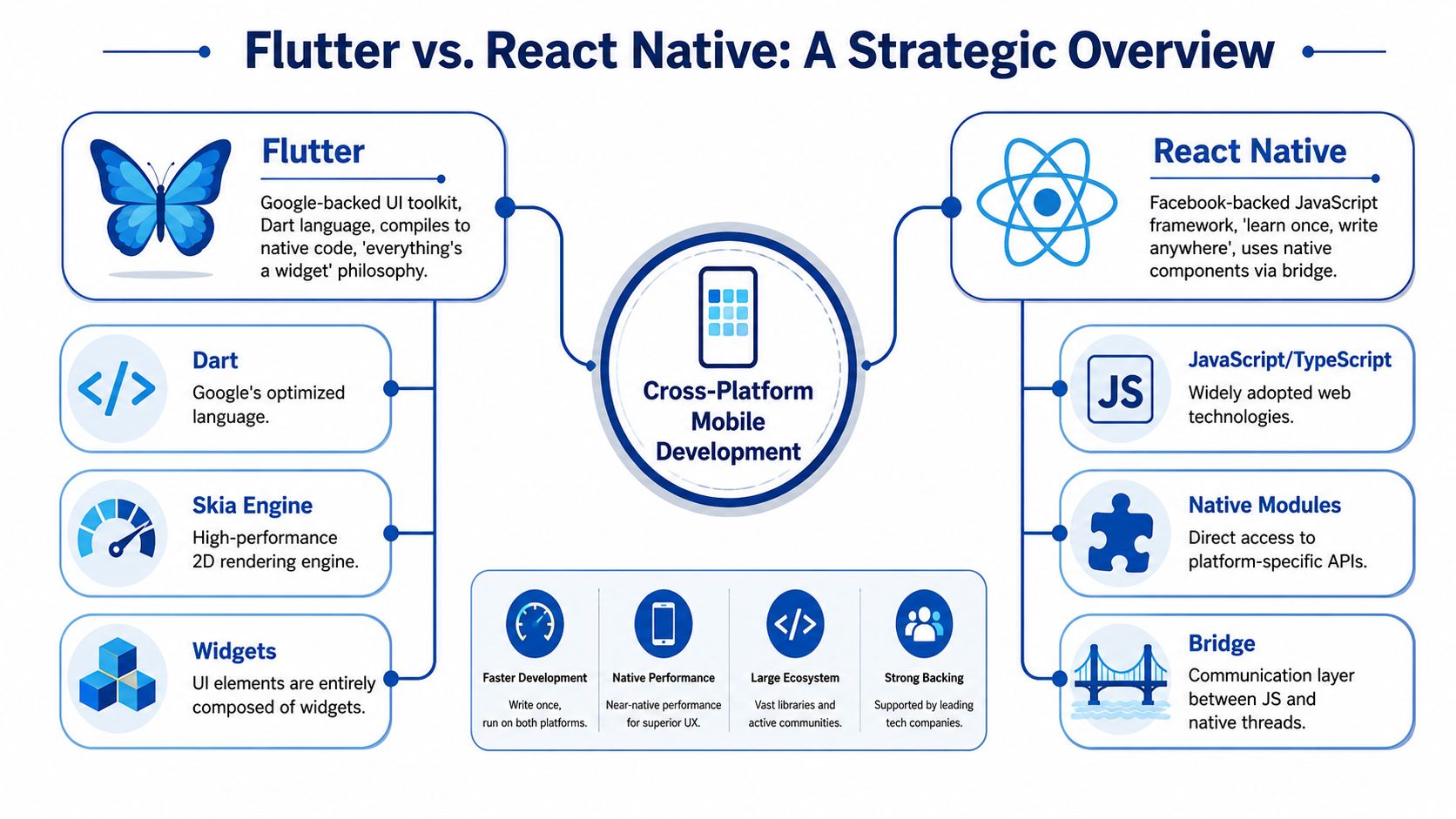
Here’s the simplest way to understand the difference. Flutter renders the interface itself. React Native uses JavaScript to work with native platform components. That architectural split drives most of the practical differences teams experience later.
| Consideration | Flutter | React Native |
|---|---|---|
| UI model | Renders its own UI | Uses native UI components through a JavaScript layer |
| Primary language | Dart | JavaScript or TypeScript |
| Best fit | Design-heavy, performance-sensitive products | Teams with strong web and React capability |
| Cross-platform consistency | Strong | Good, but more platform-specific variation |
| Native feel | Can be tailored, but not inherited by default | Naturally closer to platform conventions |
Two different architectural bets
Flutter uses Dart and its own rendering engine, Skia or Impeller, to draw UI components directly on a virtual canvas rather than relying on native platform widgets. That gives teams a consistent visual layer across platforms and can support smoother 60 to 120 fps experiences for visually rich screens, as outlined in this Flutter and React Native framework comparison.
React Native takes a different approach. It leans on JavaScript and native components, which makes it feel more familiar to web teams and often more aligned with each platform’s default look and behaviour. That can be an advantage when native conventions matter more than strict visual uniformity.
Flutter’s architecture also means every pixel is controlled by the framework, not the operating system. That gives tight control over branding and animation, but can require extra effort if you want the app to mirror each platform’s native feel closely, as discussed in the earlier comparison.
Why this matters to a CTO
This isn’t an academic distinction. It affects design QA, regression risk, and how much platform-specific work shows up later.
If you need strong visual consistency across iOS and Android, Flutter removes a lot of uncertainty. If your product strategy depends on your existing React and web talent, React Native can reduce organisational friction.
A useful way to think about it is this:
- Flutter is usually the better option when a single, controlled presentation layer matters most.
- React Native is often the better option when you want mobile delivery to sit closer to an existing JavaScript ecosystem.
- Neither framework removes native complexity entirely. Push notifications, device permissions, app store packaging, build pipelines, and platform APIs still need careful engineering.
For business leaders reviewing cross-platform strategy, architecture examples matter more than marketing claims. Well-documented delivery case studies are often the fastest way to see whether a team understands the trade-offs beyond the framework itself.
Comparing Performance and End-User Experience
Users don’t care what framework you chose. They notice whether the app launches quickly, scrolls smoothly, and stays responsive when the interface gets busy.
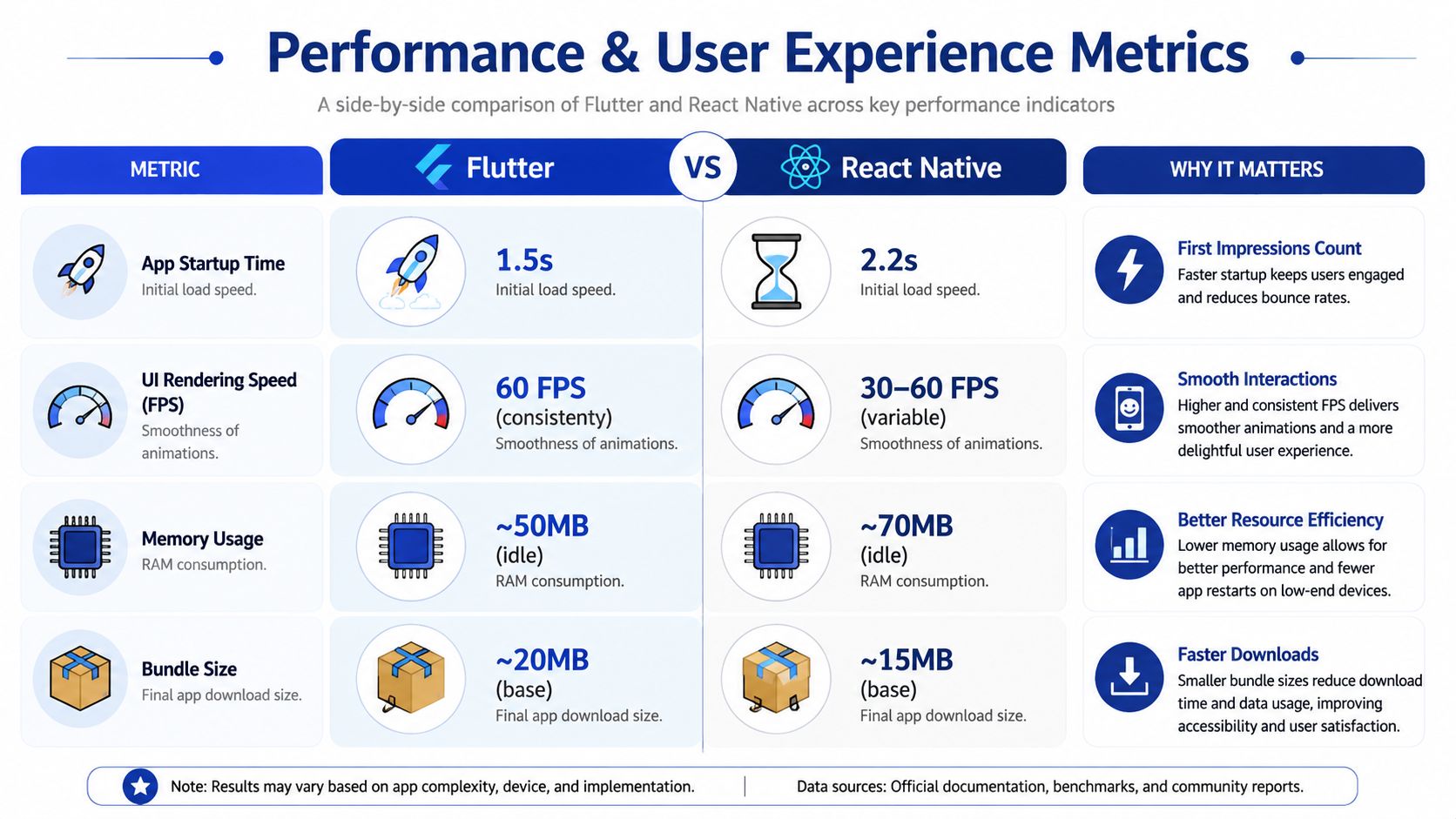
Flutter has a measurable edge in the benchmark areas that matter most for richer mobile experiences. In performance-oriented comparisons relevant to product teams, Flutter shows advantages in startup time, CPU usage, and frame-rate stability. CPU measurements cited in this benchmark summary report Flutter using around 43 to 44% CPU under typical load versus approximately 52 to 53% for React Native.
What the benchmark differences mean in practice
Those figures matter because mobile performance problems rarely appear as one dramatic failure. They show up as small friction points.
- Animations feel less stable: Users may not describe “frame drops”, but they do notice that a polished app feels rough.
- Longer sustained load affects mid-range devices: That matters for broad public-facing apps, NGO deployments, and enterprise fleets where not every handset is current.
- Busy screens expose architectural limits: Dashboards, booking flows, CRM-connected interfaces, and branded experiences often have more going on than simple forms.
Separate benchmark reporting also notes that Flutter typically sustains 60 fps in complex UI layouts and can reach 120 fps on supported hardware through Impeller, while React Native may drop into the 52 to 58 fps range in similar animation-heavy scenarios without newer architecture optimisations, based on this performance comparison.
One stress-test comparison adds an important nuance. React Native can consume less memory at baseline, while Flutter may carry a fixed engine overhead and larger app size. The same comparison reported graphics memory around 155 MB for React Native versus over 270 MB for Flutter under a synthetic stress case, while Flutter still delivered about 121 fps compared with React Native at roughly 96 fps, according to this 2025 benchmark review.
Smoothness is a product feature. For branded mobile experiences, users often judge quality before they’ve completed a single business task.
Where React Native still makes sense
That doesn’t mean React Native is a poor performer. It isn’t. For standard business apps, content-led interfaces, and products where backend latency dominates the experience, React Native is often good enough.
In practice, I’d view it this way:
- Choose Flutter when UI smoothness is central to the product promise.
- Choose React Native when performance is important but not the main differentiator.
- Don’t confuse benchmark wins with user value. A simpler app with clean architecture can outperform a badly designed app built on the “faster” framework.
For teams planning customer-facing products with integrated APIs, authentication, and operational workflows, the more valuable question is whether the framework can maintain a stable experience as the app grows. That’s where experienced application development teams in Melbourne usually focus their evaluation.
Developer Productivity and Ecosystem Maturity
Framework choice affects hiring, onboarding, QA speed, and how often your team has to build around missing tooling. Those issues don’t show up in demo videos, but they show up quickly in delivery budgets.
Flutter’s ecosystem momentum is now hard to ignore. Flutter has steadily overtaken React Native in developer surveys and usage. In Stack Overflow’s 2024 Developer Survey, Flutter placed slightly ahead of React Native in the cross-platform mobile category, and the 2025 Stack Overflow survey noted Flutter ahead by 4 percentage points, with 42% for Flutter versus 38% for React Native, as summarised in this market perspective. The same source also notes Flutter’s scale, with over 76,000 packages on pub.dev and around 760,000 GitHub repositories, compared with React Native’s roughly 520,000 repositories.

Hiring and team fit in Australia
Popularity doesn’t automatically mean the hiring decision is simple. Team fit matters more.
React Native still aligns naturally with organisations that already have React, JavaScript, or TypeScript capability in-house. If your mobile roadmap depends on reusing web talent, shared patterns, and a JavaScript-heavy development culture, React Native lowers the transition cost.
Flutter changes that equation. Dart is not usually the language your existing web team already knows, but many teams find the development model disciplined and productive once they’re over the learning curve.
In Australian delivery environments, I’d usually break the talent question down like this:
- Existing web-heavy team: React Native often gives the cleaner staffing path.
- New mobile-focused squad: Flutter becomes more attractive because you’re not inheriting prior assumptions.
- Agency or partner-led build: The internal talent pool matters less than the handover and support model.
Packages tooling and delivery rhythm
Ecosystem maturity isn’t only about raw package counts. It’s about whether the packages you need are maintained, compatible with current versions, and easy to test.
Flutter’s tooling is one of its strongest practical advantages. Teams often move quickly when building custom interfaces because the widget model is cohesive, and the tooling supports iterative UI work well. React Native benefits from the breadth of the JavaScript ecosystem, but package quality can vary more, and native module dependencies can complicate upgrades.
Operational view: The best ecosystem isn’t the largest one. It’s the one that lets your team add features without increasing upgrade risk every quarter.
Leadership teams often underestimate the effect of framework choice. If your roadmap includes a shared design system, customer portal links, embedded support flows, and integrated APIs, consistency in development patterns matters. So does your ability to support adjacent products such as custom web development projects with similar engineering discipline.
Enterprise Readiness and Long-Term Maintenance
The expensive part of mobile delivery starts after launch. That’s when frameworks meet reality: app store submissions, device QA, CI pipelines, OS upgrades, security reviews, tracing, release rollback plans, and support expectations from internal stakeholders.
TCO starts after launch
One of the least discussed aspects of Flutter vs React Native is total cost of ownership for Australian organisations. That’s surprising, because TCO is usually where technology decisions either prove themselves or create friction.
A 2025 Australian Bureau of Statistics report on the ICT price index highlighted that cloud and hosting services in Australia continue to carry a premium compared with comparable U.S. markets. The key implication isn’t that one framework has a universally lower infrastructure bill. It’s that local cost pressure makes wasted engineering time, unstable dependencies, and preventable operational overhead more expensive than many global comparisons assume.
For CTOs, that shifts the evaluation criteria:
- How many moving parts are in the runtime and dependency chain?
- How much custom native maintenance will we inherit?
- How hard is it to observe and diagnose production issues?
- How often will framework or package upgrades disrupt release plans?
React Native can be a strong choice, but its reliance on JavaScript tooling and third-party libraries can make security review, native module compatibility, and auditability more involved in regulated environments. Flutter’s single-language model and more deterministic runtime often simplify those conversations.
AWS Azure and operational discipline
Neither framework decides your cloud architecture, but each affects how smoothly your mobile app fits into it.
For AWS or Azure-backed applications, the enterprise questions usually look like this:
| Area | Flutter considerations | React Native considerations |
|---|---|---|
| CI/CD | Strong fit for controlled build pipelines | Strong fit, but native module variation can increase build complexity |
| Observability | Clear runtime boundaries can help diagnosis | JavaScript and native interactions can add another layer to investigate |
| API integration | Works well with REST and serverless patterns | Works well with REST and serverless patterns, especially in JS-heavy estates |
| QA scope | Consistent UI reduces some cross-platform variation | Native component behaviour can increase platform-specific QA paths |
In real delivery environments, AWS Lambda, API Gateway, Azure Functions, Sentry, New Relic, and mobile device farms matter more than framework advocacy. A scalable app is one that can be built, monitored, patched, and upgraded without turning every release into a special project.
Common maintenance mistakes
These are the patterns that usually create avoidable cost later:
- Treating the MVP stack as the production stack: Teams ship quickly, then discover the architecture can’t support observability, staged rollout, or structured testing.
- Ignoring native dependency risk: Cross-platform doesn’t mean no native code. Push, camera, authentication, file access, and deep links still need discipline.
- Under-scoping compliance work: Privacy obligations, retention rules, and audit requirements shape logging and support workflows.
- Overvaluing initial velocity: Fast starts are appealing. Slow maintenance is expensive.
For apps connected to CRMs, identity providers, operational systems, or membership platforms, integration design is often the bigger long-term cost driver than the framework itself. That’s why mobile projects should be planned alongside custom integration architecture, not as isolated front-end initiatives.
Decision Framework Which Should Your Business Choose
Most organisations don’t need a winner in the abstract. They need a framework that matches their product, team, and operating environment.
Flutter is usually the better strategic fit when
Flutter is often the stronger long-term option if your app is part of the brand experience itself. Think customer products with rich onboarding, polished animation, booking journeys, member portals, or interfaces where visual consistency matters across iOS and Android.
It also makes sense when you want stricter control over the UI layer and fewer surprises from platform differences. That can reduce design drift and simplify parts of QA.
Choose Flutter if these conditions describe your project:
- Custom UI is central to the product: Brand expression, motion, and interface polish aren’t optional extras.
- Performance predictability matters: You expect demanding screens, heavy interaction, or a broad device mix.
- Maintenance discipline matters more than JavaScript alignment: You’d rather optimise for controlled runtime behaviour than immediate web-team familiarity.
- Multi-platform consistency is a priority: Mobile is the starting point, but web or desktop may follow.
React Native is usually the better strategic fit when
React Native is often the practical choice when organisational fit matters more than raw UI control. If your team already builds in React, uses TypeScript heavily, and wants to extend those patterns into mobile, React Native can be the lower-friction option.
It’s also a sensible choice for simpler interfaces where native conventions are helpful and extreme animation performance isn’t the main concern.
Choose React Native if these conditions are true:
- You already have strong React capability: Reusing team experience reduces onboarding friction.
- Your product is function-first rather than animation-first: Operational apps, portals, and content-led interfaces often fit well.
- Native look and feel is desirable: Platform familiarity matters more than visual uniformity.
- You need to move quickly with an existing JavaScript culture: Staffing, code sharing, and delivery rhythm are easier to align.
Flutter vs React Native At a Glance for Decision-Makers
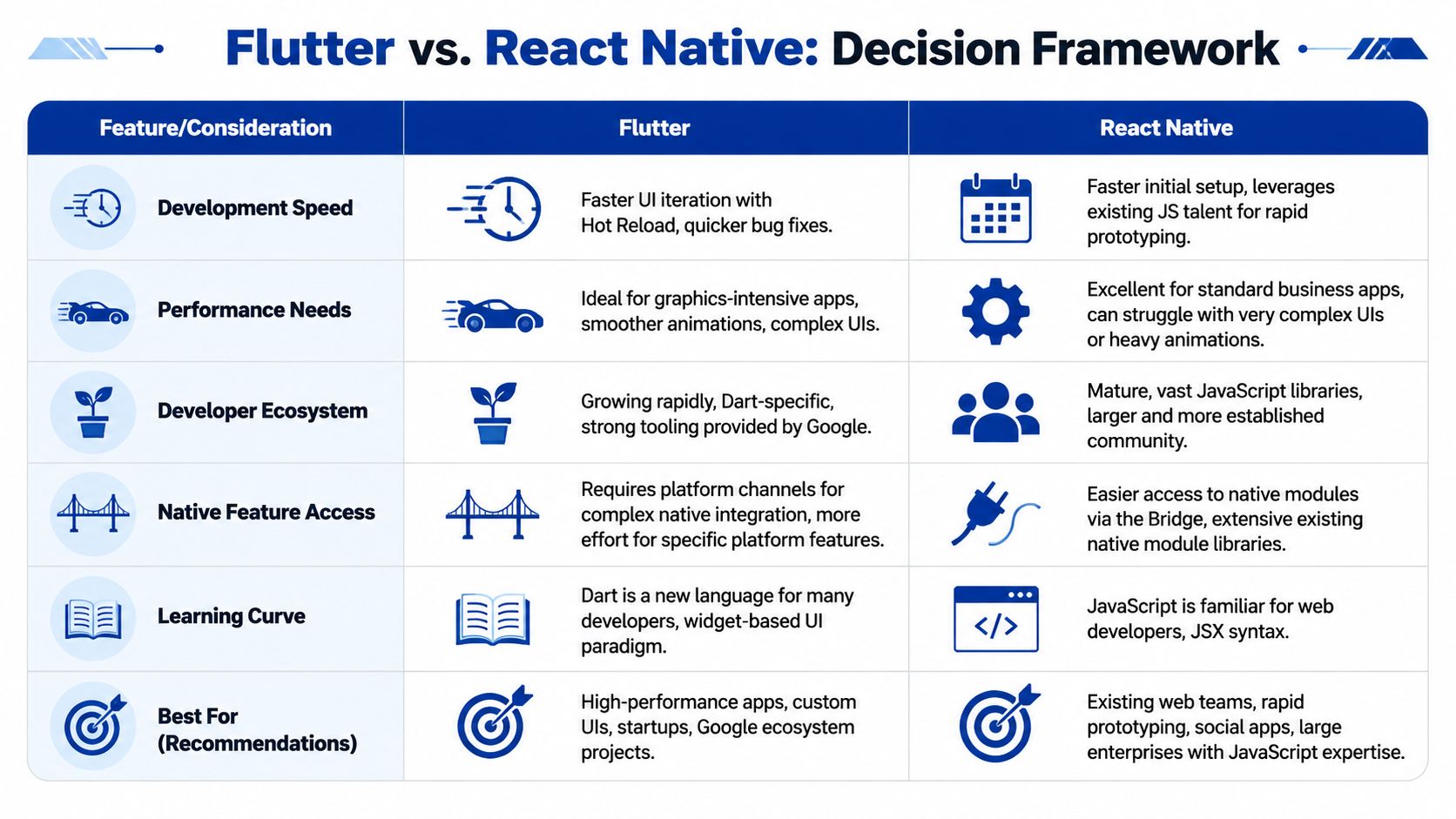
| Criteria | Flutter | React Native |
|---|---|---|
| Strategic strength | Controlled, consistent UI and strong visual performance | Organisational fit for JavaScript-heavy teams |
| Best product type | Branded, polished, interaction-heavy apps | Standard business apps and products aligned with web stacks |
| Team impact | Best with dedicated mobile capability or partner support | Best when existing React skills are already available |
| Long-term maintenance | Often cleaner when limiting runtime variation matters | Can be efficient, but dependency and native module management need care |
| QA pattern | More predictable presentation across platforms | More platform-specific verification required |
| Cloud alignment | Strong for structured mobile front ends on AWS or Azure | Strong where mobile sits close to JS services and web teams |
| Main trade-off | Dart adoption and larger baseline overhead | More moving parts in some integrations and upgrade paths |
Here’s the short version.
If I were advising a CTO on a net-new enterprise mobile product with a long shelf life, strong branding requirements, and a need for stable performance across varied devices, I’d lean toward Flutter.
If I were advising a Product Manager inside a business with an established React capability, moderate UI complexity, and a strong preference for leveraging current team skills, I’d lean toward React Native.
Pick the framework your organisation can support well in year three, not just the one that looks efficient in sprint one.
That’s the difference between a technically acceptable decision and a commercially sound one.
Partnering for Scalable and Maintainable Mobile Applications
The framework choice matters. Execution matters more.
A well-run Flutter or React Native project needs disciplined architecture, release engineering, observability, testing, and cloud alignment from the start. Without that, teams end up with a mobile app that works in demos but becomes expensive to support in production.
For organisations building business-critical mobile products, the sensible approach is to evaluate the app as part of a larger system. That includes API design, identity, cloud hosting, monitoring, incident response, and handover planning. It also means deciding early how the app will evolve through platform updates, feature expansion, and support cycles on AWS or Azure.
The best mobile projects aren’t just shipped. They’re maintainable, measurable, and designed to survive change.
If you’re weighing Flutter vs React Native and want a pragmatic view of architecture, cloud fit, long-term maintenance, and delivery risk, speak with Continuum Solutions. We help Australian organisations design, build, integrate, and support scalable mobile applications that hold up after launch, not just during procurement.