
You're in a Sydney CBD office with three AWS migration proposals on the table. Each supplier has recognisable logos, polished diagrams and an AWS tier badge. The proposals still differ sharply in price, scope and post-migration support, and your CFO wants a defensible explanation before approving the engagement.
The wrong answer is to choose the partner with the highest tier. The right answer is to choose the engagement model that can survive handover, production incidents, compliance review and the next round of AWS cost scrutiny. In Australia, that decision is becoming more important as consulting partners take a larger role in AWS delivery and internal cloud talent remains difficult to secure.
This guide gives you a practical way to assess an AWS consulting partner. It focuses on delivery evidence, capability validation, Marketplace procurement, local support and governance after the migration, not badge collecting. Before comparing proposals, review the common failure points outlined in common AWS mistakes SMEs make, then test every shortlisted firm against your own operational risk.
Table of Contents
- The Decision Most AWS Buyers Get Wrong
- What an AWS Consulting Partner Actually Is
- How AWS Partner Tiers and Certifications Work
- A Buyer's Checklist for Evaluating AWS Partners in Australia
- Engagement Models and Migration Phases That Actually Fit
- Questions to Ask and Red Flags to Walk Away From
- Choosing With Confidence and What Comes Next
The Decision Most AWS Buyers Get Wrong
The operations manager in this situation usually starts with a spreadsheet. One column records partner tier, another lists certifications, and a third compares the proposed migration price. That's a sensible starting point, but it doesn't answer the question that causes the most trouble later: who will own the platform when the project team leaves?
I've seen proposals that looked different because they were solving different problems. One supplier priced a rapid rehost with limited remediation. Another included application modernisation, observability and operational runbooks. A third priced a managed service around the target environment. Comparing those proposals by headline price alone would produce a false result.
The decision should be framed around four tests:
- Delivery evidence: Has the proposed team completed comparable migrations, integrations or modernisation work?
- Operational ownership: Who responds to incidents, controls changes and manages AWS cost after go-live?
- Compliance fit: Can the partner support your data residency, security and audit obligations?
- Commercial clarity: Can you separate AWS consumption, implementation fees and recurring managed services?
AWS's regional partner model reinforces why this matters. In Australia and New Zealand, partner contribution to AWS business increased from 47% in 2022 to 68% in 2024, a 21-point rise over two years, according to ARN's reporting on AWS partner contribution. Consulting partners are therefore part of AWS's commercial delivery route, not merely external contractors.
Practical rule: Choose the partner whose operating model matches the workload, not the partner whose badge looks strongest in a presentation.
A migration can succeed technically and still fail commercially. Your team may inherit undocumented infrastructure, unclear escalation paths and a bill nobody can explain. The proposal must price knowledge transfer, governance and stabilisation as real work. If those activities appear only as optimistic assumptions, the engagement is incomplete.
What an AWS Consulting Partner Actually Is
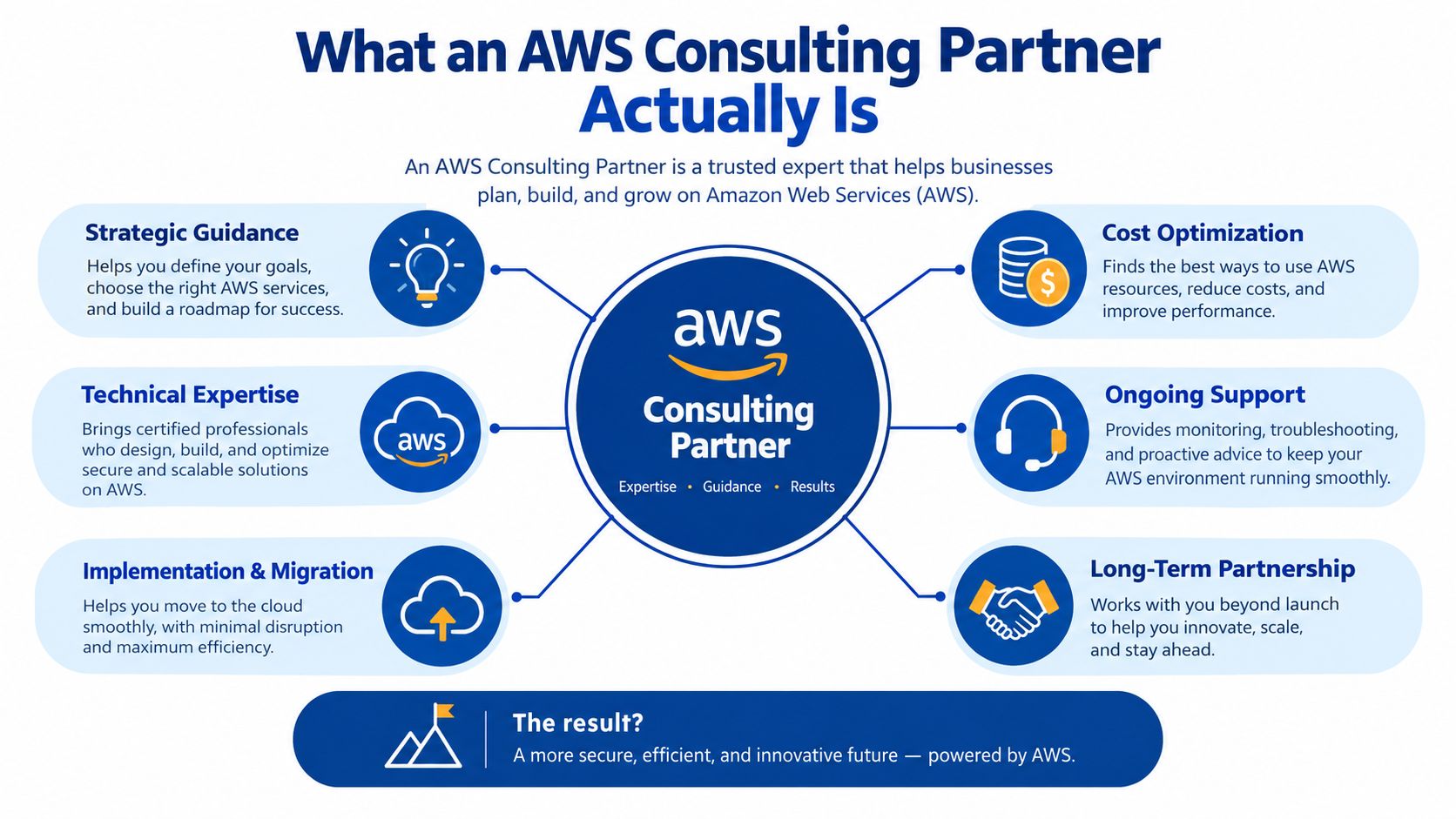
An AWS consulting partner is a firm enrolled in the AWS Partner Network, or APN, that advises on, designs, builds and supports workloads running on AWS. Its work can include architecture, migration planning, application modernisation, DevOps, systems integration, security controls, cost governance and managed cloud operations.
That definition matters because several partner types operate around the same AWS environment.
Separate the partner motions
A consulting or services partner typically leads advisory and delivery work. It might assess a legacy application, design a landing zone, migrate databases, build deployment pipelines or modernise an application using containers and serverless services.
A reseller focuses more heavily on commercial transactions, licensing and billing. A reseller can be useful when procurement simplicity matters, but it may not be the team designing your architecture or operating your production workloads.
An AWS Managed Service Provider, or MSP, is oriented towards ongoing operations. Its value lies in monitoring, incident response, patching, change management, security governance and cost oversight. Some consulting partners also hold MSP validation, but you should verify that capability rather than assume it.
An independent software vendor, or ISV, creates software that may be available through AWS Marketplace. An ISV can be part of a solution without being responsible for migration delivery or operational support.
Understand what APN membership proves
AWS controls entry into the APN. A consultancy must complete an application through the APN site, agree to the AWS Customer Agreement and receive formal acceptance from AWS, as explained in the AWS Partner Network terms and conditions. A company shouldn't describe itself as an official AWS partner solely because it has engineers who use AWS.
Tier status is earned through evidence such as accredited staff, technical certifications, launched opportunities and AWS-related recurring revenue. The thresholds are not a substitute for references, but they help distinguish a verified programme position from a generic cloud claim.
When you scope an engagement letter, identify the actual motion you're buying. If the partner is advising and building, define design authority and acceptance criteria. If it's operating the platform, define incident responsibilities and change controls. If it's reselling AWS, define billing ownership and margin transparency. A single supplier can perform all three roles, but the contract must separate them.
How AWS Partner Tiers and Certifications Work
AWS publishes three common consulting partner tiers, Select, Advanced and Premier. The requirements provide a useful verification tool, but they don't tell you whether the people assigned to your project can handle your architecture.
| Tier | Accreditations Required | Opportunities Submitted | Other Key Threshold |
|---|---|---|---|
| Select | 4 accredited individuals, 2 foundational certified individuals and 2 technical certified individuals | At least 3 launched opportunities | Total monthly recurring revenue of at least US$1,500 |
| Advanced | 8 accredited individuals, 4 foundational certified individuals and 6 technical certified individuals | 20 launched opportunities | Total monthly recurring revenue of at least US$10,000 |
| Premier | 20 accredited individuals, 10 foundational certified individuals and 25 technical certified individuals | 50 launched opportunities | Total monthly recurring revenue of at least US$50,000, an executive business review, and three AWS competencies or MSP, DevOps or CloudOps qualifications |
AWS lists an annual APN fee of US$2,500 for Select, Advanced and Premier tiers in its AWS Services Partner tier requirements. The fee isn't what earns the tier. The staffing, opportunity and delivery thresholds do the differentiating.
Match certifications to the work
Don't ask for a generic certification list. Ask why each certification is relevant to your project.
- Solutions Architect Professional: useful when the engagement involves complex architecture, multi-account design, hybrid connectivity or substantial workload dependencies.
- DevOps Engineer Professional: relevant when release automation, infrastructure as code, deployment controls and operational consistency are central.
- Security Specialty: important for identity design, encryption, logging, threat detection and regulated workloads.
- Database Specialty: valuable when the migration includes complex relational databases, replication, performance constraints or database modernisation.
- Machine Learning Specialty: relevant only when machine learning is a defined part of the solution, not because it appears in a capability deck.
Ask for the names of the architects assigned to your work, their current certifications and their role during design reviews. A tier is a leading indicator. It isn't delivery evidence. Pair it with comparable reference architectures, customer contacts and examples of what happened after handover. A practical local perspective is available in this discussion of an AWS Partner Solution Architect in Melbourne.
A Buyer's Checklist for Evaluating AWS Partners in Australia
Australian buyers need a stricter evaluation process than a logo comparison. The local market is mature and competitive. ISG assessed consulting services as a distinct category in its Australian AWS ecosystem study, identifying 24 consulting providers, including 8 Leaders and 1 Rising Star, as documented in the Australia AWS Ecosystem Partners study. Public listings also show broad competition, with Clutch listing 143 Australian AWS partner companies in August 2026 on its relevant ranking pages. That breadth gives you choice, but it also increases the need for disciplined evaluation.
Technical depth
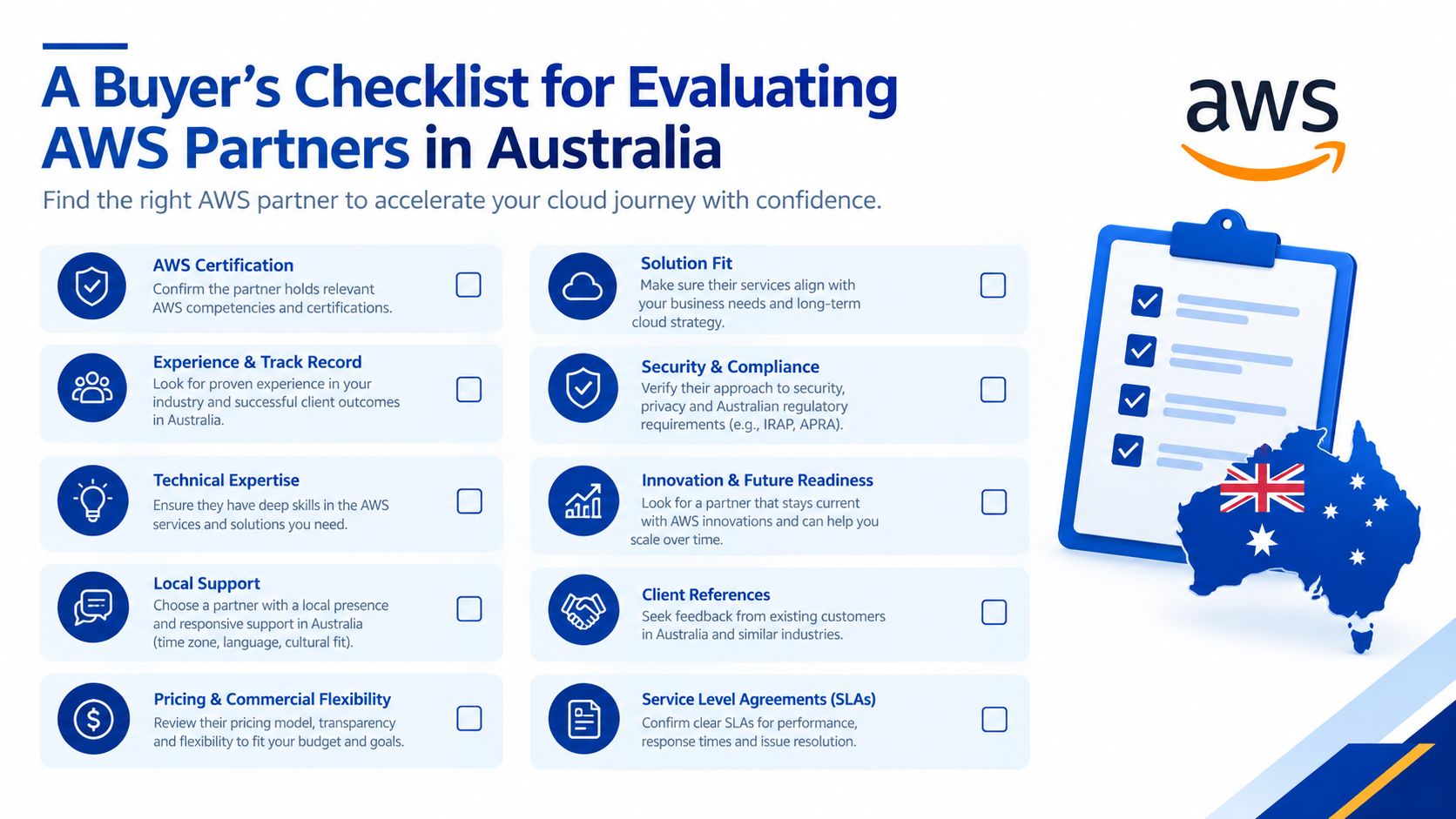
Request a named delivery team, not a generic capability matrix. Ask which architects have active AWS certifications, who will run Well-Architected reviews and which reference architectures resemble your workload.
A partner should explain why it would choose rehosting, replatforming, refactoring or another approach. If it recommends Amazon ECS, AWS Lambda, Amazon Aurora or a multi-account landing zone, it should connect that choice to operational requirements rather than present it as a fashionable default.
Delivery evidence
Ask for three comparable Australian engagements and speak to the customers where possible. Request evidence covering migration decisions, cutover controls, documentation, operating cost after handover and unresolved risks.
A go-live date is not an outcome. You need to know whether the client's internal team could operate the environment afterwards and whether the partner stayed accountable when production behaviour differed from the assessment.
Compliance posture
For regulated workloads, ask for the partner's IRAP assessment status, Essential Eight maturity position, data residency approach and handling of the Notifiable Data Breaches scheme. Don't accept “secure by design” as evidence. Ask for control mappings, audit artefacts and named owners.
The AWS partner ecosystem includes validated programmes such as Premier Tier Services, AWS Managed Service Provider, the AWS Well-Architected Partner Program and service validations such as AWS Lambda Delivery. These can help you verify specialised capability through the AWS partner information published by Mantel Group, but you should still test how that capability will apply to your environment.
Cost transparency and SLA design
Require line items for AWS consumption, professional services, managed services, support and any third-party tools. Ask whether AWS credits, private pricing or reserved-instance savings will be passed through transparently.
Your SLA should specify response times, escalation into AWS support, severity definitions and what changes after go-live. Score each dimension according to your risk profile. A regulated workload may weight compliance and incident response more heavily, while a product team may weight modernisation depth and release automation.
For a broader view of architecture, migration and support considerations, review cloud computing consulting services alongside your procurement checklist.
Engagement Models and Migration Phases That Actually Fit
The engagement model should follow the work. I don't recommend signing one open-ended statement of work for discovery, migration, modernisation and managed operations. Each phase carries different uncertainty, and the contract should reflect it.
Match the six Rs to the phase
Rehost moves a workload with limited change. It can suit a time-sensitive data centre exit, but it may preserve inefficient architecture and operating costs.
Replatform makes targeted changes, such as moving to a managed database or container platform. It often improves operations without the risk of a full rewrite.
Refactor changes the application substantially. It suits workloads where scalability, release speed or resilience justifies deeper engineering effort.
Repurchase replaces a system with a commercial service. Retire removes an unnecessary workload. Retain keeps a workload where migration risk or business value doesn't justify change.
Use a fixed-price discovery sprint when the deliverable is a defined decision artefact, such as an application inventory, dependency map, target-state architecture and migration backlog. A short assessment should end with decisions, assumptions and an executable plan, not a presentation that creates another consulting phase.
Migration execution usually fits time and materials with a capped burn and weekly burn-down reporting. Production dependencies surface during migration, so pretending the scope is fixed can push risk into change requests. Optimisation and modernisation may suit outcome-based pricing when the baseline, measurement method and partner responsibilities are contractually clear.
| Migration Phase | Recommended Model | Pricing Type | Procurement Route |
|---|---|---|---|
| Discovery and readiness | Focused assessment team | Fixed price with defined artefacts | Direct contract or AWS Marketplace |
| Migration execution | Delivery squad with client stakeholders | Time and materials with capped burn | Direct contract or Consulting Partner Private Offer |
| Modernisation | Specialist engineering team | Milestone or outcome-linked pricing | Direct contract, private offer or blended procurement |
| Optimisation and FinOps | Continuous improvement service | Retainer or agreed outcome model | AWS Marketplace or managed services agreement |
| Operations and handover | Managed service with internal ownership plan | Recurring service fee | Marketplace private offer or direct managed services contract |
AWS Marketplace now gives consulting partners in Australia and New Zealand a formal route to transact through Consulting Partner Private Offers, as described in AWS's ANZ Marketplace announcement. That can allow negotiated pricing, terms and bundled services within the AWS commercial ecosystem. It may simplify procurement and align spend with existing AWS billing, but you still need to review lock-in, support boundaries, renewal terms and price transparency.
Staff augmentation works when you have strong internal architecture and programme ownership. Fully managed delivery suits teams that need an accountable supplier, but it requires clear decision rights. Price handover separately, with named successors, documentation standards, shadowing and operational acceptance criteria.
For phased migration planning, compare the engagement against a defined cloud migration services approach, not a generic resource schedule.
Questions to Ask and Red Flags to Walk Away From
The proposal team isn't necessarily the delivery team. Before signing, ask for CVs, names, availability and interview access for the people who'll design, migrate and support your workloads. If the supplier won't identify those people, you're buying a staffing promise rather than a delivery capability.
Ask how the partner handles Australia's cloud talent shortage. Independent Australian coverage reports a 260,000 skilled-worker deficit, with migration work often exceeding internal capacity, as discussed in this Australian cloud migration strategy analysis. You need to know the subcontractor ratio, where the team sits, which offshore resources will access production data and how the supplier maintains continuity when a key consultant leaves.
Questions that belong in the contract
- Who owns architecture decisions? Name the accountable architect and define the approval process.
- Who responds to incidents? Confirm coverage hours, daylight saving overlap, severity definitions and escalation routes.
- Who touches production data? Document access controls, locations, subcontractors and approval requirements.
- What does handover include? Require runbooks, diagrams, credentials management, monitoring ownership and scheduled knowledge transfer.
- What happens after the project? Set out support options, transition assistance and the cost of retaining the supplier or moving away.
- Which claims can I verify? Check tier, competencies and validations in the AWS partner registry, rather than relying on a presentation.
Walk away from a supplier that refuses reference contacts, proposes a fixed scope for poorly understood discovery work or displays certificates that don't appear in its AWS profile. A partner that can't explain its own cost lines won't explain your AWS bill clearly either.
Australian-specific warning signs include pricing in US dollars only, no allowance for local incident coverage, no local presence for important architecture reviews and vague answers about data residency. You should also question any handover plan described only as “knowledge transfer”. That phrase has no operational value until it names activities, owners, dates and acceptance criteria.
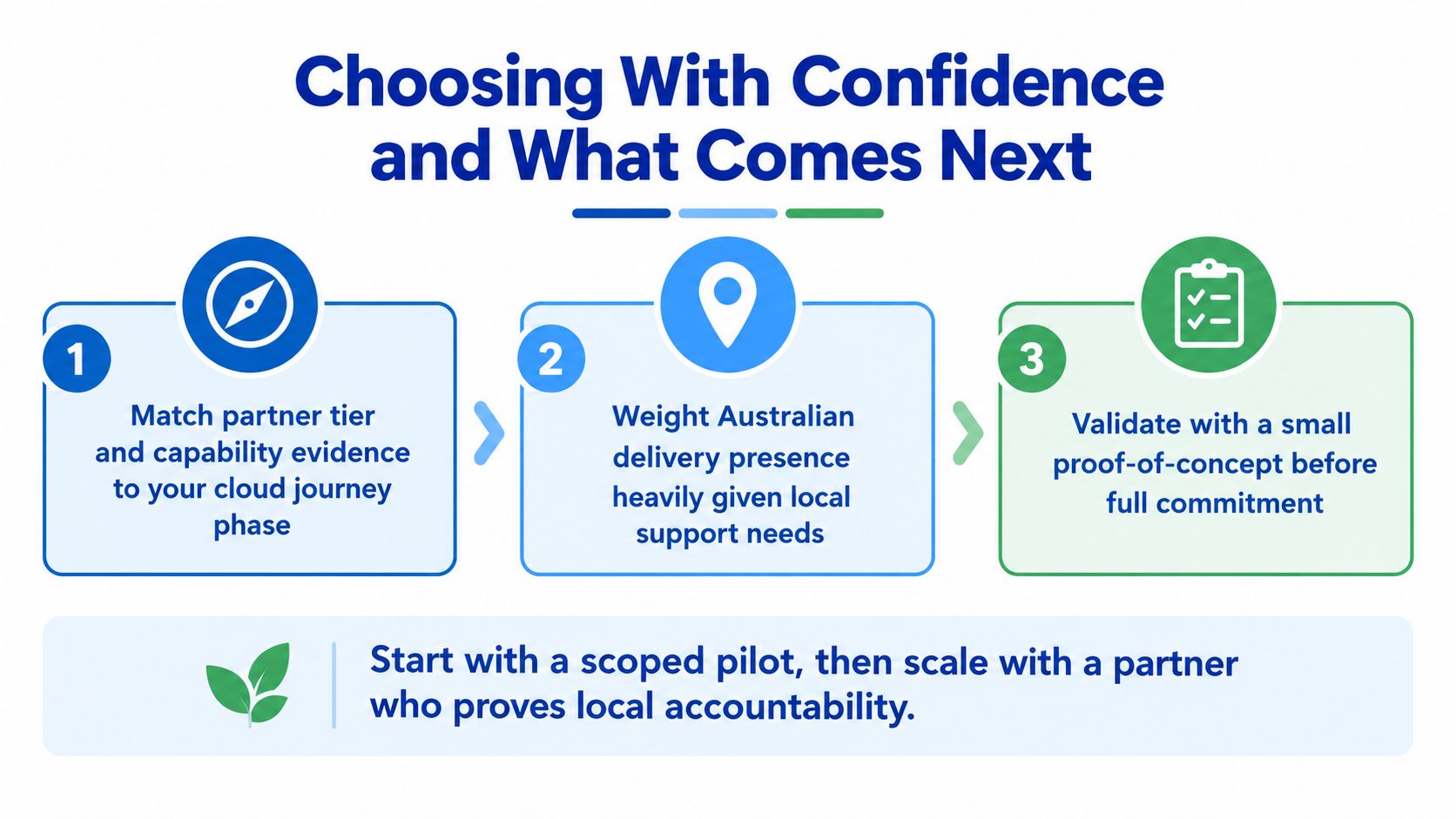
Before committing to a large programme, use a paid pilot to test the partner's documentation, communication and technical judgement. You can also benchmark the proposal against AWS migration cost considerations in Australia without treating a published guide as a substitute for workload discovery.
Choosing With Confidence and What Comes Next
The most defensible decision heuristic is simple. Match capability evidence to the phase of your cloud journey, weight Australian delivery presence heavily, and make post-handover governance a commercial requirement. A Premier tier may be appropriate for a large regulated transformation, while a smaller specialist team may be more effective for a focused application modernisation project. The tier should support the decision, not make it for you.
Your minimum bar should include migration references, named architects, verified AWS programme status, compliance evidence, transparent separation of AWS and partner costs, and contractual SLAs. Add a written handover plan before the engagement begins. If a supplier can't describe how your team will operate the platform after delivery, it hasn't finished designing the service.
AWS's ANZ partner leadership has encouraged partners to deepen Marketplace presence, build at least one validated competency and co-sell opportunities with AWS sellers. The global AWS partner network has grown to nearly 150,000 partners, according to ARN's coverage of AWS partner priorities for 2026. For buyers, the practical implication is clear. Prefer partners that can package repeatable architectures, security evidence and migration accelerators into a procurement route your finance and risk teams can approve.
Use a proof point before a full commitment
A proof of concept should answer a business question. It might validate a database migration path, prove an integration between a legacy platform and AWS, establish observability standards or demonstrate a cost governance model. Define the artefacts, acceptance criteria and handover output before the pilot starts.
Continuum Solutions is one option for Australian organisations seeking AWS architecture, phased migration, application modernisation, systems integration and managed support. Its delivery model includes local technical involvement and structured documentation, which can be relevant when continuity and maintainability matter as much as the initial cutover.
AWS also provides specialist public-sector pathways. Public sector partners must be enrolled in APN and maintain a public sector practice, with at least two references required for admission into the Public Sector Partner Program, according to the AWS public sector partner onboarding guide. For the ATO on AWS Program, a partner must be Select Tier or above and a member of the Public Sector Partner Program, as specified in the ATO on AWS consulting partner validation checklist.
Don't ask for a generic sales call. Ask for a migration readiness assessment that examines dependencies, security controls, target architecture, operational ownership and commercial assumptions. If the assessment confirms a fit, scope a paid pilot or a Marketplace private offer with explicit acceptance criteria, then expand only after the partner proves it can deliver and hand over the work properly.
Continuum Solutions helps Australian organisations assess AWS readiness, design cloud architecture, migrate and modernise applications, integrate business systems, optimise infrastructure and establish managed support. Visit Continuum Solutions, request a migration readiness assessment, and bring your current architecture, AWS billing structure and operational constraints to a focused discovery conversation.