Your team is probably already feeling the pressure. Servers are getting harder to maintain, monthly hosting costs are less predictable than they should be, developers are spending too much time on infrastructure work, and every proposed change carries operational risk. At that point, “move to the cloud” sounds simple until someone has to price it, sequence it, secure it, and keep the business running during the cutover.
That’s where cloud computing consulting becomes commercially useful. Good consulting doesn’t just recommend AWS or Azure and hand over a diagram. It helps you decide what should move, what should stay put, what needs refactoring, what can be retired, and how to avoid creating a more expensive version of the same problems.
For Australian organisations, this isn’t a niche decision anymore. Infrastructure choices now affect compliance, service reliability, delivery speed, and operating margin. If you’re evaluating options, a solid starting point is to look at practical cloud computing articles and migration guidance that focus on architecture, cost control, and operational trade-offs rather than generic cloud benefits.
Table of Contents
- Why Businesses Need Cloud Computing Consulting
- Core Cloud Consulting Service Offerings
- The Typical Consulting Engagement Lifecycle
- How to Select the Right Cloud Consulting Partner
- Understanding Pricing and Contract Models
- A Practical Cloud Migration Checklist for Decision Makers
- Tailoring Consulting for Enterprises NGOs and Startups
Why Businesses Need Cloud Computing Consulting
Most organisations don’t look for cloud consultants because cloud is fashionable. They do it because something operational has started to break. Release cycles slow down. Legacy apps become harder to support. Capacity planning turns into guesswork. A simple integration with Salesforce, HubSpot, or an internal finance system suddenly becomes a project that nobody wants to own.
When internal teams hit the limit
A CTO usually sees the pattern first. The business wants faster delivery, better resilience, and clearer cost accountability. The existing estate was often built in phases, by different teams, with different assumptions. That’s manageable until growth, compliance pressure, or platform complexity exposes the weak points.
The Australian market context matters here. Australia’s cloud computing market reached USD 13.9 billion in 2025 and is projected to reach USD 32.0 billion by 2034, with a projected CAGR of 9.38% from 2026 to 2034, according to IMARC’s Australia cloud computing market analysis. For buyers, that growth matters because it reflects a simple reality. More businesses are moving core systems into cloud environments, which raises the cost of making poor architecture decisions.
Practical rule: If your team is debating cloud at the same time as debating reliability, security, deployment speed, and budget control, you don’t have a hosting problem. You have an architecture and operating model problem.
What consulting changes in practice
Useful cloud computing consulting gives decision-makers a way to reduce uncertainty. It translates technical options into business consequences. Rehost a workload and you may cut migration complexity, but leave performance constraints untouched. Refactor an application and you may get stronger long-term scalability, but with more delivery risk and a larger upfront budget.
That’s the value. A consultant should pressure-test assumptions before your team commits money and time.
In practice, organisations usually need help with:
- Application fit: Which workloads belong on AWS, Azure, or a hybrid setup, and which should remain unchanged for now.
- Dependency mapping: Hidden integrations often break migrations, especially with CRMs, identity providers, and finance systems.
- Commercial sequencing: Some workloads justify immediate migration. Others should wait until a broader application modernisation effort.
- Risk reduction: Rollback planning, cutover windows, monitoring, and post-launch support determine whether migration is a business event or an outage.
Poor consulting focuses on “getting to cloud”. Strong consulting focuses on whether the move improves service levels, governance, and operating economics after the novelty wears off.
Core Cloud Consulting Service Offerings
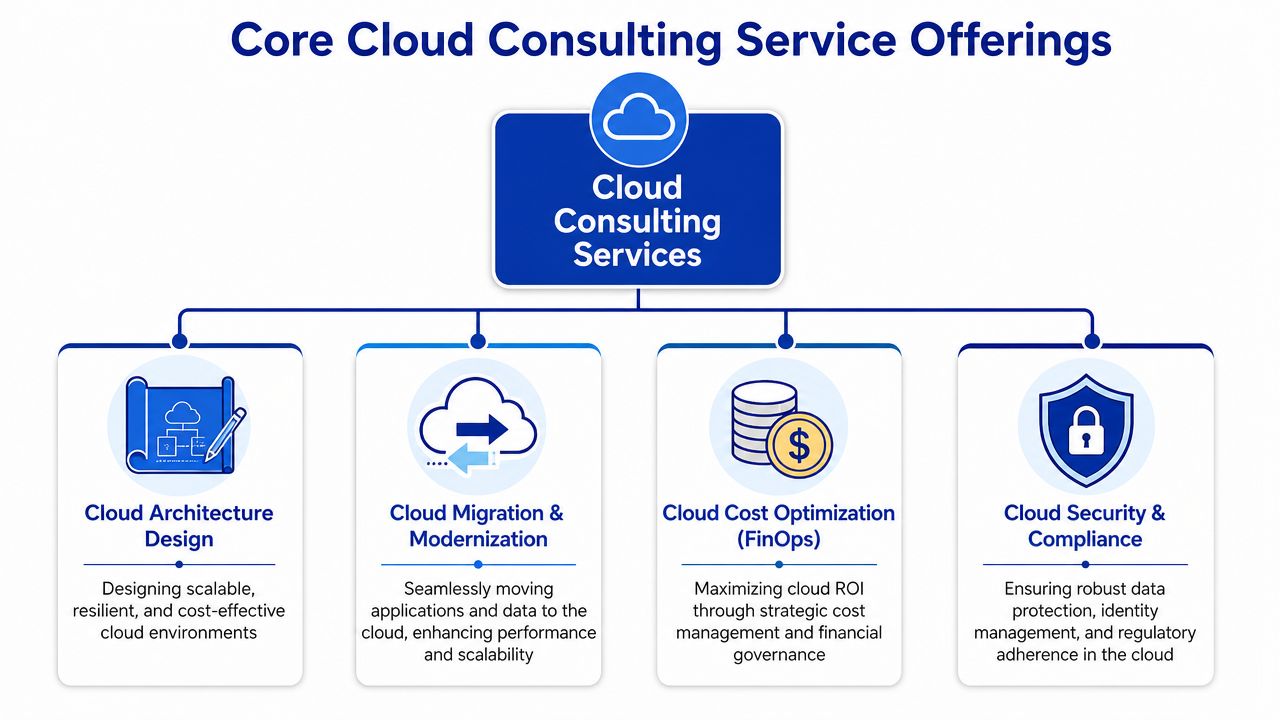
The day-to-day work of cloud computing consulting is more concrete than many buyers expect. It’s not a slide deck and a recommendation to “go serverless”. It’s a mix of architecture design, migration execution, systems integration, observability, governance, and cost management.
Architecture decisions that affect cost later
Architecture is where expensive mistakes start. Choosing between EC2, ECS, Lambda, managed databases, object storage, CDN layers, and queueing patterns isn’t just technical design. It determines how your team will operate, monitor, and pay for the platform over time.
In the Australia and New Zealand market, SaaS held a 46.75% revenue share in 2025, while PaaS is projected to grow at a 24.89% CAGR, based on Mordor Intelligence’s ANZ cloud computing market report. That matters because modern environments rarely sit in one service layer. Businesses often combine SaaS products, custom applications, managed platforms, and API integrations. Consulting has to cover the joins between them.
A typical consulting scope here includes:
- Cloud architecture design: Network layout, environments, identity structure, backup approach, and scaling model.
- Platform selection: The trade-off between virtual machines, containers, managed app platforms, and serverless services.
- Service fit analysis: A practical review such as AWS Lightsail vs EC2 vs ECS for application hosting decisions, where the wrong choice can lock a business into poor cost or operational patterns.
- Security baseline: Access control, logging, encryption approach, and data handling rules set before workloads move.
Migration modernisation and observability
Migration services usually start with one question. Are you moving the workload as-is, or improving it while it moves?
That choice affects timeline, budget, and risk. Some organisations should rehost first and modernise later. Others are paying such a heavy operational penalty for their legacy stack that a staged refactor makes more commercial sense.
Beyond migration itself, consultants should also handle the parts buyers often underestimate:
| Service area | What it looks like in practice | Why it matters |
|---|---|---|
| Application modernisation | Breaking a monolith into smaller services, replacing brittle code paths, improving deployment pipelines | Reduces support overhead and enables faster change |
| Systems integration | Connecting Salesforce, HubSpot, Shopify, WordPress, or internal tools through documented APIs | Prevents manual workarounds and data duplication |
| Observability setup | Implementing Sentry, New Relic, uptime monitoring, logs, and alerting | Gives operations teams evidence, not guesswork |
| Cost optimisation reviews | Reviewing underused resources, architecture inefficiencies, and tagging discipline | Stops cloud spend from drifting after launch |
Good consultants don’t stop at “it deployed successfully”. They make sure someone can support it at 2 am, explain the bill at month-end, and trace failures quickly when an integration breaks.
The Typical Consulting Engagement Lifecycle
Cloud consulting engagements work best when they’re structured. Buyers don’t need theatre. They need a visible process, defined deliverables, and enough transparency to understand what decisions are being made and why.
From discovery to migration
A typical engagement starts with assessment and discovery. That means reviewing the current estate, identifying business-critical systems, documenting dependencies, and finding hidden risks. It also means getting honest about what the business wants. Lower hosting cost, better uptime, faster product delivery, improved reporting, or reduced compliance exposure are not the same objective.
The professional services market in Australia is expanding alongside this need. The Australia Cloud Professional Services Market is projected to grow from USD 200.25 million in 2024 to USD 710.79 million by 2032, according to Credence Research on Australia cloud professional services. That growth reflects how many organisations now need specialist help managing hybrid and multi-cloud complexity.
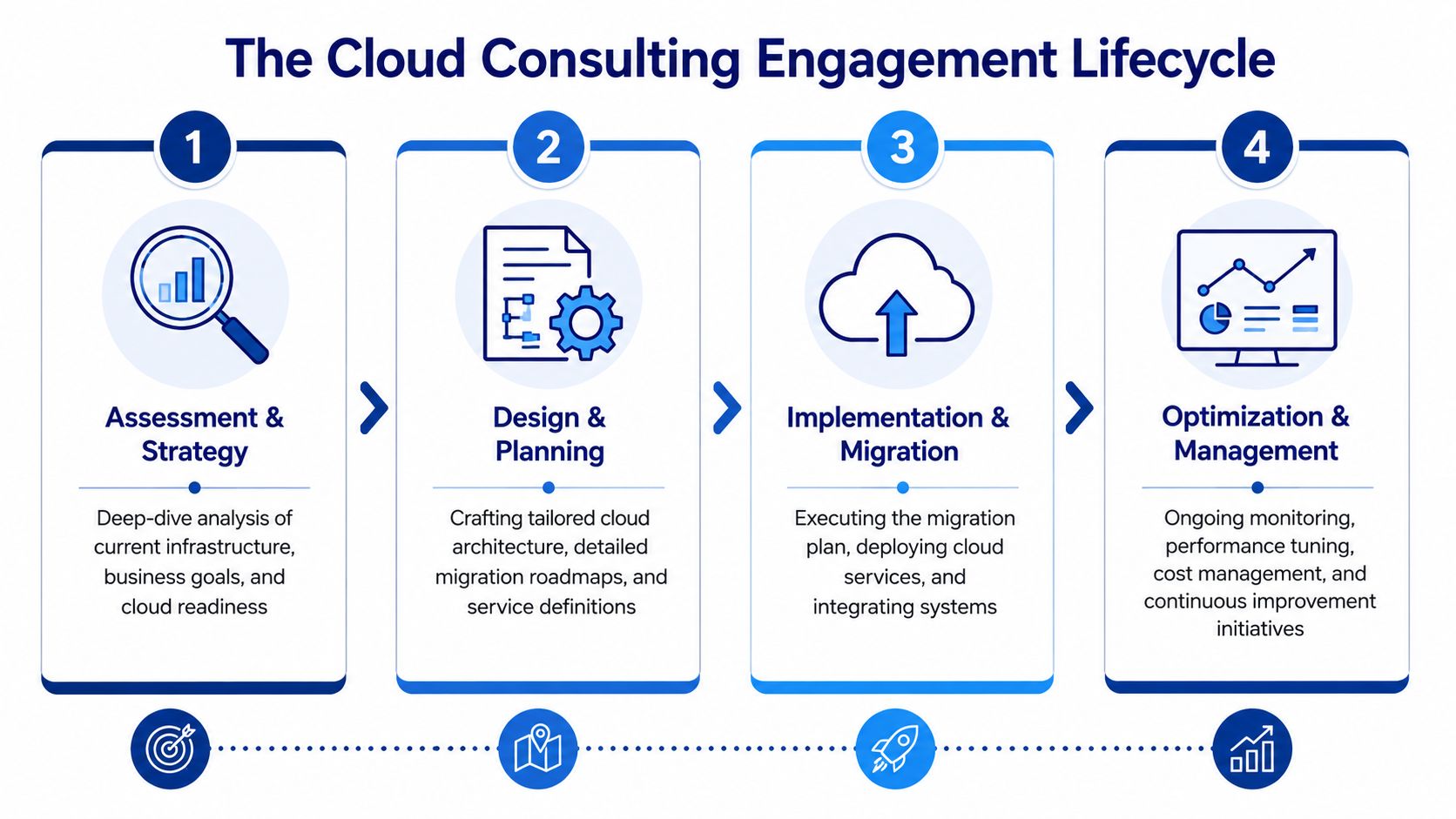
A practical engagement usually moves through four phases:
-
Assessment and discovery
Current-state audit, application inventory, stakeholder interviews, risk log, dependency mapping. -
Strategy and planning
Target architecture, migration roadmap, environment design, security controls, delivery sequencing, budget assumptions. -
Execution and migration
Landing zone setup, infrastructure build, test environments, data migration, cutover planning, rollback readiness. -
Optimisation and management
Performance tuning, access reviews, backup validation, cost governance, incident response, and support handover.
What happens after go live
The handover is where weak engagements become obvious. If the consultant disappears after cutover, the internal team inherits all the complexity without the context.
A sound post-launch phase includes runbooks, ownership mapping, escalation paths, and monitoring dashboards. If you’re running customer-facing systems, enterprise application monitoring and debugging practices should already be part of the engagement, not an afterthought bolted on after users report issues.
Operational test: If your vendor can’t show who gets alerted, what gets logged, and how incidents are triaged after migration, they’re only planning the move, not the operating model.
The best engagements also include scheduled optimisation reviews. Cloud environments drift. New services get added. Old ones aren’t retired cleanly. Permissions expand. Monitoring gets noisy. Without an explicit review cycle, your platform slowly becomes harder to govern.
How to Select the Right Cloud Consulting Partner
Most buyers can tell when a consulting firm sounds polished. That’s not the same as being technically credible or commercially reliable. The partner you choose needs enough depth to challenge your assumptions, enough delivery discipline to execute safely, and enough local context to work inside Australian compliance and operating realities.
Signals of a credible partner
Start with evidence, not branding. A consulting partner should be able to explain how they design for resilience, deployment, access control, logging, and rollback. They should also be able to discuss your actual stack, whether that involves AWS Lambda, ECS, Azure App Service, Docker, Salesforce, HubSpot, MiniOrange, New Relic, or a custom API layer.
Look for these signals:
- Verified platform capability: Formal partner status matters when it’s backed by technical depth. For example, an AWS Partner in Melbourne should be able to discuss architecture patterns, migration sequencing, and support responsibilities without reverting to generic platform talk.
- Relevant delivery history: Ask for examples that match your environment. A migration for a brochure site tells you very little about a membership platform, a regulated workload, or an integration-heavy enterprise application.
- Senior technical participation: Discovery calls should include architects or senior engineers, not only account managers.
- Clear commercial thinking: They should be comfortable discussing scope boundaries, support assumptions, total cost of ownership, and the trade-off between short-term speed and long-term maintainability.
Red flags that usually show up early
Poor vendors often reveal themselves in the first two conversations. Their proposals are vague, their timelines are overconfident, and their architecture recommendations appear before they’ve understood dependencies.
A few warning signs deserve attention:
| Red flag | Why it matters |
|---|---|
| Vague deliverables | You can’t control scope or hold anyone accountable |
| No technical depth in discovery | They may be reselling cloud labour, not solving architecture problems |
| One-size-fits-all recommendations | Your workload, compliance needs, and integrations are specific |
| Weak post-launch planning | The migration may complete, but operations will suffer afterwards |
Don’t hire the firm that says yes fastest. Hire the one that identifies the uncomfortable details early.
The right partner doesn’t just sound confident. They narrow risk, document decisions, and make the commercial implications of technical choices easy to understand.
Understanding Pricing and Contract Models
Cloud consulting fees vary because the work varies. A basic migration with a limited number of workloads is a different proposition from a regulated programme that includes refactoring, multi-environment design, governance controls, and complex data flows.
Where migration budgets move
In Australia, cloud migration costs range from approximately AUD 70,000 for small-scope engagements involving 10 to 50 workloads to more than AUD 700,000 for large government or regulated enterprise programmes involving 200 to 500 or more workloads, according to this Australian cloud migration cost guide. The same source notes that application refactoring and APRA or Privacy Act compliance are key cost drivers.
That range tells buyers two useful things. First, migration pricing is highly sensitive to complexity. Second, the headline quote is only meaningful if you understand what is included.
Common cost drivers include:
- Application refactoring: Moving code as-is is usually cheaper than redesigning it for containers, managed services, or serverless patterns.
- Compliance requirements: Regulated sectors need stronger controls, more documentation, and tighter review cycles.
- Integration depth: CRM, finance, authentication, and reporting dependencies increase testing and cutover complexity.
- Support obligations: On-call coverage, warranty periods, and managed support change the commercial model.
Choosing the right commercial model
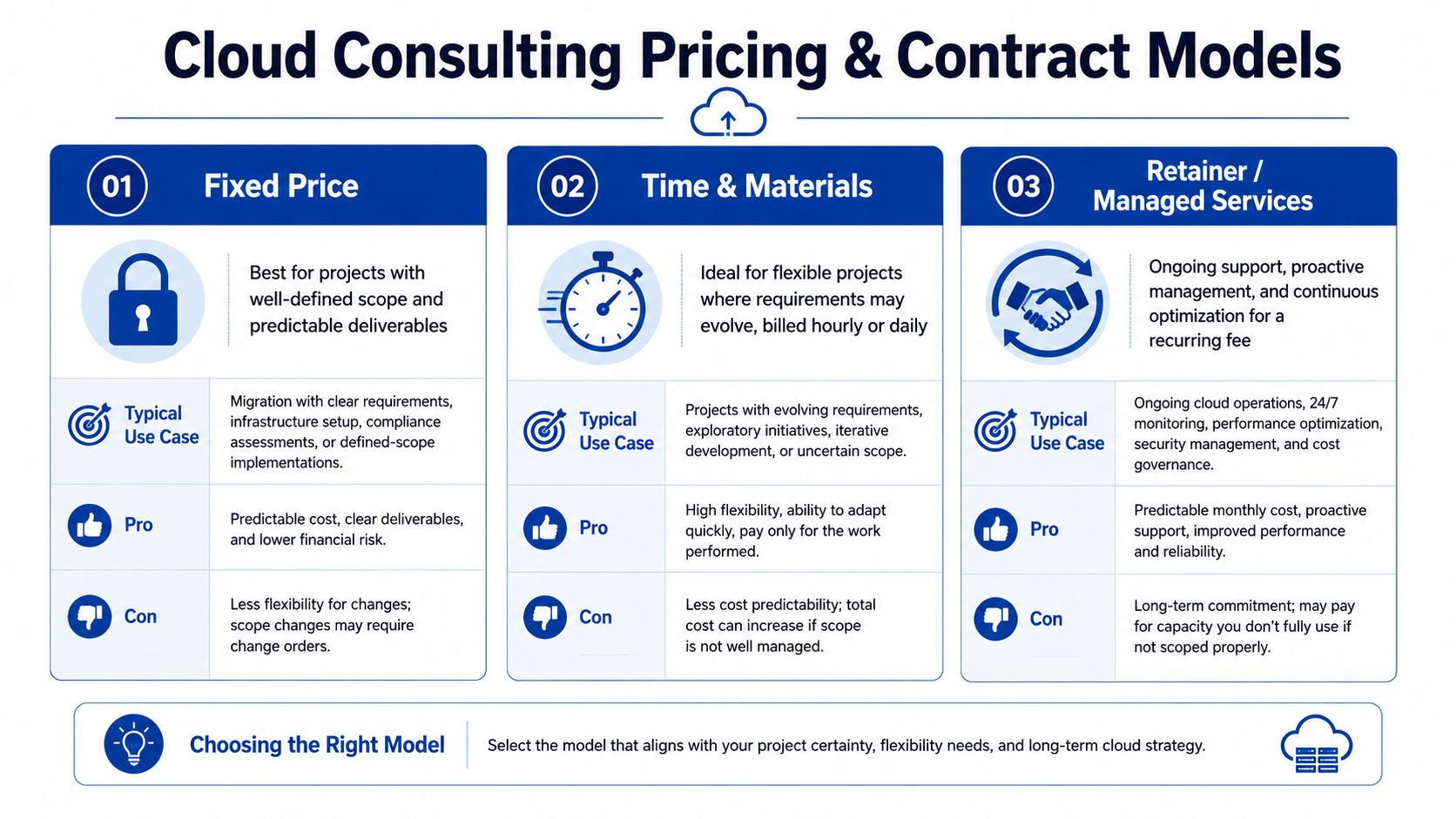
There are three contract models most buyers will see.
| Model | Best fit | Main advantage | Main drawback |
|---|---|---|---|
| Fixed price | Well-defined projects with stable scope | Budget certainty | Change requests can become expensive or contentious |
| Time and materials | Discovery, modernisation, evolving requirements | Flexibility | Requires stronger buyer governance |
| Retainer or managed services | Ongoing optimisation, support, and platform care | Continuity and proactive management | Less suitable for a one-off build-only outcome |
Fixed price works when the scope is narrow and well understood. Rehosting a limited estate with clear dependencies can fit this model.
Time and materials is often better for discovery-led work, legacy replacement, or application modernisation. If you already know requirements will change, pretending otherwise in a fixed quote usually creates friction later.
A managed services retainer makes sense once the platform is live and the business needs regular review, cost oversight, support, and small iterative improvements. Buyers comparing options should review examples such as how AWS migration cost structures are assessed in Australia before committing to a contract model.
A Practical Cloud Migration Checklist for Decision Makers
Migrations go wrong when executives assume the technical team has every dependency, risk, and ownership question covered. A short governance checklist prevents that. It also makes vendor conversations more useful because you can test whether the proposed plan is operationally complete.
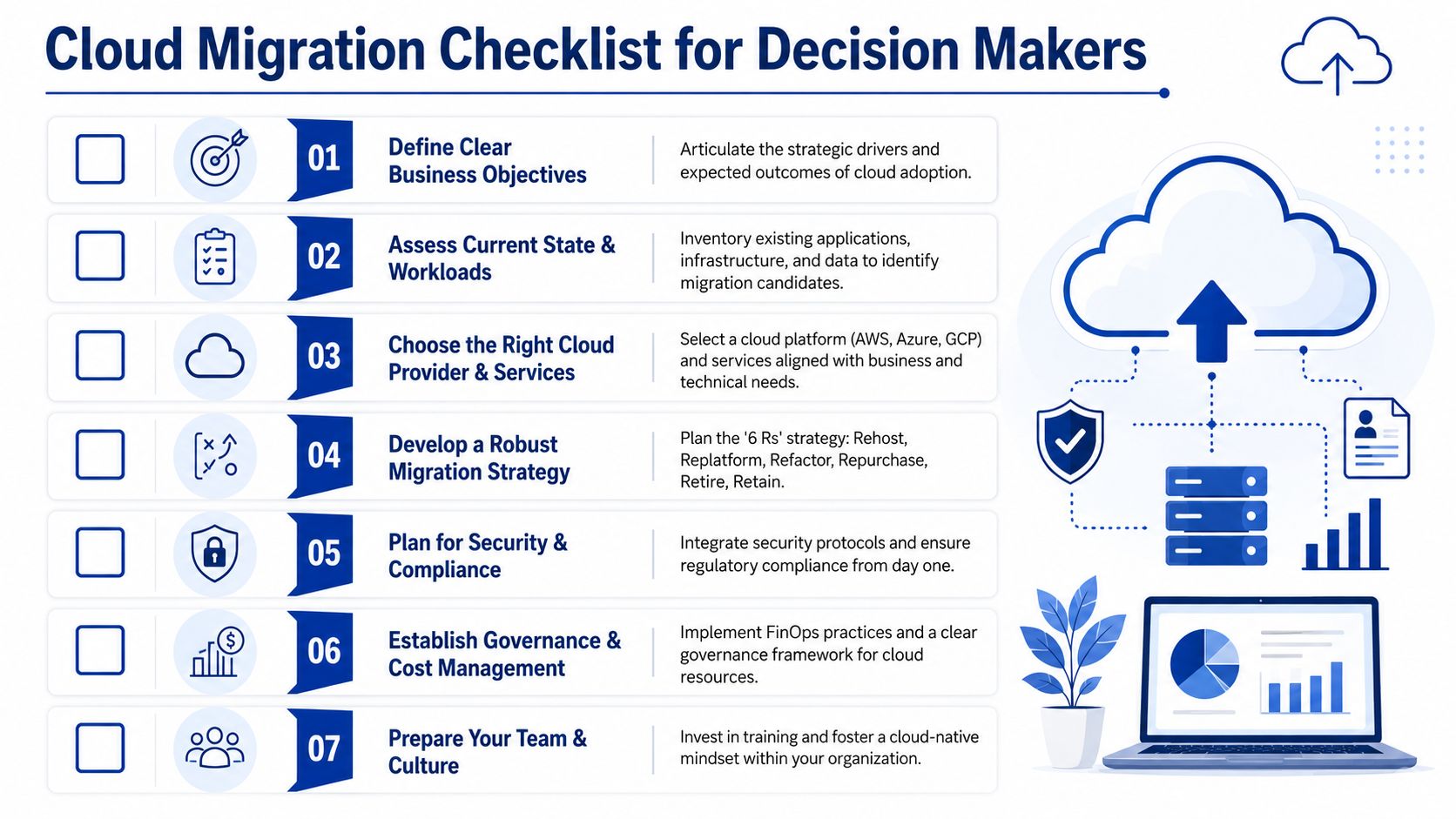
Before migration
Ask these questions before any build starts:
- Have we defined the business case clearly: Is this move about cost control, resilience, speed to market, security, or legacy replacement?
- Do we have a full application and dependency inventory: Have CRM, identity, reporting, payment, and internal workflow integrations been mapped?
- Have we chosen the right migration path: Should each workload be rehosted, replatformed, refactored, retained, or retired?
- Are ownership and decision rights clear: Who approves architecture, who signs off security, and who owns business continuity?
During and after migration
Once the project moves into execution, decision-makers should keep pressing on control points rather than technical detail for its own sake.
- Do we have a rollback plan: If cutover fails, can the business return to the previous state without prolonged disruption?
- Are monitoring and alerting live before launch: Logs, uptime checks, performance telemetry, and error tracking should be in place before users hit the new environment.
- Have security and access controls been validated: Role permissions, secrets handling, audit trails, and backup policies need testing, not assumption.
- Is post-migration governance scheduled: Cost reviews, access reviews, performance checks, and support handover dates should be locked in.
A cloud migration isn’t complete when workloads run in a new environment. It’s complete when finance can read the bill, operations can support the platform, and the business can change it safely.
This is also the point where many organisations decide whether they need an implementation partner only, or a longer-term consulting relationship that includes optimisation and systems integration support.
Tailoring Consulting for Enterprises NGOs and Startups
The phrase cloud computing consulting sounds broad because it is broad. The work only becomes useful when it adapts to the commercial realities of the organisation buying it. Enterprises, NGOs, and startups often need different architecture choices, support models, and reporting disciplines, even when they use similar cloud platforms.
Enterprises need control
Enterprise buyers usually care about governance before they care about speed. They need identity design, environment separation, auditability, integration with legacy platforms, and reliable deployment processes that multiple teams can operate safely. The challenge is rarely just “move this app to AWS”. It’s “move this app without breaking upstream finance workflows, downstream reporting, or internal security controls”.
For these clients, consulting should emphasise documented architecture, phased cutovers, testing discipline, and operational ownership. The build matters, but the handover matters just as much.
NGOs and startups need visibility
NGOs often have the opposite problem. Their infrastructure still needs to be reliable, but every platform choice has to stand up financially. Membership systems, donation workflows, CRM links, and campaign landing pages can all be mission-critical, yet the internal technical team is often small. They need straightforward architecture and clear post-launch reporting.
That gap is especially relevant in Australia. Despite 86% of Australian enterprises using cloud computing, many guides still miss post-migration governance and cost visibility for non-technical stakeholders, including the difficulty of linking cloud spend to membership or subscription metrics for Australian non-profits, as noted by Cloud Computing News on Australia’s cloud questions and gaps.
Startups tend to optimise for speed first, then discover they’ve created a platform that’s awkward to scale or expensive to operate. In that environment, a consultant should help them keep architecture lean without turning it into a future rebuild. Containers, managed databases, serverless functions, mobile backends, and API-first services can all work well, but only if the operating model matches the team’s actual capability.
One option in this market is Continuum Solutions, a Melbourne-based consultancy that works across AWS and Azure migrations, custom application development, and systems integration for enterprises, NGOs, and startups. That kind of mixed delivery capability matters when the problem isn’t just hosting, but also application modernisation, CRM integration, observability, and post-launch support.
The common mistake across all three segments is using the same consulting model for every client. Enterprises need control and traceability. NGOs need cost discipline and reliability. Startups need speed without reckless platform choices. Good consulting recognises that early and designs around it.
If you’re evaluating a migration, modernisation, or cloud cost review, Continuum Solutions can help you assess the current state, define a practical architecture, and plan a phased delivery approach that fits your budget, risk profile, and operating model.