An AWS DevOps consultant is a specialist in phased cloud migration, delivery automation, and cost stabilisation, not just an administrator who configures AWS accounts. In Australia, senior AWS DevOps roles commonly range from A$120,000 to A$180,000.
The popular advice is to start with tools, choose a CI/CD platform, containerise applications, and automate every release. That advice misses the harder problem. Australian organisations often struggle less with access to AWS services than with finding people who can design, operate, document, and hand over a maintainable platform.
A capable consultant reduces that risk. They connect architecture decisions to deployment practice, financial accountability, security controls, and the people who'll support the environment after the engagement ends. The right question isn't “Which tools will you use?” It's “How will this operating model remain reliable when the project team changes?”
Table of Contents
- Why Talent Shortages Stall Delivery More Than Tooling Choices
- What an AWS DevOps Consultant Actually Does
- When to Engage an AWS DevOps Consultant
- Australian Market Context and Cost Governance Needs
- Engagement Models and Typical Deliverables
- Evaluation Checklist for Selecting a Consultant
- How Continuum Solutions Addresses Common Problems
- Next Steps and Decision Criteria
Why Talent Shortages Stall Delivery More Than Tooling Choices
An AWS DevOps consultant is often hired after a business has already selected its tools. The harder constraint is finding people in Australia who can make those tools work together, operate them under pressure, and leave a platform that another team can maintain. Technology vacancy rates have been reported as 60% higher than the national average, while 150,000 businesses have experienced significant or severe digital skills shortages, according to Australian market coverage of the cloud skills gap.
Tool purchases create options. They do not decide how environments are separated, how secrets are controlled, which changes need approval, or how a failed release is reversed. Someone must also own incidents at two o'clock in the morning and understand the consequences of those operating decisions. That is where delivery risk accumulates.

Design for continuity, not consultant dependence
Knowledge transfer belongs in the technical design from the first workshop. The handover should include readable Infrastructure as Code, clear ownership boundaries, deployment runbooks, explanations for important alerts, recovery procedures, and a current record of unresolved risks.
Fast infrastructure delivery can still create a poor commercial outcome if only the consultant understands it. A sound engagement gives an internal team enough context to operate the platform safely, identify its cost drivers, and change it without rebuilding the original consultancy relationship.
Assess candidates against the work they will leave behind:
- Local handover: Can the internal team operate the system after the engagement?
- Operational ownership: Are alerts, incidents, approvals, and escalation paths assigned?
- Maintainable automation: Can another engineer understand and modify the pipeline?
- Migration risk: Are cutovers phased, reversible, and tested against business dependencies?
- Commercial accountability: Can the consultant explain cloud usage in terms finance and operations teams can act on?
A useful companion for assessing internal capability is this guide to common AWS mistakes SMEs make. Use it to identify which gaps could create unacceptable operational or financial exposure in the environment.
Practical rule: If a consultant cannot explain how people outside the original project room will maintain the platform, the delivery plan is incomplete.
What an AWS DevOps Consultant Actually Does
An AWS DevOps consultant works across architecture, release engineering, operations, and financial governance. The role sits above basic hosting support because it must connect the way an application is built with the way it's deployed, monitored, secured, and paid for.
The first responsibility is usually environment design. The consultant assesses the application, data flows, dependencies, access model, and operational constraints before recommending whether workloads belong on Amazon EC2, ECS, EKS, Lambda, or a combination of services. A container platform may help a team standardise deployments, but it also introduces cluster operations, image management, networking decisions, and additional observability requirements. Serverless can reduce infrastructure administration, but it requires careful attention to execution limits, event flows, testing, and cost behaviour.
Delivery automation with controlled failure
Infrastructure as Code turns infrastructure changes into reviewable, repeatable changes. Terraform, AWS CloudFormation, or AWS CDK can define networks, IAM roles, compute, databases, queues, and monitoring in a form that can be tested and version-controlled.
The consultant then builds a release path around that foundation. A practical pipeline may include:
- Source validation: Pull requests, dependency checks, linting, and unit tests.
- Environment promotion: Controlled movement from development to staging and production.
- Approval boundaries: Human review where a change could affect data, security, or availability.
- Deployment safety: Blue-green, canary, or rolling release patterns where they fit the workload.
- Rollback readiness: A tested route back to the previous application version or infrastructure state.
AWS describes the Well-Architected Framework as a consistent approach for evaluating architectures, understanding trade-offs, and implementing designs that can scale over time. Its six pillars are operational excellence, security, reliability, performance efficiency, cost optimisation, and sustainability. A DevOps consultant applies those principles to decisions rather than treating them as a checklist completed after the architecture is already fixed.
Portability and integration matter
Australian organisations commonly operate across hybrid or multiple environments. Independent Australian research found that all respondents in one enterprise survey had moved applications between environments during the preceding year, and 58% identified integration with cloud-native services such as AI and machine learning as the main driver, as reported by Frontier Enterprise.
That means a consultant should consider portability, service decomposition, API boundaries, container strategy, and migration tooling from the beginning. “Cloud-native” shouldn't mean rebuilding everything without a business reason. A well-scoped consultant will distinguish between an application that needs modernisation and one that needs a safer hosting transition first.
When to Engage an AWS DevOps Consultant
Engage specialist help when the cost of an error is higher than the cost of structured planning. That usually happens before a high-risk cutover, after cloud spending becomes difficult to explain, or when a development team has reached the point where manual deployment and environment drift are slowing the business.
Australia's public-cloud market is already operationally significant. Public-cloud workloads account for 55% of Australian organisational workloads, according to Australian cloud migration commentary. IDC data cited in Australian industry reporting projects public-cloud spending to rise from A$12.2 billion in 2022 to A$22.4 billion in 2026, an 83% increase, as described in this Australian cloud market analysis.
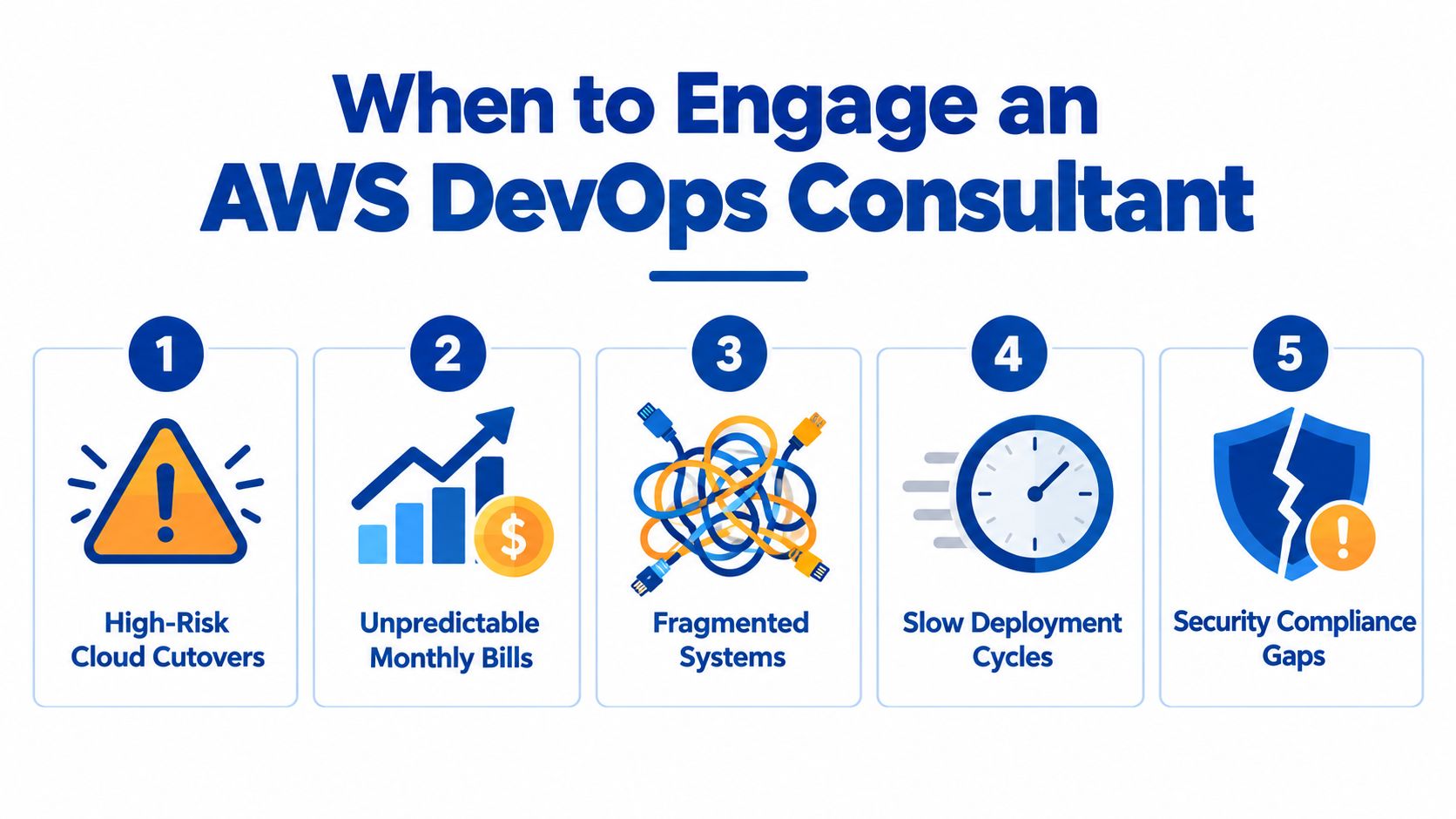
Use these triggers
- High-risk cloud cutovers: The application handles transactions, sensitive records, or operational workflows that can't tolerate an improvised migration.
- Unpredictable monthly bills: Finance receives an invoice but can't connect usage to teams, products, environments, or business value.
- Fragmented systems: CRM, authentication, billing, data, and internal tools duplicate records or rely on fragile manual transfers.
- Slow deployment cycles: Developers wait for a small group of operators to make routine changes, creating queues and release risk.
- Security or compliance gaps: Access, logging, backups, vulnerability handling, or evidence collection depends on informal practice.
A consultant can also be useful after migration. Many organisations complete the move to AWS but retain inconsistent environments, oversized resources, weak monitoring, and unclear ownership. Post-migration reliability work often produces more lasting value than a rushed lift-and-shift.
Consultant or internal hire?
Build in-house when you have enough experienced engineers to own architecture, security, release engineering, and on-call operations without weakening product delivery. Engage a consultant when the business needs specialist capability now, when a migration has a fixed risk window, or when an internal team needs an experienced partner to establish the operating model.
A phased cloud migration service should begin with dependencies and business priorities, not with a blanket instruction to move every workload. The consultant's first deliverable should make the next decision safer.
Australian Market Context and Cost Governance Needs
The Australian salary market gives buyers a useful reference point when assessing scope. SEEK salary data places DevOps engineer pay around A$130,000 in several cities, including A$135,540 in Canberra, A$131,550 in Brisbane, and A$130,000 in Adelaide, according to Australian DevOps salary data. Independent salary aggregators commonly place senior AWS DevOps roles between A$120,000 and A$180,000, with specialist roles averaging around A$150,000 per year, as reported in the same market reference.
Those figures aren't a consultancy price list. They show why the role should be scoped as specialist engineering rather than generic IT support. A consultant's commercial value comes from making high-impact decisions, reducing migration exposure, improving operational control, and transferring capability to the client team.
Make cost governance a deliverable
Australian public-sector AWS guidance links reliable cloud delivery with repeatable deployments, Infrastructure as Code, automated release pipelines, and rollback-safe changes. It also treats financial management as a technical control surface, with cost policies, continuous spend monitoring, role-based ownership, and monthly usage reviews described in the AWS ANZ Public Sector Agency FastStart Guide.
That should influence the statement of work. Ask for:
- A cost baseline: Current spend grouped by account, environment, workload, and service.
- Ownership rules: Named responsibility for reviewing usage and approving material changes.
- Rightsizing decisions: Evidence for changing instance types, storage, schedules, or architecture.
- Budget alerts: Notifications tied to teams and actions, not just a single organisation-wide threshold.
- Management reporting: A concise monthly view that finance, procurement, and technology leaders can understand.
The trade-off is straightforward. Deeper governance takes more planning at the start, but an inexpensive migration that produces an opaque, uncontrolled run rate isn't inexpensive. It has only moved the cost into operations.
For a project-specific financial assessment, buyers can use this guide to estimate AWS migration costs in Australia, then validate the assumptions against their workloads and delivery constraints.
Engagement Models and Typical Deliverables
A short architecture review and a hands-on implementation solve different problems. Combining them under one vague “DevOps project” makes it difficult to compare proposals or decide whether the engagement has succeeded.
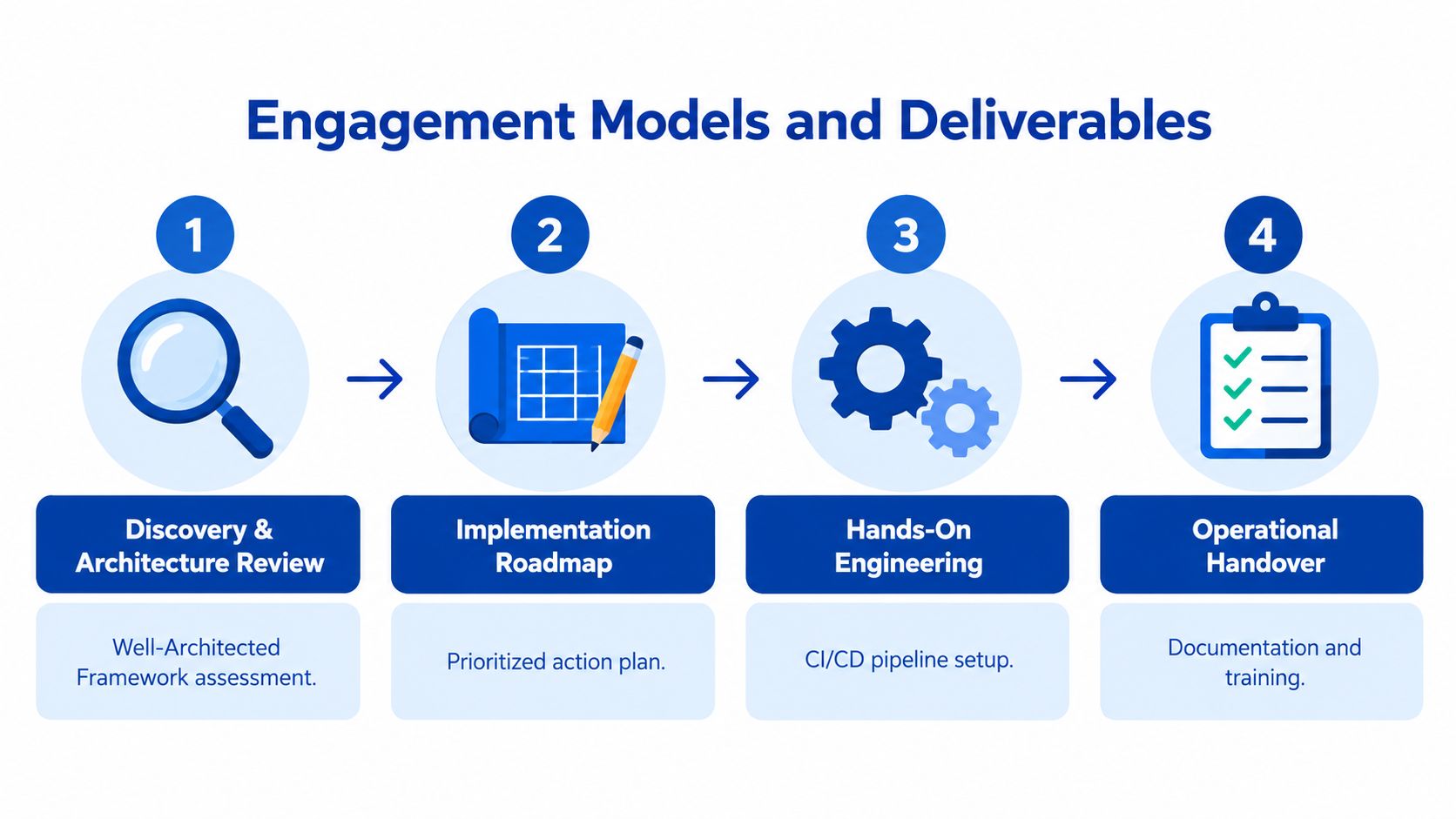
Match the model to the risk
| Engagement model | Suitable situation | Expected deliverables | Main trade-off |
|---|---|---|---|
| Discovery and architecture review | The direction is unclear or the migration carries material risk | Well-Architected assessment, dependency map, risk register, cost baseline, and options | Produces clarity, but doesn't implement the changes |
| Implementation engagement | The target architecture is understood and engineering capacity is limited | IaC repositories, CI/CD pipelines, environment configuration, monitoring, and rollback procedures | Delivers tangible change, but requires prompt client access and decisions |
| Advisory engagement | An internal team needs senior guidance during a complex programme | Design reviews, prioritisation, incident analysis, and technical decision records | Flexible, but outcomes depend on the client completing agreed actions |
| Managed or embedded support | The organisation needs continuity while building internal capability | FinOps reviews, reliability tuning, on-call support, coaching, and handover | Reduces immediate pressure, but ownership boundaries must remain explicit |
A discovery phase should answer practical questions. Which applications move first? Which dependencies prevent a clean cutover? What happens if the database migration runs late? Which service must remain available during the transition? Without those answers, an implementation team can automate the wrong sequence.
Make handover measurable
The minimum handover pack should include architecture diagrams, repository access, pipeline instructions, alert and dashboard explanations, recovery runbooks, access ownership, known limitations, and a record of decisions. Training should use the client's real deployment and incident procedures rather than a generic product demonstration.
The cloud computing consulting approach should also define baseline measures before changes begin. Useful measures include deployment lead time, failed-change frequency, recovery time, unresolved security findings, service availability against the agreed target, and cloud spend by workload. Choose measures that support business decisions, not a long list that nobody reviews.
Evaluation Checklist for Selecting a Consultant
A tool list is a weak selection criterion. Two consultants may both mention Terraform and Amazon EKS, yet have very different approaches to access control, testing, failure recovery, documentation, and commercial accountability.
Start with delivery evidence. Ask the candidate to describe a migration or platform change that involved dependencies, not just a new standalone environment. The explanation should cover what they discovered, what they deliberately didn't change, how they tested the cutover, and what the client team owned afterwards.
Ask questions that expose working practice
- Architecture: How do you run an AWS Well-Architected review, and how do you prioritise its findings?
- Migration: What makes a workload unsuitable for a direct lift-and-shift?
- Automation: Which infrastructure and application changes will be represented as code?
- Release safety: How will the team detect a bad release and reverse it?
- Observability: Which logs, metrics, traces, and alerts are essential for this workload?
- FinOps: How will the client connect AWS usage with products, environments, and owners?
- Security: How are IAM permissions, secrets, audit evidence, and vulnerability remediation managed?
- Handover: What will the internal team be able to operate without you?
Certifications can provide a useful signal. AWS DevOps Engineer Professional and AWS Solutions Architect Professional are relevant credentials, but neither replaces evidence of sound judgement. A consultant who can explain trade-offs clearly is more useful than one who recites services without connecting them to the application and operating model.
Put outcomes in the proposal
Require a written scope with assumptions, dependencies, exclusions, acceptance criteria, and named client responsibilities. Include baseline and target measures where they're meaningful. For example, the proposal might commit to an agreed deployment workflow, documented recovery procedure, cost allocation model, or environment consistency standard.
Avoid promises framed only around speed. More frequent deployments aren't a success if change failures increase, operational staff lose visibility, or the business can't explain its cloud bill. Evaluate delivery speed alongside reliability, security, cost, and the client team's ability to continue the work.
How Continuum Solutions Addresses Common Problems
A practical AWS DevOps engagement often starts with a problem that doesn't look like DevOps. A membership organisation may have separate systems for authentication, subscriptions, content, and reporting. An enterprise may have a legacy application that can't scale predictably. An NGO may need reliable infrastructure but lack the internal capacity to manage a complex migration programme.
Continuum Solutions works across AWS and Azure migrations, custom integrations, application modernisation, monitoring, and managed support. That combination matters when the delivery problem crosses application and infrastructure boundaries. A pipeline won't resolve duplicated customer records, and a replatformed application won't help if nobody owns its alerts or recovery process.
Typical problem-solving patterns
For a fragmented environment, the work may involve documented REST APIs, CRM integration, authentication, data mapping, and an internal operational tool. The outcome isn't “more automation”. It's a controlled flow of information with fewer manual hand-offs and clearer ownership.
For a slow or unstable application, the appropriate response may be containerised delivery, server-side rendering, serverless components, database changes, or a carefully staged replacement. The right pattern depends on load behaviour, data dependencies, release risk, and the team's ability to operate the result.
For a migration with unpredictable costs, the engagement can combine discovery, phased cutovers, resource review, monitoring, and financial reporting. AWS tools such as CloudWatch, Cost Explorer, CloudTrail, Systems Manager, and native deployment services can be useful, but only when someone maps their output to an operational decision.
The AWS Partner Solution Architect service in Melbourne is relevant for organisations that need local architecture input, migration planning, integration work, or technical support alongside an internal team. The practical test remains the same as with any provider: define the business risk, document the baseline, and require a handover that the client can operate.
Next Steps and Decision Criteria
An AWS DevOps consultant should be engaged against a defined business problem. “We need DevOps” is too broad to price, schedule, or evaluate. “We need to migrate this customer-facing application without interrupting transactions, establish repeatable releases, and give finance a monthly cost view” is specific enough to plan.
Use four decisions to frame the first conversation:
- Readiness: Which applications, integrations, data stores, accounts, and environments are involved?
- Priority: Is the immediate concern migration stability, cloud cost control, integration, security, deployment speed, or platform maturity?
- Ownership: Which internal people will approve changes, respond to incidents, review costs, and maintain the platform?
- Evidence: Which baseline measures will show that the engagement delivered useful change?
Request a discovery or Well-Architected review when the architecture is uncertain. Ask for a cost-baseline report when spend is difficult to allocate or explain. Define the migration waves and rollback conditions before committing to a cutover date. If the internal team is stretched, include embedded engineering and structured training rather than treating handover as an optional final meeting.
Review the proposal commercially
A credible proposal should separate discovery from implementation, identify assumptions, state what the client must provide, and describe the deliverables in operational terms. It should explain how the consultant will manage access, secrets, testing, approvals, incident response, and documentation. It should also make clear whether the engagement ends at implementation or includes ongoing reliability and cost reviews.
The cheapest proposal can be the most expensive if it leaves behind undocumented infrastructure, unowned alerts, or a bill that no one understands. A higher-value engagement earns its cost by reducing delivery risk, creating local continuity, and giving decision-makers evidence that the platform remains reliable and financially controlled.
Before kickoff, assemble application owners, finance, security, operations, and the engineers who'll inherit the system. Agree on the first workload, the first measurable outcome, and the conditions under which the team will pause or change direction. That preparation gives the consultant a real operating context and gives the business a fair basis for judging the result.
Continuum Solutions provides AWS and Azure architecture, phased migration, CI/CD and Infrastructure as Code delivery, integrations, monitoring, cost reviews, and structured handover for organisations that need dependable cloud operations. Visit Continuum Solutions to discuss your AWS DevOps requirements, migration risks, and next practical step.