
You're in a familiar spot. The workload is approved, the board wants movement on AWS, and three shortlisted partners all sound credible on paper. One has the right badge, one has a polished slide deck, and one says they can start next month. The question is which team can land the migration, keep spend under control, and not leave you with integration debt six months later.
That is where AWS Advanced Consulting Partner status becomes useful, but only as a filter. In Australia, the designation shows up in commercial commitments, supplier listings, and public procurement contexts, which tells you it's more than a logo on a website. It's a signal about delivery maturity, not a guarantee of fit. If you're evaluating an AWS project, especially one involving cloud migration, application modernisation, or regulated workloads, the badge can help you narrow the field fast, then you still need to verify delivery evidence.
For Australian buyers, the stakes are practical. The wrong partner can turn a clean migration into a long tail of cost overruns, duplicate environments, support gaps, and rewrites after cutover. The right partner should be able to explain architecture decisions, sequence risk, and show how they'll handle post-migration support without hand-waving.
This guide is written for CTOs, IT managers, operations leaders, and founders who need to choose partners on substance. If you want a broader view of how cloud advisory ties into delivery, the overview on cloud computing consulting is a useful companion. Here, the focus is narrower, what the Advanced Consulting Partner tier means, what it proves, what it doesn't, and how to use it when shortlisting firms in Australia.
Table of Contents
- Introduction Why Partner Tier Matters for Your AWS Investment
- What AWS Advanced Consulting Partner Means in Plain Terms
- Technical and Business Requirements Behind the Advanced Tier
- How Advanced Compares with Other AWS Partner Tiers
- What Advanced Status Does Not Tell You and How to Verify Maturity
- Enterprise Checklist for Choosing the Right AWS Partner
- Next Steps and How Continuum Solutions Maps to Advanced Tier Needs
Introduction Why Partner Tier Matters for Your AWS Investment
A CTO usually meets the partner problem at the wrong time, after the business has already committed to a platform direction. The commercial pressure then shifts from “Should we use AWS?” to “Which team can execute this without blowing up cost, timing, or security?” That is where partner tier matters, because it gives you an early clue about how much delivery discipline a firm has already demonstrated.
In Australia, the AWS Advanced Consulting Partner label often appears beside firms that are already handling real customer work, not just pitching capability. Recent Australian coverage of Cevo's multi-year agreement with AWS is a good example, because it tied the Advanced tier to joint investment in training, capability building, and more than 200 customer implementations across Australia and New Zealand. The point isn't that every Advanced partner looks like Cevo. The point is that the tier sits in a commercial context, where AWS collaboration, staff enablement, and delivery history all matter.
Practical rule: treat tier as a procurement screen, not a final verdict.
That matters because the partner market is crowded. Local rankings and directories show many firms using AWS partner status across Australia, including public-sector-adjacent listings and supplier platforms. When a market has that much noise, the badge helps you avoid wasting time on teams that are clearly too small or too shallow. It doesn't, by itself, tell you whether they can handle your architecture, your security obligations, or your migration sequence.
A good selection process starts with the tier, then asks harder questions. What has the partner shipped in Australia recently? Do they work in regulated sectors if you do? Can they talk about cost control without drifting into generic FinOps slogans? Those are the answers that protect budget and delivery timelines.
If you're comparing partners for a live project, the practical outcome you need is simple. By the end of your selection cycle, you should know whether the partner is just AWS-aligned in name, or whether they can carry a migration, modernisation, or integration programme through to steady-state operations. The Advanced tier helps you sort that out faster, but only if you use it properly.
What AWS Advanced Consulting Partner Means in Plain Terms
Think of AWS partner tiers like professional registration levels. A basic credential says someone has entered the field. A higher tier says they've passed more checks, sustained more delivery, and kept enough business activity alive to stay on the radar. AWS Advanced Consulting Partner sits in that middle ground where the firm has moved beyond entry-level proof, but still needs to show its work.
What the badge signals
At a practical level, the designation tells you three things. First, the partner has met AWS requirements around trained and certified staff. Second, it has enough customer validation and commercial activity to sit above the lower tier. Third, AWS has decided the firm is not just technically capable, but also active enough in delivery to remain in the programme.
That matters for buyers because mid-sized and enterprise programmes need more than enthusiasm. They need repeatable engineering, sensible change control, and enough bench depth to survive illness, leave, or parallel workstreams. An Advanced partner is more likely than a smaller firm to have those basics in place.
What it does not guarantee
The badge does not promise strong architecture judgement. It does not guarantee cost discipline. It does not prove the partner understands your sector, your legacy stack, or your internal politics. A firm can carry the label and still be wrong for a workload that needs deep integrations, strict compliance, or a phased approach to migration.
A partner tier tells you how AWS sees the firm. It does not tell you how your project will feel in week eight.
That is why the safest reading is “maturity marker, not finish line.” For a CTO, that distinction matters. You use the tier to separate serious operators from aspirational sales teams, then you inspect the partner's recent delivery pattern, team composition, and evidence of post-cutover support. If you need a broader technical view while narrowing the field, the Partner Solution Architect AWS Melbourne page is a useful reference point for how advisory and architecture work should be framed.
The best way to read Advanced status is to ask whether the partner can support a real programme, not just a workshop. If your project involves migration waves, application rewrites, managed services, or governance, the designation is a reasonable starting signal. It's not proof, but it is a strong hint that the firm has moved beyond hobby-scale AWS work.
Technical and Business Requirements Behind the Advanced Tier
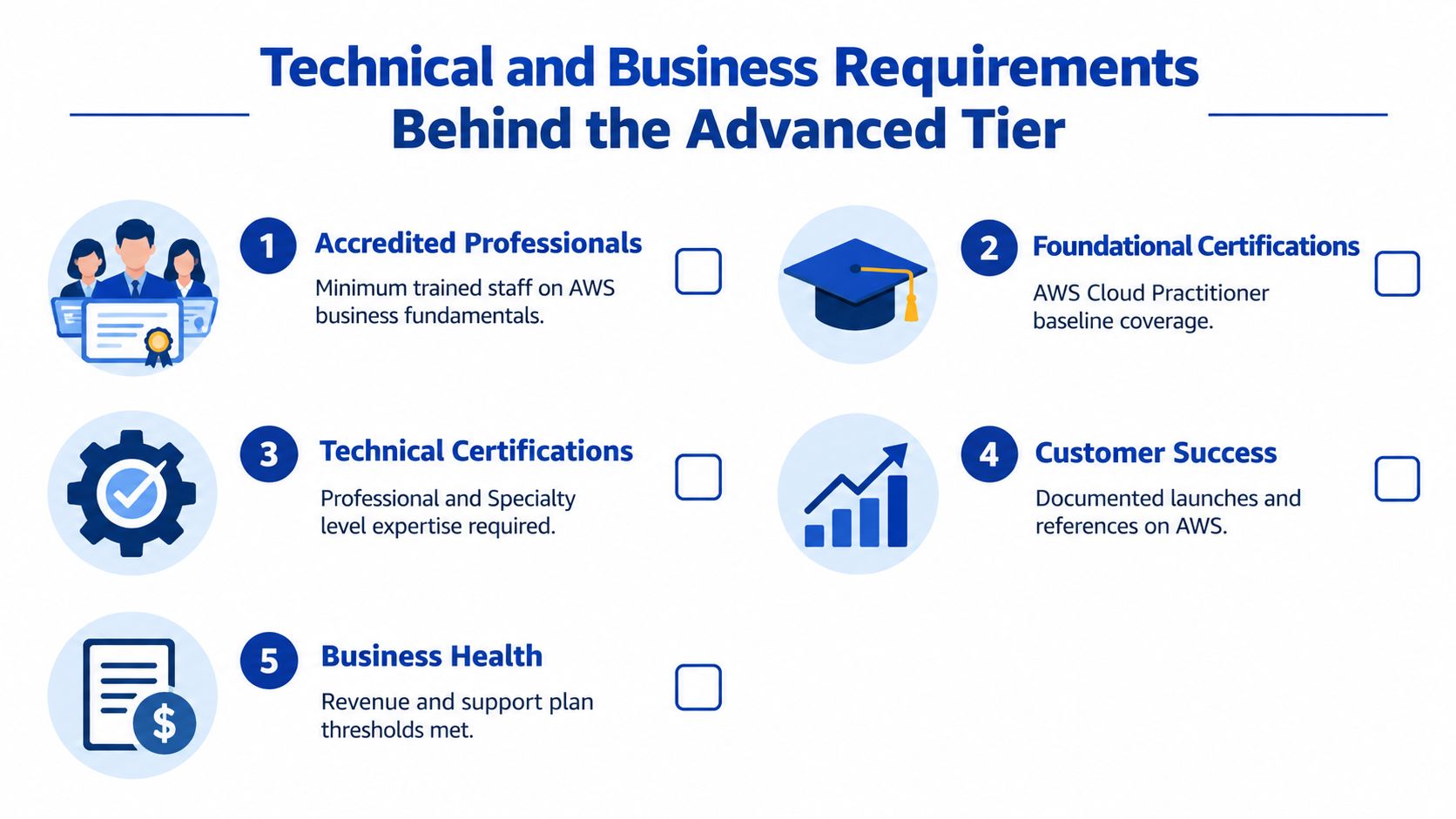
AWS doesn't award the Advanced tier on branding alone. The current Services Partner tier requirements set a concrete bar, and those requirements are useful because they reveal what AWS thinks an experienced delivery firm should look like. The numbers matter here because they show depth, not just enthusiasm.
The current thresholds buyers should ask about
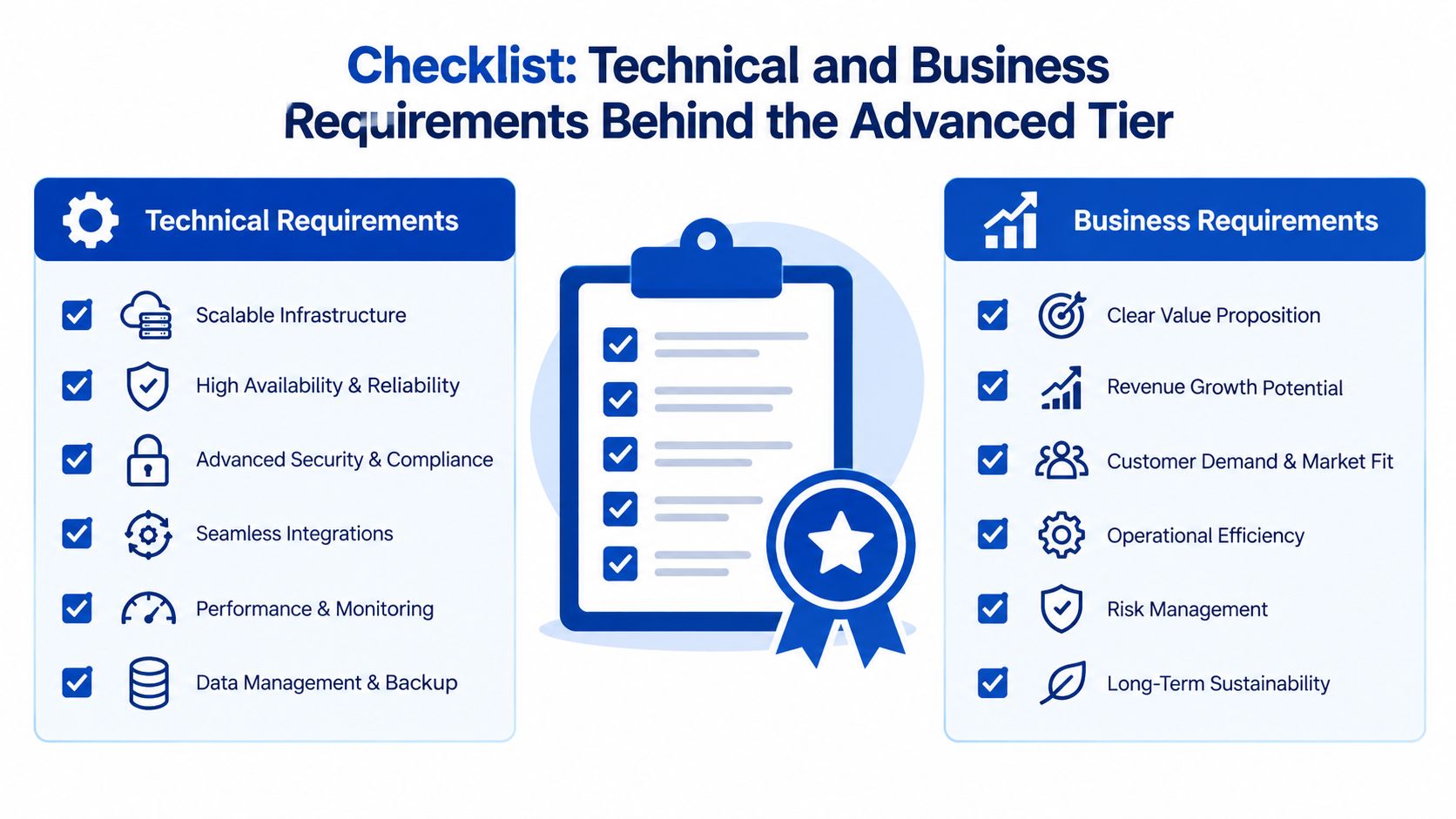
AWS Services Partner Tiers set the Advanced tier at 8 accredited professionals total, split into 4 technical and 4 business professionals. It also requires 4 AWS Foundational Certified Individuals, 6 AWS Technical Certified Individuals with at least 3 at Professional or Specialty level, and 20 total MRR engagements with total MRR of at least US$10,000 (AWS Services Partner Tiers). Those thresholds matter because they show the partner has a real mix of delivery, commercial, and certification coverage.
For buyers, this translates into useful questions. Do they have enough technical people to keep architecture decisions consistent across multiple workstreams? Do they have business-side staff who can manage scope, contracts, and stakeholder expectations? Have they handled enough recurring engagements to understand what support and optimisation look like after launch?
Why the old criteria still tell you something
Older AWS Partner Network FAQ material said Consulting Partners seeking the Standard or Advanced tiers needed a minimum of 2 and 5 AWS-trained technical staff respectively, and had to maintain a three-month average of at least US$1,000 per month for Standard or US$10,000 for Advanced in AWS billings (APN FAQs PDF). That older structure shows how AWS has shifted from simple staffing and billing minimums toward a more rounded picture of capability.
The evolution matters commercially. A partner that merely meets a billing threshold may still be weak on repeatability. A partner that meets certification, staffing, and engagement thresholds is more likely to have muscle memory around delivery governance, customer references, and support.
Buyer takeaway: ask for the certification mix, not just the badge. A firm with the right logo but thin bench depth can still become a delivery bottleneck.
If you're comparing firms for a migration, delivery risk becomes visible. I'd rather see a partner with clear certification coverage, current customer work, and a sensible engagement pattern than one with a glossy deck and vague claims about scale. For projects that need a formal migration path, the cloud migration services page is a good reminder that migration readiness should be tied to architecture, sequencing, and support, not just rehosting.
The practical test is simple. Ask who will be on the project, what their AWS credentials are, how they handle handover, and how they keep competency current. If the answers are thin, the tier won't save you.
How Advanced Compares with Other AWS Partner Tiers
Partner tier is most useful when you compare it against the alternatives. The difference between a lower-tier partner, an Advanced partner, and a Premier partner isn't just prestige. It changes the amount of proof you can reasonably expect, the cost profile you're likely to face, and the amount of delivery structure the partner will bring.
| Requirement | Select / Standard | Advanced | Premier |
|---|---|---|---|
| Bench depth | Smaller teams, lighter coverage | Stronger mix of technical and business staff | Broadest bench and deeper specialisation |
| Certification profile | Enough to start delivery | More mature certification mix, including Professional and Specialty level coverage | Deepest certification coverage and broader competency alignment |
| Customer validation | Limited proof points | More validated delivery history | Strongest reference base and highest assurance signal |
| Commercial scale | Lower recurring activity | Sustained recurring engagement activity | Highest commercial maturity and programme scale |
| Best fit | Smaller, narrower work | Mid-market modernisation, phased migrations, integration work | Large, highly complex, regulated, or global programmes |
| Trade-off | Lower cost, less depth | Balanced cost and capability | Highest support depth, usually higher overhead |
For many Australian SMEs and mid-market firms, Advanced is the sweet spot. It often gives enough delivery maturity for cloud migration, application modernisation, and managed services without bringing the overhead of a very large global integrator. That matters when you care about speed, clarity, and cost control, and not just global brand recognition.
Premier becomes more relevant when the programme has heavier governance needs, multinational scope, or extreme complexity. That can include large regulated environments, deep legacy estates, or projects where many teams need coordinated change management. The upside is breadth and process maturity. The downside is usually more overhead, a higher commercial floor, and less flexibility.
The lower tiers can still be sensible for narrow or low-risk work. If you only need a contained piece of technical delivery, a smaller partner may be cheaper and more nimble. The risk is that thin capability often shows up later, during cutover or support, when mistakes are expensive.
If you're trying to map tier to budget, the right question is not “Which tier is best?” It's “Which tier gives me enough confidence without paying for unnecessary scale?” For that kind of evaluation, the AWS migration cost guide is useful because it forces the commercial conversation early instead of leaving it until after discovery.
What Advanced Status Does Not Tell You and How to Verify Maturity
A badge is a starting point, not a verdict. That becomes obvious in Australia, where the market is crowded and partner differentiation is harder than it looks. AWS has nearly 150,000 partners globally, and local rankings list 143 AWS partner firms in Australia (ARN article). In a market that busy, a tier alone won't separate the useful firms from the merely accredited ones.
What to check beyond the logo
Recent Australian and APAC reporting shows the market moving toward Marketplace participation, AI competencies, and co-sell activity, while hybrid cloud remains common and full migration is far from universal (Westcon-Comstor Australia). That means a partner's real value is increasingly tied to how well it handles sequencing, governance, and modernisation, not just lift-and-shift delivery.
Look for evidence in four areas:
- Recent ANZ wins, especially work similar to your environment.
- Regulated sector experience, if you operate in finance, utilities, healthcare, or the public sector.
- Marketplace activity, because commercial maturity often shows up there.
- AI competency and modernisation capability, because many buyers now need a roadmap beyond migration.
Questions that expose real delivery maturity
Ask the team who will own architecture decisions after go-live. Ask how they control cost drift when environments stay up longer than expected. Ask whether they can show a phased migration path, not just a single cutover plan. Then ask what happens if your first release exposes integration issues or data quality problems.
If a partner can't talk clearly about cutover risk, ongoing optimisation, and support handover, the badge is probably doing too much of the selling.
The contrarian read is simple. Advanced Consulting Partner can be a weak proxy for fit unless the buyer verifies recent delivery, commercial depth, and modernisation capability. In a market moving toward hybrid and AI-enabled work, the strongest partners will be the ones that can combine migration, governance, and optimisation into a coherent roadmap.
For CTOs, that means the due diligence needs to be more like procurement and less like brand comparison. You're not buying accreditation. You're buying the chance that a team can carry your cloud estate into production, keep it stable, and improve it without expensive surprises.
Enterprise Checklist for Choosing the Right AWS Partner
The fastest way to avoid a bad partner selection is to score the partner on the work that creates risk. I use a simple lens with decision makers, because it keeps the conversation on architecture, commercial transparency, and support continuity instead of soft claims.
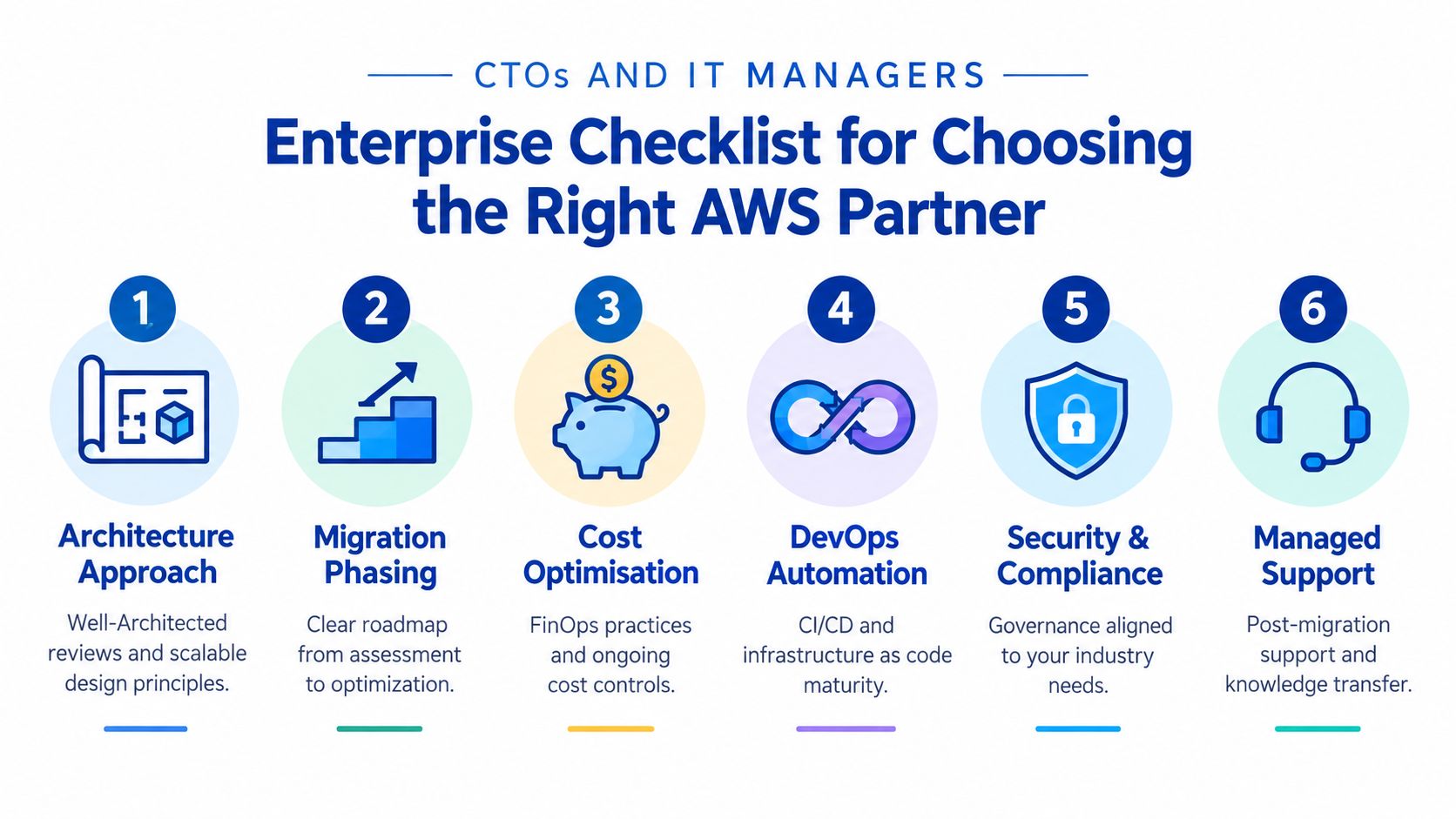
Score the partner on delivery, not presentation
Start with the architecture approach. A serious partner can explain how they design for resilience, cost control, and integration without hiding behind buzzwords. They should be able to describe how they handle Well-Architected reviews, dependency mapping, and future-state constraints.
Then test migration phasing. Big-bang cutovers are risky unless the environment is small and well understood. A stronger partner will talk about assessment, wave planning, validation, and rollback points. They should also be honest about duplicated environments, temporary spend spikes, and the operational cost of running old and new systems at the same time.
Cost optimisation deserves its own line item. Oversized instances, unmanaged storage growth, and idle environments are common failure points. A partner should explain how they'll monitor spend, set baselines, and avoid surprise invoices after launch.
Don't ignore post-launch capability
DevOps and observability matter because every migration creates a new operational pattern. If the partner can't show how they handle CI/CD, infrastructure as code, logging, and alerting, you'll probably inherit manual work. That usually means more incidents and slower fixes.
Security and compliance should be concrete, not generic. Ask how they align controls to your industry, how they handle access boundaries, and how they document decisions for audit or internal review. Managed support is the last filter, and it's a big one. A partner that hands over a system without knowledge transfer often creates more cost than it saves.
One practical option in this area is Continuum Solutions, which provides AWS architecture, phased migration, integration, and managed support services for Australian teams. That kind of mix is relevant because partner maturity is rarely just about migration. It's about whether the team can stay useful after the first release.
Common mistake: choosing a partner for migration speed and then discovering they have no plan for stabilisation, observability, or business continuity.
If you want a simple decision matrix, score each shortlisted partner on technical depth, commercial clarity, and local support continuity. The winner is rarely the one with the loudest pitch. It's the one that can explain how the system will run after go-live and who owns the mess if something slips.
Next Steps and How Continuum Solutions Maps to Advanced Tier Needs
A good buying process starts with discovery, not commitments. Begin with a short review of your current estate, your cost baseline, and your risk constraints. Then decide whether you need a phased migration, an application modernisation effort, or a mixed programme that also covers integrations and managed operations.
That approach suits different organisations for different reasons. An NGO may need stable hosting, lower operational burden, and clean handover. An enterprise may need governance, identity alignment, and integration across legacy systems. A startup may care more about speed, observability, and making sure the platform can scale without constant rework.
The next step is to compare partners on how they deliver. If a team can support AWS architecture, migration planning, application modernisation, DevOps, system integration, and ongoing managed services, they're closer to what Advanced-tier buyers usually need. If they can only do one of those well, the project can still work, but the gaps usually surface later in cost or support.
For buyers in Melbourne or broader Australia, the AWS partner Melbourne page is a useful starting point for evaluating local delivery continuity. Local presence matters when you need stakeholder workshops, cutover support, or close operational coordination across teams.
A sensible 30-60-90 day plan looks like this. First, define the business outcome and current-state risk. Second, get a partner to produce a phased delivery plan with cost assumptions and dependencies. Third, validate who will build, test, and support the solution after launch. If the partner can't walk you through that sequence clearly, keep looking.
If you need help choosing an AWS partner for a migration, modernisation, or systems integration programme, Continuum Solutions can review your current environment, map delivery risks, and shape a phased plan that fits your budget and operating model. Visit Continuum Solutions to discuss AWS architecture, migration, application modernisation, and managed support for your next project.