
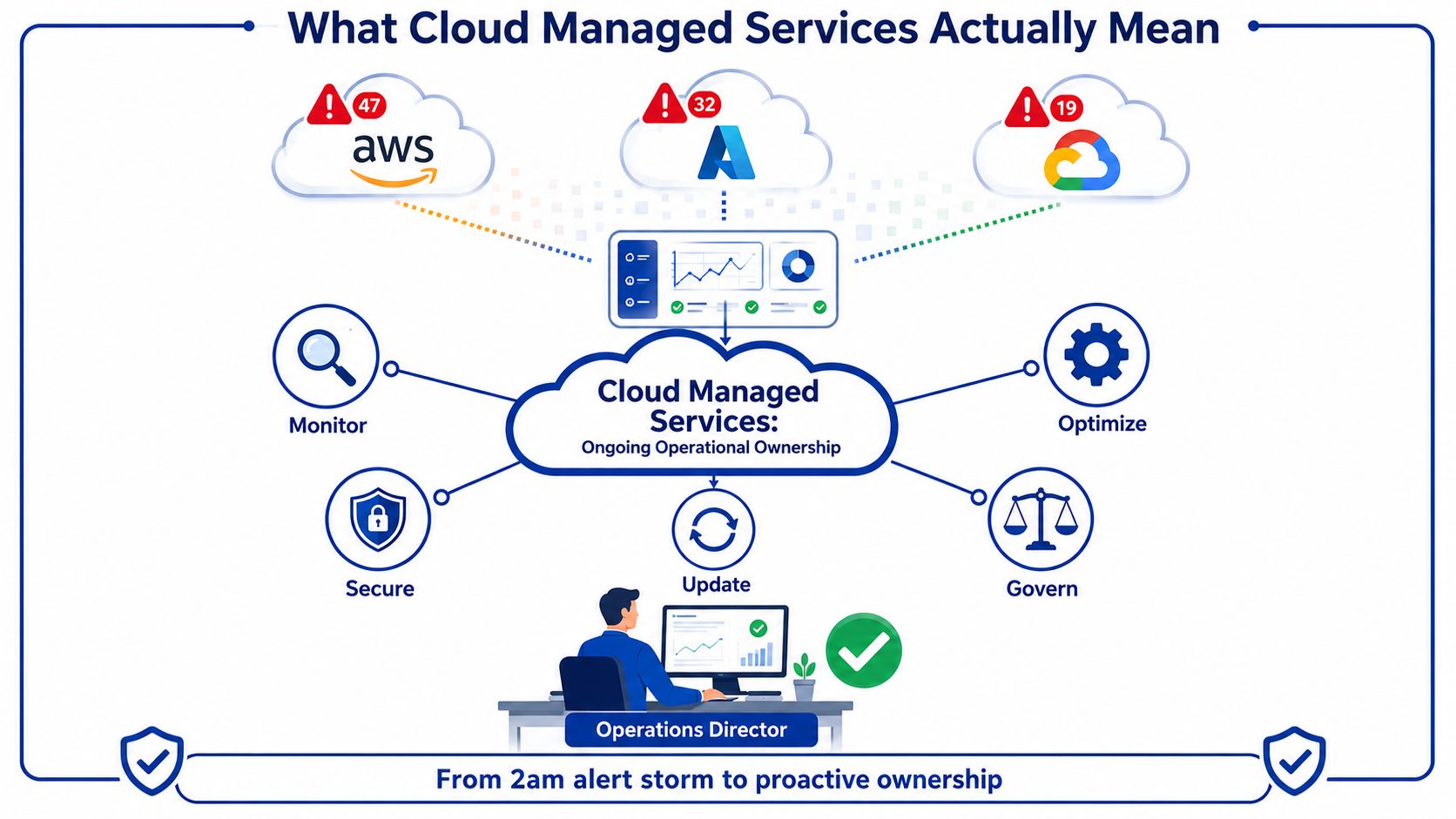
The operations director gets the call at 2am. AWS is reporting high errors, Azure is sending health alerts, a backup job has failed, and the internal team is trying to work out which notification matters first. The organisation has already migrated to the cloud, but it hasn't built a dependable way to operate what it now runs.
That situation is common in Australian engagements. Public cloud adoption moved from an early niche to mainstream use, with fewer than one in five businesses reporting a paid cloud service in 2013–14 and 42% reporting use by 2017–18, based on ABS data reported by Computer Weekly. The commercial question has changed. It's no longer just whether to migrate, but who should own the administration, security, reliability and cost control after migration.
Table of Contents
- What Cloud Managed Services Actually Mean
- The Core Components You Should Expect
- When Outsourcing Beats Self-Management
- Pricing Models and Cost Considerations
- AWS and Azure Considerations for Australian Workloads
- A Phased Migration and Onboarding Approach
- Common Pitfalls and How to Avoid Them
- Choosing a Partner and Your Next Steps
What Cloud Managed Services Actually Mean
The phrase cloud managed services is often used for almost anything involving a cloud account. That's a problem. A migration consultancy may design and execute a cutover, while a cloud provider supplies compute, storage and platform services. A managed services partner takes ongoing responsibility for operating agreed parts of the environment after go-live.
I define the service as continuous operational ownership by a third party, governed by documented responsibilities and service levels. That usually includes administration, patching, monitoring, incident response, backup oversight, security tasks and optimisation. It doesn't mean the provider owns your business decisions, application roadmap or data governance.
Where the boundary sits
In a well-written agreement, the provider runs the operational layer, while the customer retains authority over data, access policy, architecture direction and business priorities. The provider might manage Amazon EC2 patching, Azure Monitor alerts, backup policies and identity workflows. Your team still decides which data may be stored, which users need access and what the application must do.
That boundary separates managed services from adjacent models:
- Professional services: A consultant delivers a defined project, such as a landing zone, migration or application modernisation.
- Co-managed operations: Your team and the provider divide responsibilities, for example, your engineers own application releases while the partner owns infrastructure, backups and patching.
- Native support plans: AWS or Microsoft provides platform support, but your organisation may still operate much of the environment.
- Break-fix support: The provider responds when something fails, rather than continuously improving the operating model.
Australian businesses are increasingly managing production estates rather than testing cloud concepts. That makes operational ownership more important than a successful migration certificate. If the contract only promises access to engineers when you raise a ticket, you haven't bought managed cloud operations. You've bought escalation support.
My recommendation is simple. Ask the prospective provider to show the responsibility matrix, alert workflow, runbooks, escalation path and monthly service outputs before discussing marketing claims. You can compare that detail with the practical scope of cloud computing consulting and decide whether you need advisory work, project delivery or a continuing operating service.
The Core Components You Should Expect
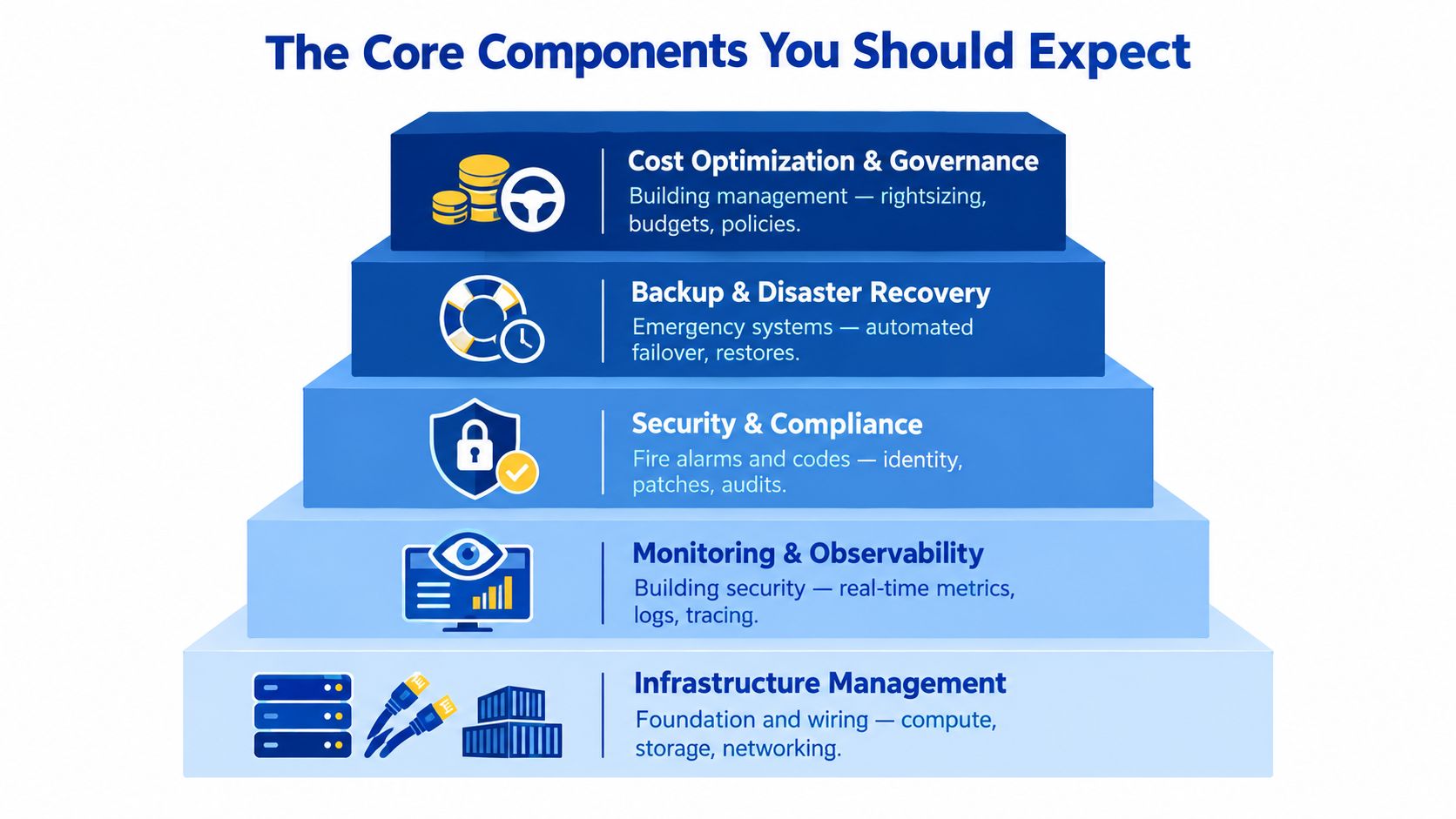
A managed cloud environment is like a commercial building. Infrastructure is the foundation and wiring, monitoring is the building management system, security is the locks and alarms, disaster recovery is the emergency system, and cost governance is the meter and billing office. Removing one layer doesn't simplify the building. It creates a blind spot.
Infrastructure management
This is the foundation. Expect administration of compute, storage, networking, containers, accounts and environments. The provider should maintain configuration standards, handle approved changes and identify unsupported or inconsistent resources.
A useful deliverable isn't a vague promise to “manage infrastructure”. It's a maintained inventory, ownership map, configuration baseline and escalation procedure. In AWS, that could include account and tagging standards around EC2, ECS, RDS and Lambda. In Azure, it could include management groups, subscriptions, virtual networks and platform services.
Monitoring and observability
Monitoring tells the team that something is unhealthy. Observability helps explain why. The service should combine metrics, logs, traces and application signals rather than forwarding every event to an already overloaded inbox.
I expect alert classification, named owners, escalation rules and a review of noisy alerts. The provider should report recurring incidents and recommend instrumentation changes. Tools such as Sentry, New Relic, CloudWatch and Azure Monitor can support this layer, but the tool isn't the service. The service is the operational response around it. Application teams needing deeper fault diagnosis should assess enterprise application monitoring and debugging as a separate capability where appropriate.
Security and compliance
Security operations include vulnerability remediation, patching, identity and access management, encryption controls, logging and evidence collection. The provider should state exactly which controls it operates and which remain with your team.
Australian government agencies must identify the authorisation boundary, document shared security responsibilities, map applicable ISM controls and record ownership in the assessment report and cloud controls matrix, as set out in Australian Government cloud assessment guidance. A provider that cannot produce clear evidence and ownership records isn't ready for a regulated engagement.
Backup and disaster recovery
Backups aren't a recovery strategy until someone has restored them. Require defined recovery objectives, backup monitoring, retention rules, encryption, restore testing and an incident runbook.
Cost optimisation and governance
Cost management should operate continuously. The provider should review utilisation, rightsizing opportunities, tagging quality, budgets, reservations or savings plans where suitable, and unusual consumption. Monthly reporting is useful, but it arrives too late if no one is accountable for a sudden increase.
These pillars interact. Security requirements influence backup encryption. Monitoring detects cost anomalies. Identity policy limits who can change recovery settings. A serious managed contract covers the connections between layers, not just a list of isolated tasks.
When Outsourcing Beats Self-Management
The make-versus-buy decision should follow operational evidence, not a preference for keeping everything internal. I recommend outsourcing when your engineers spend a substantial share of their time on repetitive cloud administration, when incidents arrive outside staffed hours, or when compliance work requires processes and evidence the team hasn't built.
A regulated workload makes the decision sharper. Under APRA CPS 231, an outsourcing arrangement is material when disruption could significantly affect business operations or risk management, and APRA's cloud guidance treats a significant part of IT supporting core business as a material business activity, as explained in this Australian regulated cloud outsourcing overview. For government workloads, the Australian Signals Directorate recommends a provider with Hosting Certification Framework certification and an IRAP assessment against the Information Security Manual completed within the previous 24 months, according to cloud security guidance for executives.
Make vs Buy Decision Triggers
| Trigger | Lean Outsourced | Lean Co-Managed | Lean Internal |
|---|---|---|---|
| Out-of-hours incidents | You need an established on-call service | Your team handles application incidents, provider handles platform escalation | Your team already staffs dependable coverage |
| Compliance evidence | Processes, control ownership or audit evidence are incomplete | Provider operates selected controls and your team retains approval | Internal governance is mature and tested |
| Engineering capacity | Cloud toil displaces product delivery | Responsibilities can be divided by layer | Platform engineering is a deliberate capability |
| Workload profile | Multiple accounts, platforms or persistent production services | Mixed estate with clear ownership boundaries | Small, stable or highly proprietary environment |
| Change velocity | Reliability and repeatability matter more than direct intervention | Shared release and change control | Product team needs immediate low-level control |
Co-managed operations are often the sensible middle path. Your developers keep application ownership, while the provider manages backups, patching, monitoring and infrastructure incidents. That model works only when the hand-offs are explicit. “We'll work it out during an outage” is not a governance model.
Keep operations internal when the workload is small, tightly coupled to one product team and supported by engineers who already have the necessary automation and recovery discipline. Even then, review the arrangement when the estate expands or the business begins carrying regulatory obligations. Self-management is valid when it's an intentional trade-off, not when nobody has revisited the decision.
Pricing Models and Cost Considerations
Australian providers commonly quote cloud managed services through four commercial models. None is automatically cheaper. The right choice depends on whether your environment is predictable, elastic, user-centric or spread across many resources.
| Pricing Model | Typical Coverage | Best Fit | Main Gotcha |
|---|---|---|---|
| Per user per month | User support, access administration and defined service desk activity | Organisations buying an end-user operations layer | It may exclude infrastructure incidents and platform work |
| Per resource or instance | Monitoring, patching and administration for listed servers, databases or containers | Stable estates with a clear resource inventory | Auto-scaling can increase fees during demand peaks |
| Consumption aligned to hyperscaler spend | Operational support linked to cloud usage | Larger estates seeking a commercial link to consumption | Automation overhead, excluded services and spend bands need disclosure |
| Fixed-fee managed bundle | Agreed monitoring, response windows, patch coverage and backup administration | Buyers wanting predictable operating expenditure | Project work and non-standard changes are often outside scope |
The phrase “24/7 monitoring” doesn't tell you what you're paying for. Ask whether the fee includes alert triage, P1 response, patching windows, vulnerability remediation, backup retention, restore tests, cost reviews and service reporting. Then ask what happens when a resource is added, a workload scales, a new region is introduced or a project team requests a change.
Commercial rule: price the responsibility transferred, not the number of dashboards opened.
Tie the fee to the five operational components. Infrastructure administration may be included while database tuning is separate. Backup monitoring may be covered while a full disaster recovery exercise is project work. Cost reporting may be included while remediation requires an engineering day rate.
Before signing, require a scope schedule, included resource definitions, response targets, change rates, after-hours rules, egress assumptions, backup retention boundaries and a process for approving work outside the bundle. A migration estimate should be separate from steady-state operations. The distinction is covered in this AWS migration cost guide for Australia.
Australian cloud demand makes this discipline more important. Organisations are forecast to spend nearly A$26.6 billion on public cloud services in 2025, up 18.9% year over year, according to Tech Business News Australia. Your managed services fee is only one line in the operating model. Poor tagging, uncontrolled access, inefficient architecture and unexpected data transfer can matter more.
AWS and Azure Considerations for Australian Workloads
Choose AWS or Azure based on capability clusters, not a feature-counting exercise. Both can support serious Australian workloads. The better choice is usually the platform that matches your identity estate, engineering habits, regulatory pathway and application architecture.
Azure usually has the stronger starting position for a Microsoft-heavy organisation. Microsoft 365, Entra ID, hybrid Active Directory, Windows estates and existing licensing relationships can reduce friction. That matters for enterprises with established identity processes or government-facing environments. Azure management groups and policy tooling can also fit organisations that already think in terms of Microsoft governance hierarchies.
AWS tends to suit digital-native teams, ecommerce platforms, data-heavy applications and organisations building around services such as Lambda, ECS, RDS and event-driven architectures. Its account model can support strong separation between environments when designed properly. I favour AWS for teams that want broad architectural choice and already have engineers comfortable with its operating patterns.
Australian location and compliance decisions
Latency from Australian users should influence placement, but it shouldn't be the only consideration. Review the location of compute, databases, backups, logs and disaster recovery copies. A workload that runs in Australia while sending data to another geography for analytics can create governance, latency and transfer implications.
Ask whether the partner's engineers have verified platform competency and practical experience with the controls your organisation must evidence. The Australian Government Hosting Certification Framework applies to hosting service providers serving government customers and defines Strategic, Assured and Uncertified certification levels, as described by the Hosting Certification Framework. Certification isn't a substitute for your own assessment, but it is a meaningful selection filter.
For APRA-regulated organisations, map material business activities to the operating model before selecting tools. For all regulated workloads, document the shared responsibility model, access ownership, logging, recovery and exit plan. Also model cross-region data transfer and egress before approving a multi-region design. Local Australian zones, partner capability and data residency choices can change the commercial answer.
Use a cloud migration service when the work involves architecture, dependency mapping and operational transition, not just moving virtual machines. The managed provider must inherit a design it can run.
A Phased Migration and Onboarding Approach
I don't move a critical production workload directly into a managed contract and hope the operating model settles afterwards. The safest engagements establish the controls first, prove them on lower-risk systems and only then transfer responsibility for business-critical services.
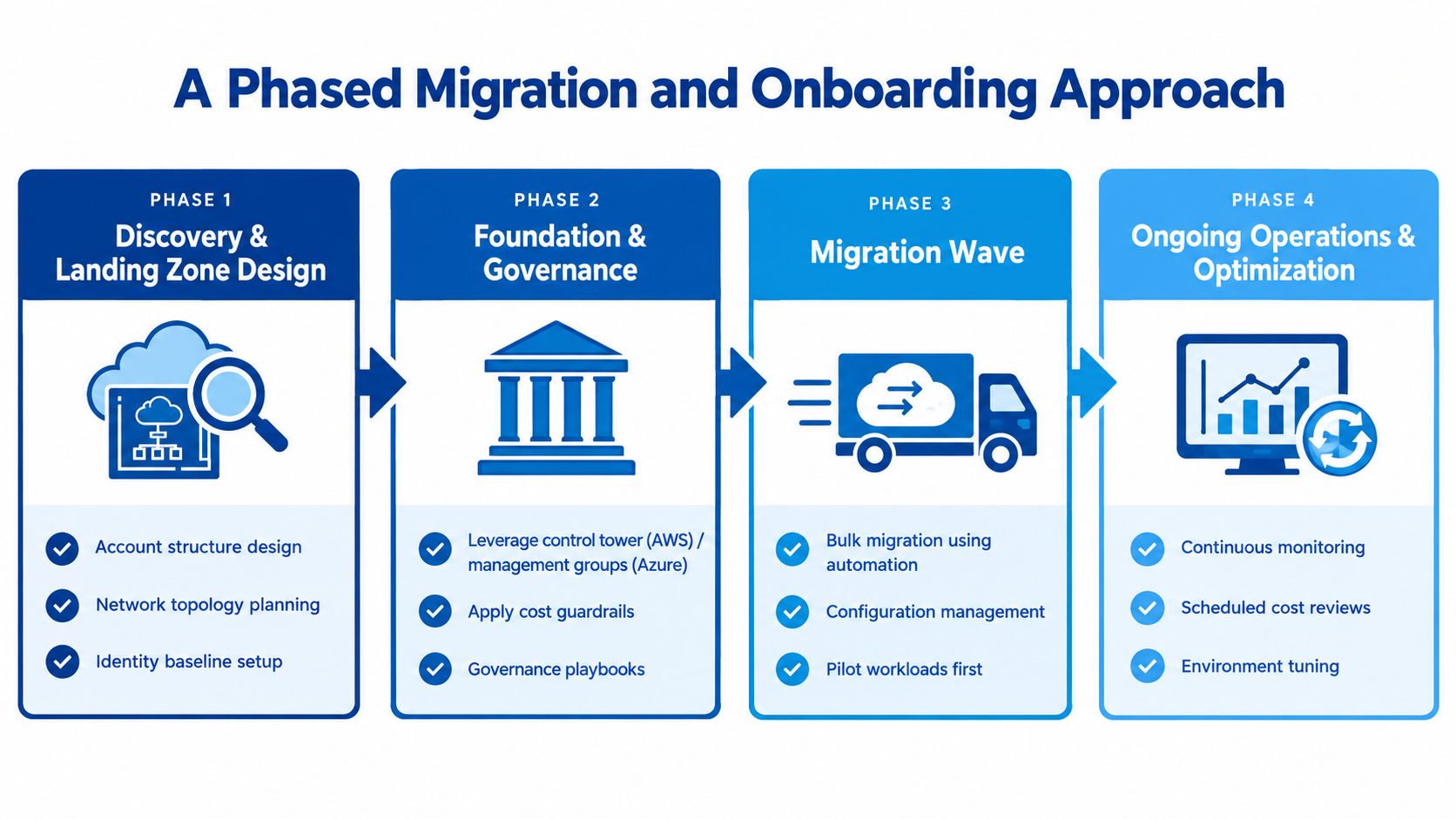
Phase one covers discovery and landing zone design
I start by documenting accounts or subscriptions, network topology, identity boundaries, environments, dependencies, data classifications and tagging standards. The output should include an estate inventory, target architecture, responsibility matrix, initial risk register and onboarding backlog.
This phase commonly takes several weeks, depending on estate complexity. The provider shouldn't take operational responsibility yet. The exit condition is an approved landing zone design, known ownership gaps and a migration sequence that the customer accepts.
Phase two establishes the foundation
The team implements governance using AWS Control Tower patterns or Azure management groups, applies access baselines, configures logging, introduces cost guardrails and writes the first runbooks. I use non-production and low-risk workloads to test alert routing, patch windows, backup handling and escalation.
The MSP begins owning the agreed platform tasks here. The exit criteria are practical: alerts reach named responders, backups report correctly, access works as designed, and both sides can follow the incident procedure without improvisation.
Phase three moves critical workloads
Production migration needs formal cutover planning, dependency validation, rollback criteria and a rehearsed P1 response. Runbooks should cover service restart, access failure, backup restoration, certificate issues, capacity alerts and vendor escalation.
The provider owns the services transferred in the signed responsibility matrix. The customer retains business approval and application decisions. Progress only when the pilot has demonstrated stable operations and the production team has accepted the cutover evidence.
Phase four embeds optimisation
After migration, the service must become an operating rhythm. That means continuous monitoring, scheduled cost reviews, vulnerability cycles, architecture tuning and quarterly service reviews.
I expect a service report that distinguishes incidents from recurring problems and completed changes from proposed improvements. The final exit condition isn't a calendar date. It's a stable handover of responsibilities, measurable service outcomes and a backlog with named owners.
Common Pitfalls and How to Avoid Them
Most managed services failures aren't caused by a missing cloud feature. They start with an operating agreement that looks complete but doesn't change how people work.
Five patterns I watch for
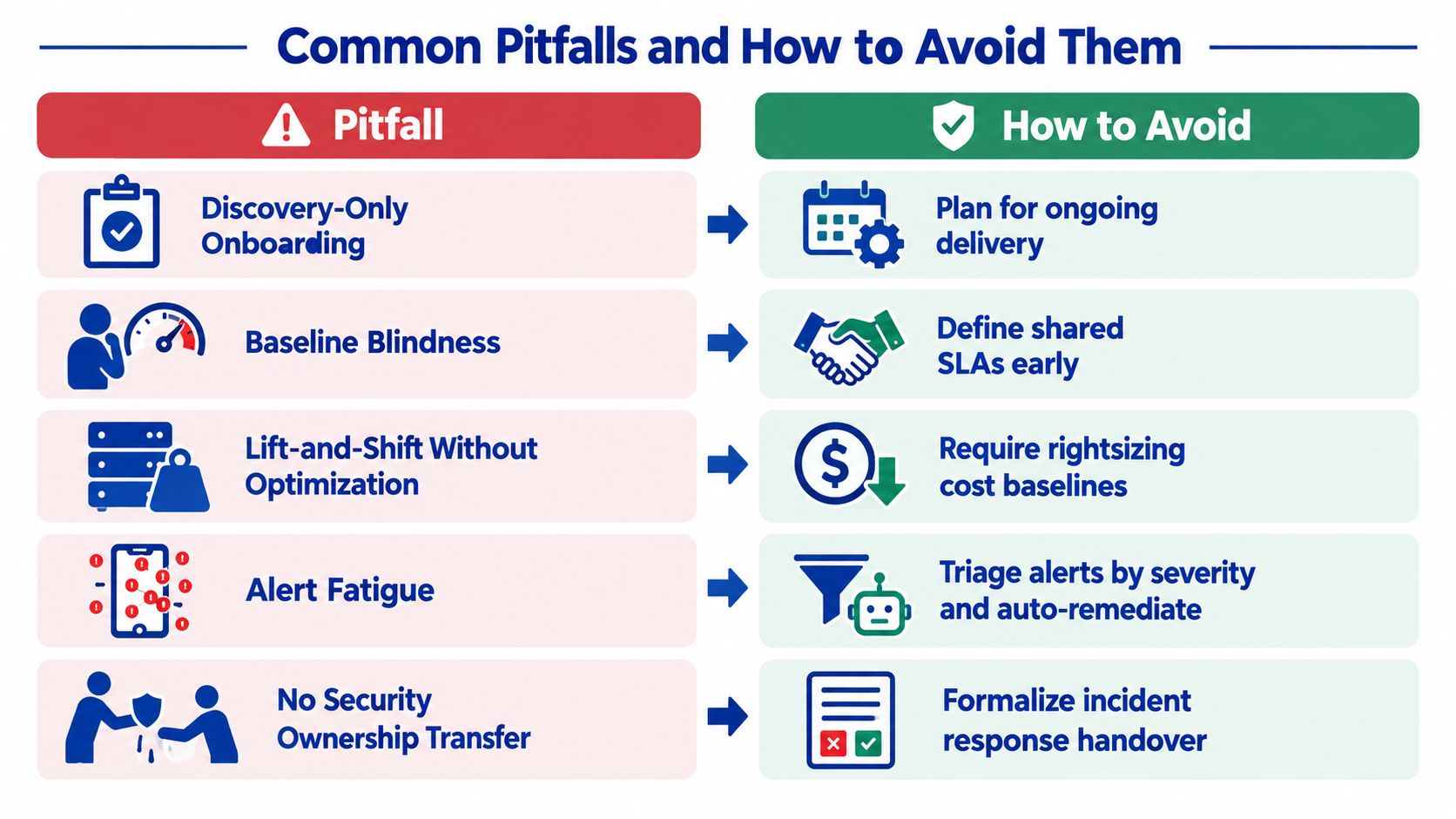
- Discovery-only onboarding: The provider documents the estate, then leaves the customer without usable procedures. Require signed runbook acceptance and an operational rehearsal.
- Baseline blindness: The organisation receives a monthly cost report but nobody owns daily anomalies. Use continuous dashboards, named accountability and an escalation path for unusual consumption.
- Lift-and-shift without optimisation: The workload moves, but oversized resources, weak tagging and unnecessary complexity remain. Establish a cost and performance baseline before migration, then review it after stabilisation.
- Alert fatigue: Every notification reaches the same inbox, so urgent events compete with noise. Triage by severity, suppress duplicates and automate safe remediation.
- No security ownership transfer: The customer assumes the MSP owns security, while the contract leaves control evidence and audit rights unclear. Specify control ownership, retain audit access and require evidence suitable for the relevant framework.
Scope creep deserves separate attention. Ad-hoc project work often appears inside an operational relationship without a clear rate, approval path or delivery boundary. Maintain a change-control register with pre-agreed rates and distinguish incidents, standard changes and projects.
Exit clauses also need testing. Ask how data, configurations, credentials, logs, runbooks and monitoring history will be returned. Model egress costs and knowledge transfer, then test the process in a non-critical environment before signing. The common AWS mistakes guide for SMEs is useful context, but the practical safeguard is a governance cadence with named people on both sides.
Choosing a Partner and Your Next Steps
Select a partner against four clusters, not a glossy service catalogue.
- Platform depth: Verify AWS or Azure competency, relevant architecture experience, IRAP-aware engineers where required and familiarity with APRA CPS 231 obligations.
- Operational maturity: Ask for named on-call rotations, documented response targets, tested disaster recovery runbooks and examples of incident reporting.
- Commercial clarity: Match the pricing model to your workload shape. Define resource changes, project boundaries, backup scope, data egress assumptions and approval rules.
- Cultural fit: Look for Australian business-hours overlap, plain-English reporting and a willingness to transfer knowledge rather than create dependency.
A provider should be able to explain what it will do during an incident, what it won't do, which evidence it will provide and how your team can leave. If the answers remain at the level of “proactive support”, keep evaluating.
What to do this week
- Pull the last quarter's cloud invoice: Tag the top five workloads and identify the owners.
- List the three skills you can't hire for: Include out-of-hours response, security evidence and cost governance if they apply.
- Write a one-page outcome statement: Define the reliability, compliance, cost and delivery outcomes you need.
- Shortlist three providers: Give each the same estate summary and responsibility questions.
- Request a paid two-week diagnostic: Buy evidence and an actionable backlog instead of accepting a free sales presentation.
Cloud managed services isn't a one-time procurement decision. It's an ongoing governance arrangement that should make ownership clearer, operational risk visible and cloud investment easier to control.
Continuum Solutions designs and supports AWS and Azure architectures, phased migrations, monitoring, integrations and ongoing managed cloud operations for Australian organisations. Visit Continuum Solutions to discuss a diagnostic that maps your current environment, operating responsibilities and next practical step.