
You're usually not short of testing activity before a cutover. You're short of a cloud migration test strategy that tells the CTO, the security lead, and the business sponsor what has to pass, what can fail, and who signs their name to the decision. In Australian programs, that matters more than ever, because cloud migration now sits inside explicit governance, continuity, and security expectations, not just project delivery habits.
The pattern is familiar. Teams run a few happy-path checks, call it UAT, then discover that logging is thin, rollback is shaky, or recovery was never exercised under realistic pressure. The result is avoidable risk, extended dual-running, and a cutover meeting where no one wants to own the go-live call. If you want to cut through that, the test strategy has to be designed around evidence, recovery, and named accountability from the start.
Table of Contents
- Why Cloud Migration Testing Is Treated as an Afterthought
- The Building Blocks of a Cloud Migration Test Strategy
- Choosing the Right Test Types for AWS and Azure Workloads
- Running a Pilot to Cutover Sequence That Actually Works
- Success Criteria, Rollback Plans and Recovery-Time Testing
- Observability, Security Validation and Stakeholder Signoff
- Common Mistakes and a Cloud Migration Readiness Checklist
Why Cloud Migration Testing Is Treated as an Afterthought
I've seen this go wrong on a Saturday night cutover for an Australian mid-tier bank moving payment workloads into AWS. The project team had tested the application journey, but not the ugly parts. Batch jobs failed because the integration tests covered happy paths only, customer statements arrived late, and the CFO ended up signing a rollback at 11pm because the business couldn't tolerate a broken settlement cycle.
That failure pattern is common. Testing gets squeezed into the last two weeks, a junior QA lead owns the checklist, and no executive owner has defined the failure criteria. The migration is treated like a release, when it should be treated like a continuity event with business, security, and operations all sharing the risk.
A stronger approach starts with the Australian policy environment. The Whole-of-Government Cloud Computing Policy requires agencies to prioritise cloud for new digital and ICT investments, define and monitor reliability metrics, and maintain exit strategies and data migration plans as part of governance, which means test planning has to validate service levels, logging, monitoring, and rollback readiness, not just whether the server boots after cutover. That is the standard now, not an optional extra. Digital Government cloud policy requirements
Practical rule: If the migration plan does not name who can stop the cutover, it is not a plan. It is a hope.
Australian guidance also shows why this matters commercially. In one migration context, 36% of Australian organisations reported failing to realise notable cloud benefits when migration was not integrated into the broader transformation strategy, while the main blockers were legacy systems at 52%, architectural challenges at 46%, and compliance issues at 43%. Australian cloud migration barriers and outcomes
The lesson is blunt. A cloud migration test strategy is not a QA artefact. It's a decision framework that gives the CTO a clear stop, go, or rollback position before production traffic moves.
The Building Blocks of a Cloud Migration Test Strategy
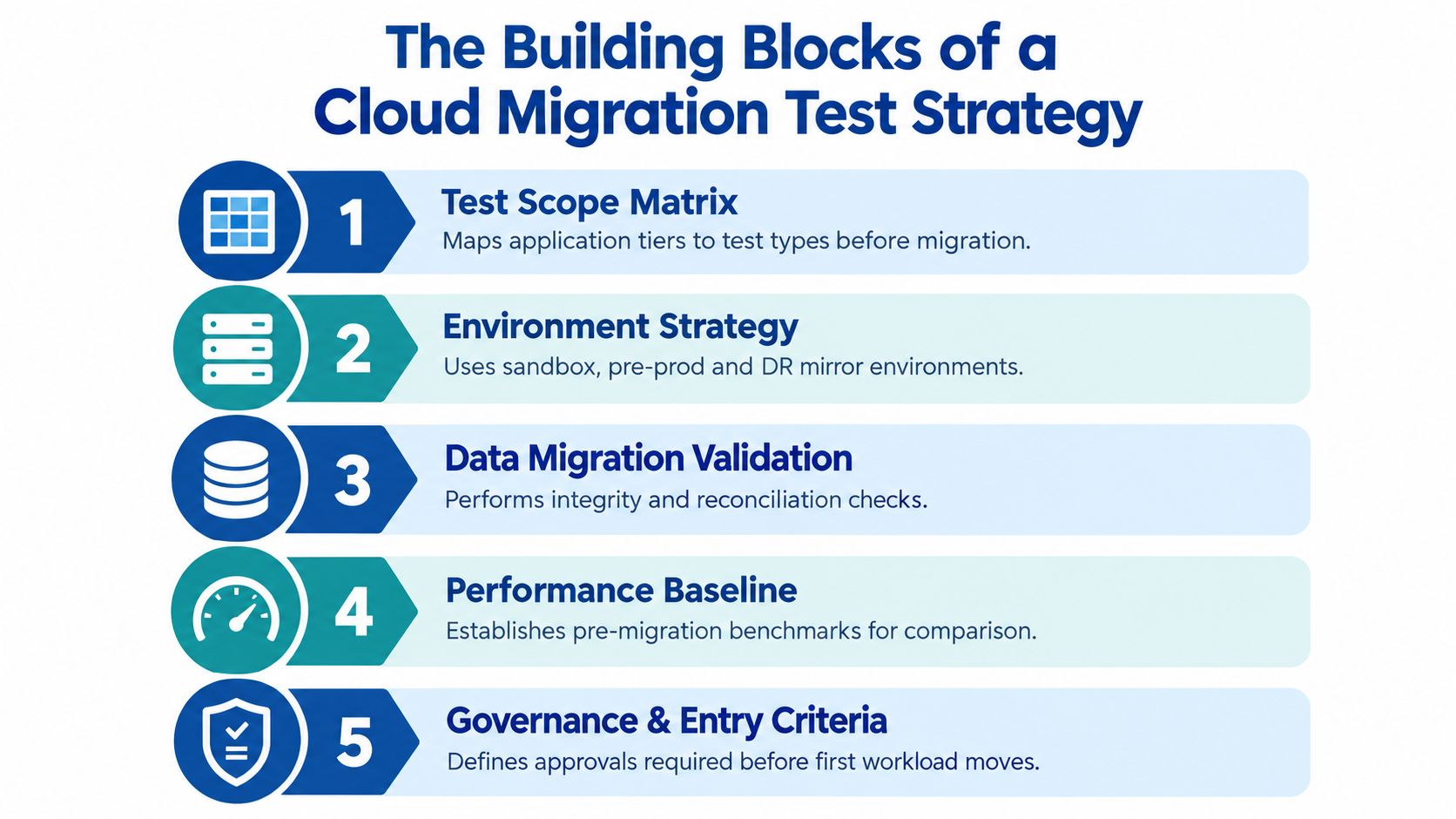
A cutover fails long before the workload moves if the test plan is thin. I anchor the plan on five pillars, because each one maps to a separate decision point for the CTO, the release manager, or the business owner. In Australia, that matters even more. Continuity, security, and sign-off discipline define whether a migration is ready.
Start with scope, not enthusiasm
The first pillar is a test scope matrix. It should map every application tier to the exact checks it must pass. Front end, API, integration, database, reporting, and identity layers fail in different ways, so one generic pass or fail box is useless.
The second pillar is an environment strategy. You need a sandbox for early proof, a pre-production environment that behaves like production, and a DR mirror in AWS or Azure where continuity exposure is real. Skip one of those environments and you invite defects to surface at cutover, when the business has the least room to absorb them.
Treat data as a test asset
The third pillar is data masking and synthetic data generation. Copying production data into lower environments creates privacy and access problems. Using fake data without realistic relationships creates false confidence. Both fail the test.
The fourth pillar is automation, ideally in CodePipeline or Azure DevOps, so every validation run follows the same path and leaves evidence you can audit. The fifth pillar is exit gates with named owners. If no one is assigned to say yes or stop the move, the gate is meaningless.
In Australian public-sector and regulated programs, that discipline lines up with the RBA's recovery expectations and the Secure Cloud Strategy controls that require cloud consumers to assess providers, services, and their own systems together. Secure Cloud Strategy for the Australian Government
Practical rule: If you can't show the evidence pack, the test didn't happen.
The Australian Government cloud strategy guidance points to risk-based decisions, public cloud by default, cloud automation, and real-time health monitoring. That is the standard to test against. Use those controls to decide what gets automated, what gets signed off, and what goes into the rollback plan. Australian Government cloud strategy guidance
For the commercial side, align the test design with migration cost reality before you lock scope. The cleanest way to do that is to bring in cloud migration services early, then set the test effort against the actual delivery plan, not an optimistic estimate. AWS migration cost considerations in Australia
Choosing the Right Test Types for AWS and Azure Workloads
The right test types depend on what can break business operations, not on what's easiest to run. On AWS and Azure programs, I focus on five categories because each one catches a different class of cutover failure. If you miss one, you tend to find the problem in production rather than in the test window.
Functional and integration tests need real failure modes
Functional testing should confirm that the migrated app still does the same job after network, identity, or routing changes. In practice, I use assertion suites in Selenium or Playwright against migrated APIs and user journeys. The failure mode to watch for is auth header drift after ALB or Front Door reconfiguration, because the app can appear alive while the session layer breaks.
Integration testing belongs just as early. Pact contract tests are useful when microservices and SaaS dependencies have to keep talking across cloud and on-premises boundaries. The failure mode here is often DNS propagation gaps, where one side resolves the new path and the other still sees the old one.
Performance, security, and data integrity each need a different lens
Performance testing has to happen against production-sized data, not a stripped-down sample. I use k6 or Azure Load Testing when I need to validate response times, queue behaviour, and service saturation under realistic demand. A common cloud-specific failure is cold-start latency on Lambda or Functions, which can look fine in a light test but hurt the business after cutover.
Security testing should include SAST, DAST, IAM posture checks, and Key Vault validation against the ISM and Essential Eight baseline. Data integrity testing should use row counts, checksums, and reconciliation against the source of truth. The failure mode that catches teams out most often is timezone-mismatched timestamps, which can corrupt reporting even when the total row count looks clean.
| Test Type | What to Measure | Common Failure Mode | AWS Tool | Azure Tool |
|---|---|---|---|---|
| Functional | User journeys, API responses, permissions | Auth header drift after routing changes | Selenium, Playwright, CloudWatch Synthetics | Selenium, Playwright, Azure Monitor |
| Integration | Contract compatibility, service handshakes | DNS propagation gaps | Pact, AWS Cloud Map | Pact, Azure DNS checks |
| Performance | Latency, throughput, saturation, cold starts | Cold-start latency on serverless | k6, CloudWatch, AWS Lambda testing | Azure Load Testing, Application Insights |
| Security | Vulnerability coverage, IAM, secrets, encryption | Weak least-privilege or stale secrets | AWS Inspector, IAM Access Analyzer | Defender for Cloud, Key Vault checks |
| Data Integrity | Row counts, checksums, reconciliation | Timezone-mismatched timestamps | AWS DMS validation, database checks | Azure Database tools, reconciliation scripts |
Running a Pilot to Cutover Sequence That Actually Works
A proper migration does not jump from test to production. It moves through gates, and each gate has an owner, a success criterion, and a reason to stop. That sequence matters more than the tool choice, because AWS Migration Hub and Azure Migrate can coordinate work, but they don't sign off risk.
The pilot should begin with a non-production workload that behaves like a production one. I want the workload lead to own the first gate, because they understand functional parity and downstream dependencies. If the pilot exposes basic application mismatch, there is no point dragging security or finance into a false go-live debate.
Use named owners, not anonymous project teams
The middle gates need different owners because the evidence is different. The security architect should sign off on control coverage, the DBA on data reconciliation, the compliance lead on regulatory fit, and the business sponsor on operational acceptance. If any of those owners are missing, the gate should repeat.
For a migration team working through the structure, I'd keep the evidence tight and decision-focused, and I'd anchor the programme in cloud computing consulting support rather than broad implementation chatter.
| Gate | Owner | Success Criterion | Failure Trigger |
|---|---|---|---|
| Pilot in non-production | Workload lead | Functional parity confirmed | Missing critical user journey |
| Integration validation | Workload lead | No high-severity interface defects | Unresolved contract break |
| Performance benchmark | Platform lead | Latency delta is acceptable against baseline | Saturation or serverless cold-start regression |
| Security review | Security architect | Control coverage accepted | Unresolved critical CVE or failed IAM review |
| Data reconciliation | DBA | Data matches source of truth | Reconciliation mismatch or timestamp error |
| Cutover approval | Business sponsor | Go/no-go memo complete | Missing sign-off artefact |
Make the artefacts non-negotiable
Every gate should produce a test report, an evidence pack, and a go/no-go memo. That keeps the discussion aligned with risk tolerance instead of vendor optimism. It also fits the Australian public-sector and regulated mindset, where sign-off has to be defensible after the fact, not just convenient at the time.
Practical rule: If a gate can't be repeated, it wasn't a gate.
I'd also keep the cadence aligned with RBA operational risk expectations and APS secure-cloud guardrails, because a cutover is only successful if the institution can explain why it was safe to proceed. The migration team shouldn't be improvising that answer on the day.
Success Criteria, Rollback Plans and Recovery-Time Testing
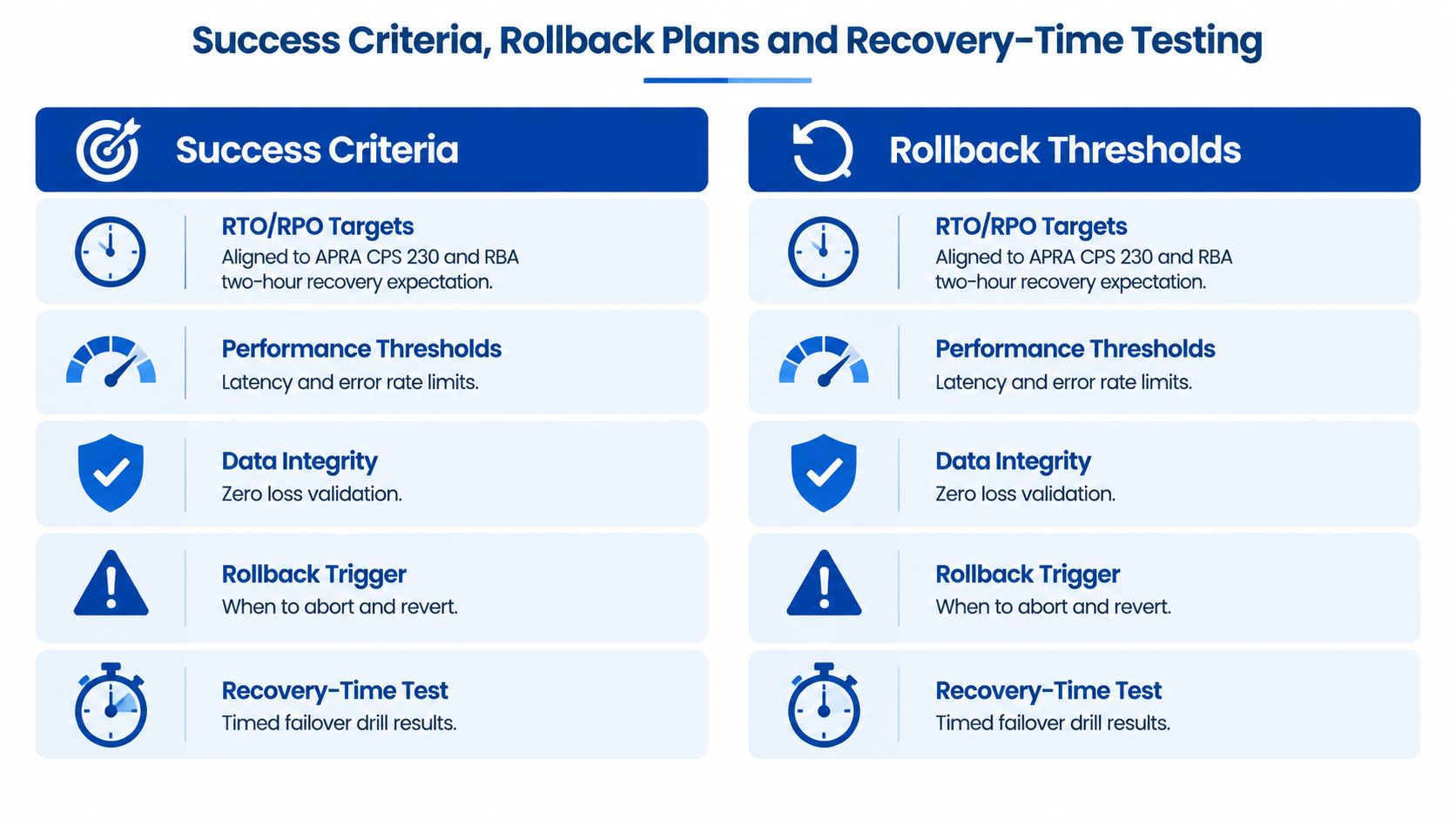
Success criteria and rollback thresholds should live on the same page. If they're separated, the cutover team starts treating rollback as a theoretical appendix instead of a real business control. That's a mistake, especially in Australia, where continuity obligations can't be waved away after the event.
The RBA highlights that public-cloud migration raises business-continuity and recovery requirements, including arrangements for critical operations to resume within two hours after an operational or security disruption and no later than end-of-day even in extreme circumstances. That means the important question is not whether the application starts. It's whether the workload can be safely rolled back, failed over, and restored within the expected recovery window under realistic disruption. RBA migration risks and regulatory requirements
Test recovery, not just forward motion
I use game-day failover drills and controlled traffic cutbacks through DNS or traffic manager tooling to prove that recovery works. The runbook needs to include DNS reversal, database restore path, secret rotation, and the comms tree, because people forget that rollback is as much an operational process as it is a technical one. Dual-running buys safety, but it also costs money, so the team should agree up front how long legacy and cloud environments stay live together.
Practical rule: A rollback plan that hasn't been rehearsed is just documentation.
I've also seen a staged cutover expose a four-hour data replication lag before customer impact, which is exactly why recovery-time testing has to sit beside data validation, not after it. That kind of lag can be invisible in a standard smoke test and obvious only when the business starts comparing old and new records during the parallel run.
Set the thresholds before the pressure starts
A useful cutover pack has three layers of decision points. First, the go-live criteria, which cover performance, integrity, and security. Second, the rollback triggers, which should include breached latency, missing data, failed control evidence, or any unresolved issue that affects customer-facing operations. Third, the post-cutover review, which records what happened, what was deferred, and what remains on the risk register.
The point is simple. A migration isn't successful because the switch was flipped. It's successful because the business can explain, with evidence, that the new operating state is safer than the old one.
Observability, Security Validation and Stakeholder Signoff
Observability has to be part of the test strategy from day one. If the dashboards only appear in the final week, the migration team is flying blind when it matters most. I want the same discipline for security validation, because the cutover environment should be judged on active evidence, not on assumptions carried over from the source system.
The baseline dashboards should cover latency, error rate, saturation, data replication lag, and a clear security posture score. In practice, that often means a mix of CloudWatch, Azure Monitor, Datadog, or Grafana, depending on the stack. The point is consistency, not tool sprawl.
Security checks need to be continuous
Security validation has to include IAM least-privilege reviews, encryption-at-rest and in-transit checks, secret rotation, and penetration testing against the new environment. For APS workloads and regulated platforms, I'd want the evidence pack to include SOC 2 or ISO 27001 reports, Essential Eight maturity evidence, and IRAP findings where applicable. The cutover should not proceed if the security evidence is vague or out of date.
If you need practical monitoring design, I'd put the observability discussion in the hands of the team that already understands production debugging and incident response, which is where enterprise application monitoring and debugging becomes relevant in a serious migration programme.
Make signoff auditable
The stakeholder signoff matrix should tie each artefact to an approver and a timestamp. That sounds bureaucratic until you're trying to prove why a production move was reasonable. The approver list should be short and obvious, usually the CISO for security evidence, the DBA for data integrity, the workload owner for service readiness, and the business sponsor for commercial acceptance.
Practical rule: If the timestamp is missing, the approval doesn't count.
The Secure Cloud Strategy guidance and the whole-of-government policy both point in the same direction, cloud use should be assessed against risk, monitored in real time, and governed with exit planning in mind. That means the signoff pack isn't an admin task. It is part of the control system.
Common Mistakes and a Cloud Migration Readiness Checklist
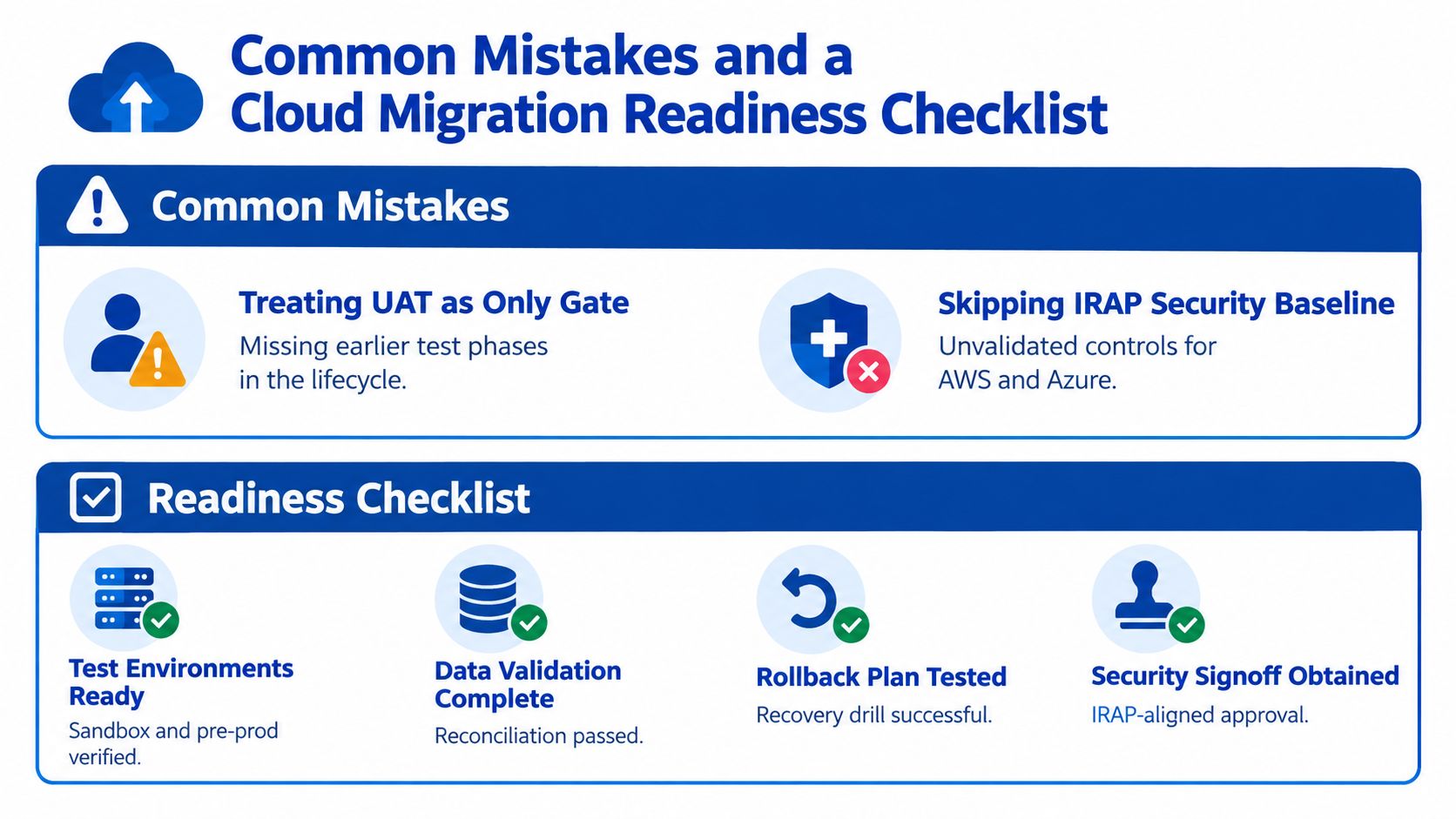
The biggest mistake I still see in Australian AWS and Azure programs is treating UAT as the only real gate. That usually shows up when project teams have green user testing but no evidence of security baseline review, no APRA-aligned assurance artefacts, and no realistic recovery drill. Another recurring problem is keeping dual-stack only in dev, which means production cutover is the first time anyone sees the integration pattern under pressure.
Skipping the RBA-aligned two-hour recovery test creates the most expensive surprise of all, because the team has never measured rollback under a real time constraint. If the business sponsor can't see the recovery evidence, they're being asked to accept risk they can't quantify. For a familiar pattern in smaller Australian environments, common AWS mistakes SMEs make covers how these errors usually start small and then compound.
Readiness checklist for cutover
- CTO, cutover readiness: Confirm the test scope matrix, gate owners, and rollback authority are signed.
- CISO, security evidence: Confirm security baseline reviews, IAM checks, encryption validation, and pen test findings are complete.
- Test lead, environments and data: Confirm sandbox, pre-prod, and DR mirror environments are usable, and reconciliation has passed.
- Business sponsor, operational signoff: Confirm service levels, monitoring, and recovery evidence match business tolerance.
- Go or no-go box: Confirm observability dashboards are live, RTO and RPO have been demonstrated, and stakeholder signoff is captured.
The cleanest next step is either a migration consultancy-led readiness assessment or a two-week internal pilot on a non-critical workload. I'd choose the pilot if the team already has decent cloud maturity and the assessment if the migration touches compliance-heavy or customer-facing services. Either way, the framework above should be used before the first production workload moves.
If you're planning an AWS or Azure cutover, Continuum Solutions can help you build the test strategy, evidence pack, and rollback plan before the first workload moves. We design migration programs around observability, integration, and recovery evidence, then help teams prove readiness with practical testing and signoff. Visit Continuum Solutions to start a readiness review for your migration.