
If you’re planning an app right now, you’re probably dealing with a familiar mix of pressure and ambiguity. The board wants a budget. Operations wants workflow fixes. Sales wants customer visibility. Your internal team wants to know whether this is a mobile product, a systems integration project, or both.
That tension is why hiring mobile app developers in Melbourne isn’t a simple vendor search. It’s a capital allocation decision. The wrong team can leave you with an expensive interface sitting on top of fragile APIs, unclear ownership, and a release process nobody can support six months later. The right team can turn the app into a durable business asset that fits your architecture, compliance obligations, and growth plans.
Table of Contents
- Why Your Choice of Mobile Developer Defines Project Success
- Defining Your App Project and Choosing a Hiring Model
- Budgeting and Timeline Benchmarks for Melbourne Apps
- How to Shortlist and Vet Potential App Developers
- Key Technical and Compliance Considerations in Australia
- Partnering with Continuum for Reliable App Development
Why Your Choice of Mobile Developer Defines Project Success

A lot of app projects fail long before the first line of production code. They fail in procurement, when a business treats development as a commodity purchase and compares vendors only on price, mock-ups, or promised speed.
Melbourne offers choice, not certainty
Australia’s smartphone app developers industry is projected to reach 667 businesses in 2026, growing at a 4.4% compound annual rate to a $2.8 billion AUD market size, according to IBISWorld’s Australian smartphone app developers industry data. That sounds positive, and it is. But it also means Melbourne buyers face a crowded field with very different levels of process maturity, engineering depth, and post-launch support capability.
Some teams are strong at interface design but weak on backend architecture. Others can ship code but don’t have a disciplined QA approach across real devices. Some can build an MVP quickly, then struggle when the app needs identity management, payments, CRM sync, analytics, or operational reporting.
Practical rule: if your app touches revenue, customer data, staff workflows, or external systems, you’re not just buying screens. You’re buying architecture decisions that will affect cost, speed, and risk for years.
Melbourne businesses usually don’t need the flashiest agency. They need a delivery partner that can translate business requirements into a stable release process, a maintainable codebase, and a cloud setup your team can operate. That’s the difference between a pilot that stalls and a product that earns continued investment.
The real selection criteria are commercial
When I assess mobile app developers in Melbourne for clients, I don’t start with visual design. I start with questions like these:
- Can they transparently scope uncertainty: If a team gives fixed answers too early, they may be pricing blind risk into the project or hiding it.
- Can they handle integration complexity: Many app failures come from weak API design, brittle data flows, or unclear ownership between systems.
- Can they support the app after launch: A release without monitoring, triage, and maintenance isn’t finished.
- Can they work with business stakeholders: CTOs, operations managers, and founders need structured decision-making, not vague updates.
If you want a concrete example of what mature delivery looks like in practice, review this ClubScout project case study. The useful signal isn’t that an app was launched. It’s how the underlying platform and business model were supported.
Defining Your App Project and Choosing a Hiring Model
Most hiring mistakes start with a scope document that’s really just a feature wish list. Before you speak with developers, get clear on the business problem, the operating model, and what the first release must prove.
Define the problem before you define the app
Write your brief around outcomes, not screens. Good examples include reducing manual booking administration, giving members self-service access, improving field staff data capture, or replacing fragmented spreadsheets and email workflows.
Your initial definition should cover:
- Business objective: What process or revenue line is this app meant to support?
- Primary users: Customers, staff, members, contractors, franchisees, or a mix.
- Core actions: What are the few things users must be able to do reliably?
- System dependencies: CRM, ERP, payments, identity, inventory, scheduling, or reporting tools.
- Operational constraints: Privacy obligations, approvals, release windows, and support expectations.
That level of definition helps you decide whether you need a true mobile build, a progressive web app, or a staged rollout that starts with a web-based operational layer. In some cases, a Progressive Web App approach is the better commercial decision if offline capability and native device features aren’t central to the first release.
Compare the four hiring models properly
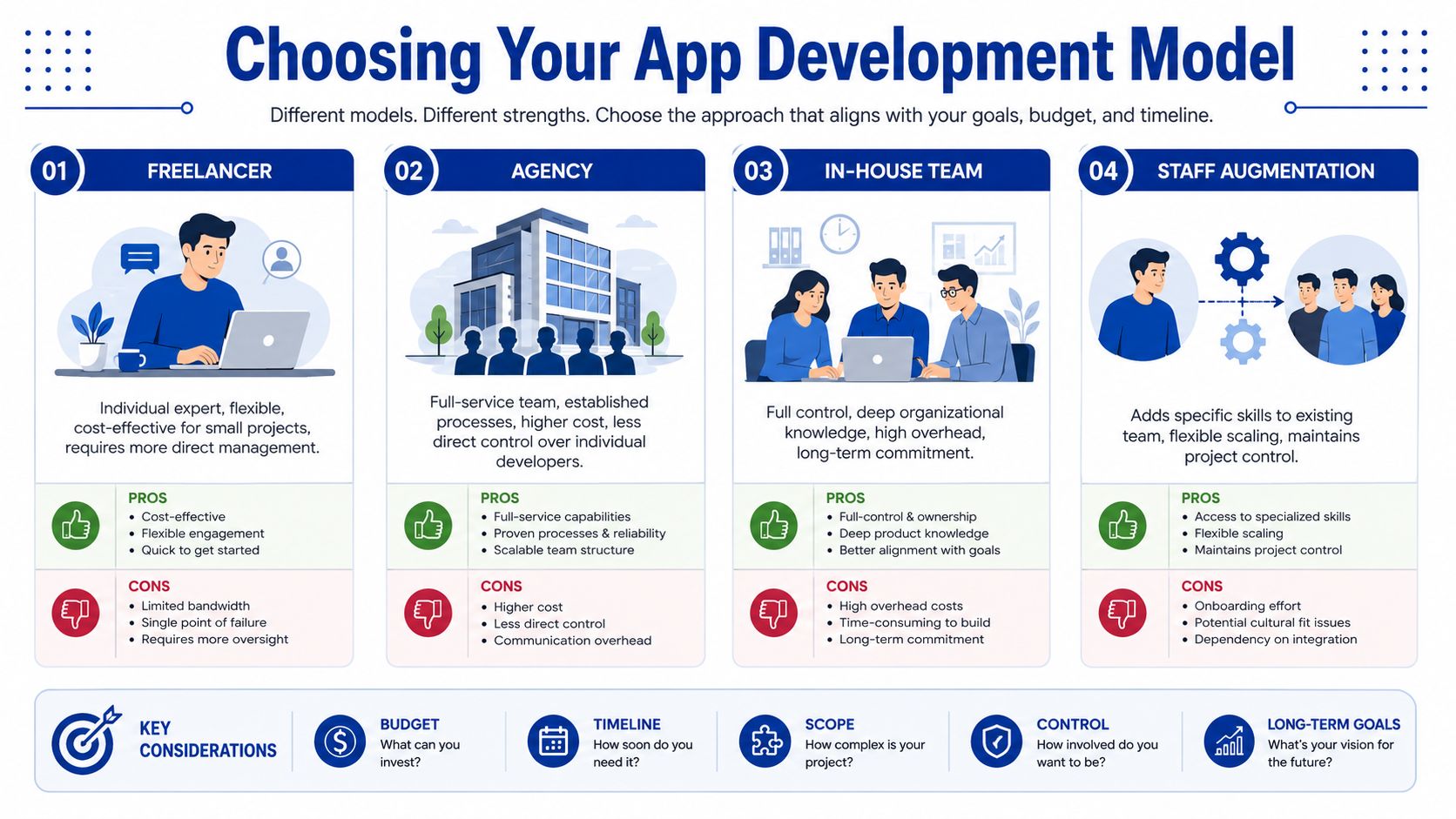
The right hiring model depends on your internal capability, speed requirements, and how much delivery risk you can absorb.
| Model | Best fit | Main advantage | Main drawback |
|---|---|---|---|
| Freelancer | Small, tightly scoped builds | Lower upfront cost and direct access | High dependence on one person |
| Agency | End-to-end delivery | Structured team, QA, design, delivery process | Higher cost than solo contractors |
| In-house team | Long-term product organisations | Internal control and knowledge retention | Recruiting, payroll, and management overhead |
| Staff augmentation | Existing internal product team | Adds specialist capability without replacing your team | You still need internal delivery leadership |
An in-house model sounds attractive until you price it realistically. In Australia, total annual pay typically ranges from AUD $125,000 to $140,000 for an Android developer and AUD $115,000 to $135,000 for an iOS developer, based on Business of Apps salary benchmarks for Australia. That doesn’t include the wider delivery function you still need, such as product leadership, QA, design, DevOps, and release management.
A single developer is not a delivery system. If you hire in-house, you also need process, architecture oversight, testing discipline, and someone accountable for business alignment.
What usually works in practice
For most Melbourne organisations building a business-critical app, the practical choice is either an agency or a hybrid model. The hybrid model usually means keeping product ownership, operational knowledge, and prioritisation in-house while using an external team for engineering, cloud architecture, QA, and release support.
Freelancers can work well for contained tasks, interface updates, or specialist remediation. They are a riskier primary model when the app needs integrations, compliance review, app store readiness, and ongoing support.
In-house teams make more sense when mobile is a long-term product capability, not a one-off project. If your roadmap includes continuous releases, multiple squads, and direct ownership of product IP and workflows, in-house can be justified. If not, outsourced delivery is often the more commercially stable decision.
Budgeting and Timeline Benchmarks for Melbourne Apps
A Melbourne business usually hits budget trouble at the same point. The first estimate is approved on the strength of a feature list, then the actual work appears. Integration rules, security reviews, test coverage, app store preparation, and internal stakeholder changes all push the original number.
That is why budgeting needs to be tied to delivery risk, not just screens.
What the Melbourne cost ranges actually mean
If you review market benchmarks for app development in Melbourne, the useful question is not “what does an app cost?” but “what level of operational complexity are we funding?” External benchmarks vary, but they broadly place a simple app at AUD 30,000 to 60,000, while complex or enterprise-grade apps with advanced integrations can cost AUD 120,000 to over 250,000, with timelines of 6 to 12 months according to Appinventiv’s Melbourne mobile app cost guide. A focused MVP can start around AUD $40,000, while enterprise platforms can begin at AUD $300,000+, as noted by EB Pearls’ Melbourne app development cost overview.
Those ranges only help if scope is defined properly. A lower-cost app usually has limited user roles, predictable workflows, light backend logic, and very few dependencies. Costs rise fast once the app needs approvals, payments, document handling, CRM or ERP sync, audit logs, field data capture, or custom reporting.
Melbourne App Development Cost & Timeline Benchmarks 2026
| App Complexity | Typical Cost Range (AUD) | Estimated Timeline |
|---|---|---|
| Simple app | AUD 30,000 to 60,000 | Shorter timeline, depending on scope |
| Mid-level product | AUD 60,000 to 120,000 | Varies by features and integrations |
| Complex or enterprise-grade app | AUD 120,000 to over 250,000 | 6 to 12 months |
| Focused MVP | From AUD 40,000 | Depends on release scope |
| Enterprise-grade platform | From AUD 300,000+ | Depends on architecture and integration complexity |
Where budgets usually blow out
The expensive part of mobile delivery is often the work buyers cannot see in a prototype.
- Backend and integration work: Connecting the app to CRMs, ERPs, booking systems, payment gateways, or internal databases adds architecture effort, edge-case handling, and regression testing.
- Permissions and workflow rules: Cost increases when different user groups need different actions, approvals, visibility rules, and escalation paths.
- Security and compliance controls: Consent records, access logging, data retention rules, and secure authentication add design and testing overhead.
- Release readiness: Device testing, app store submissions, crash monitoring, analytics, and rollback planning all take time.
- Operating environment: Hosting, push notifications, file storage, identity management, and support processes affect both build cost and ongoing spend.
One budgeting method works well in practice. Split the project into three commercial stages: discovery and architecture, build and QA, then launch and support. That structure makes procurement easier, gives stakeholders clearer approval points, and lets you reduce scope without weakening the parts that matter most.
If two proposals come in far apart on price, compare assumptions line by line. In many cases, the cheaper quote excludes architecture definition, test planning, deployment, warranty support, or integration complexity. The higher quote may still be poor value, but the gap is rarely explained by efficiency alone.
How to Shortlist and Vet Potential App Developers
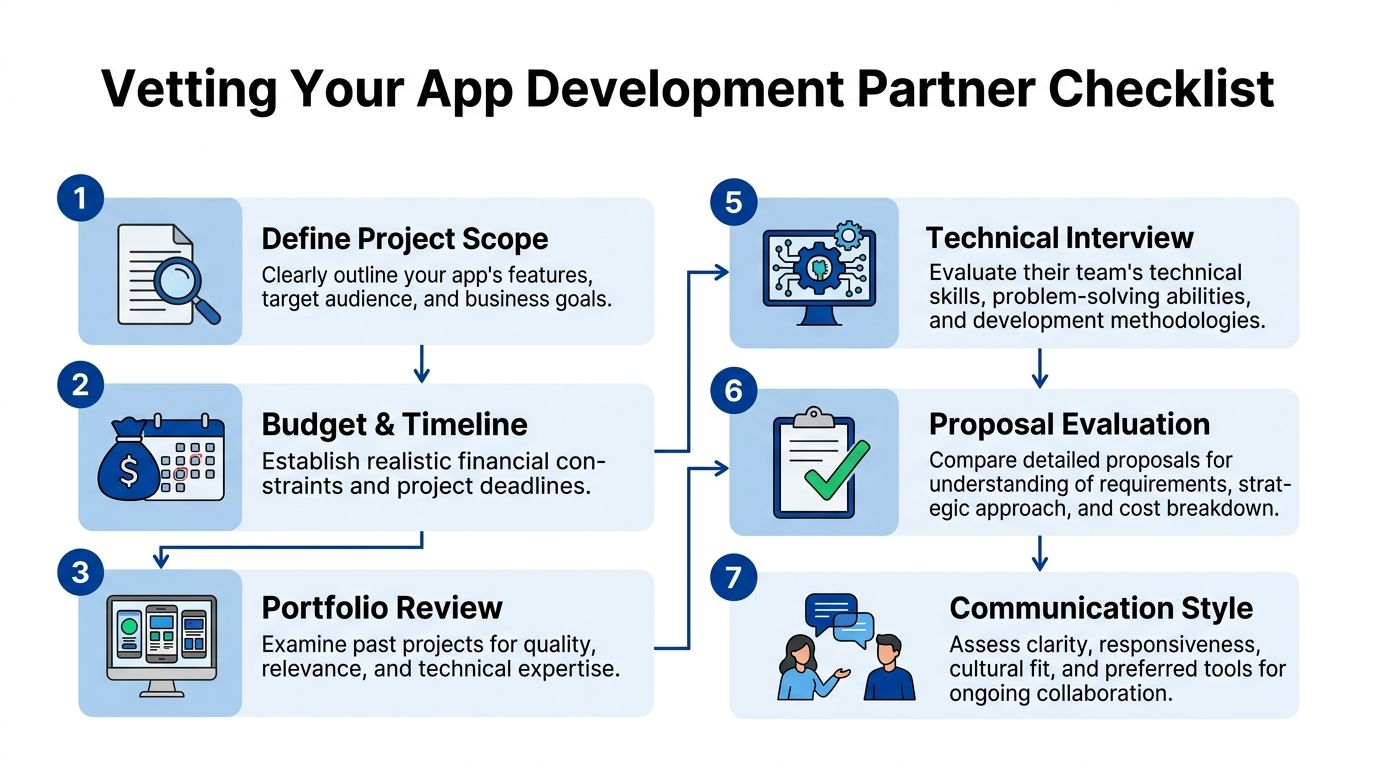
Once you’ve framed the problem and set a budget range, the next task is reducing risk. Most buyers still shortlist app developers on portfolio style and headline price. That’s not enough for a business system that will touch customer data, operations, and internal reporting.
What to review before you request proposals
Start with evidence of work that resembles your level of complexity, not your exact industry. A healthcare booking app and a field service app may serve different sectors, but both can reveal whether a team understands role-based access, scheduling logic, notifications, and data integrity.
Look for these signals in a portfolio review:
- Business relevance: Did the project solve an operational problem, not just present a polished interface?
- Integration depth: Is there evidence of API work, cloud architecture, payment handling, or authentication?
- Platform thinking: Can they explain why they used Flutter, React Native, Swift, Kotlin, AWS, or another stack?
- Post-launch maturity: Do they mention monitoring, maintenance, release support, or technical handover?
Client references matter more when you ask operational questions. Ask whether the team was responsive during ambiguity, whether defects were handled properly, and whether scope changes were managed commercially rather than emotionally.
Questions that expose delivery risk
The best vetting questions aren’t theatrical technical tests. They’re practical prompts that reveal how a team works under real constraints.
- How do you run discovery and specification? If the answer is vague, that’s a problem.
- Who will work on the project? You need role clarity, not just sales-led confidence.
- How do you test across iOS and Android devices? Real-device QA is materially different from simulator-only checks.
- How do you manage cloud environments and releases? Development, staging, and production discipline matters.
- What happens after launch? Support windows, monitoring, defect triage, and ownership should be explicit.
If the team has a mature engineering practice, they should also be comfortable discussing monitoring and debugging tooling. A partner that understands enterprise application monitoring and debugging usually has a more realistic view of what production support involves.
Why discovery should be paid and structured
The strongest red flag in this market is a supplier willing to skip discovery and jump straight into build. Melbourne firms that skip a structured discovery phase face a 65% higher rate of post-launch defects and a 40% increase in total cost, while projects that invest 15% to 20% of budget in discovery achieve a 92% success rate in meeting initial business objectives, based on Classic Informatics’ Australia-focused app development guidance.
That tracks with what experienced buyers already know. Discovery isn’t paperwork. It’s where architecture, scope boundaries, technical unknowns, integrations, and business rules get surfaced before they become expensive rework.
Pay for discovery when the app matters. It’s cheaper than paying for misunderstandings in build, testing, and support.
Key Technical and Compliance Considerations in Australia
Technology selection for a Melbourne app shouldn’t start with trend preference. It should start with your operating constraints, support model, integration environment, and compliance exposure.
Choose the stack based on operating reality
For many business apps, cross-platform delivery is the sensible starting point. Melbourne projects using Flutter or React Native backed by AWS have been associated with 99% uptime targets, according to Esferasoft’s Melbourne mobile app benchmark summary. That combination can work well when you need one product roadmap across iOS and Android without funding two separate native teams.
But cross-platform isn’t automatically easier. The same benchmark summary points to common pitfalls, including poor Material Design compliance causing 35% of Android UI rejections and inadequate technical debt planning leading to 50% of performance regressions. In practice, that means the framework isn’t the problem. The delivery discipline is.
Use Swift or Kotlin when platform-specific behaviour, deep native integrations, or strict performance requirements justify the added investment. Use Flutter or React Native when shared business logic, faster iteration, and lower parallel maintenance overhead matter more.
Cloud, integration and observability matter early
A mobile app is usually the visible layer of a broader system. The hidden work sits behind it in APIs, authentication, event flows, logging, and cloud services.
For Australian businesses, it’s usually sensible to host core workloads in local AWS or Azure regions when privacy, latency, and governance matter. Teams should also decide early how the app will authenticate users, store files, synchronise data, and recover gracefully when upstream systems fail.
Good technical planning also includes:
- API ownership: Someone must own the contracts, versioning, and error handling.
- Environment discipline: Separate development, staging, and production workflows reduce release risk.
- Observability: Sentry, New Relic, uptime monitoring, and structured logs make post-launch support manageable.
- Technical debt planning: If you defer refactoring decisions, record them and assign ownership.
For teams comparing frameworks, a practical starting point is this Flutter vs React Native comparison. The useful question isn’t which framework wins in theory. It’s which one fits your release model, internal capability, and long-term maintenance expectations.
Compliance can’t be bolted on later
If your app collects personal information, handles member records, connects to payment systems, or exposes business data to field staff, legal and governance questions need to be handled from the start.
At minimum, your development partner should be able to discuss:
- Australian Privacy Act obligations
- Australian Privacy Principles
- Consent and data handling flows
- Access controls and auditability
- Consumer Data Right considerations where applicable
- IP ownership, support obligations, and handover terms
These aren’t abstract legal details. They shape architecture, data retention, roles, permissions, and vendor contracts. A team that treats compliance as a final review step usually creates expensive rework.
Partnering with Continuum for Reliable App Development
A Melbourne business owner usually reaches this stage after the first round of agency calls. The proposals look similar, the rates vary widely, and every firm says it can build the app. The harder question is whether the partner can carry the work from discovery into delivery, then support it once real users, internal systems, and compliance obligations start putting pressure on the product.
What a dependable delivery model looks like
For Melbourne organisations, a mobile app partner should do more than produce screens and push builds to the app stores. Business apps usually depend on APIs, identity systems, reporting, cloud hosting, and post-release support processes. If those pieces sit with different vendors and no one owns the whole delivery path, delays and blame-shifting follow.
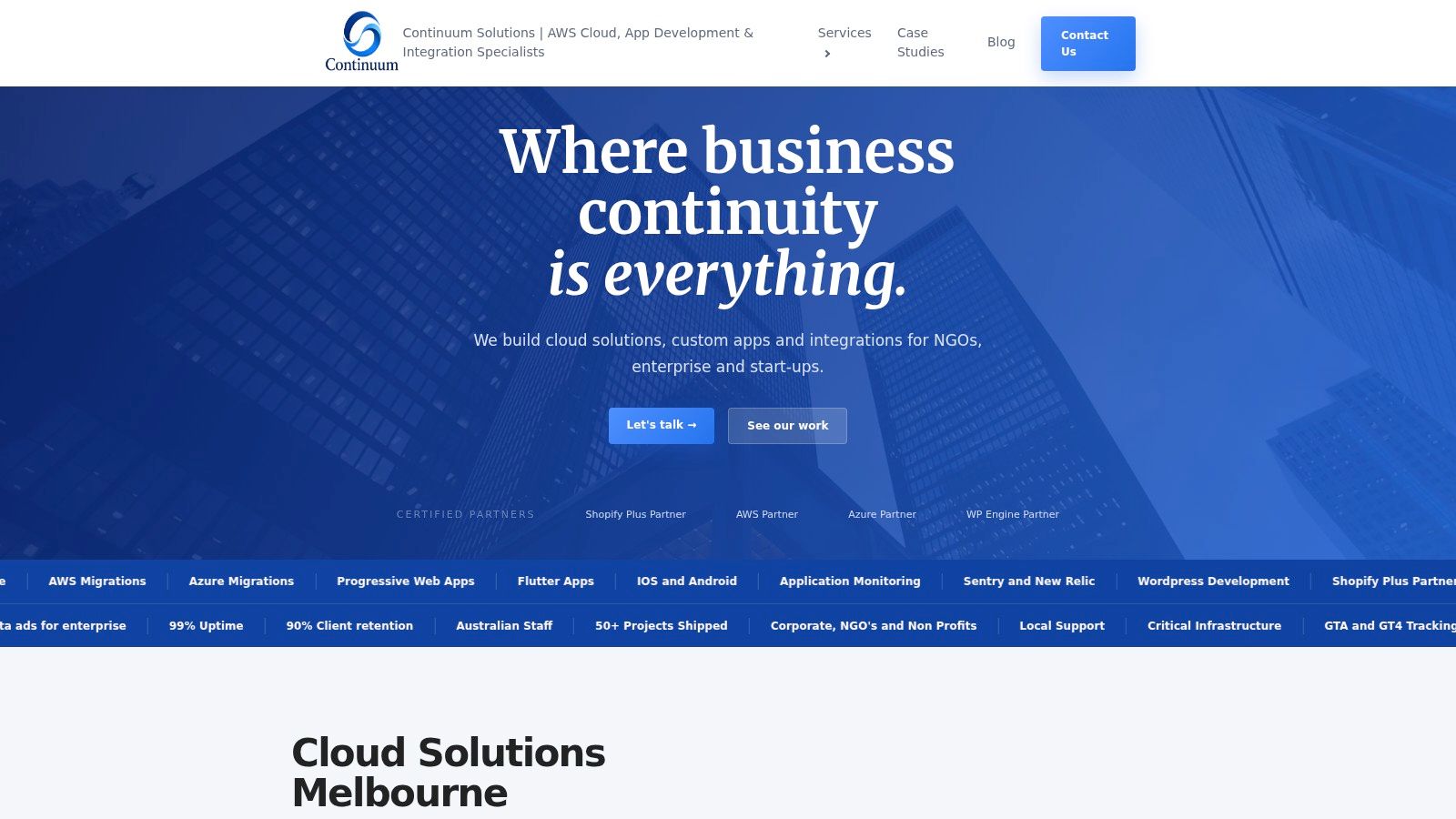
Continuum Solutions is one example of a Melbourne consultancy working in that broader model. Its delivery scope includes cross-platform iOS and Android development with Flutter or React Native, cloud architecture across AWS and Azure, API integration work, monitoring, and structured handover. That model suits organisations where the app supports operations, field teams, customers, or members, rather than serving as a short-lived marketing asset.
A reliable project has continuity from planning through support. The team shaping the architecture should also understand release risk, production support expectations, and the business systems the app depends on.
Why this matters for Melbourne organisations
This matters most when the app has consequences beyond the mobile interface. A charity may need donor or member data handled correctly. A services business may need staff authentication tied to internal platforms. A growing company may need the app to fit existing reporting, CRM, or workflow tools without creating another isolated system to maintain.
The practical value is straightforward. Senior teams usually make clearer trade-offs on scope, framework choice, and release sequencing. Smaller delivery groups with direct technical leadership also reduce the communication gaps that often appear in larger agency structures. That does not mean the cheapest option wins. It means the partner should be able to explain where complexity sits, what should be phased, and what support model will be needed after launch.
For a Melbourne CTO or business owner, that is the standard to use in partner discussions. Assess whether the team can connect commercial goals, architecture decisions, compliance responsibilities, and ongoing ownership before the build starts.
If you’re assessing app delivery options and want a commercially grounded view of scope, architecture, integrations, and support, Continuum Solutions is a practical place to start. The first useful conversation is not about a fast quote. It is about business outcomes, system dependencies, delivery risk, and the level of reliability your organisation expects.