You’re probably weighing the same tension most Australian founders, CTOs, and business owners face at the start of a product initiative. The idea is commercially strong. The internal stakeholders are interested. The problem is that a full build feels like a large bet before you’ve proved customer demand, integration feasibility, operating cost, or compliance fit.
That’s where MVP development services matter. Not as a startup cliché, and not as a way to build something cheap, but as a disciplined way to reduce risk while preserving momentum. In practice, a well-run MVP lets you answer the questions affecting investment decisions: Will users adopt it? Can the core workflow be delivered without major technical compromise? Can the platform run in an Australian compliance context without creating expensive rework later?
For Australian organisations, those questions are sharper than they look. Local data residency, the Privacy Act 1988, operational budget limits, and the need to integrate with systems like Xero, Salesforce, Shopify, HubSpot, or internal line-of-business tools all shape whether an MVP is viable. The build itself is only part of the equation. The architecture and delivery model are what determine whether the MVP becomes a usable platform or an expensive prototype that has to be rebuilt.
Table of Contents
- Beyond the Idea The Case for Strategic MVP Development
- What an MVP Is and Why It Matters Strategically
- The Phased MVP Development Process from Discovery to Launch
- Understanding MVP Pricing and Timeline Models in Australia
- Critical Technical Architecture Choices for Your MVP
- Common MVP Risks and How to Mitigate Them
- How to Evaluate and Select an MVP Development Partner
Beyond the Idea The Case for Strategic MVP Development
A common scenario looks like this. A business sees a gap in the market, often around bookings, subscriptions, member access, quoting, field operations, or customer self-service. Someone sketches the end-state platform with every desirable feature included. Native mobile apps, dashboards, admin tools, payments, notifications, reporting, CRM sync, marketing automation. The list is logical. It’s also where projects start to fail.
Large all-at-once builds create two risks at the same time. First, market risk. You may build capabilities customers don’t value. Second, delivery risk. Each added feature increases cost, testing load, integration complexity, and post-launch support pressure. That’s why the “build everything first” approach usually burns budget before it produces useful evidence.
An MVP works differently. It narrows the question. Instead of asking, “Can we build the complete platform?”, it asks, “What’s the smallest production-grade version that proves this business should continue investing?”
Australian businesses are increasingly making that shift. Between 2018 and 2023, the share of Australian startups launching via an MVP rose from 38% to 62%. Among these, 45% reduced time-to-market by at least four months, and 32% cut early development costs by 30-50%, according to analysis published via the Australian MVP adoption data referenced in this guide.
What this looks like in a real business setting
A Melbourne business launching a member platform doesn’t need the full loyalty engine, referral system, advanced reporting suite, and multi-role administration on day one. It needs the core loop to work. Sign-up, profile creation, search or browse, booking or purchase, payment, confirmation, and enough analytics to learn where users stall.
That’s the difference between a validation build and a wish-list build.
A practical local example is the kind of phased digital delivery shown in this Club Scout case study, where the product direction is tied to measurable rollout rather than speculative feature volume. That’s the commercial logic behind good MVP development services. You’re buying evidence, not just code.
Practical rule: If a feature doesn’t directly help you validate demand, complete a core transaction, or reduce immediate operational risk, it usually belongs after launch.
Why the strategic framing matters
An MVP is often misunderstood as a startup tactic. It’s more useful to treat it as an investment filter.
That matters whether you’re a funded startup, an established SME modernising a process, or an NGO replacing a legacy workflow. In each case, the early product must answer a small number of high-value questions:
- Customer fit: Will a target user complete the core journey?
- Operational fit: Can your team support the workflow without manual workarounds taking over?
- Technical fit: Can the chosen architecture handle launch conditions without creating preventable rework?
- Financial fit: Does the first release justify the next tranche of spend?
If you can’t answer those questions quickly, the build isn’t de-risking anything. It’s just delaying the moment you discover what should have been tested first.
What an MVP Is and Why It Matters Strategically
An MVP is not a rough prototype, a clickable demo, or a deliberately underbuilt version of the final product. It is a production-ready release with the minimum feature set needed to solve one clear problem for one clear user group.
That definition matters because many teams confuse “minimum” with “low quality”. They’re not the same. A proper MVP should still have reliable authentication, coherent UX, error handling, analytics, and a supportable deployment path. What it removes is unnecessary scope, not engineering discipline.

What an MVP is not
A lot of bad decisions come from using the same label for very different deliverables.
| Deliverable | What it proves | Where it falls short |
|---|---|---|
| Proof of concept | Technical feasibility | Doesn’t prove users want it |
| Prototype | User flow and interface direction | Usually not production-ready |
| Beta | Broader release testing | Often assumes the product direction is already set |
| MVP | Whether a real user will adopt a core solution in a live environment | Doesn’t answer every future scaling or feature question |
If you need investor conversations, internal buy-in, or customer validation, the MVP is usually the first version that carries commercial weight. It creates evidence from real use, not internal opinion.
Why viable matters more than minimum
The word “viable” does the heavy lifting. A viable product has to complete a job end-to-end. For a booking app, that might mean account creation, availability display, payment, confirmation, and admin visibility. For a B2B SaaS tool, it might mean onboarding, one core workflow, and reporting on that workflow. For a field operations app, it may mean job assignment, mobile data capture, and a supervisor review screen.
A thin but complete workflow is more valuable than a broad but unreliable one.
That’s why teams investing in custom web development for operational or product platforms usually get better results when they define one measurable user outcome and build around it. The MVP should answer a business hypothesis such as:
- Users will complete self-service onboarding without staff assistance
- Customers will pay for faster digital booking instead of phone-based processing
- Internal teams will replace spreadsheets with a dedicated workflow
- Members will return to the platform if the core action is simple enough
The best MVPs don’t try to impress everyone. They solve one painful problem well enough that real users change behaviour.
Strategically, that’s why MVP development services are useful. They turn early software investment into a testable commercial decision, rather than a drawn-out implementation based on assumptions.
The Phased MVP Development Process from Discovery to Launch
A strong MVP project doesn’t move from idea straight into code. It moves through controlled stages, each with a decision point. That’s what keeps the product commercially aligned when pressure starts building for “just one more feature”.
Discovery and strategy
At this stage, the project either becomes clear or goes off track. Discovery should identify the user segment, the core workflow, the operational constraint, and the success signal you’ll measure after launch. If you skip this, the backlog fills with opinions instead of priorities.
Typical outputs at this stage include:
- Business hypotheses: What must be true for the product to justify further investment
- User journeys: The shortest path from entry to value
- Scope boundaries: What is excluded from the first release
- Technical direction: Web, mobile, PWA, cross-platform app, integration requirements, and cloud approach
For Australian businesses, this is also when compliance questions should surface. If personal information is involved, you need to think about storage location, consent flows, third-party processors, and auditability early, not after launch.
UX and clickable prototyping
Before engineering starts, the team should test how the product feels. A clickable prototype won’t prove market demand on its own, but it will expose confusing workflows, missing screens, and unnecessary steps.
That saves money because UX corrections in Figma are far cheaper than corrections after development begins. It also helps stakeholders agree on what the MVP includes.
Iterative development sprints
Many outsourced projects commonly drift. Teams often try to build too much in parallel. The better pattern is to ship the backbone first. Authentication, core data model, primary workflow, admin visibility, analytics, and deployment.
There’s strong evidence for keeping the first scope tight. Analysis of Australian MVPs shows that products shipping in 8-12 weeks with 3-5 core features achieve a median time-to-first-paying-user of 47 days, versus 92 days for MVPs with 8+ features, and experience 30-40% fewer critical defects, according to Australian MVP scope and defect analysis.
That result matches what experienced delivery teams already know. Narrow scope improves learning velocity and reduces the number of production issues caused by too many moving parts.
Quality assurance and integration discipline
QA in an MVP isn’t optional. It’s focused.
You don’t need enterprise-scale test coverage for every possible future use case. You do need confidence in the core path. Login, role permissions, payments, forms, notifications, mobile behaviour, and failure states all need testing. If the platform integrates with other business systems, those touchpoints need contract clarity as well. Teams delivering custom integrations between cloud apps and internal platforms know that the integration itself is often where scope and support cost expand fastest.
A fragile integration can turn a clean MVP into an expensive support problem within weeks of launch.
Launch and learn
Launch isn’t the finish line. It’s the first live test.
A commercially sound launch should include analytics, structured logging, uptime monitoring, and a clear decision framework for what happens next. Do you extend the product, rework the workflow, add automation, or pause investment? Without those signals, the MVP becomes anecdotal instead of measurable.
The best phased process gives you something more valuable than a release date. It gives you clean points to stop, continue, or change direction before too much capital is committed.
Understanding MVP Pricing and Timeline Models in Australia
The most common budgeting mistake in MVP work is asking for a single fixed number before the scope is stable. That usually produces one of two outcomes. Either the estimate is padded to absorb uncertainty, or the quote looks attractive and the variation costs arrive later.
For most Australian businesses, the more useful question is not “What’s the cheapest way to build this?” It’s “What pricing model gives us enough control without locking us into bad assumptions?”
What a realistic MVP budget looks like
There is useful Australian benchmark data here. The median cost for a professionally built Australian MVP in 2022 ranged from AUD 45,000 to AUD 90,000; 68% of Australian MVP projects stayed within 120% of their original budget, compared to only 44% for non-MVP projects, according to Australian MVP cost and budget predictability data.
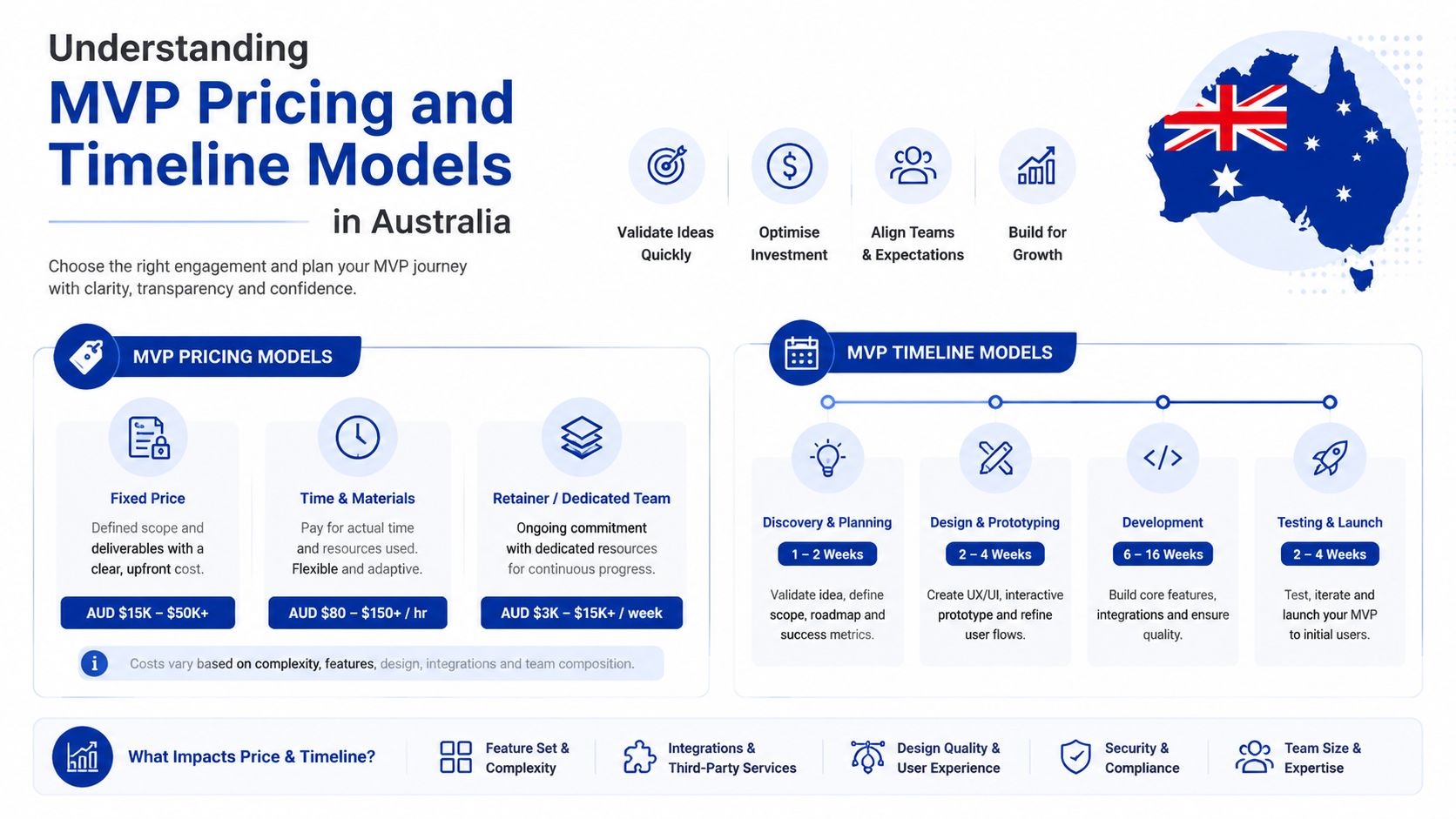
That range is broad because the term MVP covers very different projects. A simple internal workflow tool is not the same as a customer-facing mobile app with payments, identity, admin dashboards, and third-party integrations.
The variables that move cost up or down
A useful way to assess pricing is to look at the cost drivers that matter most.
| Cost driver | Lower complexity | Higher complexity |
|---|---|---|
| Platform choice | Single web app or PWA | Web plus mobile app delivery |
| Authentication | Basic email login | Role-based access, SSO, external identity |
| Data model | Simple entities and workflows | Complex permissions, audit trails, multi-tenant logic |
| Integrations | Minimal external services | CRM, ERP, payments, analytics, auth, support systems |
| Operational needs | Light admin tooling | Rich admin console, reporting, exports, support workflows |
This is also where architecture and hosting decisions start affecting total cost of ownership. A build estimate that ignores cloud spend, observability, support, and future refactoring isn’t a complete estimate.
If you’re already looking at platform hosting and migration implications, guides on AWS migration cost in Australia are useful because they frame delivery as build cost plus operating cost, not build cost alone.
Fixed price versus time and materials
For MVP development services, time and materials is often the better commercial model once discovery is complete. That’s because MVPs are designed to learn from evidence, and evidence changes priorities.
A fixed-price build can work when the workflow is very stable, the integration map is simple, and everyone agrees on a rigid scope. But that same rigidity becomes a problem when you discover a feature doesn’t matter, or when one missing workflow turns out to be essential.
Time and materials tends to suit MVPs better when:
- The product is new: You don’t yet know which user behaviour will matter most
- Stakeholders need flexibility: The roadmap may change after prototype reviews or early usage
- Integrations are uncertain: External systems often introduce hidden complexity
- The business wants staged decisions: You can stop after discovery, prototype, or first release if the evidence says you should
Commercial view: The cheapest quote is often the one that assumes the most and reveals the least.
Timeline expectations
Timelines depend on scope quality more than raw team size. A well-scoped MVP with one clear workflow can move quickly. A poorly scoped MVP with too many dependencies won’t, even with more developers assigned.
For decision-makers, the useful benchmark is whether the partner can show how scope, technical choices, and approval cadence affect time. If they can’t explain that clearly, the schedule is probably optimism, not planning.
Critical Technical Architecture Choices for Your MVP
The fastest way to create future rework is to treat the MVP architecture as disposable. It isn’t. Early choices around cloud region, app model, data flow, and observability shape performance, compliance, and operating cost long after the first release.
That doesn’t mean over-engineering. It means making a small number of decisions correctly the first time.
Start with Australian hosting realities
For products aimed at Australian users, region choice matters immediately. Using the AWS Sydney region for an MVP backend can reduce median API latency to ~25-40ms for domestic users. A serverless stack in this region can deliver 99.5-99.9% uptime for early-stage traffic (10k-50k MAU) with costs in the A$500-A$2,500/month range, according to AWS Sydney region MVP performance and cost guidance.
That’s not just a performance issue. It’s a business issue. Faster response times improve the feel of high-interaction products, especially mobile-first apps. Local hosting also makes data residency conversations simpler when you’re dealing with personal information and Privacy Act considerations.
Choose an application model that fits the first release
A lot of teams rush into native iOS and Android apps because it feels more complete. Often that’s premature.
In many MVPs, a Progressive Web App or a responsive web platform is the right first move. It reduces platform overhead, simplifies release management, and gets real users onto the product faster. If the product depends on deeper device features, offline workflows, or app-store distribution, then Flutter or React Native may be the better path. The decision should come from the user journey, not from habit.
If the hosting question is still open, comparisons like AWS Lightsail vs EC2 vs ECS are useful because they expose the trade-off between simplicity, flexibility, and operational control. That trade-off matters even at MVP stage.
Why serverless often makes commercial sense
For Australian MVPs, a serverless backend is frequently the most sensible starting point. Services such as AWS Lambda, API Gateway, DynamoDB, Aurora Serverless, and managed authentication reduce infrastructure management load. That keeps the technical team focused on product learning rather than server maintenance.
Serverless isn’t perfect. Cold starts, vendor-specific patterns, and workload fit still matter. But for early-stage products with uncertain demand, it usually creates better cost alignment than provisioning more infrastructure than you need.
A commercially sensible MVP architecture often looks like this:
- Frontend: Next.js, React, or cross-platform mobile client
- Backend: API Gateway and Lambda for core services
- Data layer: DynamoDB or Aurora Serverless depending on access patterns
- Storage: Managed object storage for uploads and assets
- Observability: Sentry, New Relic, CloudWatch, uptime checks, and cost tagging
- Security basics: WAF, access controls, secrets management, audit logging
Don’t separate compliance from architecture
Australian buyers often treat compliance as a legal review at the end. In reality, the product team makes many compliance decisions through architecture. Where data is stored. Which third-party APIs receive user information. Whether logs contain personal data. How long data is retained. Whether export and deletion workflows are possible later.
If your MVP handles personal information, “we’ll tidy that up later” usually means “we’ll rebuild parts of this later”.
Good MVP development services don’t overload the first release with enterprise complexity. But they do make sure the foundation won’t force an expensive redesign when usage grows or governance catches up.
Common MVP Risks and How to Mitigate Them
Most failed MVPs don’t fail because developers wrote bad code. They fail because the project was framed badly, scoped badly, or measured badly.
The technical risk is real, but it’s rarely the first problem. The first problem is usually that the business hasn’t decided what the MVP must prove.
The four risks that matter most
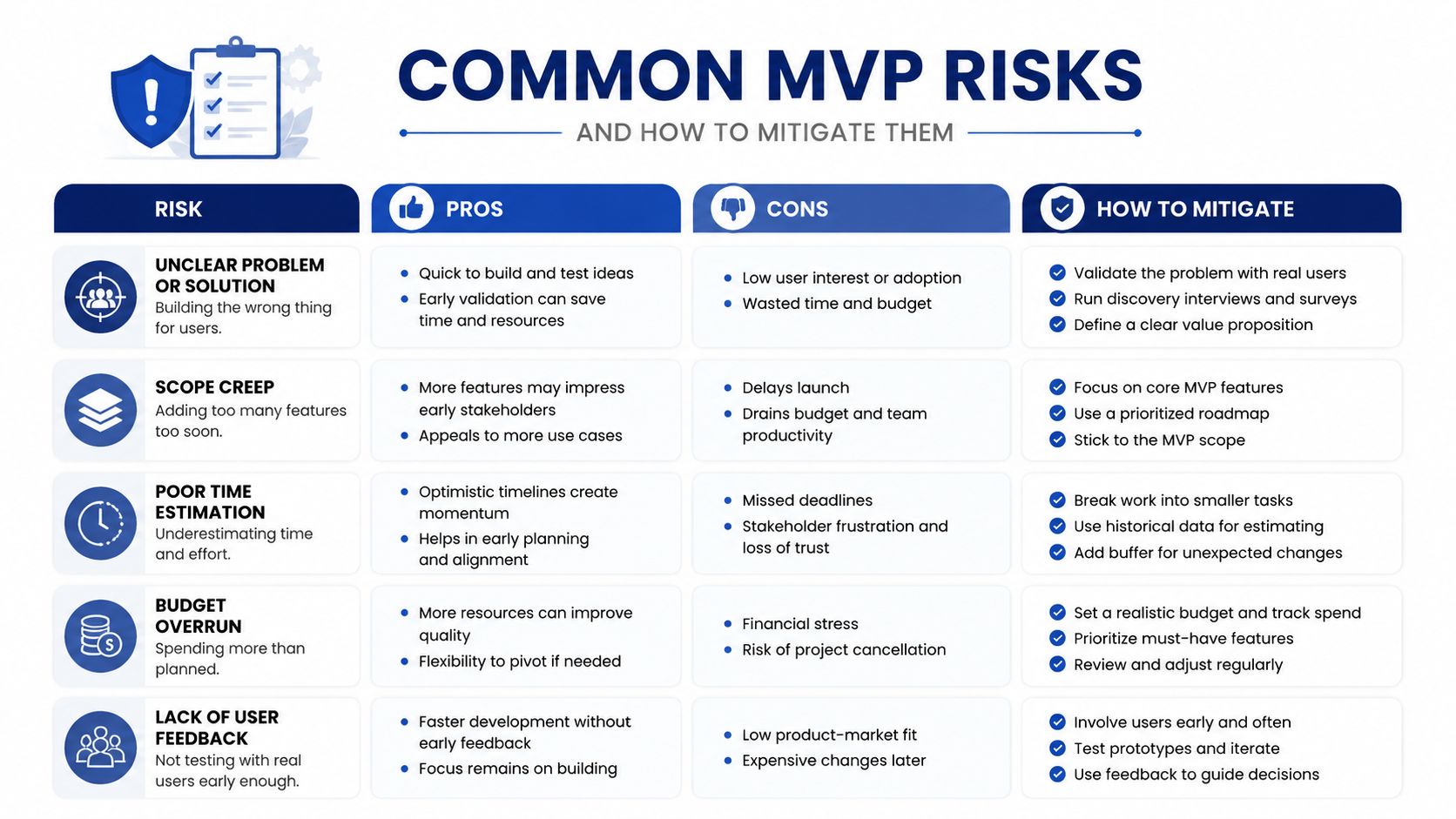
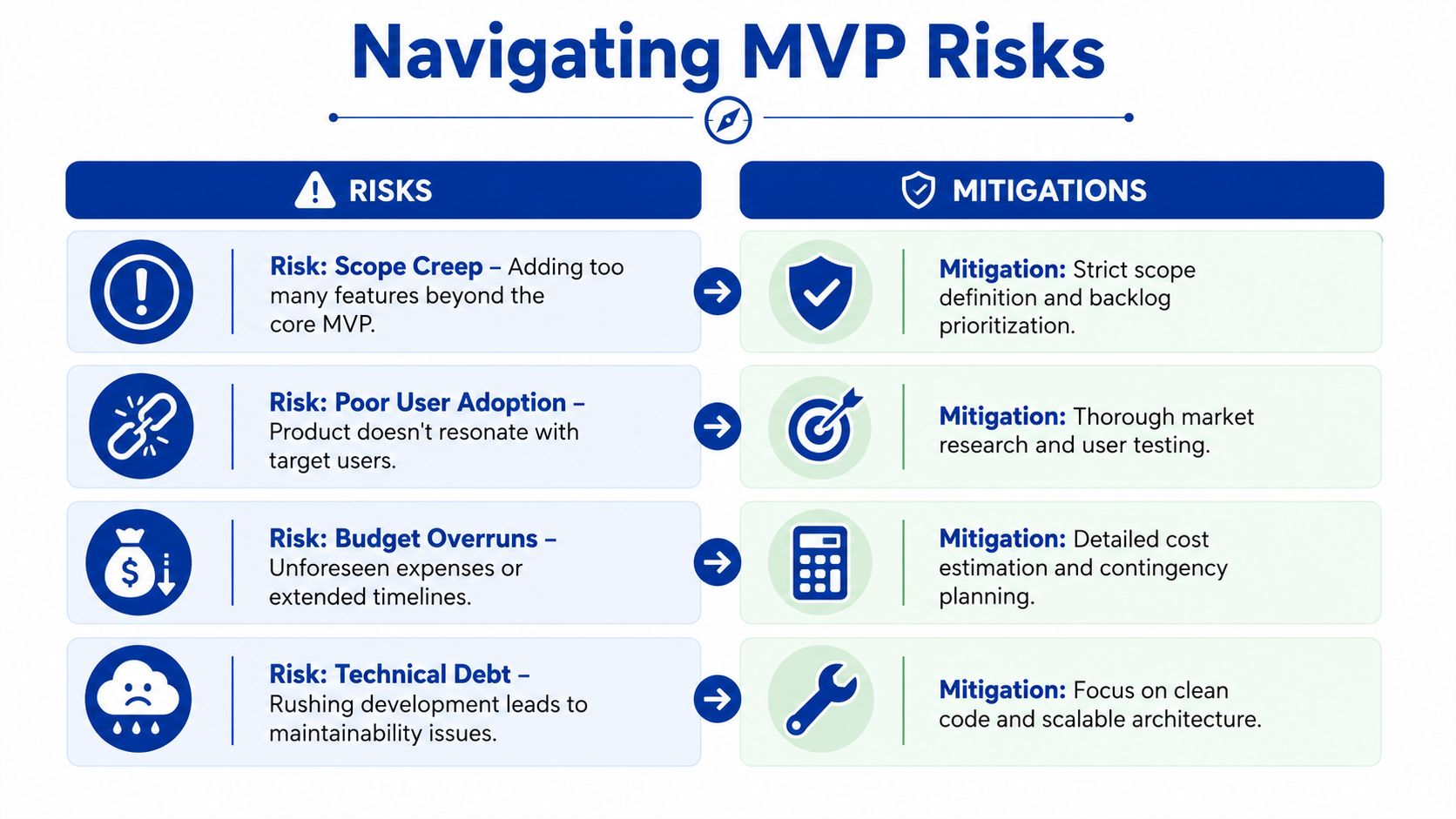
- Market risk: You launch a product that technically works but doesn’t solve a painful enough problem. The mitigation is disciplined discovery, direct user interviews, and success criteria tied to behaviour rather than stakeholder enthusiasm.
- Scope creep: The team keeps adding useful but non-essential features. The mitigation is a hard release boundary and backlog governance that protects the core workflow.
- Technical debt: The build is rushed in ways that make support and iteration harder. The mitigation is clean architecture, code review, and deliberate choices about what is temporary versus foundational.
- Post-launch cost blowouts: The product is cheap to build but expensive to run. The mitigation is observability from day one, especially around errors, traffic patterns, and cloud spend.
One Australian pain point deserves more attention here. A 2023 ABS survey found that 48% of small Australian tech firms reported cloud or hosting costs as a major barrier to scaling, as noted in this summary of ABS cloud cost findings for Australian tech firms. That’s why cost visibility can’t be treated as a later optimisation exercise.
What mitigation looks like in practice
The practical stack matters. If you launch without structured logging, error monitoring, alerting, and cost tagging, you’ll struggle to understand whether the problem is user adoption, product design, or infrastructure behaviour. Tools like Sentry, New Relic, and cloud-native monitoring aren’t “nice to have” in an MVP if the product is live and customer-facing.
A good risk posture usually includes:
- A tracked hypothesis: The team knows what result would justify the next investment decision
- A constrained first release: Features outside the core workflow are explicitly deferred
- Integration discipline: External systems are kept to what the MVP needs
- Operational telemetry: Errors, uptime, and spend are visible early
A launch without measurement isn’t lean. It’s blind.
When businesses talk about MVP risk, they usually mean delivery delay. In practice, the bigger risks are building the wrong thing, learning too slowly, and discovering too late that the operating model doesn’t work.
How to Evaluate and Select an MVP Development Partner
Choosing an MVP partner isn’t mainly about hourly rates or visual polish. It’s about whether the team can make sound product and architecture decisions under uncertainty. That’s the actual job.
A weak partner takes requirements and starts building. A strong one challenges assumptions, narrows scope, identifies risk early, and explains the commercial consequences of technical choices.
Questions worth asking before you sign
Start with how they think, not how they sell.
Ask questions like:
- How do you run discovery? If they can’t explain how they convert an idea into testable scope, expect ambiguity later.
- How do you decide what stays out of the MVP? This is usually more revealing than what they say goes in.
- How do you approach Australian hosting, privacy, and data residency? If your product handles personal or operational data, this should not be an afterthought.
- What’s your view on PWA versus Flutter or React Native for this use case? You want reasoning, not a default preference.
- How do you handle observability and post-launch support? If they stop at deployment, you may inherit a support problem immediately after release.
- What happens if the product direction changes mid-project? Their answer will expose whether the delivery model is rigid or pragmatic.
What to look for in evidence
Case studies matter, but only if they show the right things. Look for examples of phased delivery, integration work, architecture decisions, and measurable operational outcomes. Generic portfolios full of polished screens won’t tell you much about delivery quality.
You should also look for signs of engineering maturity:
| Signal | Why it matters |
|---|---|
| Clear handover practices | Reduces dependency and future maintenance risk |
| Cloud capability | Prevents a decent app from sitting on weak infrastructure |
| Integration experience | MVPs often fail at system boundaries, not inside the UI |
| Post-launch support model | Live products need monitoring, triage, and iteration |
| Senior involvement | Early decisions have outsized impact and shouldn’t be delegated too far down |
The decision criterion most buyers miss
The right partner should make your scope smaller before they make your build bigger.
That sounds counterintuitive, but it’s one of the clearest signs of maturity. Teams that understand MVP development services know the first release should produce evidence, not satisfy every internal stakeholder. If a vendor agrees to every feature request without challenge, they’re acting like a code supplier, not a strategic delivery partner.
The best engagements feel commercially grounded. The partner understands product validation, cloud architecture, integration complexity, supportability, and the realities of Australian organisations operating under budget and compliance pressure.
If you’re planning an MVP and want a team that can advise on architecture, application delivery, integrations, and cloud operating cost in an Australian context, Continuum Solutions works with businesses that need more than a basic build. The focus is on phased delivery, measurable outcomes, and platforms that can scale without forcing a rebuild once the MVP proves itself.