
A mid-market Australian retailer can reach the point where standard Shopify feels restrictive without having a clear reason to adopt Shopify Plus. The symptoms usually appear in operations first: wholesale orders follow a separate process, finance reconciles payment data manually, the CRM has incomplete customer histories, and the analytics team can't explain why reported revenue differs across platforms. An NGO can face a similar problem when fundraising campaigns, regional payment methods, donor records and staff access all depend on loosely connected systems.
Shopify Plus can address some of that complexity, but the platform alone won't produce a coherent operating model. The outcome depends on architecture, integration design, data governance, release management and post-launch support. That's why choosing a Shopify Plus agency is a technology decision with long-term operational consequences, not a commodity procurement exercise.
Table of Contents
- Why Shopify Plus Demands a Specialist Agency
- Vetting Checklist and Commercial Questions
- Migration and Launch Phases That Reduce Risk
- Required Integrations for CRM Authentication and Analytics
- Performance and Observability Expectations
- Case Study Takeaways Across Enterprise NGO and Startup Contexts
Why Shopify Plus Demands a Specialist Agency
A business moving from standard Shopify or a legacy platform often starts with a storefront problem and discovers a systems problem. A replatforming programme may involve multi-currency and tax logic, B2B wholesale channels, custom checkout extensions, headless storefronts, inventory synchronisation, customer identity and fulfilment workflows. Each decision affects another system, and a visually polished theme won't resolve those dependencies.
The Australian market makes this a specialist niche rather than a mass-market implementation exercise. One independent Australian snapshot reported 150,817 active Australian Shopify storefronts and 3,627 Shopify Plus stores, with Plus representing about 2.4% of the local Shopify base (Australian online retail market snapshot). Another snapshot recorded 3,656 Plus stores as of August 2026, reinforcing that Plus is meaningful for enterprise work while remaining a small segment of the broader ecosystem (Australian Shopify landscape data).
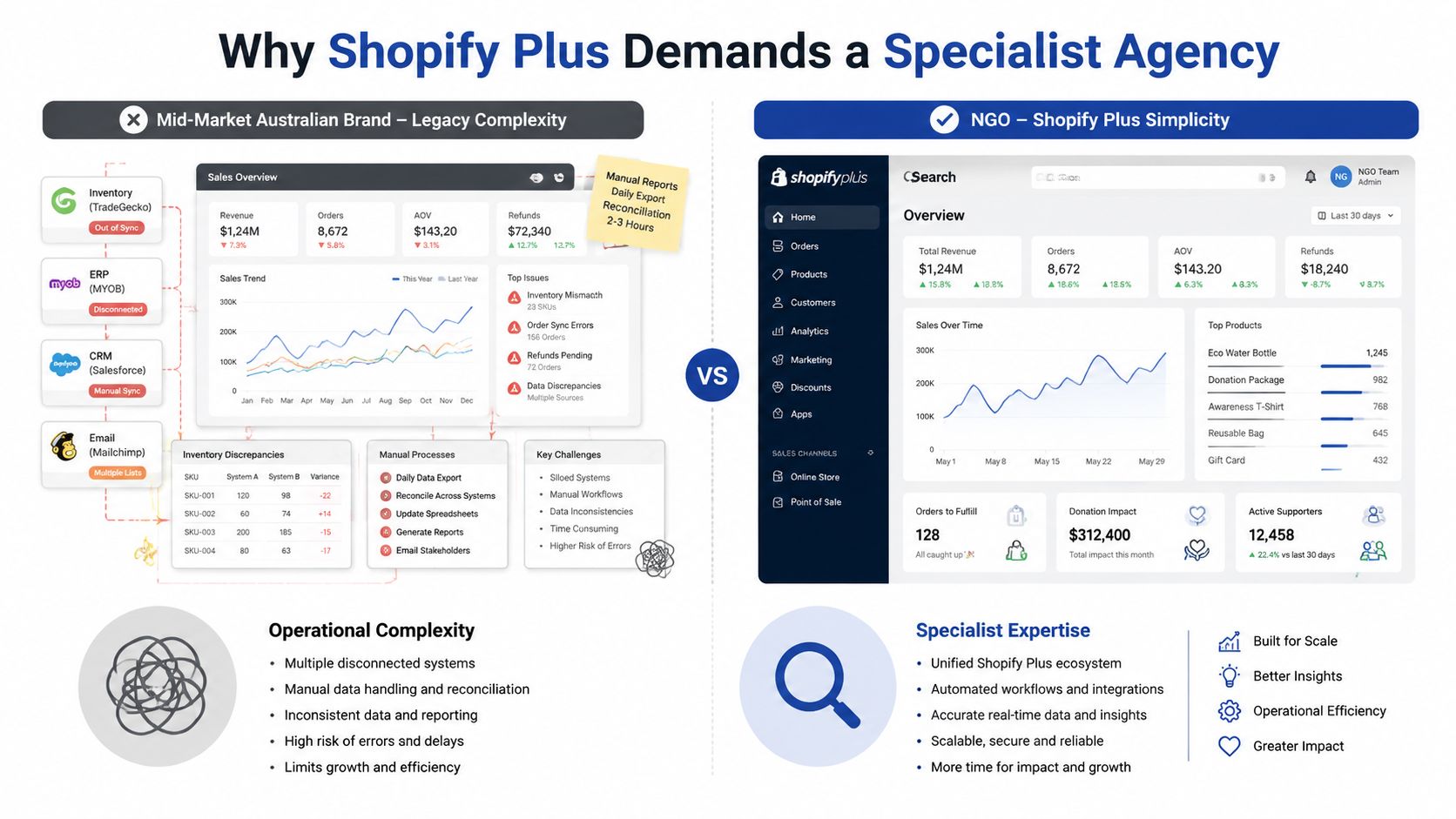
The platform is only one component
A generalist agency may be very capable at Liquid theme development and visual merchandising. That doesn't automatically mean it can design a reliable order lifecycle across Shopify Plus, an ERP, a CRM, an identity provider and a warehouse platform.
A specialist partner should be able to explain:
- Integration ownership: Which system owns products, prices, customer records, tax decisions and fulfilment status?
- Failure handling: What happens when an ERP endpoint is unavailable or a webhook is delivered twice?
- Release governance: How are checkout changes tested, approved and rolled back?
- Data accountability: Who validates customer, order, subscription and consent records after migration?
- Operational visibility: How will staff trace an order from storefront activity through middleware into finance and fulfilment?
Practical rule: If an agency presents Shopify Plus as a theme project, it probably hasn't scoped the real delivery risk.
The commercial threshold also deserves attention. Shopify Plus pricing in Australia starts at $3,700 AUD per month on a 3-year term or $4,000 AUD per month on a 1-year term, billed monthly, according to Shopify's Australian Plus pricing page. That subscription is only one part of total cost of ownership. Discovery, migration, custom applications, middleware, testing, support and internal change management may represent a larger delivery commitment.
Shopify Plus can provide a strong commerce foundation, but the right question isn't whether Plus looks more enterprise-ready. The question is whether a specialist agency can convert its capabilities into a governed operating system for your business.
Vetting Checklist and Commercial Questions
A useful shortlist should separate platform capability, integration competence and delivery maturity. I recommend scoring each agency against the same evidence rather than relying on a polished portfolio or a partner badge alone. Ask for demonstrations of the actual patterns your organisation will need.
A decision matrix for agency selection
| Evaluation Criteria | Generalist Agency | Specialist Plus Partner |
|---|---|---|
| Shopify development | Shows theme customisation and Liquid templates | Explains Liquid, Hydrogen, React storefronts and checkout extensibility in relation to business requirements |
| Integration architecture | Adds apps individually and connects systems case by case | Defines system ownership, API contracts, middleware, retries, monitoring and data reconciliation |
| Data migration | Imports products and customers as a project task | Maps legacy entities to Shopify objects, metafields, consent states and downstream records |
| DevOps | Works directly in production or uses informal reviews | Uses source control, CI/CD, staging, approvals and repeatable release processes |
| Quality assurance | Tests pages and purchase flows manually | Combines functional, integration, regression, accessibility and performance testing |
| Post-launch support | Offers ad hoc fixes | Defines support scope, incident priorities, response targets and ongoing improvement |
| Commercial control | Provides a broad estimate with unclear assumptions | Separates discovery, build, change control, support and third-party costs |
For a deeper assessment, use Continuum Solutions' business IT consulting services as a reference point for the kind of architecture and governance conversation a complex engagement requires. The agency should be able to discuss business process dependencies, not just storefront screens.
Questions that expose delivery depth
Ask how discovery is priced and what it produces. A credible answer should include an architecture decision record, integration inventory, data mapping approach, risk register, delivery plan and explicit assumptions. If discovery only produces wireframes, the project may be under-scoped before development begins.
Ask how the agency handles change requests. You want a documented distinction between a defect, a clarification, a new requirement and a third-party dependency. Request examples of how they forecast the impact on cost, timeline, testing and support.
Commercial questions should also cover:
- Support boundaries: Does post-launch support include integration failures, analytics defects and third-party app issues?
- Service levels: Which incidents receive priority, and how are response and resolution expectations documented?
- Team continuity: Who owns the solution after launch, and what happens if a lead developer leaves?
- Knowledge transfer: Will your team receive integration diagrams, runbooks, credentials guidance and deployment documentation?
- Exit arrangements: Can another technical team maintain the code and infrastructure if the relationship ends?
Red flags include a demo focused entirely on theme changes, an inability to explain API rate limits, no rollback strategy, vague data migration assumptions and proposals that price integrations as a late-stage add-on. A serious Shopify Plus agency won't pretend every requirement is simple. It will show where uncertainty remains and explain how the team will remove it.
Migration and Launch Phases That Reduce Risk
A replatforming launch becomes dangerous when the team treats it as a single weekend event. The safer pattern is a sequence of gates, with each phase proving that the next phase is ready.
Discovery and architecture
The first phase establishes the current state. Document product structures, customer types, order states, discounts, subscriptions, payment flows, warehouse processes, CRM rules and analytics events. For an Australian merchant, confirm GST-inclusive pricing behaviour, local payment methods, delivery services and privacy requirements before anyone promises a launch date.
The output should be an agreed target architecture. It should show Shopify Plus, the ERP, CRM, identity provider, payment services, fulfilment systems, analytics destinations and middleware. The team should also identify which system owns each data object.
Data migration and integration build
Many projects slow down. Legacy platforms rarely model products, variants, customer accounts, addresses, subscriptions and order history in the same way as Shopify. Teams need a mapping strategy for Shopify objects, metafields and downstream records, followed by repeatable migration scripts and reconciliation checks.
The integration build should include duplicate-event protection, retry handling, dead-letter processing and operational alerts. Middleware may be appropriate where multiple systems need orchestration, while a focused serverless function can suit a narrow transformation with clear ownership.
UAT and performance baselining
User acceptance testing should involve operations, finance, customer service, warehouse staff and marketing, not just the ecommerce team. Test realistic scenarios, including failed payments, partial fulfilment, refunds, customer account changes, wholesale pricing and promotional exclusions.
Establish a baseline before launch using Shopify's Australian benchmark tooling. The feature supports comparison across online store conversion, average order value, retention rate and time to fulfil, ship and deliver, allowing teams to compare performance with similar merchants rather than relying on generic global averages (Shopify Australian benchmarks).
Staged cutover and hypercare
A strong agency prepares DNS TTL changes, rollback procedures, support rosters, payment gateway certification and realistic load tests well before cutover. Where possible, use a parallel-run approach for critical data and reconcile transactions before switching operational ownership.
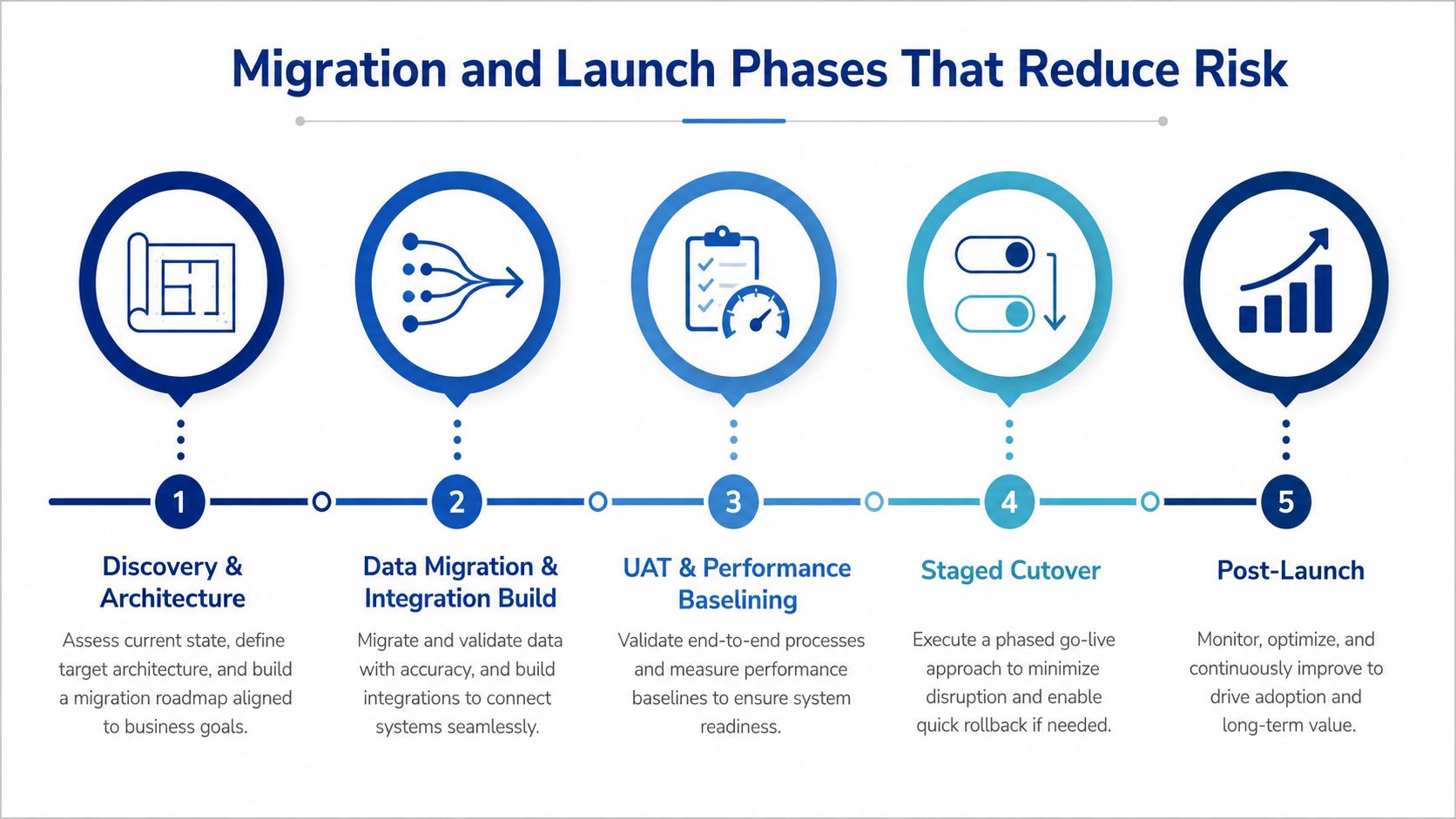
Teams launching across regions also need timezone coordination, local payment validation and privacy review. A phased migration approach, similar to the controls used in broader cloud migration services, gives decision-makers clear gate criteria instead of relying on optimism.
The first 72 hours after launch deserve explicit coverage. Treat them as a controlled operating period with live monitoring, incident triage, data reconciliation and daily review of customer-impacting defects. A launch isn't complete when the storefront loads. It's complete when orders, payments, fulfilment, reporting and support processes operate reliably together.
Required Integrations for CRM Authentication and Analytics
Shopify Plus should sit inside a designed integration system, not at the centre of an uncontrolled app collection. The architecture needs clear boundaries for customer identity, commercial data, payment state, marketing consent and operational reporting.
A CRM such as Salesforce or HubSpot may need customer lifetime value inputs, account ownership, service history and lead or wholesale pipeline data. B2B portals introduce authentication decisions for staff, buyers and administrators. Depending on the security model, the agency may use Shopify's customer accounts API, Okta, Auth0 or another identity layer. Authentication shouldn't be bolted on after the storefront is live, because account states and permissions affect customer journeys and support processes.
Payment architecture also requires deliberate planning. Australian Shopify data reports Afterpay on 26.3% of AU Shopify stores and Klaviyo on 21.4%, indicating that payment and lifecycle platforms can be material dependencies during replatforming (AU Shopify landscape analysis). The same planning should cover GST-inclusive pricing logic, regional gateways, refunds, settlement reconciliation and wallet behaviour.
Dependency decisions before cutover
| Integration Category | Examples | Launch Criticality | Implementation Phase | Middleware Recommendation |
|---|---|---|---|---|
| CRM and customer data | Salesforce, HubSpot, donor records | High when customer service or account workflows depend on it | Architecture, build and end-to-end testing | Celigo or custom AWS Lambda functions, depending on orchestration complexity |
| Authentication | Okta, Auth0, Shopify customer accounts API | High for B2B portals, staff access or protected content | Architecture and security testing | Identity provider integrations with documented token and permission flows |
| Payments | Shopify Payments, Afterpay, regional gateways | Critical for transaction processing and refunds | Build, certification and UAT | Shopify-native configuration first, middleware for reconciliation or orchestration |
| Shipping and fulfilment | Australia Post, Sendle, warehouse systems | Critical when delivery quotes or fulfilment automation drive operations | Build and operational testing | API middleware with retries, alerts and reconciliation |
| Analytics | GA4, GTM, Segment, first-party data layer | High for measurement integrity, though some enrichment can follow launch | Baseline, implementation and validation | Server-side event pipeline or controlled data layer |
| Reporting | Finance, data warehouse, operational dashboards | Depends on management reporting requirements | Build in parallel, phase enrichment after launch | API-led integration with traceable transformations |
A competent agency should document where customer PII is stored and processed, particularly when data sovereignty requirements influence cloud regions, vendors and logging. It should also distinguish transactional truth from analytical copies, so a reporting correction doesn't alter a customer's operational record.
Use custom integrations from Continuum Solutions as a useful comparison point when assessing whether a prospective agency can design documented REST APIs, Salesforce or HubSpot connections and authentication workflows. The important test isn't the number of tools listed in a proposal. It's whether the partner can explain failure modes, ownership and support for each dependency.
Performance and Observability Expectations
A storefront can pass launch review while operations are already failing. A payment may decline without an alert, an order may stop before reaching the ERP, GA4 may record an incomplete purchase, or a release may slow key journeys. The agency must design for those failures before production.
The contract should define observability, attribution integrity and performance baselines alongside design and development. For a headless build, run Lighthouse CI in pull requests and synthetic transaction monitoring with tools such as SpeedCurve or Calibre. For a theme implementation, apply the same controls to templates, scripts, checkout extensions and third-party applications.
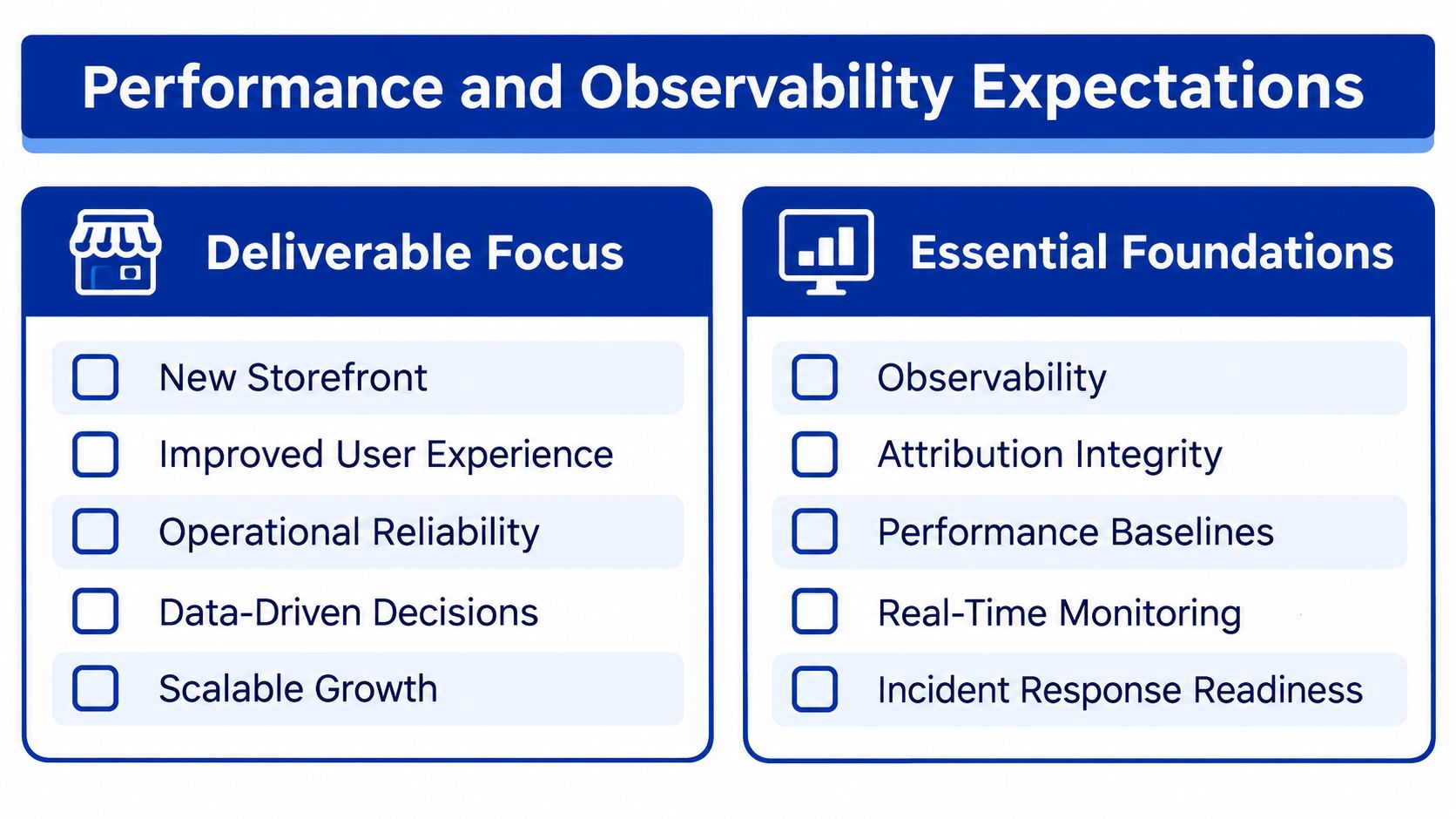
What to require in the delivery agreement
- Performance gates: Set Core Web Vitals targets such as LCP under 2.5 seconds and CLS under 0.1, then document test conditions and devices.
- Transaction monitoring: Test product discovery, cart, checkout and confirmation journeys synthetically, with alerts for failed transactions.
- Traceable orders: Use structured logs to follow an order from storefront event through middleware, payment and ERP processing.
- Analytics validation: Confirm GA4 events across checkout steps, including refunds and consent-dependent behaviour.
- Incident response: Document uptime expectations, priority definitions and response times instead of writing “support available.”
- Hypercare reviews: Require recurring post-launch reviews of performance and integrations, supported by defect trends and event reconciliation.
Attribution integrity requires direct testing. Browser restrictions, consent choices and checkout boundaries can separate advertising platforms, analytics tools and Shopify transaction records. A server-side or first-party measurement design may reduce those gaps, but the agency must validate it against known orders and finance data. Otherwise, marketing teams can make budget decisions from incomplete reporting.
Link deployment approval to measurable checks. Enterprise application monitoring and debugging may cover Sentry, New Relic, uptime monitoring and structured incident investigation. The tools matter less than clear ownership, useful alerts and a team able to act on detected failures.
A storefront that looks finished but cannot explain failed orders isn't production-ready.
Case Study Takeaways Across Enterprise NGO and Startup Contexts
Different organisations need different Shopify Plus architectures. An enterprise retailer may prioritise consolidation and ERP control, an NGO may prioritise regional fundraising and donor governance, while a startup may prioritise rapid campaign execution. The right Shopify Plus agency should recognise those differences before proposing a standard package.
The examples below are anonymised decision patterns, not universal templates.
Enterprise retailer
A $50M Australian retailer consolidated three legacy Magento stores into a single Plus instance over a 14-week migration timeline. The difficult work wasn't recreating the catalogue. It was sequencing product, customer and order data while preserving ERP integration and operational reporting.
The successful decision was to establish system ownership before migration scripts were written. The team mapped legacy entities to Shopify structures, validated downstream order states and rehearsed reconciliation. The risky alternative would have been to migrate data first and discover after launch that finance, fulfilment and customer service each interpreted status differently.
Humanitarian NGO
A humanitarian organisation used Plus multi-storefront capability for regional fundraising campaigns with localised payment methods while keeping donor CRM synchronisation centralised. The architecture needed to distinguish a campaign storefront from the organisation's donor record, so regional presentation changes didn't fragment supporter history.
The agency choice mattered in the authentication and data model. Campaign operators needed controlled access, finance needed reliable settlement information, and donor services needed a consistent view. A design-led partner might have delivered attractive regional pages without addressing those operational boundaries.
Venture-backed startup
A venture-backed direct-to-consumer brand used Launchpad and Scripts APIs for high-volume flash-sale execution without taking responsibility for infrastructure scaling in the same way as a fully custom commerce platform. The important decision was restraint. The team used native Plus capabilities where they met the requirement and reserved custom development for genuine gaps.
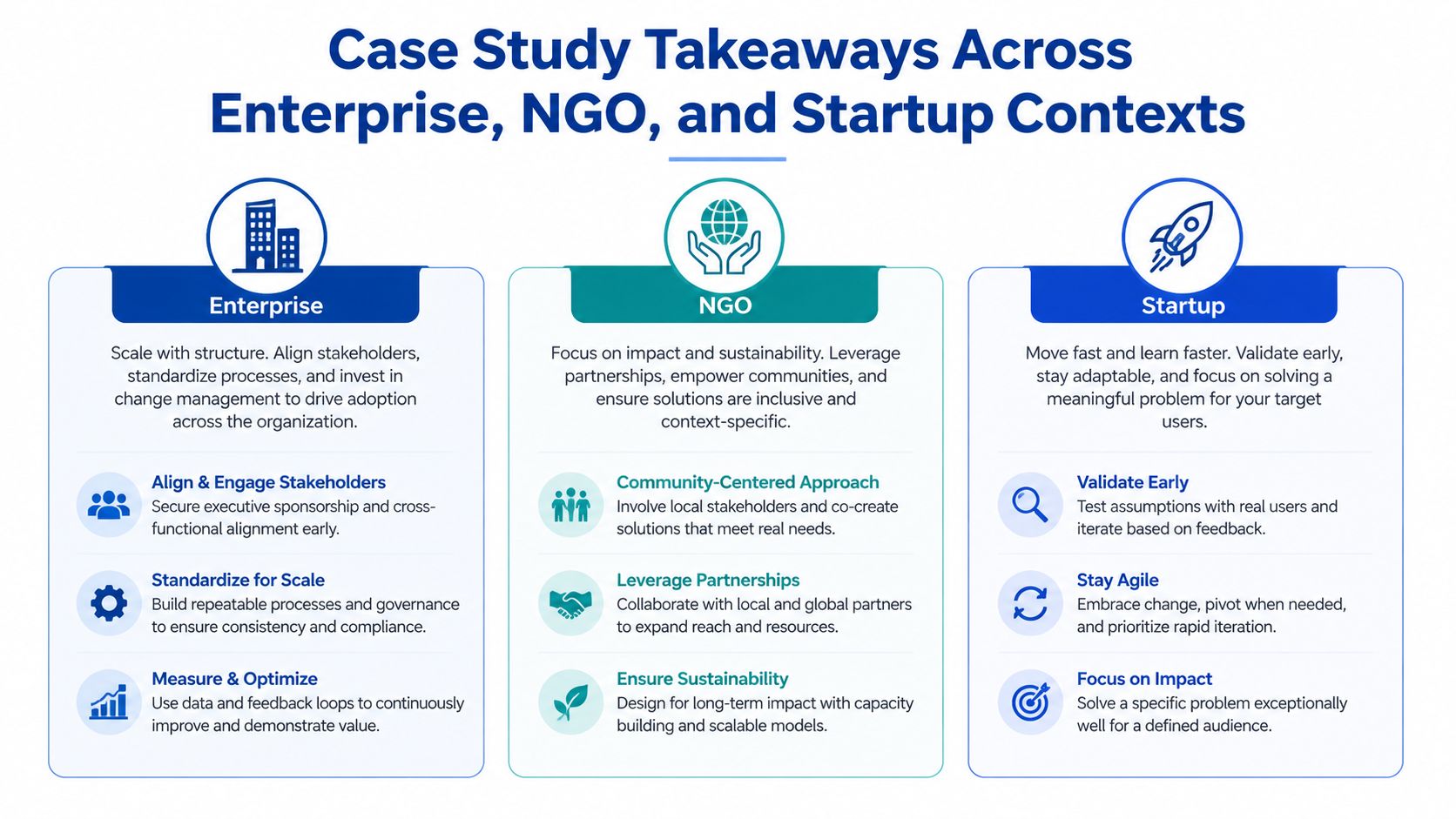
The pattern to apply
| Organisation | Primary constraint | Agency decision that mattered | Common failure mode |
|---|---|---|---|
| Enterprise | Consolidated operations across legacy stores | Sequenced migration around ERP and data ownership | Treating catalogue import as the whole migration |
| NGO | Regional campaigns with central donor governance | Separated storefront localisation from CRM identity | Creating disconnected donor records |
| Startup | Campaign speed and operational simplicity | Used Plus capabilities before commissioning custom infrastructure | Overbuilding a platform before validating the requirement |
Shopify Plus also has specific operational rules that should appear in the solution design. The platform supports up to 200 locations for inventory tracking and order fulfilment, and its POS Pro terms include the first 20 POS Pro locations in all plans. Merchants with more than 20 POS Pro locations may have POS Pro waived across retail locations up to the 200-location maximum when they use Shopify Payments for at least one retail transaction per month at any retail location, as documented in Shopify Plus plan features. An agency should test whether those rules fit the proposed retail and fulfilment model rather than assuming the plan automatically solves omnichannel operations.
Review Continuum Solutions' case studies for examples of the broader delivery questions to ask, including system stability, data flow, application modernisation and measurable baselines. Your selection process should end with a written architecture, a phased commercial proposal and a clear owner for every integration after launch.
Continuum Solutions designs and delivers Shopify Plus builds, custom applications, cloud infrastructure and system integrations for enterprises, NGOs and startups that need reliable operations beyond the storefront. Visit Continuum Solutions to discuss your migration, integration architecture, analytics measurement and post-launch support requirements with an Australian technology consultancy.