
You're usually not short on cloud ambition when you start talking about AWS. You're short on a clear plan, a realistic budget, and someone who can separate a sensible migration from an expensive rebuild. That's why the right AWS cloud consultant changes the outcome so much.
Australian organisations are making this decision in a market where cloud use is already mainstream and still growing. The ABS-based research paper says Australian businesses' paid cloud use rose from 31% in 2015–16 to 42% in 2017–18 and then to 55% by 2021 (source), while cloud spending was about $14 billion in 2021 and expected to reach about $17 billion in 2022 (ABS research paper). The caution sign is just as real. A cross-country survey reported that one in three cloud migrations in Australia failed to meet expectations (Unisys survey release).
For a CTO or operations manager, that gap matters more than the logo on the consultant's slide deck. A consultant's methodology, not just their certifications, is what keeps the migration from turning into a prolonged clean-up job. If you want a broader service view alongside cloud, integration, and delivery capability, see Continuum Solutions' business IT consulting services.
Table of Contents
- Why the Right AWS Cloud Consultant Changes Everything
- Assessing Your Cloud Needs Before Engaging a Consultant
- Evaluating AWS Cloud Consultant Capabilities and Fit
- Structuring the Engagement with Clear Milestones
- Understanding AWS Consulting Costs in Australia
- Measuring Success After the Engagement
- Common Mistakes That Derail Consultant Engagements
Why the Right AWS Cloud Consultant Changes Everything
A mid-sized team often starts here. The board wants lower hosting friction, the operations manager wants fewer outages, and finance wants a cloud bill that makes sense. Meanwhile, the internal team is juggling pricing models, service choices, and concerns about what breaks when production moves.
That's where a good AWS cloud consultant earns their fee. The wrong one sells a lift-and-shift story too early. The right one starts by testing assumptions, mapping dependencies, and deciding whether the organisation needs migration, replatforming, or a broader modernisation programme.
AWS's local footprint makes this decision more nuanced for Australian buyers. AWS announced its Melbourne Region in January 2023 as its second infrastructure region in Australia, and later said it had invested more than AU$8 billion in local infrastructure and jobs while supporting hundreds of thousands of customers each month (Amazon Australia). That changes where workloads belong, how latency is managed, and how a consultant should think about resilience and data residency.
Practical rule: If a consultant starts with service names instead of business dependencies, they're already too far into solution mode.
A strong engagement usually looks less like a product selection exercise and more like an operating change programme. The best consultants make it easier to answer hard questions early. What moves first, what must stay local, what needs redesign, and what can be deferred without creating future debt.
Assessing Your Cloud Needs Before Engaging a Consultant
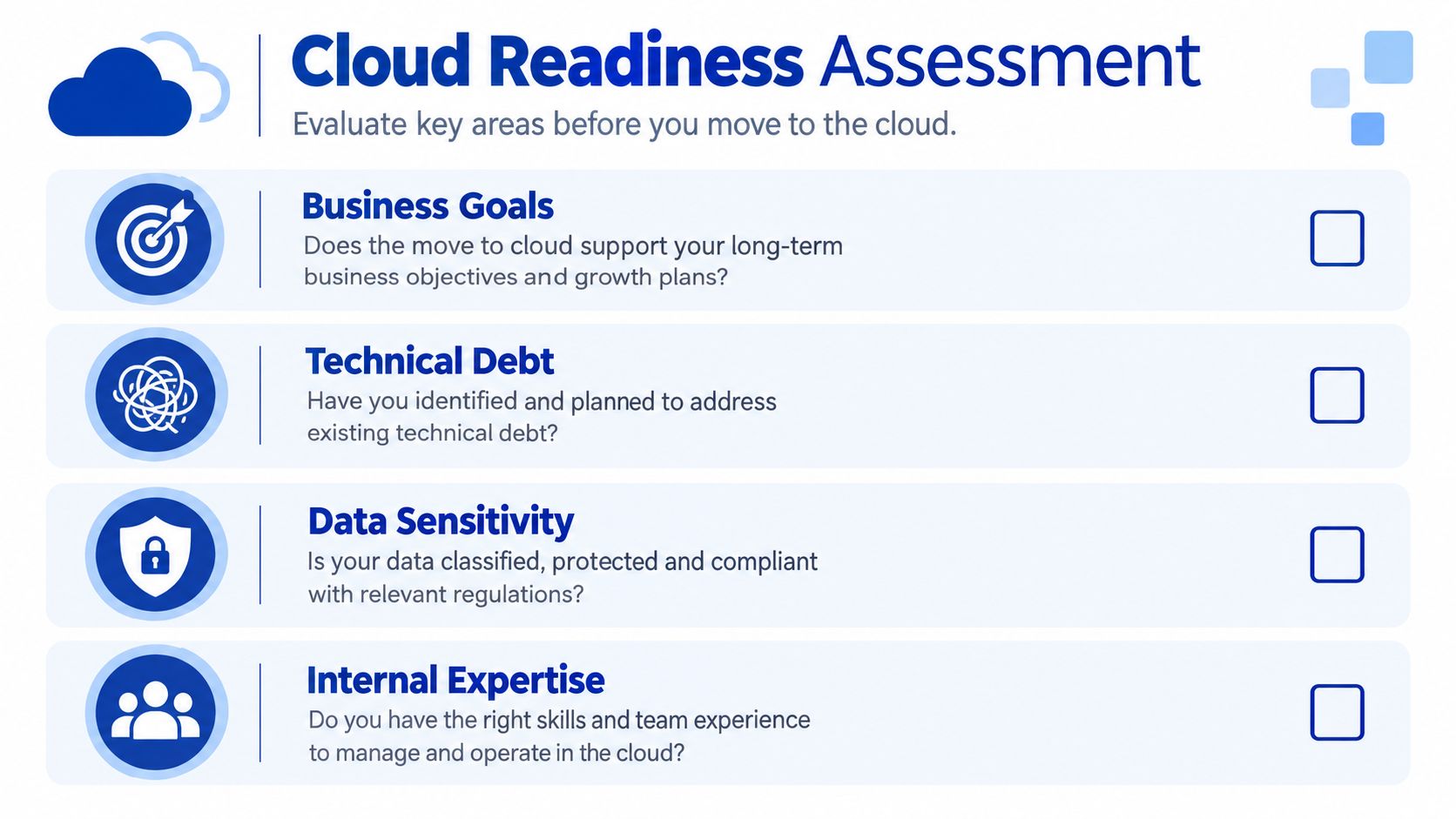
Before you brief anyone, define the job properly. A lot of organisations say they want to “move to AWS”, but that can mean anything from hosting a single web app to rebuilding a fragile stack with multiple databases, external integrations, and legacy authentication. Those are not the same project, and they shouldn't produce the same proposal.
Start with workload inventory
List every application, supporting database, file store, batch job, API integration, and scheduled report. The hidden work is usually not the core system, it's the connected pieces around it. In Australian delivery work, the biggest surprises usually show up in the dependency chain, not in the headline application.
AWS migration training frames success around discovering, planning, performing, and tracking migrations before execution, which is why the discovery stage matters so much in practice (Lumify Work). A consultant should ask what talks to what, which systems own source of truth, and which integrations would fail if a batch window slipped. If you can't explain that on paper, the consultant can't safely design the move.
A dependency map isn't a formality. It's the difference between a controlled cutover and a production incident.
Separate migration from modernisation
The next step is deciding what kind of change you want. A lift-and-shift move keeps the existing structure mostly intact. Replatforming changes parts of the stack without full redesign. Modernisation means replacing older patterns with a new architecture that may use managed services, containers, or serverless components.
That distinction matters commercially. The more redesign work you ask for, the more important it becomes to define acceptance criteria and avoid vague goals like “make it cloud-native”. If the brief isn't clear, every proposal will look cheaper or more expensive for the wrong reasons.
Surface compliance and operational constraints early
For regulated or public-sector workloads, the consultant must see governance requirements from day one. The Western Australian Government's AWS suitability statement says agencies must perform their own risk assessments for each cloud development or migration project and identify additional risk treatments for their own risk profile, and it requires AWS to maintain IRAP certification on a regular basis, with revised certification not exceeding a two-year interval (WA Government).
If you're scoping an engagement for a similar environment, those controls need to shape the architecture and delivery plan, not get bolted on later. A consultant who ignores them is selling speed at the expense of rework. If your team is working through a migration brief, the cloud migration services overview is a useful reference point for how a structured engagement is usually framed.
Evaluating AWS Cloud Consultant Capabilities and Fit
The Australian market has a real skills gap, and that affects how you should assess candidates. Australian-based partners report that 68% are seeking specialised cloud skills, but only about half are confident they can meet that demand (CRN Australia). That tells you the scarce resource isn't generic AWS familiarity, it's senior design and delivery capability.
A strong consultant should be able to discuss landing zones, IaC, security patterns, observability, and handover without hiding behind buzzwords. They should also know where they're strong. Some consultants are excellent at lift-and-shift migration. Others are far better when the work involves containers, serverless, DevOps pipelines, or data-heavy architecture. Buying the wrong shape of expertise is how projects drift.
Compare consultants against the work you actually need
| Criterion | Migration Project | Platform Build | Cost Optimisation |
|---|---|---|---|
| Discovery depth | Can they map dependencies and classify workloads before cutover? | Can they define the right target architecture before coding starts? | Can they identify waste, idle services, and over-provisioning patterns? |
| Delivery style | Can they sequence waves and manage phased cutovers? | Can they build foundations for deployment, testing, and release control? | Can they prioritise quick wins without destabilising production? |
| Technical focus | Rehost, replatform, data transfer, resilience | Architecture, DevOps, CI/CD, observability | Rightsizing, usage review, governance, monitoring |
| Handover quality | Can the internal team run the environment after migration? | Can they document decisions and operating models? | Can they leave behind measurable controls and a repeatable process? |
Use reference checks to test whether the consultant has delivered the kind of work you need. Ask what failed, what changed midstream, and how they handled dependencies they didn't expect. A polished case study is useful, but it's not enough on its own.
Useful interview test: ask them to explain how they'd run a pilot wave before broad rollout. Good consultants answer in sequence, not in slogans.
If you're comparing firms that do this work across AWS architecture, migration, and cloud cost review, cloud computing consulting is the right category to benchmark against rather than general IT support.
Structuring the Engagement with Clear Milestones
The engagement structure matters as much as the consultant. A weak statement of work turns a capable team into a reactive one. A good structure gives them room to think while protecting you from scope creep and vague “progress”.
Use phased deliverables
The most reliable model is staged. Start with discovery and assessment, move into architecture design, then a pilot migration, followed by full rollout, and finish with post-migration optimisation. Each phase should have a deliverable, an owner, and an acceptance gate.
Discovery should produce a workload inventory, dependency map, target migration pattern, and risk register. Architecture design should produce the landing zone, network approach, identity model, backup strategy, and delivery sequence. Pilot migration should validate assumptions about security, network paths, data transfer, and operational support before the larger rollout begins.
Tie milestones to business outcomes
Technical completion is not the same as business value. If the goal is lower operating friction, the milestone should show that recurring manual tasks have been reduced. If the goal is better responsiveness, define what application behaviour should look like after the cutover. If the goal is safer operations, the acceptance criteria should include recovery, monitoring, and handover readiness.
A discovery phase should always come before any committed migration date. That isn't consultant self-preservation, it's how you stop the plan being built on guesswork. Fixed-price works well for a bounded discovery or assessment. Time-and-materials is often better for phases where the scope will evolve after technical evidence comes back.
Don't sign up to a migration timeline before the dependency map exists. You'll just be pricing uncertainty.
For teams needing direct migration support, AWS migration services should be framed around phase gates, not a single promise to “move everything”.
Understanding AWS Consulting Costs in Australia
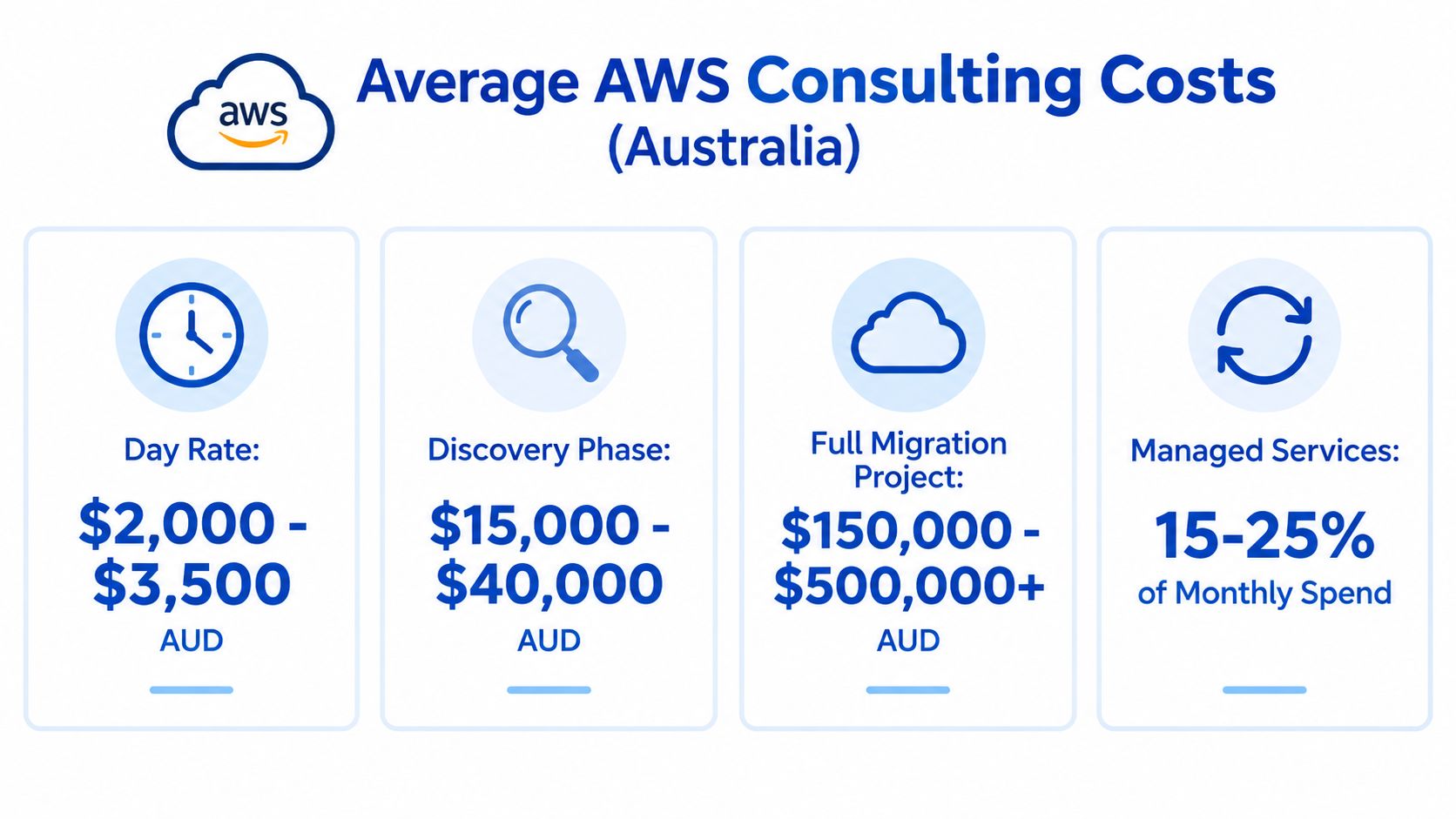
A quote only makes sense once you know what it covers. For an aws cloud consultant, the better question is how the work is packaged, what risk is being removed, and which decisions stay with your team. A low number that skips discovery often becomes the expensive option once rework starts.
Australian migration guidance shows that small-business rehost projects can still cost AUD 20,000-60,000 upfront, mid-market programs AUD 80,000-250,000, and enterprise refactoring AUD 300,000-1,000,000+ before ongoing infrastructure spend (Adamosoft). Those ranges matter because they reflect different levels of complexity, not just labour time. A move with compliance work, architecture changes, and many dependencies is a different engagement from a straight server lift.
For salary and contract expectations, Australian market guides point to cloud and DevOps architect pay in Sydney and Melbourne around AUD 160,000-210,000 base and contract rates around AUD 1,050-1,350/day (Hays Salary Guide). That helps explain why senior consultants are not priced like generalist support. Buyers are paying for judgement, pattern recognition, and fewer expensive mistakes.
Watch for pricing traps
A very low fixed price often leaves out the work that protects the migration. Discovery, dependency mapping, stakeholder workshops, and acceptance criteria are what reduce delivery risk. If those pieces are missing, you are buying optimism, not certainty.
Time-and-materials can work, but only when each phase has a clear stop point. Without milestones, there is no clean way to check whether the design still matches the brief. A consultant should be clear about what is included, what is excluded, and how scope changes are handled.
When comparing providers, look for firms that bundle architecture, phased migration, and cost review into one engagement rather than selling implementation alone. If you want to see how pricing varies across migration work, this AWS migration cost guide for Australia is a useful starting point.
Measuring Success After the Engagement
The test starts after cutover. A migration that finishes on schedule but leaves the team with brittle operations, unclear ownership, or rising spend hasn't solved the problem. Success has to be measured across cost, performance, operational maturity, and team capability.
In Australian delivery work, the clearest evidence comes from baseline comparisons. One local AWS migration completed with zero downtime and improved performance by 25%, while another Australian transformation migrated over 400 services and reported 100% availability for cloud services after the move (Cevo case study). Those are useful because they show what a consultant-led engagement should prove after stabilisation. It's not enough to say the workloads moved. The team should be able to show what got better.
Measure four things, not one
Cost efficiency should show whether spend is being governed, not just whether invoices arrived on time. Performance and reliability should be checked against the pre-migration baseline. Operational maturity should be visible in monitoring, backup, recovery, release process, and documentation quality. Team capability should answer a simple question, can your internal people run this without the consultant in the room every week?
AWS positions the Well-Architected review as a structured assessment of workloads against best practices for efficiency, security, performance, and cost optimisation, so it belongs after the environment has stabilised, not as a box-ticking exercise during panic mode. Use it to tune network topology, autoscaling, backup and DR, and cost controls. Then re-check service health against the original baseline.
The best handover is boring. Your team knows what to do, where the risks sit, and who owns the next decision.
Support after the engagement can take different forms. Some teams want a short advisory runway. Others need managed services while internal capability catches up. Either way, the consultant should leave behind documentation that makes the environment maintainable and defensible.
Common Mistakes That Derail Consultant Engagements
The costliest mistake is rushing the brief. Teams skip discovery to save time, then pay for it later in incident calls, scope disputes, and rework. Treat the engagement like a controlled project, not a vendor purchase.
The mistakes that keep repeating
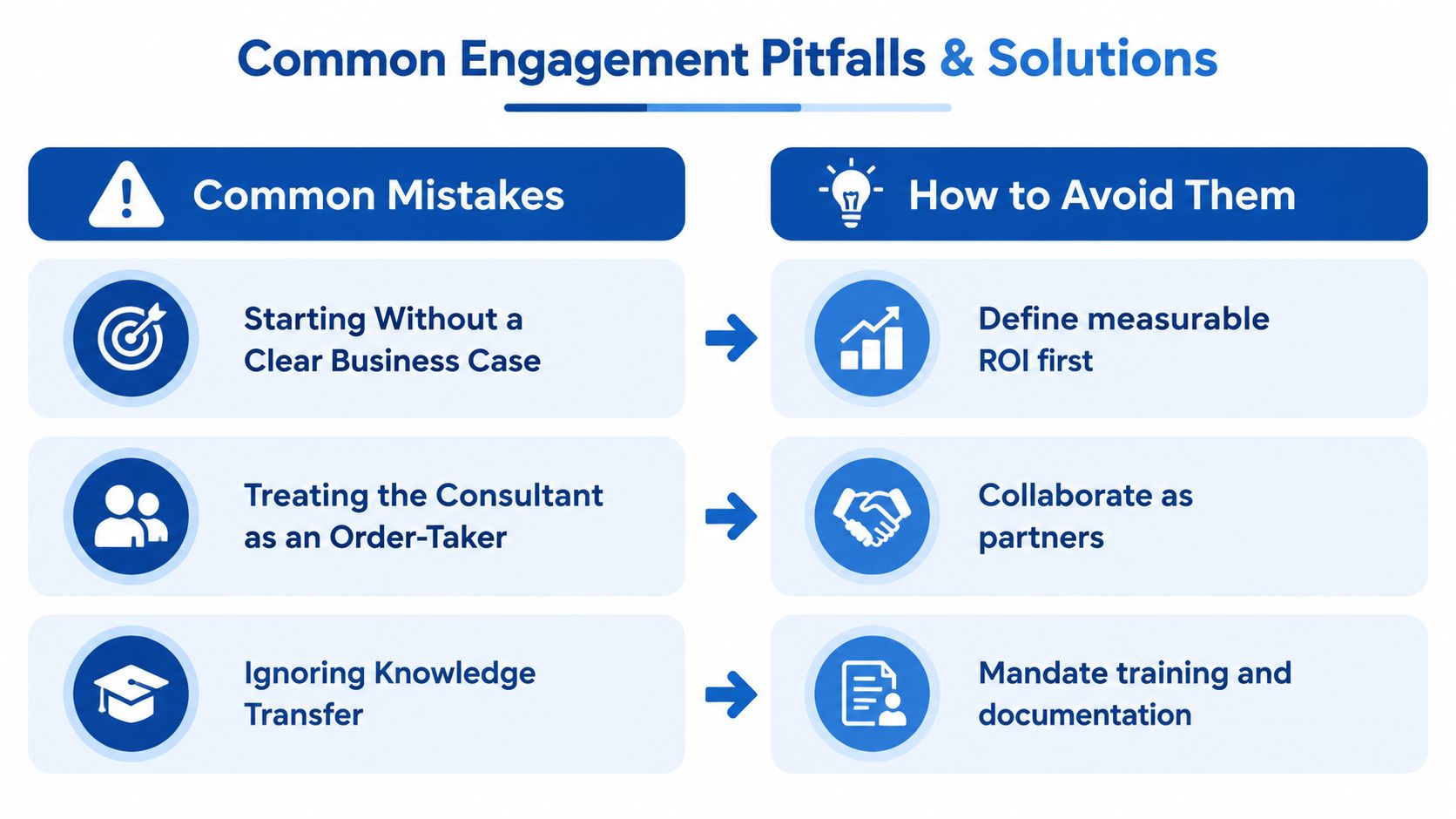
Starting without a clear business case creates arguments about priorities later. Treating the consultant as an order-taker means the architecture often goes unchallenged when it should be tested. Ignoring knowledge transfer leaves the organisation dependent on the consultant for routine tasks that should have been handed over.
Scope creep is another predictable problem. If the first statement of work has no boundary, every new idea gets treated as part of the original brief. Change requests are not a sign of failure, they keep the project honest and give the buyer a clear record of what changed.
A more subtle mistake is skipping a documented rollback plan before cutover. If a migration step fails and nobody has agreed how to return traffic, data, or access to the old state, the team is forced into live triage under pressure. That is where risk turns into downtime.
For a practical checklist of what to avoid, see common AWS mistakes SMEs make.
Australian cloud migrations do not fail only for technical reasons. Some fail because the buyer never defined what success should look like. Others fail because the consultant was engaged as a pair of hands instead of a design partner. Regulated and public-sector workloads also need governance decisions raised early, not after delivery starts. The safest path is to keep the brief, milestones, handover requirements, and rollback steps explicit from the outset.