
You started with a small API and a few S3 triggers. Now that same system handles member logins, donation payments, or ecommerce checkouts, and you’re asking whether the functions still form a coherent system or just distributed glue. That’s the point where AWS Lambda architecture stops being a runtime choice and becomes a design discipline covering events, state, failure, cost, and residency.
Table of Contents
- Why AWS Lambda Architecture Matters for Australian Teams
- The Core Building Blocks of an AWS Lambda Architecture
- Common Architecture Patterns and When to Use Them
- Concurrency, Cold Starts, and Scaling Behaviour
- Packaging, Layers, VPC Networking, and IAM Boundaries
- Observability, CI/CD, and the Day-Two Cost Lever
- Data Residency, Multi-Region Failover, and Australian Compliance
- Common Mistakes, Trade-Offs, and Practical Next Steps
Why AWS Lambda Architecture Matters for Australian Teams
A team I advised began with three functions behind an API. Within a year they’d added webhook intake, payment confirmations, file processing, and a nightly reconciliation job, each added because Lambda made it easy. The system worked until a campaign peak exposed shared concurrency, unclear retries, and logs nobody could trace end to end.
That pattern is common. Lambda removes server management, but it doesn’t remove architecture. You’re still deciding where state lives, what happens when a downstream service fails, how duplicate events are handled, and who can invoke what.
What architecture means here
AWS Lambda architecture describes how event sources, functions, managed services, and operational controls fit together. A function list tells you nothing about failure behaviour. An architecture shows the path from trigger to outcome, including queues, dead letter queues, data stores, permissions, and observability.
For CTOs, technical founders, and engineering managers at NGOs, enterprises, and startups, the relevant decisions are commercial as much as technical. Which workloads suit event-driven compute. Which are cheaper or simpler on containers. Where data must stay in Australia, and what fails over if a Region degrades.
Lambda isn’t a drop-in replacement for a server. It’s a different contract, where you trade control of the host for explicit design of events, retries, and concurrency.
Australia adds a specific dimension that generic guides skip. You have two in-country Regions to design around, plus residency expectations for logs, backups, and event payloads, not just primary data. Treating Region selection as a latency setting misses that. The sections ahead cover building blocks, patterns, scaling limits, deployment decisions, day-two operations, residency and failover, and the mistakes that cost Australian teams money or uptime.
The Core Building Blocks of an AWS Lambda Architecture
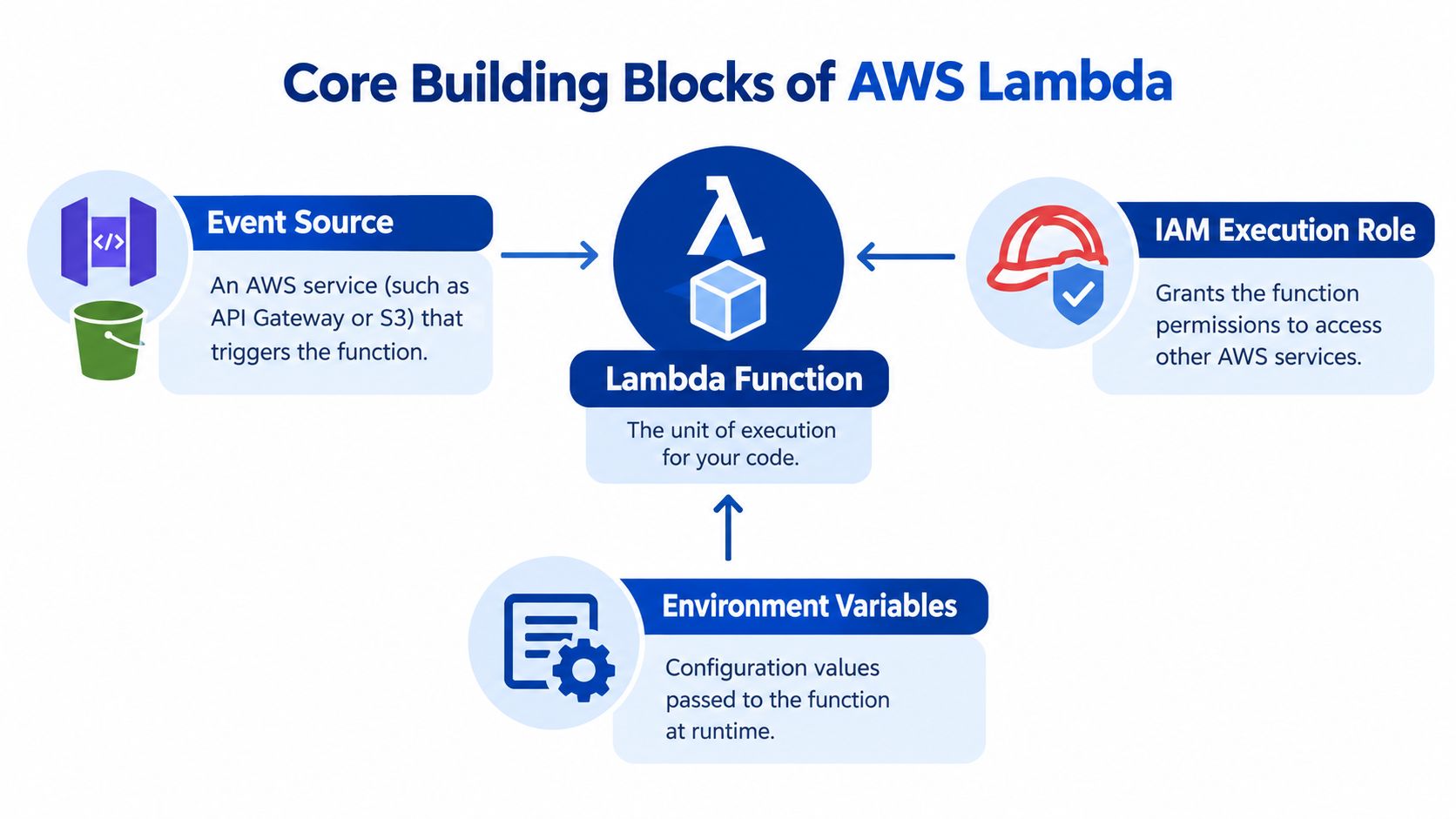
Start with the function as a unit of execution tied to a single event source. A function receives an event, runs your handler, and returns or writes a result. It holds no durable state between invocations, so anything that must survive belongs in DynamoDB, S3, or another managed store.
Configuration and permissions
Two things wrap every function. First, an IAM execution role defines what the function can call, and it should permit only the specific tables, buckets, or queues that handler needs. Second, environment variables carry configuration such as table names or feature flags into the runtime. Secrets don’t belong there in plain form. Use Secrets Manager or Parameter Store and reference them at startup.
The connective tissue
Most production systems combine a small set of services:
- API Gateway: Terminates HTTP, handles authorisation, and invokes functions synchronously for mobile and web backends.
- EventBridge and SNS: Route domain events to one or more subscribers without tight coupling.
- SQS: Buffers work so a slow consumer doesn’t block the producer.
- DynamoDB: Provides low latency structured access that scales without connection management.
- Step Functions: Coordinates multi-step workflows where state and retry logic would otherwise sprawl across handlers.
Take an Australian mobile backend. API Gateway fronts login and profile calls. A webhook function receives payment confirmations and publishes an event. A queue-fed worker updates the membership record, and a Step Functions workflow runs nightly reconciliation against the payment provider. Each piece has one job, and failure in reconciliation can’t stall logins.
If you’re weighing this against always-on compute, our comparison of Lightsail, EC2, and ECS hosting options helps frame where Lambda sits. The mental shift is that scaling, retries, and idempotency are now your design inputs, not side effects of a running server. Sketch the event flow before you write code, and you’ll see most production problems early.
Common Architecture Patterns and When to Use Them
Four patterns cover most Lambda workloads we see in production. Choosing between them is a business decision about latency, ordering, and failure tolerance, not a fashion choice.
Synchronous API backends
API Gateway invokes Lambda and waits for the response. This suits mobile backends, form submissions, and lightweight integrations where the caller needs an immediate answer. The failure mode is direct. Latency or throttling in the function becomes latency for your user, so timeouts, connection reuse, and cache behaviour matter. For membership platforms with steady interactive traffic, this pattern works well, as outlined in our guide to AWS hosting for membership platforms.
File, stream, and scheduled processing
S3 events trigger functions to resize images, validate uploads, or parse documents. Kinesis streams suit ordered, continuous records. EventBridge schedules handle reports, expiry checks, and reconciliation, while Step Functions adds branching and human-scale waits.
- Good fit: Bursty, short-lived work with clear inputs and outputs.
- Poor fit: Long-running or heavily stateful jobs that fight timeout and memory limits.
Queue-based burst absorption
Placing SQS between producer and function decouples intake from processing. Donation platforms and ecommerce backends use this so a televised appeal or promotion doesn’t push synchronous throttling onto donors. The cost is eventual completion. Users get an acknowledgement, not a finished result, so your product design must reflect that.
Decision rule: If the caller can’t act without the result, invoke synchronously. If the caller only needs confirmation you’ve accepted the work, queue it.
Modernisation programmes fail when teams lift a monolith into functions without redesigning these boundaries. The analysis of cloud modernization failure rates from Software Modernization Intelligence is useful context on why pattern selection matters before migration. Where work is sustained, predictable, and long-running, a container on Fargate is often simpler and cheaper. Lambda earns its place when demand is uneven, events are discrete, and scale to zero has real value.
Concurrency, Cold Starts, and Scaling Behaviour
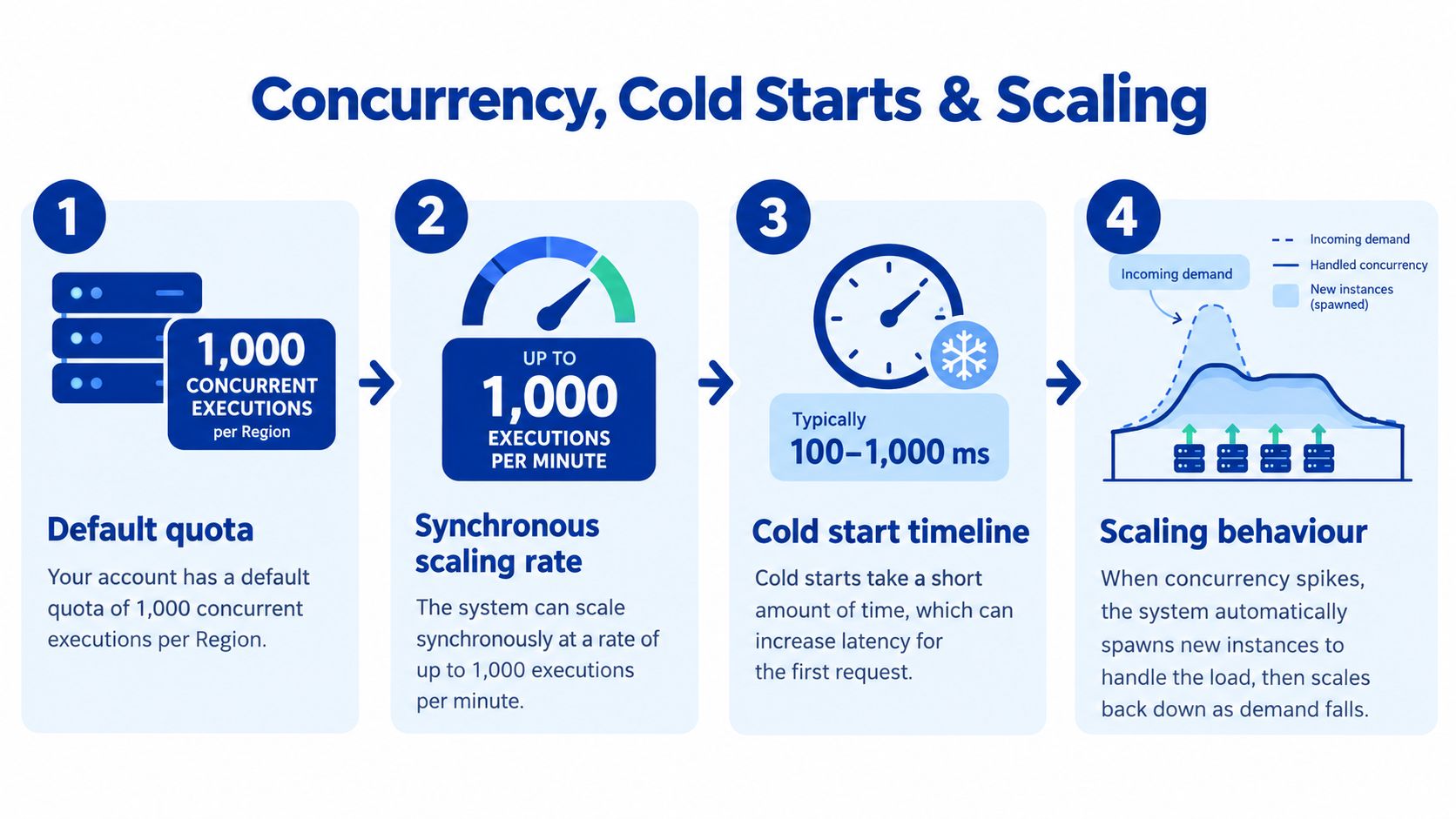
Concurrency is the limit teams encounter first, and usually during a peak they cared about. Treat it as a regional capacity boundary, not a runtime detail.
The default quota is 1,000 concurrent executions per AWS Region, and the default scaling rate permits an increase of up to 1,000 concurrent executions every 10 seconds for synchronously invoked functions, as documented in AWS Lambda service quotas. Average load is irrelevant if a campaign launch multiplies traffic inside that window. Synchronous callers then receive throttling unless you’ve added retries with backoff, upstream rate limiting, or a queue in front.
Reserved versus provisioned concurrency
These solve different problems and teams regularly confuse them:
- Reserved concurrency: Guarantees a slice of the regional pool for a critical function, protecting checkout or login from a noisy reporting job.
- Provisioned concurrency: Keeps execution environments initialised so requests avoid cold start delay. It costs money while idle, so reserve it for latency-sensitive paths with predictable demand.
I solved a donation peak problem by separating the interactive payment function from asynchronous receipt and CRM workers, then reserving concurrency for payment only. The workers could lag safely behind a queue. The payment path couldn’t.
Cold starts in practice
A cold start happens when Lambda initialises a new execution environment. Runtime choice, package size, memory allocation, and VPC attachment all influence it. Interpreted runtimes with small packages generally start faster than large JVM deployments. Measure with production-like payloads in your target Region, because downstream connection setup to Australian databases and SaaS endpoints often dominates the delay users feel.
Don’t chase cold starts everywhere. For a queue worker processing reconciliation records, initialisation delay is invisible. For a synchronous API at low traffic, it’s your tail latency. Match the remedy to the path, and request quota increases before a known peak, not during it.
Packaging, Layers, VPC Networking, and IAM Boundaries
Deployment decisions made in week one determine whether the system stays pleasant to operate in year two. Packaging, networking, and permissions deserve the same rigour as handler code.
Packaging and layers
ZIP packages suit most functions. They’re simple, fast to build, and easy to inspect. Container images help when you need custom runtimes, large dependencies, or consistency with existing container tooling, at the cost of heavier build pipelines and image management. Lambda layers share dependencies such as logging libraries across functions. Use them sparingly. A layer version change can affect many functions at once, which complicates rollback and testing.
VPC networking
Functions only need a VPC when they must reach private resources such as an RDS database. Attachment adds networking complexity, and Lambda’s VPC networking is constrained by elastic network interfaces, with a documented default of 3,000 ENIs per VPC in the quota documentation referenced earlier. Once inside a VPC, a function loses default internet access. You’ll need NAT gateways for external APIs, which add ongoing cost, or VPC endpoints for AWS services such as S3 and DynamoDB. I regularly see teams attach every function to a VPC by default, then wonder why costs and cold behaviour worsened. Attach only the functions that need private access.
IAM boundaries
Apply least privilege per function. One execution role per function, scoped to specific resources, beats a shared role with broad DynamoDB or S3 access. Resource-based policies control which event sources may invoke the function, completing the boundary from the other direction. If you’re setting these controls for the first time, DevArmor’s guidance to build your AWS security baseline provides a practical starting framework.
- Decide early: Packaging format, layer policy, VPC attachment, endpoint strategy, and per-function roles.
- Review quarterly: Unused permissions, layer versions, and NAT costs as the estate grows.
Observability, CI/CD, and the Day-Two Cost Lever
A Lambda system you can’t observe is a system you can’t operate. Because work crosses functions, queues, and managed services, you need correlation across the whole path, not log files per function.
Seeing the whole request
Use structured logging with a correlation identifier generated at entry and passed through every downstream call. CloudWatch metrics cover invocations, errors, duration, and throttles. AWS X-Ray tracing shows where time goes across services. Teams needing richer alerting often add Datadog or New Relic, and our notes on enterprise application monitoring and debugging cover how that tooling fits together. Continuum Solutions provides AWS architecture and managed services work that includes this observability setup, alongside the integration and application development it supports.
Deploying safely
Define infrastructure as code with CDK, Terraform, or SAM so environments are reproducible. Build an immutable artifact once, promote it through environments, and shift traffic with aliases and canary releases. That gives you fast rollback when a change misbehaves under real events.
Memory as the cost lever
Lambda’s memory setting controls both performance and price. AWS states that CPU scales proportionally with assigned memory, while billing is based on requests and execution duration measured in GB-seconds, per AWS Lambda pricing. Benchmark representative functions at several memory sizes with production-like payloads, then compare cost per completed transaction. More memory sometimes lowers total cost by finishing sooner. Excess memory just raises the bill.
Queue configuration interacts with cost and reliability too. For SQS, Lambda polls the queue and invokes synchronously with a batch, deleting messages after success, as described in using Lambda with Amazon SQS.
| Setting | Standard Queue | FIFO Queue | Design Implication |
|---|---|---|---|
| Batch size | Larger batches permitted | Smaller batches, ordered | Throughput versus ordering trade-off |
| Failure handling | Partial batch responses advised | Partial batch responses advised | Avoid retrying successful messages |
| Visibility timeout | Sized well above function timeout | Same rule applies | Prevents premature redelivery |
| Dead letter queue | Strongly recommended | Strongly recommended | Stops poison messages cycling |
Tune one lever at a time, measure, and keep the change only if transaction cost or tail latency improves.
Data Residency, Multi-Region Failover, and Australian Compliance
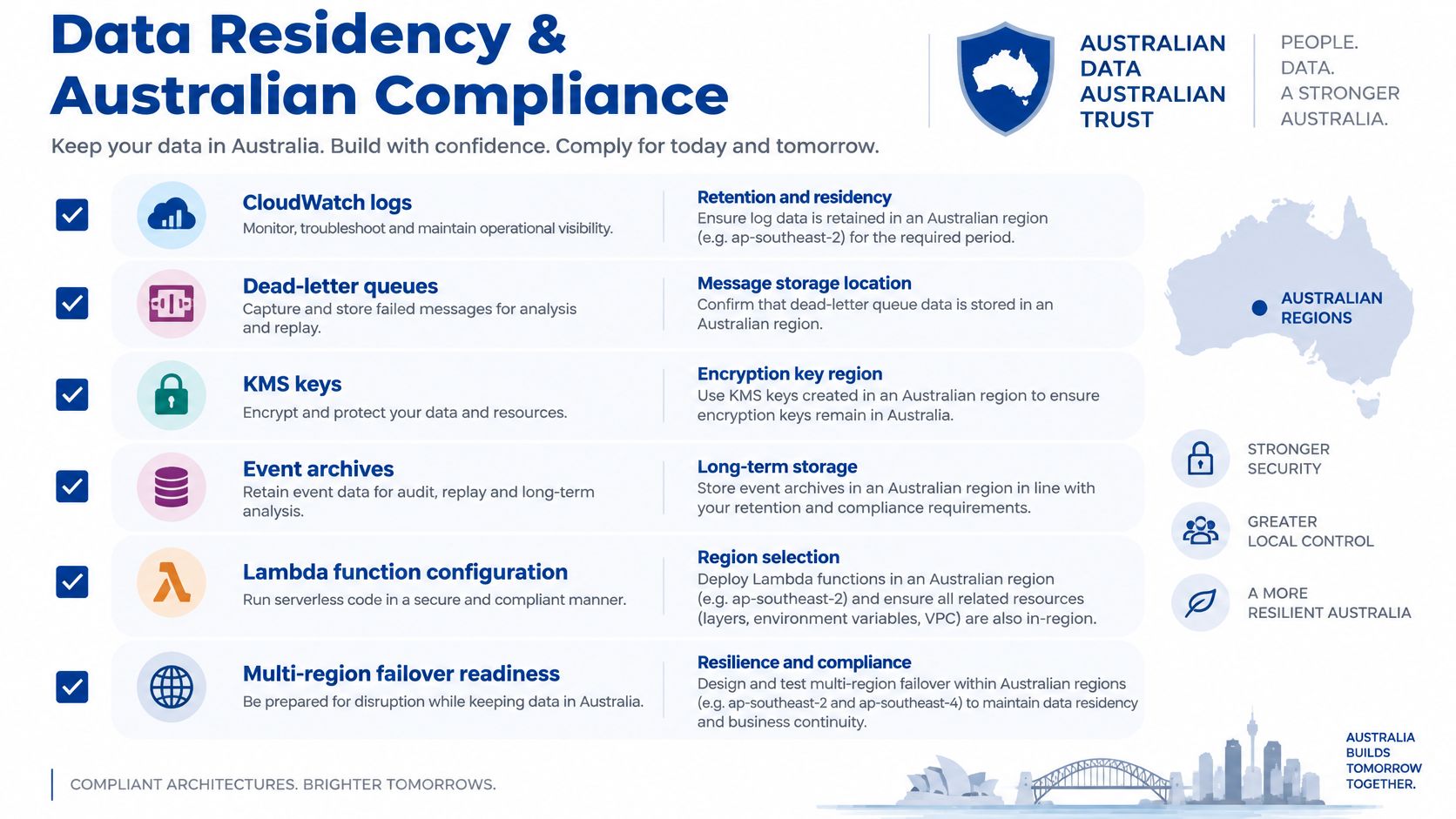
Picking an Australian Region isn’t only a latency decision. For NGOs handling donor data, health adjacent systems, and regulated enterprises, residency applies to every component that stores or copies information.
Australian teams have two in-country options. The Asia Pacific (Sydney) Region, ap-southeast-2, launched on 12 November 2012, and the Asia Pacific (Melbourne) Region, ap-southeast-4, launched on 23 January 2023, according to AWS Region launch history. That pairing enables disaster recovery designs that keep data inside Australia.
Map every component, not just the database
Residency gaps usually hide in supporting services:
- CloudWatch logs: Log groups live in a Region and may contain personal data from payloads.
- Dead letter queues: Failed messages retain full event content, often for days.
- KMS keys: Key location governs where encrypted data can be decrypted.
- Event archives and backups: Replay copies and snapshots need the same controls as primary stores.
- Secrets and configuration: Replicate deliberately, not by copying exports offshore.
Australia’s CSIRO built its sBeacon platform with S3, Lambda, DynamoDB, and Athena for secure genomic variant querying, as described on the AWS Architecture Blog Lambda category. It shows Lambda composing managed services for sensitive research data, though you’ll still need your own controls for identity, encryption, auditability, and schema governance.
Failover must be provisioned
Quotas don’t transfer between Regions. Concurrency, downstream database capacity, networking, and observability must exist in the secondary Region before you need them. Define RTO and RPO per workload, replicate only what those objectives require, and test the cutover. An untested failover plan is a hypothesis. If you’re costing that work, our breakdown of AWS migration costs in Australia helps scope the dual-Region investment.
Residency is a property of the whole system, including logs, queues, and keys. Audit the copies, not just the source.
Common Mistakes, Trade-Offs, and Practical Next Steps
Most Lambda problems we remediate in Australia aren’t exotic. They’re predictable consequences of skipping design decisions that servers used to hide.
Mistakes that recur
Missing idempotency on queue triggers. If an SQS batch invocation fails, messages normally become visible again after the visibility timeout, including ones you already processed. Partial batch responses let you return only failed items using ReportBatchItemFailures and a batchItemFailures response, as set out in SQS error handling for Lambda. Pair that with idempotency keys in your handler and a dead letter queue, so repeated failures don’t snowball.
Undersized visibility timeouts. AWS recommends a visibility timeout of at least six times the function timeout, per configuring Lambda with SQS. Shorter values cause premature redelivery, duplicate processing, and confusing duplicate side effects in CRM or payment systems.
Batch size chosen by guesswork. Standard queues allow a maximum batch of 10,000 messages while FIFO queues allow 10, and a batch ships in one invocation only within the 6 MB synchronous payload quota, according to SQS event source parameters. Oversized batches amplify failure blast radius. Undersized batches waste invocations.
Oversized memory and broad IAM roles. Both inflate risk, one through GB-second cost, the other through blast radius if a function is compromised. Our roundup of common AWS mistakes SMEs make covers the account level habits behind these patterns.
Architecture diagrams with no failure path. If the diagram doesn’t show retries, dead letter queues, throttling behaviour, and Regional degradation, it’s a marketing picture, not an architecture. AWS notes Lambda applications can deploy across multiple Regions with API Gateway routing, in its application design concepts, but you must supply the residency and recovery decisions yourself.
Trade-offs to accept consciously
Lambda trades host control for event design. You gain scale to zero, fine-grained billing, and managed scaling. You accept timeout limits, concurrency management, and debugging across distributed services. For steady, heavy, long-running workloads, containers often win on simplicity. For spiky integrations, mobile backends, webhook processing, and automation, Lambda usually wins on cost and operational effort.
Practical next steps
- New workload: Run a short discovery to classify patterns, residency constraints, and peak behaviour before writing functions.
- Existing estate: Commission an architecture review covering concurrency, memory sizing, IAM scope, queue settings, and observability gaps.
- Legacy replacement: Phase the migration, moving discrete event-driven pieces first while the monolith keeps running, rather than attempting a single cutover.
Start with one workload, measure cost per transaction and tail latency in your chosen Australian Region, and let those numbers guide expansion. That discipline separates a Lambda architecture from a collection of functions.
If you’re designing a new Lambda workload or stabilising one that’s outgrown its first diagram, we can review your architecture, quotas, and residency posture across the Sydney and Melbourne Regions. Visit Continuum Solutions to discuss a discovery session or a phased migration plan for your team.