You usually realise you've got the wrong AWS setup when the migration project is “done”, but the work keeps getting harder. The app is live, the board wants a clean handover, finance is staring at a fresh cloud bill, and security has started asking for evidence that nobody documented during delivery. That's the point where aws consulting services stop being a project and become an operating model.
In Australia, that shift matters more than many teams expect. AWS now has two in-country Regions, Sydney and Melbourne, and AWS says customers can choose where content is stored and keep workloads onshore when that's the requirement AWS Australia and New Zealand compliance guidance. For regulated buyers, that turns consulting into a mix of architecture, compliance, cost control, and handover discipline, not just build work. If you treat it as a one-off migration, you usually pay twice, once during the project, and again after go-live.
Table of Contents
- Why AWS Consulting Is a Lifecycle Decision, Not a One-Off Project
- The Core Service Categories Inside AWS Consulting
- How a Phased AWS Migration Actually Unfolds
- Tailoring AWS Consulting to Enterprise, NGO, Startup, and Ecommerce Buyers
- The Real Cost of AWS Consulting in Australia
- Choosing the Right AWS Consulting Partner
- Your Next Steps With AWS Consulting Services
Why AWS Consulting Is a Lifecycle Decision, Not a One-Off Project
A 60-person fintech goes live after a four-month migration. The handover deck looks neat, the engineers are back on feature work, and leadership is relieved that the old hosting contract is finally gone. Then the first quarterly bill lands, a PSP audit asks for logging and encryption evidence, and two engineers lose half a day untangling IAM drift that nobody owned after cutover.
That's the shape of AWS work. Migration is only the first phase, and the rest of the cost sits in stabilisation, optimisation, and compliance upkeep. AWS's Melbourne Region launch made this even more obvious for Australian buyers, because local-region architecture, low latency, and data handling choices now sit inside the consulting conversation, not outside it AWS's Melbourne Region announcement.
Practical rule: if a consultant only talks about getting workloads onto AWS, they're selling you a finish line that doesn't exist.
I'd frame the lifecycle like this. First comes migration, where the team moves workloads and proves the target architecture is viable. Then stabilisation, where the environment stops wobbling and the support model becomes real. After that comes optimisation, where the bill, the performance profile, and the service boundaries get tuned. Finally, continuous compliance becomes part of the operating rhythm, especially where audits, procurement checks, or board risk reporting are involved.
That's why a handover should never be treated as the end of the engagement. It should be the point where the consultant proves the environment can be run by your team, or by a managed service with clear controls. If you're still figuring out common delivery traps, I'd also keep an eye on common AWS mistakes SMEs make, because most post-go-live pain starts there.
The Core Service Categories Inside AWS Consulting
Most buyers get tripped up because they ask for “AWS consulting” as if it were one thing. It isn't. The work usually falls into four practical buckets, and the engagement you need depends on which bucket is broken inside your team right now.
Migration and modernisation
This is the visible part. It covers lift-and-shift moves, re-platforming, and proper refactoring when the application is too brittle to carry over unchanged. In practice, that can mean moving databases, untangling old network assumptions, or breaking a monolith into services that your engineers can support. If a partner can't explain how they'd move your workload with the least blast radius, they're not ready for your production estate.
Architecture and engineering
The serious money gets protected. Good consultants design multi-account structures, account boundaries, network segmentation, IAM patterns, and security baselines that fit the business, not a generic template. They also run Well-Architected reviews, which are useful when your architecture is already in AWS but no longer makes sense under current compliance or scale pressure.
Cost optimisation and FinOps
This is the category too many teams leave until the invoice hurts. It includes rightsizing, storage tiering, reserved capacity decisions, tagging discipline, budgets, and reporting cadence. Done properly, it gives finance and engineering the same numbers instead of two different stories.
Managed operations and security
The environment becomes sustainable when it covers monitoring, incident response, patching, IAM governance, alert tuning, and evidence collection for control frameworks that matter to Australian buyers, including ISO 27001, SOC 2, CPS 234, and the Essential Eight. If your consultant can't explain the handover into steady-state operations, they're not offering a full service, they're offering a project with a blind spot.
| Category | Core deliverables | Typical buyer | Primary outcome |
|---|---|---|---|
| Migration and modernisation | Workload moves, re-platforming, refactoring, database transition | CTOs, engineering leaders | Workloads land safely and stay supportable |
| Architecture and engineering | Landing zones, account design, network topology, Well-Architected review | Platform teams, security teams | A structure that can scale without chaos |
| Cost optimisation | Rightsizing, tagging, FinOps reporting, storage decisions | Finance, CTO, ops leaders | Lower waste and better budget control |
| Managed operations and security | Monitoring, incident response, patching, IAM governance, evidence packs | IT managers, regulated buyers | Stable service with ongoing assurance |
If you're sizing up options, a provider such as Continuum Solutions can sit across migration, cloud architecture, and managed support, which is useful when one team needs design, build, and handover under the same roof.
How a Phased AWS Migration Actually Unfolds
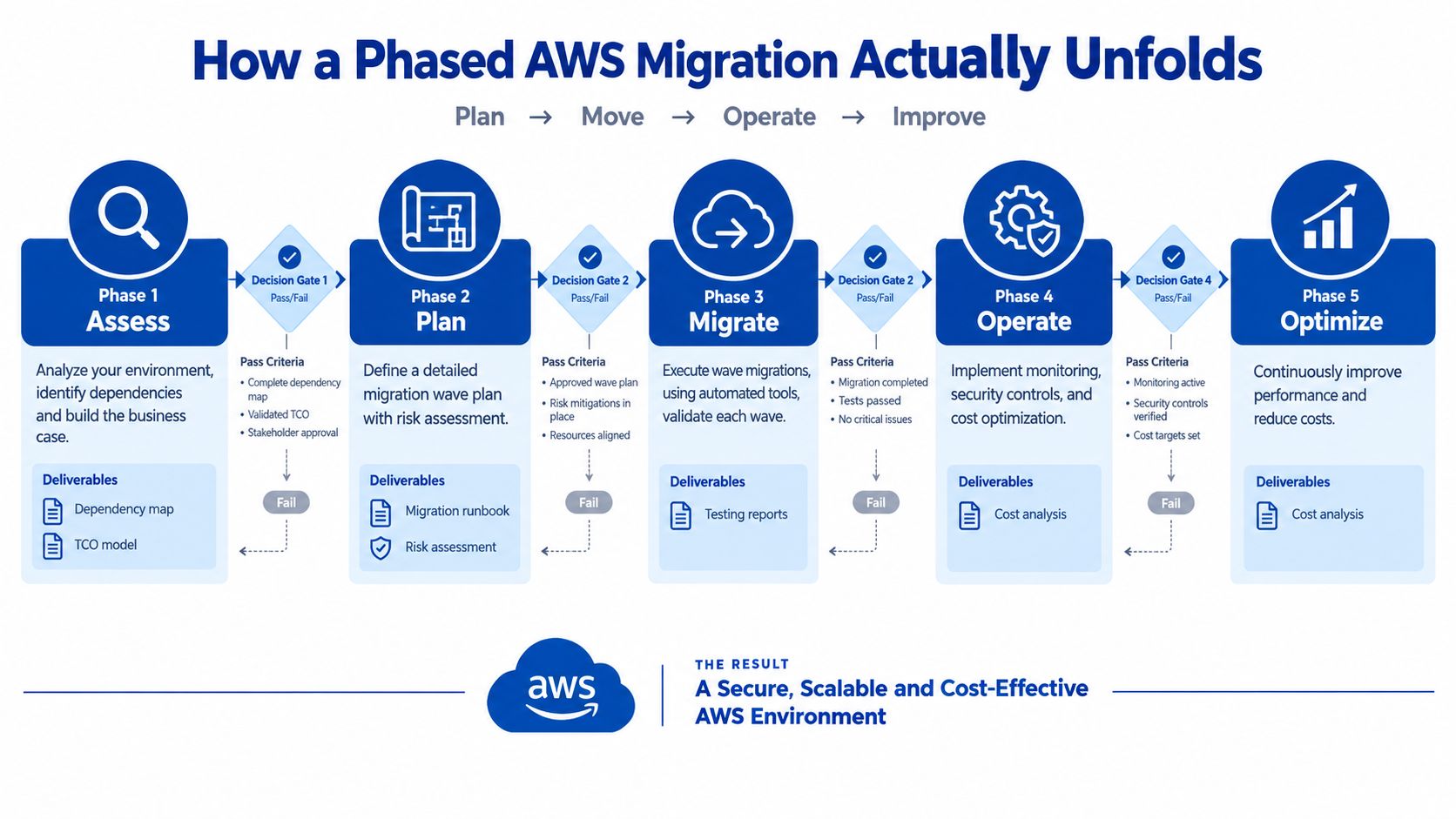
The cleanest AWS migrations I've seen don't start with the big workloads. They start with a decision gate. The team assesses the estate, proves the economics, and only then commits to design and delivery. That discipline matters because Australian buyers are often juggling compliance, internal politics, and a live business that can't afford a guess.
Assess and design
The assess phase should produce a dependency map, a TCO model, and a risk register. That's the output, not a slide deck full of cloud buzzwords. If the consultant can't show you what depends on what, you don't have a migration plan, you have optimism.
Design comes next, and it should include a target architecture, a Landing Zone blueprint, a security baseline, and a migration wave plan ordered by blast radius. That sequencing is what keeps low-risk systems from getting blocked behind fragile ones. The gate at the end of design should be written, not verbal, and it should answer a simple question, are we ready to spend real money on implementation?
A migration that skips written gates usually turns into a calendar problem before it turns into a technical problem.
Pilot, cutover, and optimise
The pilot should move one non-critical workload end to end. That tells you whether IAM patterns work, whether the cutover runbook is usable, and whether your tooling behaves the way the consultant promised. If the pilot fails, you've bought a cheap lesson instead of a costly outage.
Cutover is where the waves execute, rollback criteria are enforced, and the war room stays active until the service is stable. After that, optimisation should begin within the first month. It covers rightsizing, tagging hygiene, Savings Plan decisions, and the point where the project hands over into managed operations. The mistake is treating optimise as optional, because that's where the hidden cost starts to show up.
For teams planning the move, AWS migration services should always be judged by how the consultant handles these gates, not by how elegant the architecture diagram looks.
Tailoring AWS Consulting to Enterprise, NGO, Startup, and Ecommerce Buyers
The wrong consultant sells the same AWS plan to everyone. That's lazy, and it usually fails in predictable ways. A finance director, an NGO operations lead, a startup CTO, and an ecommerce manager all buy different outcomes, even if the tools sit in the same AWS account.
Enterprise and NGO priorities
Enterprise buyers usually care about audit-ready controls, identity federation, integration with existing service desks, and a landing zone that won't collapse under internal governance. The migration itself is often the easy part. The hard part is making AWS fit the organisation's risk framework and operating model.
NGOs face a different constraint. They need systems they can sustain with thin teams and irregular funding. That pushes the architecture towards managed services, reusable infrastructure-as-code, and a smaller support burden. A consultant who adds complexity to “show value” is working against the buyer's reality.
Startup and ecommerce priorities
Startups usually want velocity and runway discipline. They don't need a large consulting team, they need a narrow intervention that makes a small product team faster. That could be a serverless API skeleton, CI/CD baseline, or a simple guardrail that stops cost from drifting before product-market fit is clear.
Ecommerce sits in the middle. It needs elasticity, caching, and observability that won't buckle under traffic spikes, while also staying tight on encryption, tokenisation, and boundary controls. Seasonal peaks punish weak architecture fast, so the consultant's job is to protect conversion and keep the platform legible for ops.
| Buyer | Primary constraint | Typical consulting focus | Risk profile |
|---|---|---|---|
| Enterprise | Governance and integration | Landing zones, identity, audit controls | Slow approvals, high compliance exposure |
| NGO | Limited headcount and budget | Lean architecture, managed services, reusable code | Supportability risk if the build is too complex |
| Startup | Speed and runway | Narrow build support, cost guardrails | Overbuilding and unnecessary platform weight |
| Ecommerce | Seasonal load and revenue sensitivity | Scaling, caching, observability, security controls | Outages and performance regressions during peaks |
If your business runs a membership or subscription model, the same logic applies. AWS hosting for membership platforms is never just about uptime, it's about retaining clean data flows, keeping auth stable, and making the platform maintainable when the team is small.
The Real Cost of AWS Consulting in Australia
The first mistake buyers make is comparing AWS consulting on day rate alone. That's too shallow. You're not paying for hours, you're paying for risk reduction, delivery quality, and whether the environment can still be run six months later.
Australian pricing varies widely. Focused advisory work can be materially cheaper than a full migration programme, and regulated programmes cost more because the design, evidence, and governance layers take real effort. If you want a useful starting point for migration budgeting, this Australian AWS migration cost guide is the better lens than a generic hourly rate page.
What many buyers miss is the ongoing compliance bill. Once workloads land in AWS, logging, monitoring, key management, secrets handling, and security tooling add overhead that doesn't disappear after launch. That's why the cheapest consulting proposal often becomes the most expensive operating model.
Where the budget usually gets distorted
- Discovery gets underfunded. Teams want to move fast, so they skip the detailed dependency work and pay for it later in rework.
- Security is treated as a bolt-on. That creates late-stage friction, especially when audit evidence or control mapping appears after cutover.
- Optimisation is left for later. Later usually means after the first ugly bill.
My rule of thumb: if the proposal doesn't include the handover and operating cadence, it isn't a full AWS engagement, it's a build sprint with missing paperwork.
For cost-sensitive buyers, the question isn't whether AWS consulting is expensive. It's whether you want a one-time build or a lifecycle model that keeps the platform safe, measurable, and supportable. The second option costs more upfront, but it usually avoids the far larger cost of patching a rushed environment after go-live.
Choosing the Right AWS Consulting Partner
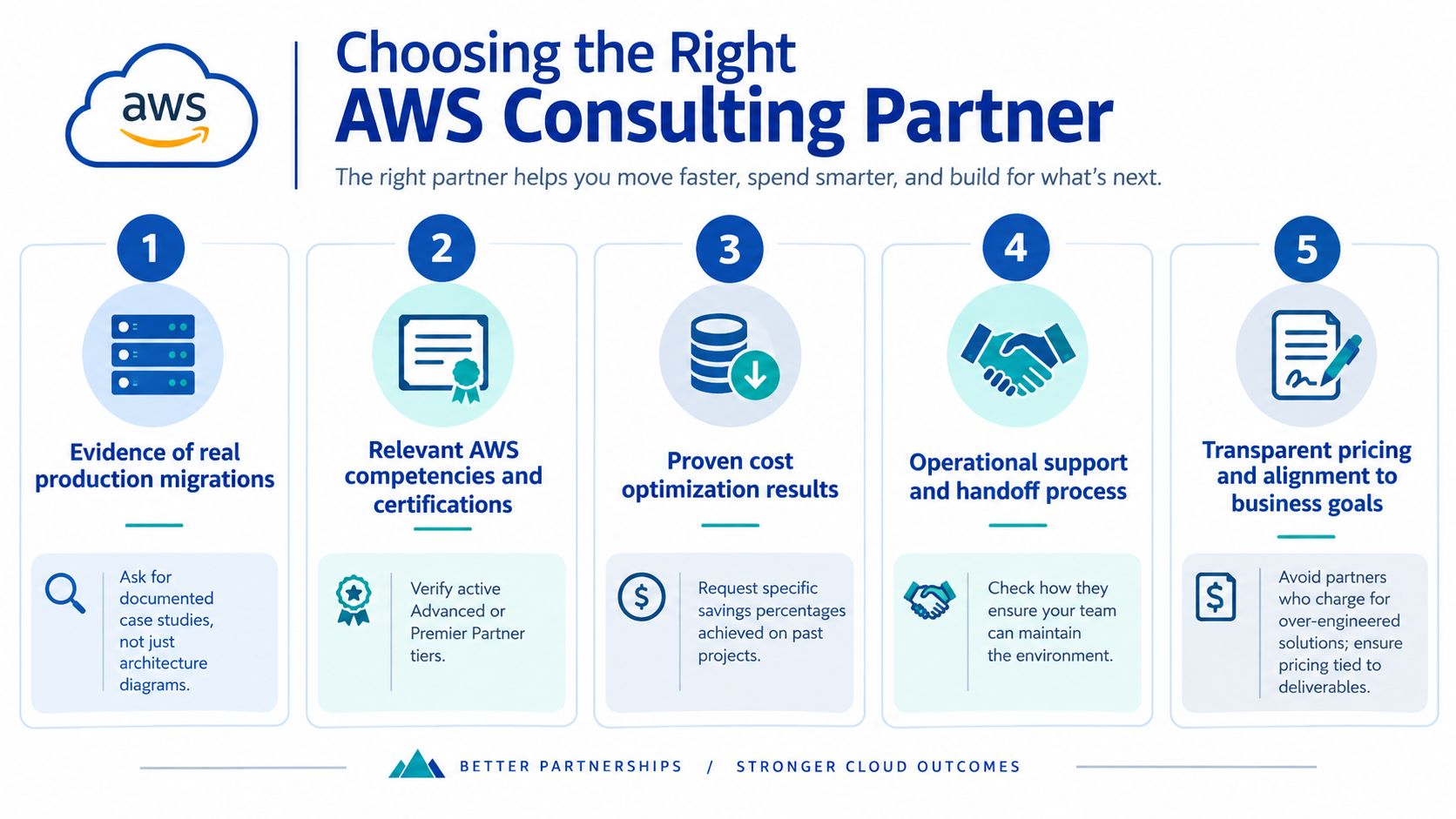
Pick on price and you'll usually buy rework. Pick on headcount and you'll often get a good sales deck with a weak delivery team. What matters is whether the consultant has carried a workload from discovery through cutover and into steady-state support.
What to ask before you sign
Start with architecture depth. Ask how they would structure accounts, network boundaries, and identity for your compliance posture, not for a generic reference design. If the answer is vague, they're selling packaging, not judgement.
Then test phased delivery. A serious partner will treat discovery, pilot, and cutover as separate stages with clear exits. That tells you they expect to earn the next phase through evidence, not assumption.
Finally, press on post-go-live accountability. You want named contacts, response expectations, and an optimisation cadence at 30, 90, and 180 days. If nobody owns what happens after launch, you've got a handover risk sitting in the contract.
Signals that matter more than slogans
- Production evidence: ask for migration examples where the team supported the environment after go-live, not just designed it.
- Partner status and certifications: useful, but not enough on their own.
- Internal controls: ask whether the consultancy itself has structured security and quality processes.
- Commercial shape: fixed-price discovery, time-and-materials build, and a managed tail priced per environment is usually healthier than one oversized statement of work.
If you want a provider that can cover cloud architecture, migration, and ongoing support in one engagement, cloud computing consulting is the category to compare, but only after you've checked how they handle handover in practice.
Your Next Steps With AWS Consulting Services
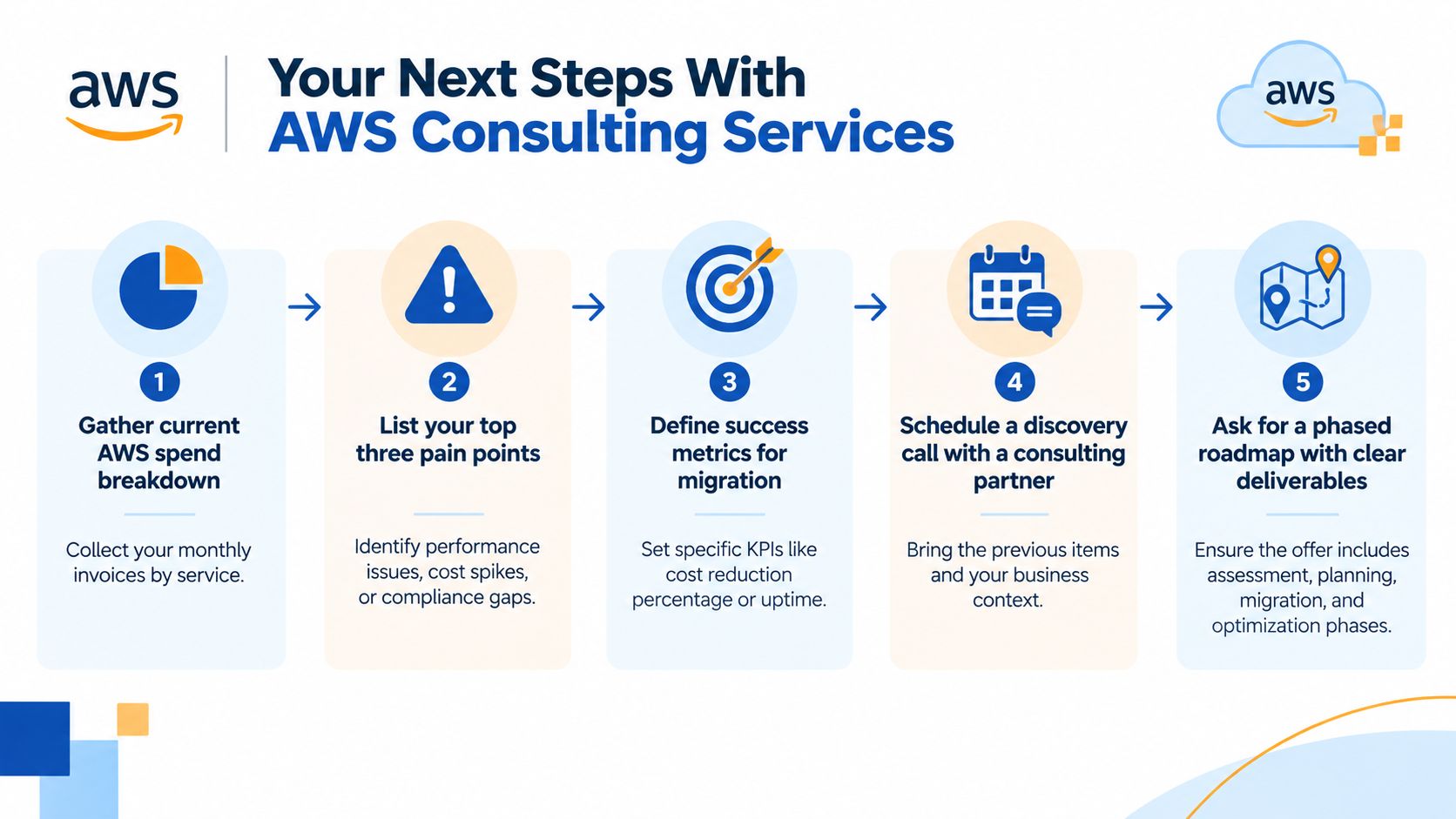
Bring the right material to the first conversation and you'll get a better answer straight away. I'd walk into the call with your current AWS spend breakdown, the top three pain points, your compliance obligations, and the go-live horizon you need. If those four things aren't on the table, the consultant will spend the first meeting guessing.
A low-commitment first engagement should be narrow and concrete. A two-week architecture review or migration readiness assessment works well because it forces a dependency view, a risk list, and a go or no-go decision without locking you into a full programme. That's the right size for NGOs, startups, and mid-market teams that need clarity before commitment.
What to ask on the discovery call
- Show me phased delivery: ask for a real example of assess, pilot, cutover, and optimise.
- Tell me who owns cost control after go-live: budgeting, tagging, and rightsizing shouldn't vanish after the project.
- Explain the escalation path: you need to know who answers when something breaks.
- Describe knowledge transfer: your team should be able to run the environment without depending on heroics.
- Prove the evidence, not the deck: ask for artefacts from similar work, not polished diagrams.
Sequence your internal stakeholders before procurement gets involved. The CTO should set the technical outcome, finance should define budget guardrails, security should define the essential requirements, and operations should pressure-test handover. That order saves time, because it stops the consultant from optimising for the wrong audience.
Australian engagements usually move faster when the scope is tight and the evidence is clear. A practical next step is to compare one migration-readiness assessment, one architecture review, and one managed services proposal side by side. If you want a team that works across AWS architecture, phased migration, and post-go-live support, start a conversation with Continuum Solutions and ask for a lifecycle plan, not just a build quote.