
You don't usually call in help with AWS because things are broken. You call when the stack has grown past the point where your team can keep up, the monthly bill keeps drifting, and the after-hours phone starts belonging to the same few people. At that stage, AWS Managed Services stops looking like a procurement line and starts looking like an operating model question.
That's the decision many Australian teams are making now. AWS has deep public-sector adoption in Australia, the local footprint keeps expanding, and cloud spend keeps rising, so the issue isn't whether AWS can host the workload, it's how to run it without letting cost, compliance, and overnight support drift out of control. If you're weighing self-managed AWS against a managed model, this guide is written for you, especially if you care about Australian data residency, service continuity, and a support model that won't buckle after the first migration wave. For broader cloud planning context, see Continuum Solutions' cloud consulting approach.
Table of Contents
- Introduction Why AWS Managed Services Matters Now
- What AWS Managed Services Is and How It Differs From Alternatives
- Core Responsibilities and Operating Model Inside AWS Managed Services
- Choosing Between Self Managed AWS AMS and Third Party MSPs
- Migration and Onboarding Checklist for AWS Managed Services
- Pricing Cost Optimisation and Governance That Lasts
- Next Steps and How Continuum Solutions Supports Your Transition
Introduction Why AWS Managed Services Matters Now
A lot of Australian IT leaders reach the same point in different ways. An operations manager inherits a growing AWS footprint after a migration, finance wants a clearer answer on cloud spend, and the internal team is already covering too much outside business hours. The issue isn't that AWS is unreliable, it's that reliability, patching, monitoring, reporting, and incident handling all need a steady operating rhythm, and that rhythm is hard to maintain when the team is already stretched.
AWS is already treated as a government-grade platform in Australia, not a niche hosting choice. Australian government data cited by the Australian Computer Society says AWS had won more than A$712 million in Australian federal government contracts from September 2013 to April 2023, and the Digital Transformation Agency said more than 140 Commonwealth, state, and territory agencies were already using AWS in its 2025 whole-of-government arrangement. The Australian Bureau of Statistics also renewed a three-year AWS services contract worth A$10.6 million in 2022 to support new statistical services and reduce technical debt, which is a good reminder that managed cloud isn't just about servers, it's about durable operating discipline. Those figures come from the ACS coverage of Australian government AWS usage.
That context matters because Australian cloud demand is still large and still moving. AWS launched its second infrastructure region in Australia in January 2023, and Gartner forecast that Australian organisations would spend more than A$33.6 billion on public cloud services in 2026, up 17.9% from 2025, according to AWS's own launch announcement. AWS also states that its Sydney and Melbourne regions each have three Availability Zones, which gives teams more options for resilience without pushing day-to-day operations offshore. You can see the practical implications in AWS's Australian cloud architecture and migration options.
The point of this guide is simple. If you're responsible for uptime, residency, and spend control, you need to know whether AWS Managed Services is the right layer, what it covers, what stays on your side, and where the commercial traps sit.
What AWS Managed Services Is and How It Differs From Alternatives
AWS Managed Services is an operations layer run with AWS guardrails around your environment. Think of it less like renting a server and more like handing building management to a specialist while you still own the tenancy fit-out, the business process, and the floor plan. AWS handles a defined set of operational tasks, but it doesn't take over every design choice or every application decision.
The big mistake buyers make is lumping every managed option together. Self-managed AWS means your team owns the platform, the patching, the backup design, the incident playbooks, and the overnight escalation path. A third-party MSP can take on some or most of that work, but quality varies a lot by provider, and the operating model depends heavily on how the partner structures support, governance, and commercial incentives. AWS Managed Services sits in the middle, because AWS is operating within its own service model and giving you a standardised framework rather than a fully bespoke outsourced stack.
AWS says AMS Accelerate is an operations support plan for organisations that want help achieving operational excellence on AWS, and its regional service pages show that managed services and the Advanced Operations Plan are available in the Asia Pacific (Sydney) region. AWS also says AMS provides 24×7 global coverage with tier-1 response and remediation, which is a major practical difference for teams that don't want to build an internal overnight roster. For Australian buyers, that matters because the operations layer can be delivered in-region, rather than depending on offshore day-to-day support for every incident. AWS's public-sector guidance on AMS Accelerate is the clearest starting point.
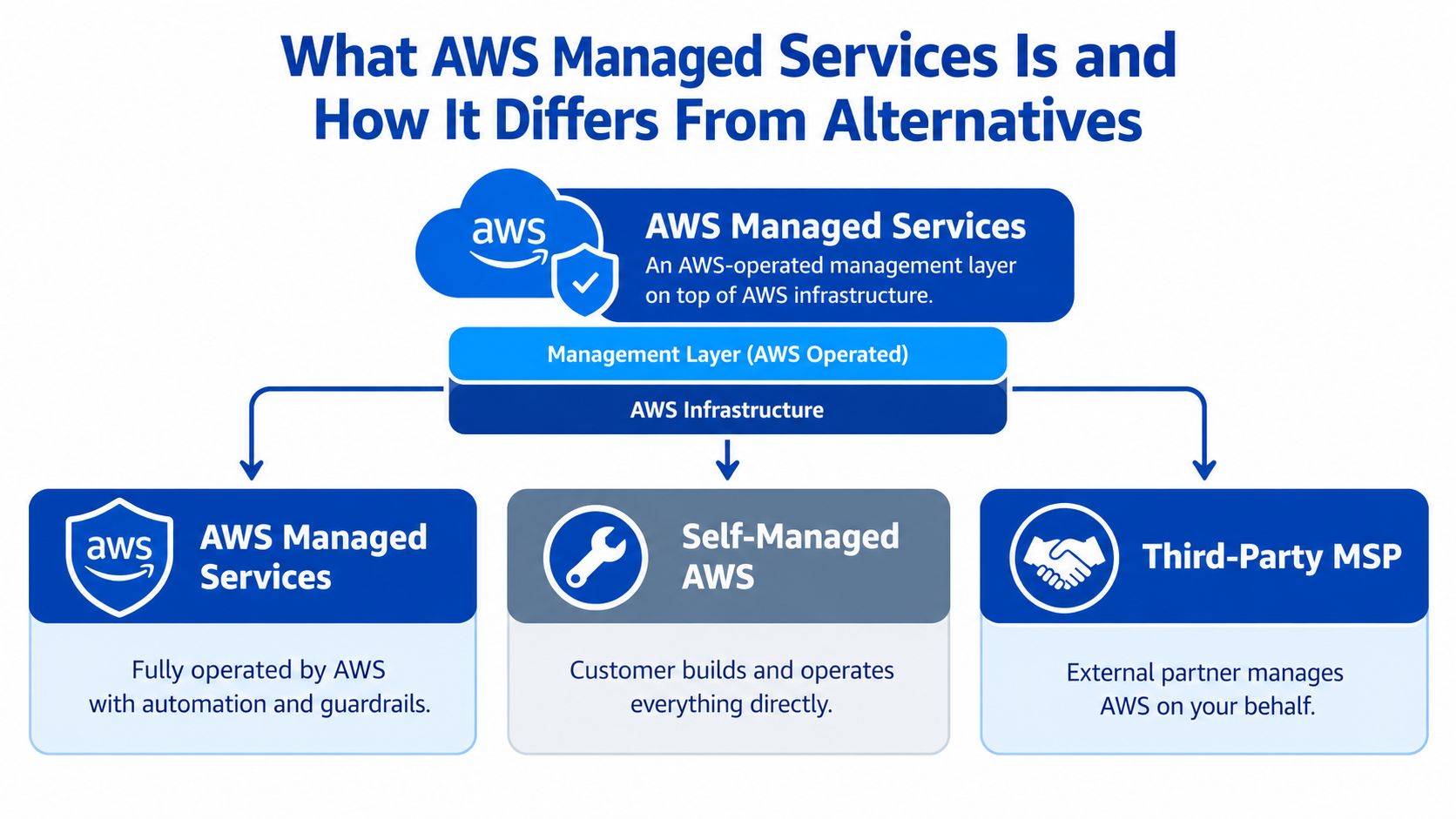
The three operating paths
- AWS Managed Services, useful when you want standardised operations, AWS-run coverage, and fewer moving parts in the support model.
- Self-Managed AWS, useful when your team has the skills, time, and appetite to own day-to-day operations end to end.
- Third-Party MSP, useful when you want a partner-led model with more room for bespoke processes, custom integrations, and provider choice.
Practical rule: if your team can't explain who owns patching, backup checks, incident triage, and cost reviews at 2 a.m., the operating model isn't mature enough yet.
The decision lens is straightforward. Choose self-managed AWS when internal control matters more than support efficiency. Choose AWS Managed Services when you want a standard operating framework and region-local delivery. Choose a third-party MSP when your workload needs custom handling that AWS's managed model won't expose cleanly. For application fit decisions that often drive that choice, this hosting comparison is a useful companion.
Core Responsibilities and Operating Model Inside AWS Managed Services
The best way to understand AWS Managed Services is to look at the work it takes off your plate and the work it leaves behind. The service is not a blank cheque for all operations, and it's not a replacement for architecture discipline. It's an operating boundary, which means the value only appears when the boundary is clear.
AWS states that AMS provides 24×7 global coverage with tier-1 response and remediation. That reduces the need for your own overnight operations team, especially if your current model relies on engineers being on call for alerts that are mostly routine. In practice, that coverage can absorb a lot of the noise, but it doesn't remove the need for good service ownership on your side.
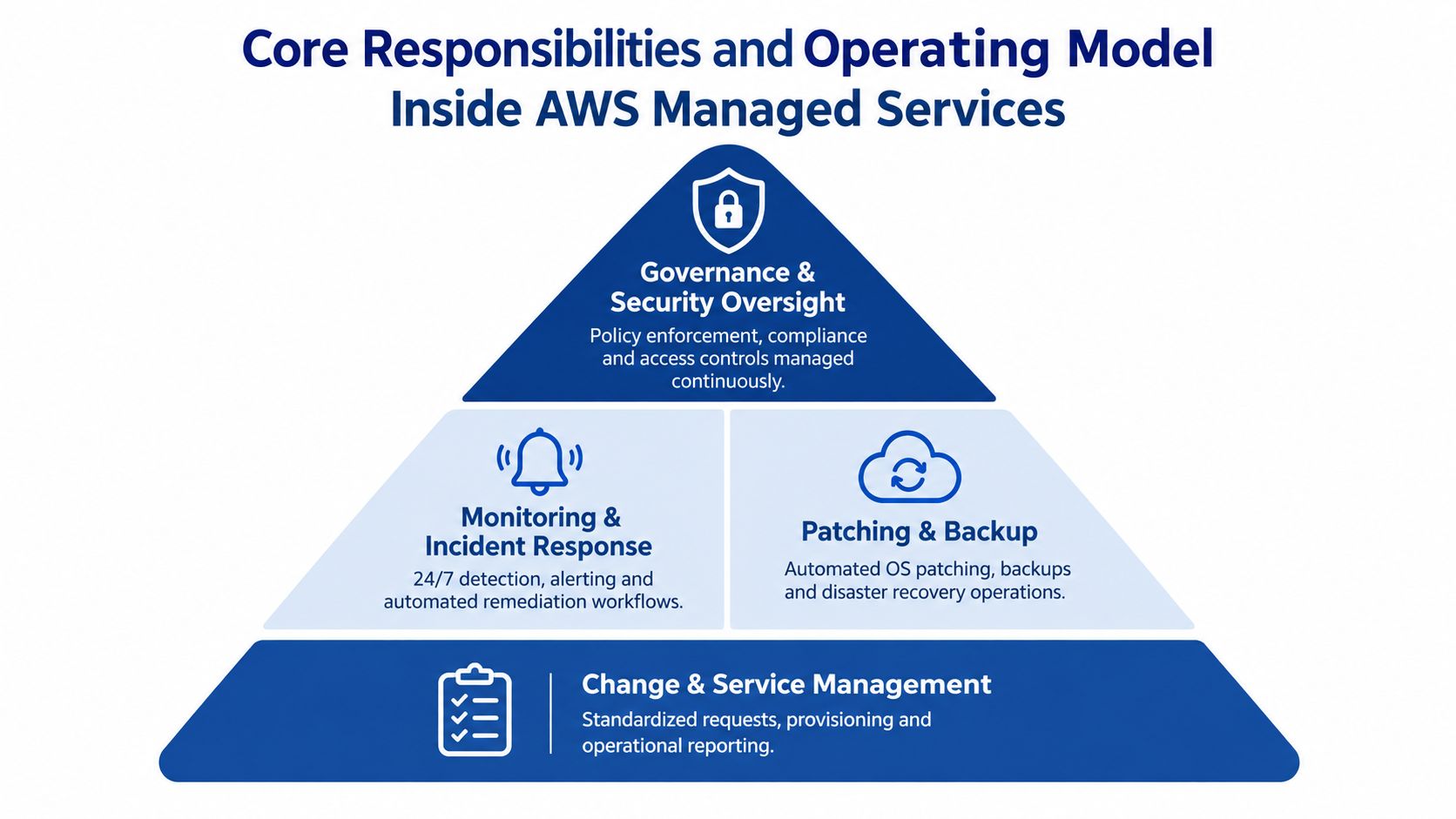
What AMS typically handles
AWS's managed-services materials point to a pattern many Australian teams recognise:
- Monitoring and incident response, so alerts, triage, and first-pass remediation don't all land on your internal engineers.
- Patching and backup operations, which removes a lot of repetitive admin work if your environment is standardised.
- Governance and security oversight, which matters when audit evidence, access controls, and policy enforcement need to be repeatable.
- Change and service management, so requests and operational reporting aren't handled ad hoc.
A useful example is an NGO running membership, donations, and volunteer systems on AWS. The organisation may not need a large ops team, but it still needs reliable uptime, documented access control, and clear incident handling. That's where a managed model helps, because it gives smaller teams a way to operate critical services without improvising every runbook.
What still stays with the customer
AWS Managed Services doesn't own your application code, your release decisions, or your business priorities. Your team still owns architecture choices, data model changes, integration logic, and whether a workload should be replatformed, refactored, or retired. If that ownership isn't clear, people blame the managed service for problems that started in the application layer.
The cleanest way to run AMS is to treat it like a RACI, even if you don't formalise it that way on paper. AWS owns the standard operational layer. Your team owns the workload design, the business rules, and the decisions that affect compliance and data movement.
For teams that need observability around those responsibilities, enterprise application monitoring and debugging becomes part of the handover design, not an afterthought.
Good managed-service hygiene is boring on purpose. If your monitoring, access control, and backup evidence are not documented, the provider can't save you from ambiguity.
The operating model works when the boundary is explicit. It fails when teams assume AWS will also solve weak release management, unclear ownership, or messy integration dependencies.
Choosing Between Self Managed AWS AMS and Third Party MSPs
A Sydney-based team running regulated workloads often starts with the same question. Keep operations in-house, hand them to AWS Managed Services, or bring in a third-party MSP. The core decision is not just about support. It is about how much control you need over governance, audit evidence, and cost discipline after the migration settles.
Self-managed AWS gives you the most freedom, and the most burden. Your team owns the runbooks, the after-hours coverage, the alert tuning, and the evidence trail for auditors and procurement teams. AWS Managed Services reduces the operational load by standardising the control layer, while a third-party MSP can sit in the middle if you need more customisation without taking everything back inside.
Operating Model Comparison for AWS Workloads
| Criteria | Self-Managed AWS | AWS Managed Services | Third-Party MSP |
|---|---|---|---|
| Cost predictability | Can work well with an experienced team, but support effort stays internal | More structured, with managed operations layered onto AWS usage | Depends on contract design and how tightly the provider governs change |
| Operational overhead | Highest internal burden, especially after hours | Lower internal burden for routine operations and tier-1 response | Can be lower than self-managed, but provider maturity varies |
| Compliance evidence | Fully owned internally, so weak processes slow audits | Better standardisation for audits, runbooks, and evidence collection | Often good if the MSP understands compliance, but quality varies |
| Scalability | Scales with your team, which can become the bottleneck | Suits standardised scaling and repeatable operations | Works well if the partner is built for your workload shape |
| SLAs | Internally defined and often hard to sustain overnight | Clearer managed-operations model | Depends on the provider and escalation design |
| Flexibility | Highest flexibility for custom integrations and edge cases | Good for standard operations, less flexible for bespoke needs | Usually the most flexible outsourced option |
If the workload is stable, regulated, and needs a clean support boundary, AWS Managed Services is often easier to defend with finance, procurement, and risk stakeholders. It gives you a clearer operating model, which matters when residency rules, access controls, and cost allocation all need to hold up after the project team has moved on.
If you need unusual integrations, deep bespoke process handling, or a hybrid operating model across multiple platforms, a third-party MSP may be the better fit. If your internal platform team is already mature, self-managed AWS can still be the right choice because you keep architectural freedom and avoid paying for duplicate support layers.
The common mistakes are predictable. Teams underestimate on-call load, assume managed services will fix cost creep on their own, or customise the operating model until it no longer behaves like a managed service. Smaller teams can run complex environments, but only if tagging, alerting, runbooks, and escalation paths are disciplined enough to support audit and budget control.
For organisations that need both application change and cloud operations support, the operating model should be chosen alongside the migration plan rather than after it. The best answer is the one that matches internal capability, compliance exposure, and the amount of bespoke control the workload needs.
Migration and Onboarding Checklist for AWS Managed Services
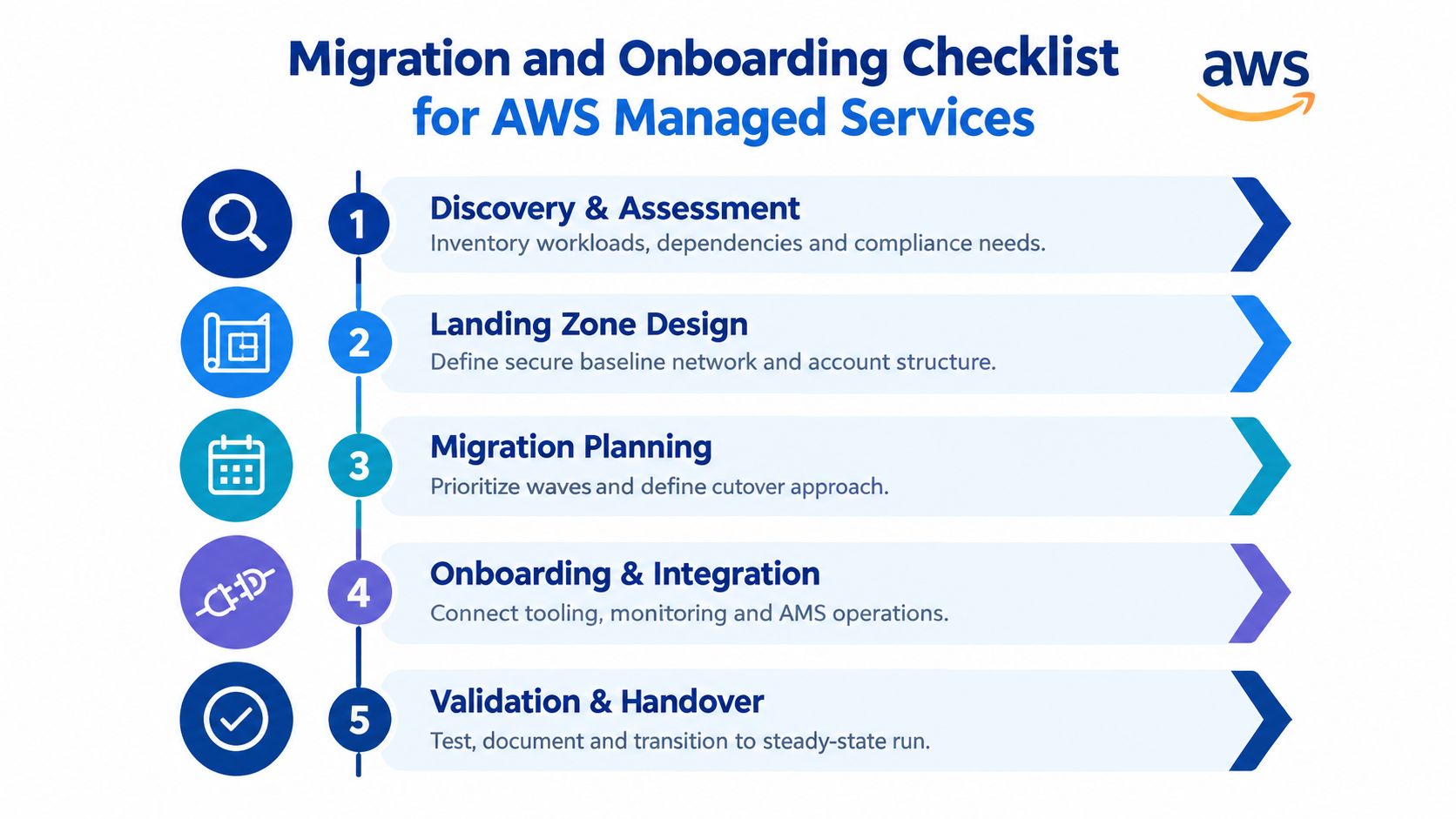
Moving into AWS Managed Services is less about switching a contract and more about proving the environment is ready for standardised operations. The better the discovery and landing-zone work, the less pain you get later when incidents, audits, or cost reviews start exposing gaps. If you rush onboarding, the managed layer inherits your ambiguity.
Five checks that reduce cutover risk
- Inventory the workloads properly. Document dependencies, owners, release paths, and compliance constraints before the first migration wave. This is the point where hidden integration links usually show up.
- Design the landing zone for residency and recovery. Build around the Sydney and Melbourne regions, with multi-AZ resilience inside the chosen geography rather than assuming global defaults.
- Write the backup and replication rules. AWS's privacy guidance says customers choose where content is stored, can deploy exclusively in Sydney, and can replicate or back up across regions only with agreement except where legally required. That means the replication policy has to be deliberate, not accidental.
- Build the service matrix. AWS says region-aware service availability matters, so check which services exist in which region before you standardise on a pattern. A service that works in one region may not be available everywhere you plan to use it.
- Hand over runbooks with observability attached. Tooling patterns such as Sentry and New Relic make sense when they're part of the transition package, not bolted on after the cutover.
A Melbourne-based agency supporting NGOs and enterprises needs this kind of discipline because the managed model only works if the environment is already predictable. That's why staging, validation, and handover documentation matter more than glossy migration slides.
The safest cutovers are the ones where every dependency has a named owner and every rollback path has been tested in writing, not assumed.
For teams that need structured migration support, cloud migration services should be scoped around landing-zone design, cutover planning, and post-migration validation, not just the lift itself. That's the difference between moving workloads and operationalising them.
Pricing Cost Optimisation and Governance That Lasts
A managed AWS setup only pays off when you measure the full operating cycle, not the first month after go-live. AWS describes its approach as identifying, presenting, agreeing, optimising, and measuring savings, and its managed-services material says customers receive monthly cost and utilisation reports. That reporting helps, but only if someone inside the business owns the decisions that follow.
The Australian procurement context matters. Government procurement data shows the AWS whole-of-government arrangement is scheduled to run on a three-year term through 31 March 2028, with fees of 0% to 2.5% of agency spend depending on the arrangement. The central issue is not the fee itself, it is whether the fee keeps returning value after the first round of savings. In practice, the hard part is stopping optimisation from fading once the easy wins are captured.
What tends to work
AWS says customers see 10 to 15% annual operational and AWS cost savings on average, but those gains do not hold on their own. They need ownership around instance right-sizing, scheduling, reserved capacity reviews, tagging discipline, and budget controls. They also need a clear line between the provider's recommendations and the business's final approval, otherwise spend drift has no clear owner.
A lot of buyers focus too narrowly on compute costs and miss the messier issues. Oversized instances, unmanaged data transfer, and duplicate environments can erase the initial win. Monthly utilisation reviews and quarterly re-baselining keep the optimisation work alive as a control process, not a one-time clean-up.
What to govern tightly
- Budget ownership, so finance, platform, and application leads know who approves spend changes.
- Tagging and cost allocation, so cost is not hidden inside a shared account.
- Report cadence, so monthly reviews turn into decisions, not just PDF filing.
- Exception handling, so production urgency does not become a standing excuse for overspend.
For Australian teams that want to avoid the common traps, common AWS mistakes SMEs make usually starts with the same pattern, weak visibility first, then cost surprises, then governance catch-up. The fix is to treat cost control as part of the operating model, not a separate finance task.
If nobody owns the monthly review, the managed-service savings usually drift away.
That is why the strongest AWS managed-services setup in Australia works like a governance mechanism, not just a support wrapper. It keeps residency decisions, reporting cadence, and cost accountability tied to the workloads themselves.
Next Steps and How Continuum Solutions Supports Your Transition
If the current AWS setup is already stretching your team, the next step is to separate workload risk from operating noise. Start by identifying which systems need continuous support, which ones need residency controls, and which ones are wasting time through manual handling. Then phase the migration so the most stable workloads establish the operating pattern before you move the more sensitive ones.
A practical partner should be able to help with architecture, migration sequencing, observability, and steady-state support. Continuum Solutions is a Melbourne-based team that works across AWS architecture, phased migrations, application modernisation, and managed operations, with a delivery style built around small senior teams, documented handover, and measurable performance baselines. For buyers, that matters because the risk is not getting workloads onto AWS, it's keeping them stable, measurable, and supportable after the migration settles.
A sensible first move is a cost and operating-model review. That review should check current on-call burden, residency constraints, cost allocation, and whether your environment is better served by self-managed AWS, AWS Managed Services, or a hybrid with targeted partner support. If you want a guided pilot, pick one workload with clear dependencies, a known business owner, and enough operational pain to prove the value of a managed model without risking the core platform.
If you want a practical assessment of whether AWS Managed Services fits your current environment, Continuum Solutions can review the architecture, the support burden, and the cost-control gaps before you commit to a migration path. Visit Continuum Solutions to discuss a phased AWS plan, request a cost review, and line up a pilot that gives your team a clearer operating model without adding avoidable risk.