
You're already seeing it in the monthly bill, the slow cutovers, or the awkward silence after a post-migration incident review. The problem usually isn't that the team “doesn't know AWS”, it's that nobody owned the architecture decisions that stop a cloud project from turning into a sequence of expensive surprises.
An AWS Solutions Architect is the person who makes those decisions before they become operational debt. In Australia, that means choosing the right region, shaping the landing zone, sequencing migration waves, and forcing trade-offs across cost, reliability, security, and speed.
Table of Contents
- What an AWS Solutions Architect Does
- The Associate and Professional Certifications Explained
- Core Architecture Skills That Matter Most
- Common Architecture Patterns and When They Fit
- How Architects Sequence Migrations and Cutovers
- Designing for Australia's Cloud Skills Shortage
- Hiring or Partnering With an AWS Solutions Architect
What an AWS Solutions Architect Does
A Sydney SaaS company can lift and shift a legacy .NET app into AWS, keep it in a single Availability Zone, ignore storage egress patterns, and then wonder why the bill climbs faster than revenue. That is an architecture failure. A hosting decision was made without owning the risk, the failure mode, or the rollback path.
The job is sequencing, not just service selection
An AWS Solutions Architect sequences a workload through change. They decide what moves first, what stays put, what gets refactored later, and what should wait until the business is ready. In practice, they sit between business stakeholders and engineers, translating operational constraints into AWS choices the delivery team can execute.
Practical rule: if a migration plan doesn't name the rollback path, it isn't an architecture plan. It's a hope document.
Good architects work inside the AWS Well-Architected Framework, because the trade-offs always land in the same places, security, reliability, performance efficiency, cost optimisation, and operational excellence. The point is not to admire diagrams. The point is to design systems that survive real delivery, fail safely, and stay supportable six months later.
What you should expect them to own
In a real project, the architect owns workload inventory, dependency mapping, migration wave planning, landing zone design, and cutover governance. They also force cost into the open early, not after the first ugly billing cycle. That stops engineers from overbuilding and stops business teams from underestimating operational effort.
The value is blunt. A good architect reduces the blast radius when something goes wrong, and in cloud projects something always goes wrong. For Australian enterprises, NGOs, and startups, that matters because the skills shortage makes bad sequencing expensive. Fewer experienced people means more risk if the workload design is vague, the cutover plan is thin, or the handover into day-two operations is sloppy.
An architect is not there to replace engineers. They narrow the engineering decision space, lower risk, and make the environment cheaper to run.
The Associate and Professional Certifications Explained
The AWS certifications matter because they signal different levels of architectural responsibility, not because they look good on a resume. The AWS Certified Solutions Architect – Associate suits the person who can shape a landing zone, review workloads, and sequence a migration without creating avoidable risk. The AWS Certified Solutions Architect – Professional is for the architect who has to make harder calls across hybrid networking, multi-account design, regulated workloads, and recovery planning. AWS's own certification page describes the Associate as a role-based certification for people who perform a solutions architect role, and it can be taken through Pearson VUE at a test centre or online proctored, which helps distributed Australian teams (AWS certification page).
Associate first, Professional when the work demands it
Use the Associate level when the job is foundational architecture. That includes landing zones, well-architected reviews, lift-and-shift sequencing, and getting a safe platform in place before the broader migration wave starts. Use the Professional level when the architecture has to absorb more moving parts, such as cross-account control, recovery design, and the dependencies that show up in larger enterprise cutovers.
A team that hires only for the Professional badge often misses the point. The Associate proves broad delivery capability. The Professional proves depth in integration and migration design.
The distinction matters in Australia because the skills shortage punishes vague role definitions. If you need someone to own the first solid design pass and keep delivery moving, an Associate-level architect with real experience is often the right call. If you are coordinating a multi-system cutover with network, security, and recovery decisions all tied together, the Professional-level skill set earns its keep.
Associate vs Professional Certification Comparison
| Dimension | Associate (SAA-C03) | Professional (SAP-C02) |
|---|---|---|
| Role fit | Solutions architect work, landing zones, migration sequencing | Advanced architecture, complex migrations, multi-account design |
| Exam shape | 65 questions, 130 minutes, multiple-choice and multiple-response (BNA Education) | 75 questions, 180 minutes, scenario-heavy (TAFE Courses) |
| Main emphasis | Secure, resilient, high-performing, and cost-optimised architectures | Scalable, highly available, fault-tolerant systems, plus migration and DR |
| Best AU use cases | Well-architected reviews, phased lift-and-shift, landing zone builds | Hybrid networking, regulated workloads, disaster recovery planning |
| Hiring signal | Broad practical capability | Deeper enterprise architecture judgement |
The table should not be read as a ladder for its own sake. It is a delivery filter. Associate is the safer fit when you need someone to own the early architecture decisions and keep the migration sequence clean. Professional is the better fit when the workload inventory is messy, the dependency map is dense, and the cutover governance needs someone who can handle failure paths without improvising under pressure.
Core Architecture Skills That Matter Most
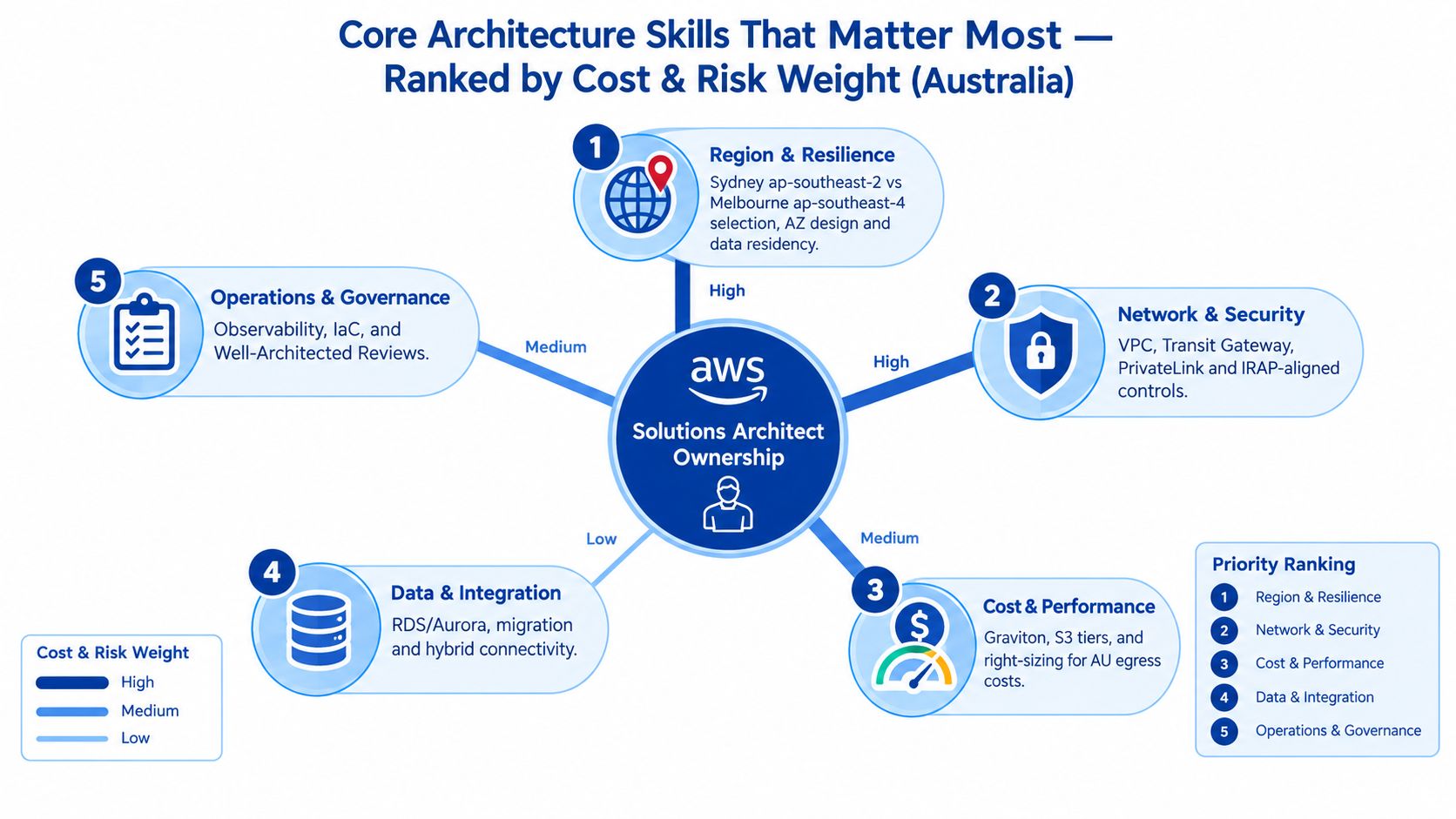
Region choice and resilience come first
For Australian workloads, region selection sets latency, data residency, and recovery options. Keeping services onshore in Sydney or Melbourne can simplify residency requirements, while multi-AZ design limits the effect of an Availability Zone failure. Each Australian region contains at least three isolated Availability Zones connected by high-bandwidth, low-latency metro fibre (Hazercloud).
A single zone failure should not take down the application. The architect must map user locations, data boundaries, recovery requirements, and dependencies before selecting a region or failover approach. This sequence matters more than memorising service features, especially when Australian teams have limited cloud engineering capacity.
Networking, identity, data, and observability
Networking and identity decisions define the operating boundaries. Use a simple VPC structure where it is sufficient, and introduce Transit Gateway, multi-account separation, or private connectivity only when the workload dependencies and risk justify them. IAM and AWS Organizations provide guardrails, not administrative busywork. A weak permission model can turn one team's mistake into a wider outage.
The data tier carries similar cost and migration risk. RDS, Aurora, and DynamoDB address different workload requirements, so the choice must account for access patterns, operational ownership, recovery needs, and migration effort. CloudWatch, X-Ray, and managed OpenSearch give teams the failure signals needed to act before customers report an incident.
The deliverable is decision records
Architecture diagrams support the discussion. Decision records govern delivery. Each record should state the service choice, cost driver, failure mode, and rollback path, giving an Australian team a clear reference when specialist capacity is stretched.
Before development begins, require these artefacts:
- Workload inventory: what exists, who owns it, and what it depends on.
- Target-state decisions: regions, accounts, networks, data stores, and the observability model.
- Risk register: failure conditions, business impact, and recovery actions.
- Cutover plan: sequence, dependencies, rollback gates, and accountable owners.
- Operations handover: runbooks, escalation paths, and maintenance responsibilities.
This documentation also exposes avoidable design shortcuts. Review common AWS mistakes made by Australian SMEs alongside the architecture work, then turn relevant findings into explicit controls and owners.
Common Architecture Patterns and When They Fit
Start with the landing zone when the business is messy
The migration landing zone is the pattern I use when a company has grown fast and built ten years of sprawl. It usually means multiple environments, inconsistent permissions, unclear logging, and a pile of shared services nobody fully owns. The fix is a multi-account structure with centralised logging, controlled network foundations, and clear separation between platforms, workloads, and security functions.
That pattern fits a mid-market retailer consolidating e-commerce systems, payment integrations, and analytics drift into something supportable. It fails when the landing zone team is not able to make decisions, because then everyone keeps requesting exceptions and the whole structure turns into a compromise factory.
Use serverless when the workload is event-driven
A serverless-first pattern is the right call when the workload is naturally asynchronous or bursty. API Gateway, Lambda, DynamoDB, Step Functions, and EventBridge work well when the business cares more about throughput, rapid change, and simpler operations than about long-running compute. That makes sense for a NSW fintech handling transactional webhooks under strict governance, where the architecture needs tight boundaries and controlled operational overhead.
The failure mode is predictable. Serverless starts to struggle when teams try to force it into steady high-throughput analytics or awkward long-running processing. Costs can also become harder to reason about when people skip the design discipline and let every team invent its own event model.
Optimise cost only after the foundation is stable
The cost-optimised pattern is for systems that already exist and need to be rationalised, not for teams hoping cost control will happen by itself. That's where right-sizing, Savings Plans, S3 Intelligent-Tiering, and Graviton adoption become practical levers. A Melbourne SaaS platform burning money on idle EC2 instances is a classic candidate, especially when the application footprint is stable and predictable.
This is also where many cost programmes fail. Without showback reporting and executive sponsorship, teams will argue about instance families forever and never change the operating model.
| Pattern | Best fit workload | Core AWS services | Failure mode |
|---|---|---|---|
| Migration landing zone | Multi-system migration or consolidation | AWS Organizations, Control Tower, central logging, network foundations | No authority to enforce standards |
| Serverless-first | Event-driven, API-heavy, bursty workloads | API Gateway, Lambda, DynamoDB, Step Functions, EventBridge | Forced into workloads that need steady heavy compute |
| Cost-optimised | Stable production systems needing spend reduction | Compute Optimizer, Savings Plans, S3 Intelligent-Tiering, Graviton | No accountability for spend ownership |
For a platform choice lens that often sits alongside this decision, see AWS Lightsail vs EC2 vs ECS.
How Architects Sequence Migrations and Cutovers
A serious migration starts with inventory, not enthusiasm. I want AWS Application Discovery Service where it fits, and I still want manual tagging spreadsheets because shadow IT never shows up neatly in a dashboard. That first pass shows what exists, who depends on it, and where the hidden coupling sits.
Map dependencies before you touch the application
Dependency mapping comes next. Network flow logs, application telemetry, and operational interviews expose database links, batch windows, authentication chains, and integration points that will fail if you rehost too aggressively. The architect then scores each workload for network, data, identity, observability, and operations readiness, and builds migration waves from that ranking.
The six Rs still matter, rehost, replatform, refactor, repurchase, retire, retain. In Australian programmes, the first wave is often heavy on rehost because it lowers risk and buys time. That is not laziness. It is the right way to reduce cutover pressure while the organisation learns how to operate in AWS.
Cutover governance is where projects live or die
The cutover itself should be boring. Pilot wave first. Then parallel run where it makes sense. Then weighted DNS failover, database replication lag monitoring, rollback gates, and hypercare monitoring until the team can prove stability. That is the difference between controlled change and a late-night fire drill.
Independent reporting on Commonwealth Bank's AWS migration shows the programme began in July 2024 and completed by May 2025, after an earlier expectation of 18 months shifted materially (DataCenterDynamics). Large Australian migrations are sequencing problems, not one-shot cloud moves.
If the first cutover does not have a rollback gate, the migration has already been over-scoped.
The governance pack should include runbooks, decision records, and cutover checklists. Without them, the board thinks the risk is migration. The risk is uncontrolled ambiguity.
For a practical view of phased execution, see how a structured cloud migration service model handles cutovers.
Designing for Australia's Cloud Skills Shortage
The architecture answer to Australia's cloud skills shortage starts with restraint. A platform that depends on a deep bench of specialists will fail teams that already struggle to hire and retain them. AWS-reported Australian workforce data said the country needed 6.5 million newly skilled and reskilled digital workers by 2025, with the average worker needing seven new digital skills (About Amazon Australia). That reality should shape every design decision.
Build systems that survive a small operations team
Choose managed services wherever the workload allows it. I would rather see RDS than self-managed Postgres on EC2, and ECS Fargate than self-managed Kubernetes unless the scale case for EKS is real. Managed services cut the patching, recovery, and specialist knowledge burden that small Australian teams cannot absorb easily.
Observability needs the same discipline. Keep the stack narrow, usually CloudWatch plus one external analytics or dashboard layer if the team needs it. Then bake handover into infrastructure modules and a shared service catalogue so support does not depend on tribal knowledge.
The hiring gap should influence the architecture
Recent Australian reporting said 39% of businesses reported insufficient relevant skills as a blocker to adopting or improving AI applications, and AWS-reported survey data said 63% of Australian employers prioritise AI talent while 75% cannot find it. The same survey was used for both sets of figures, which is the point. Operations teams are already stretched, so the architecture has to assume limited depth and uneven experience.
That makes “certify the team first” poor advice when the platform still has to run. SAA-C03 study can take months, SAP-C02 longer, but certification does not replace live production exposure. Design the system so it still operates when only one or two people are on call, and keep the failure domains small enough for that team to manage.
Use support models to reduce handover risk
Embedded AWS support plans and a partner for design assurance often beat a pure hiring strategy. A supportable operating model with fewer surprises matters more than headcount. If you need external help to shape the platform for handover and operating clarity, cloud computing consulting is the sensible place to start.
Hiring or Partnering With an AWS Solutions Architect
Treat this as a capacity and governance decision, not a branding exercise. Hire when you need long-term ownership across multiple programmes and enough internal depth to keep design decisions consistent. Partner when you need senior judgement now, especially if the workload mix is unclear, integrations are messy, or delivery pressure is already high. In Australian teams, the right answer is often a blend.
What to evaluate before you commit
Start with real delivery evidence. The person should be able to run a Well-Architected review, explain recent Australian migration work, and show how they handle cost governance without hand-waving. Security and clearance constraints matter too, because some environments cannot be designed or supported by whoever is available on the day.
Check the handover method with the same care. You want design decisions documented, support boundaries clear, and operational ownership defined before the architect exits. For teams in Melbourne, a partner solution architect engagement can shortlist the evaluation criteria above.
Red flags I would not ignore
If an architect cannot explain cutover risk, stop the conversation. If a partner forces you into a proprietary landing zone, the long-term support burden is on you. If anyone promises cost savings before reviewing the bill and the workload mix, they are guessing.
A paid discovery sprint is a better test than a free assessment because it shows how they think, how they document decisions, and whether they can work with your operations people without creating dependency. That is the standard that matters.
Hiring vs Partnering: Decision Criteria
| Criterion | Internal Hire | External Partner |
|---|---|---|
| Speed to start | Slower, because recruitment takes time | Faster, because delivery can begin sooner |
| Long-term ownership | Strong if the role is well-defined | Weaker unless handover is planned |
| Architecture depth | Depends on the candidate pool | Usually stronger for short, complex engagements |
| Handover discipline | Can be excellent if the culture supports it | Must be contractually enforced |
| Cost control | Better over time if retained | Better for scoped work, discovery, and migration phases |
A 30-60-90 day plan should be required. It needs to spell out what gets delivered, what gets documented, and how the internal team takes over. If that plan is vague, the engagement is too loose to trust.
Start with a review, not a leap of faith
Commission a Well-Architected review before you commit to any large build. Then run a paid discovery sprint and insist on handover milestones that cover documentation, ownership transfer, and cutover sign-off. If you want senior AWS architecture without the delay of a permanent hire, Continuum Solutions can help with the planning, governance, and post-cutover controls needed to hand the platform over cleanly.