
As of 2025, Business Support+ starts at $29 per month, Business Support at $100 per month, and Enterprise Support at $5,000 per month, with the actual bill driven by tiered percentages of monthly AWS spend. For Australian teams, the final amount also depends on USD conversion, 10% GST and how AWS accounts are grouped.
A finance lead at a mid-sized Australian company is staring at a $4,200 monthly AWS Support line item. Engineering can't explain which workload created it, finance can't forecast whether it will rise, and the original AWS plan selection was made when the environment was much smaller.
That situation is common because AWS Support pricing isn't a flat SaaS subscription. Paid support is linked to monthly AWS consumption, so the charge changes as usage changes. A new EC2 fleet, larger S3 footprint, higher data transfer or an acquisition that adds accounts can all affect the support bill.
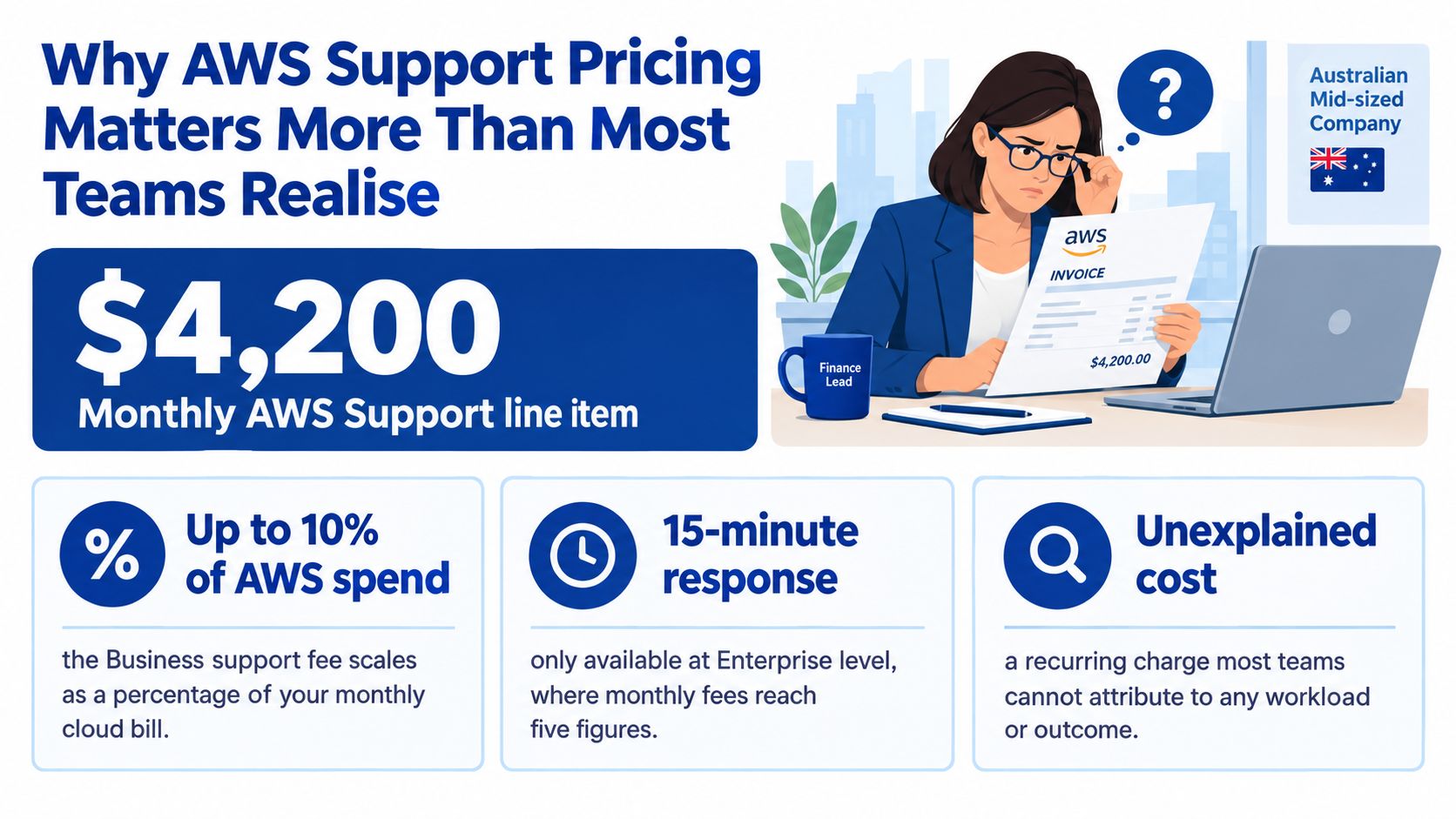
Table of Contents
- Why AWS Support Pricing Matters More Than Most Teams Realise
- The Four AWS Support Plans Side by Side
- How the Support Pricing Formulas Are Calculated
- Real Cost Examples for Australian AWS Bills
- AWS Support Versus a Managed Support Partner
- Common Mistakes and a Plan Selection Checklist
- Practical Next Steps and Quick Answers
Why AWS Support Pricing Matters More Than Most Teams Realise
Treat support as a variable cloud cost
The first forecasting mistake is to budget AWS Support as a fixed line. A percentage-based fee scales with the underlying AWS bill, which means support can increase even when nobody changes the support subscription.
AWS also applies different billing logic by plan. Business Support is calculated per account, while Enterprise On-Ramp and Enterprise use aggregate monthly gross AWS charges across subscribed account IDs, as set out in the AWS Support pricing rules. That distinction matters in a multi-account landing zone. A simple estimate based on the production account alone can understate the amount used for Enterprise calculations.
I recommend building the forecast in this order:
- List every subscribed account. Include production, development, testing, security and shared-services accounts.
- Separate AWS consumption from support charges. Support is an additional operating cost, not part of the EC2, S3 or data transfer line items.
- Apply the relevant pricing curve. Don't multiply the whole AWS bill by one headline percentage when the plan uses progressive tiers.
- Add Australian billing effects. AWS publishes pricing in USD, then converts it for billing. Australian accounts also attract 10% GST on services sold by AWS Australia, according to AWS Australia's terms.
Practical rule: Forecast AWS Support from expected cloud consumption, not from your current headcount or the amount your team paid last month.
The operational question matters as much as the financial one. A team that needs occasional account guidance shouldn't buy enterprise operating involvement just because its architecture looks complex. A team running revenue-critical systems may need response targets, a Technical Account Manager and Infrastructure Event Management, but those capabilities only make financial sense if the organisation will use them.
Three minimums should stay visible in your forecast: $29 for Business Support+, $100 for Business Support, and $5,000 for Enterprise Support, based on AWS's 2025 announcement and pricing material. The minimum isn't necessarily the final bill. Once usage-linked calculations exceed it, the percentage-based amount becomes the charge.
For Australian organisations evaluating architecture, migration or ongoing operations, a cloud computing consulting assessment should include support costs alongside compute, storage, networking, security and labour. Leaving support out produces an incomplete total cost of ownership.
The Four AWS Support Plans Side by Side
The right comparison isn't “cheap, standard or premium”. It's what operational problem does the plan solve, and what will still be left for your engineers or a managed partner?
Compare capability before price
| Feature | Basic | Developer | Business | Enterprise |
|---|---|---|---|---|
| Typical fit | New, non-production or low-risk workloads | Individual builders and pre-production environments | Production teams needing broader assistance | Mission-critical environments requiring deeper AWS engagement |
| AWS case access | Limited account and billing assistance | Account-level technical guidance | Broader technical support and unlimited cases | Highest level of AWS engagement |
| Response target | No production incident commitment | General guidance response target | Faster response for production-impaired issues | 15-minute response for business-critical outages |
| Trusted Advisor | Limited checks | Limited checks | Full checks | Full checks |
| Named TAM | No | No | No | Yes |
| Infrastructure Event Management | No | No | No | Yes |
| Concierge support | No | No | No | Yes |
The Basic plan is appropriate for low-risk accounts and workloads that aren't carrying production obligations. Keeping it on a customer-facing production system is an avoidable operational risk. The plan may cost nothing, but it also doesn't give a production team the same assistance as a paid tier.
Developer Support suits a solo builder, a small development team or a pre-production environment where general guidance matters more than incident coordination. It isn't a substitute for an operating model that includes monitoring, deployment controls and someone accountable for production recovery.
Business Support is the practical starting point for many production workloads. It gives teams a stronger case-handling model, Trusted Advisor checks and access to AWS APIs. Business Support On-Demand is also available as a pay-per-case approach above its applicable minimum, which can suit teams that need occasional assistance rather than a regular percentage-based plan.
Enterprise Support is for organisations that need AWS to participate in operational planning, not just answer tickets. A named Technical Account Manager, Infrastructure Event Management and Concierge support can be valuable during major launches, migrations and business-critical incidents. They can also be expensive features to leave unused.
A team modernising a membership platform should assess support alongside uptime, deployment ownership, database recovery and integration dependencies. The AWS hosting guidance for membership platforms is a useful architecture reference, but support selection still needs to reflect the actual incident and governance model.
How the Support Pricing Formulas Are Calculated
Start with the curve, not the minimum
AWS pricing is usage-linked, and that matters fast once a team runs multiple accounts, separate environments, or a landing zone with shared services. The bill does not stay flat just because support feels like overhead.
Business Support+ starts at $29 per month or 3% of monthly AWS charges, whichever is higher. Business Support starts at $100 per month, then applies progressive rates of 10% on the first $0 to $10,000, 7% from $10,000 to $80,000, 5% from $80,000 to $250,000, and 3% above $250,000, according to the AWS Support pricing page.
Enterprise pricing uses a different set of thresholds. AWS's published Australian pricing lists Enterprise On-Ramp at $5,500 per month or 10% of monthly AWS charges, while Enterprise starts at $15,000 per month and applies 10% up to $150,000, 7% to $500,000, 5% to $1 million, and 3% above $1 million. AWS's 2025 announcement separately describes the redesigned Enterprise Support entry price as $5,000 per month, so procurement teams should verify which plan and regional pricing schedule applies before signing.
| Plan | Pricing formula | Monthly minimum | Effective rate at $25K spend |
|---|---|---|---|
| Business Support+ | 3% of monthly AWS charges or minimum, whichever is higher | $29 | 3% |
| Business Support | Progressive rates across spend bands | $100 | 8.2% |
| Enterprise On-Ramp | 10% of monthly AWS charges or minimum, whichever is higher | $5,500 | 22% minimum-driven |
| Enterprise | Progressive rates across enterprise spend bands | $15,000 | 60% minimum-driven |
Business Support is easy to model at mid-range spend. At $25,000 monthly AWS spend, the fee is 10% of the first $10,000, plus 7% of the remaining $15,000. That equals $1,000 + $1,050, or $2,050 per month before regional taxes.
The proportional rate drops as spend rises because later bands carry lower marginal percentages. The total support charge still climbs sharply in dollars. Finance teams should model both the effective rate and the absolute invoice amount.
Use scenarios to test the forecast
For Business Support, the fee curve produces these pre-tax calculations:
- $5,000 spend: the $100 minimum applies.
- $25,000 spend: $2,050.
- $80,000 spend: $1,000 plus $4,900, or $5,900.
- $250,000 spend: $1,000 plus $4,900 plus $8,500, or $14,400.
- $1 million spend: $1,000 plus $4,900 plus $8,500 plus $22,500, or $36,900.
These are USD-based calculations before Australian GST and foreign exchange conversion. The thresholds and minimums are current published AWS rates, so verify them before procurement or renewal.
For migration planning, put support into the business case, not beside it. A cost guide for AWS migration in Australia should include post-migration support from the start.
Real Cost Examples for Australian AWS Bills
Australian finance teams need to separate published currency, billing currency and tax treatment. AWS states that Australian pricing is published in USD and converted for billing. Credit-card customers are billed in AUD by default, while invoice customers can choose AUD or USD. AWS Australia also applies 10% GST to services sold by AWS Australia.
The table below keeps the calculations in the published USD basis and labels the display as AUD only because finance teams often need an Australian reporting view. It excludes GST and foreign exchange movement. Don't treat the AUD figures as a locked invoice amount without checking the account's billing configuration.
| Monthly AWS Spend (USD) | Basic (AUD) | Developer (AUD) | Business (AUD) | Enterprise (AUD) |
|---|---|---|---|---|
| $5,000 | $0 | 3% of spend | $100 minimum | $15,000 minimum |
| $25,000 | $0 | 3% of spend | $2,050 | $15,000 minimum |
| $80,000 | $0 | 3% of spend | $5,900 | $15,000 minimum |
| $250,000 | $0 | 3% of spend | $14,400 | $15,000 minimum |
| $1,000,000 | $0 | 3% of spend | $36,900 | $32,500 under the stated Enterprise tiers |
Basic is shown as zero because it has no paid support charge. Developer is shown as a formula rather than a converted amount because the available verified pricing data doesn't provide a separate minimum or a fixed AUD exchange rate for that plan.
Model the Australian invoice properly
A useful forecast has three layers:
- Support calculation: Apply the plan formula to the relevant AWS charges.
- Currency conversion: Convert the USD result using the account's billing treatment and applicable exchange rate.
- GST: Add the 10% Australian GST where AWS Australia sells the service.
At $80,000 monthly AWS spend, Business Support calculates to $5,900 per month before GST and foreign exchange. Annualising that monthly figure produces $70,800 before GST and foreign exchange. That is the number finance should place in the operating model, followed by a separate assumption for currency and tax.
Enterprise is more complex in a landing zone because AWS calculates Enterprise and Enterprise On-Ramp using aggregate monthly gross charges across subscribed account IDs. A centralised organisation with production, security, shared networking and development accounts can therefore reach the relevant calculation band sooner than a single-account estimate suggests.
If your organisation is preparing a phased cloud migration service, request a support-cost model that uses the target account structure, not only the current invoice. Otherwise, the forecast will be accurate only until the migration creates the operating model you need.
AWS Support Versus a Managed Support Partner
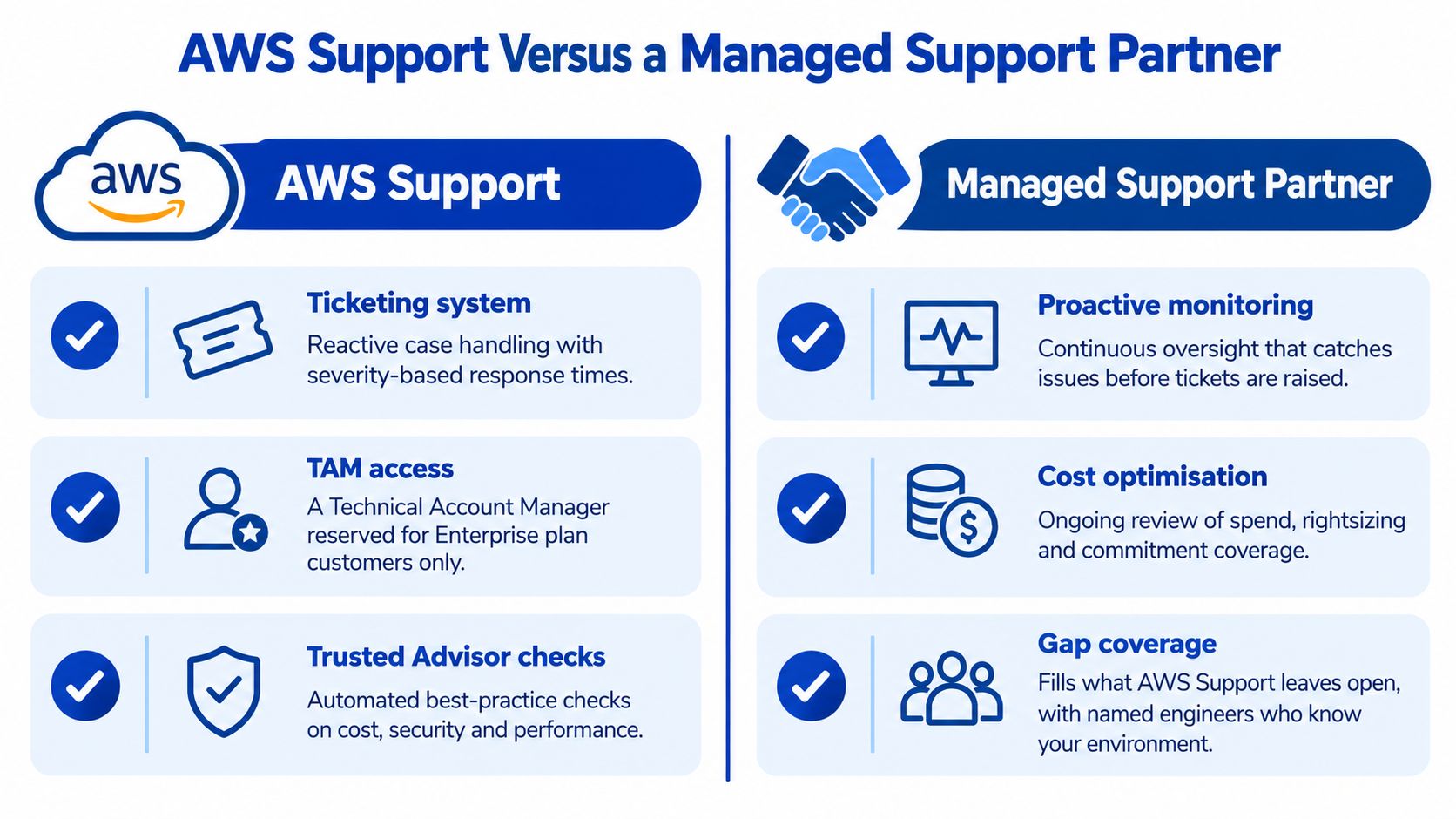
AWS Support gives you access to AWS's own support channels, case handling, plan-specific response targets and, at higher tiers, capabilities such as a Technical Account Manager, Trusted Advisor checks and Infrastructure Event Management. It doesn't automatically become your complete cloud operations function.
Compare reactive access with operational ownership
A managed support partner can cover areas AWS Support may leave with the customer:
| Requirement | AWS Support | Managed support partner |
|---|---|---|
| Incident cases | Severity-based AWS case handling | Direct operational triage and escalation |
| Monitoring | Plan-dependent AWS capabilities | Proactive monitoring across agreed services |
| FinOps | Guidance and checks | Recurring spend review, rightsizing and commitment analysis |
| Security posture | AWS recommendations and checks | Ongoing remediation ownership and governance support |
| Local coverage | AWS service channels | Local Australian engineers and agreed after-hours arrangements |
| Multi-cloud | AWS-focused | Can coordinate AWS, Azure and connected systems |
The commercial comparison needs discipline. Australian managed support commonly sits around 8% to 15% of AWS spend, or a fixed monthly retainer between $3,000 and $25,000, depending on environment complexity. Those figures are market guidance supplied for this comparison, not AWS list prices, so obtain a scoped proposal rather than treating them as a guaranteed quote.
For an organisation spending more than $15,000 per month on AWS, I usually test a partner before recommending a move from Business to Enterprise. The reason isn't that Enterprise lacks value. It's that many teams buy Enterprise for a response target while still lacking alert ownership, cost governance, release discipline and documented recovery procedures.
If you're using less than 20% of Enterprise features, paying for the tier is probably solving the wrong problem.
A partner such as Continuum Solutions can combine AWS architecture, cost reviews, monitoring, migrations and application operations in one engagement. That model makes more sense when your business needs proactive advice and local continuity rather than another ticketing channel.
Common Mistakes and a Plan Selection Checklist
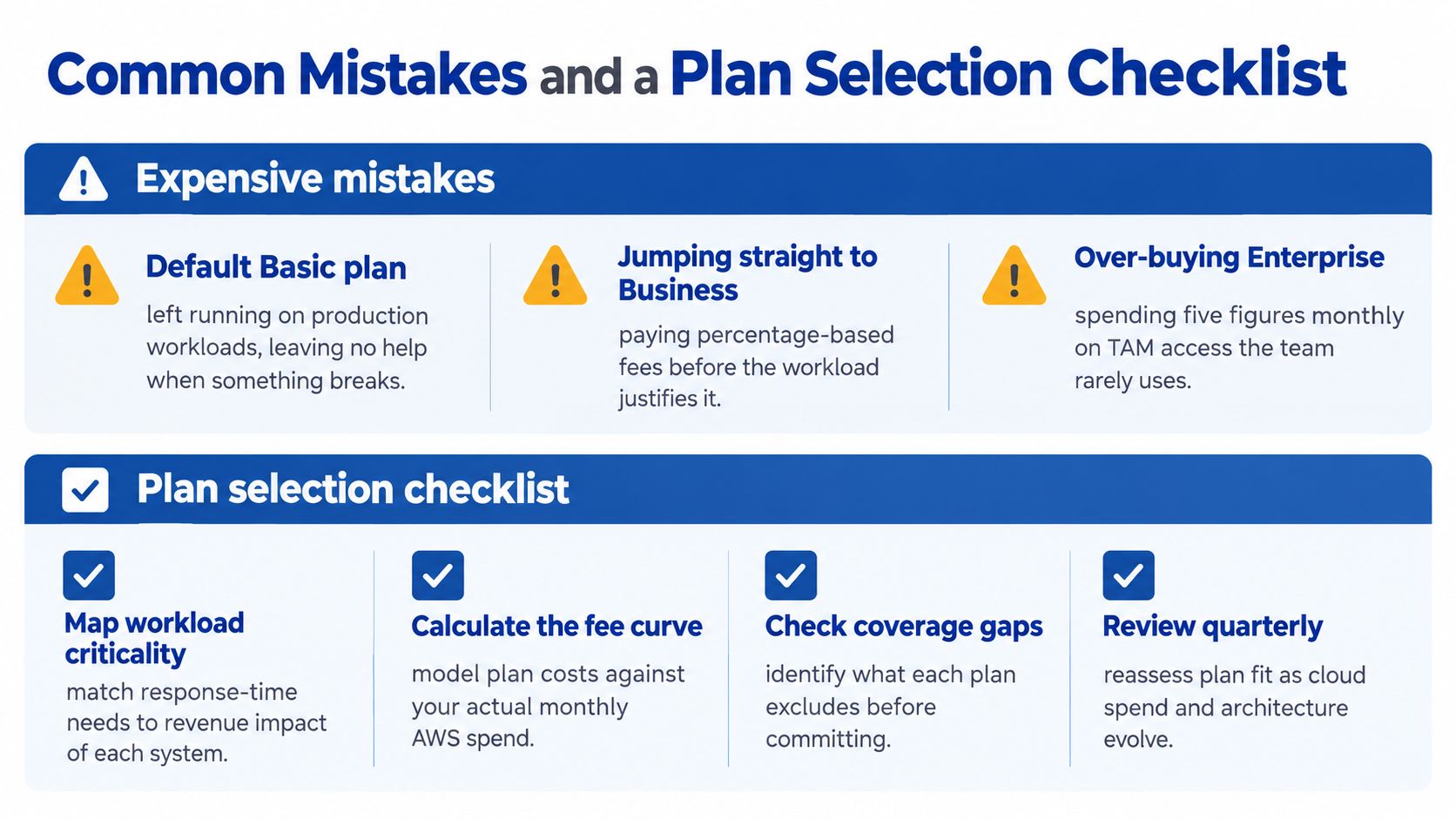
More support isn't automatically better support. It becomes wasteful when the team buys capabilities that don't match its workload, incident pattern or internal skills.
Avoid these expensive decisions
- Leaving Basic on production: A production system with customer or revenue impact needs an explicit incident response model, not an unexamined default.
- Buying Business too early: A small pre-production account may not justify a percentage-based paid plan when the team can manage routine issues internally.
- Paying for Enterprise access without using it: A named TAM and event-management capability have little value if nobody schedules reviews or involves AWS in operational planning.
- Ignoring Trusted Advisor: Teams often discover useful cost, security and performance recommendations only when a renewal or incident forces a review.
- Treating one account as the whole environment: Enterprise calculations can use aggregate charges across subscribed accounts, so the landing-zone structure belongs in the model.
Run the selection test
Use AWS Cost Explorer to review the AWS consumption trend, then reconcile the support line against the account and plan structure. For technical validation, review available support information through the AWS Support API and confirm which checks, response targets and escalation paths your team has used.
Ask these questions before changing plans:
- What is the monthly spend band? Use actual consumption and a forecast, not a single unusually low invoice.
- How often do production incidents occur? Record the incidents that needed AWS involvement, not every internal alert.
- Do you need a TAM or Infrastructure Event Management? If the answer is no, Enterprise may be excessive.
- How many accounts are included? Map the landing zone and understand whether the plan is calculated per account or in aggregate.
- What skills exist internally? A strong platform team may need AWS escalation but not full managed operations.
- Would a partner close more gaps? Compare proactive monitoring, FinOps, security and local coverage with the cost of a higher AWS tier.
My rule is direct: once AWS spend is above $15,000 per month, start a managed support conversation before moving up an AWS tier. The right answer might still be AWS Enterprise, but you should prove that with usage rather than assuming the highest plan is the safest choice. The guide to common AWS mistakes for SMEs provides additional context for that review.
Practical Next Steps and Quick Answers
You can complete a useful AWS Support pricing review in one working week:
- Pull the last three months of AWS spend from Cost Explorer.
- Map each account to its production role and billing structure.
- Calculate the plan fee using the current AWS pricing curve.
- Check actual usage of response targets, Trusted Advisor, TAM engagement and event management.
- Add GST and currency assumptions to the Australian forecast.
- Compare Enterprise with a scoped managed support proposal if your monthly spend is above $15,000.
| Question | Short Answer |
|---|---|
| What happens if we downgrade? | You lose the features and response targets tied to the higher plan, so confirm the operational impact before changing it. |
| Can Basic Support be removed? | Basic is the default support level for AWS accounts, so treat it as the baseline rather than a subscription you can simply cancel. |
| Does annual pre-payment reduce the minimum? | AWS states that paid support plans are billed monthly with no long-term contracts, so don't model an annual pre-payment discount without written confirmation. |
| Why is the AWS console amount in USD? | AWS publishes Australian support pricing in USD and converts it for billing; invoice customers may choose AUD or USD. |
| How is GST handled? | AWS Australia charges 10% GST on services sold by AWS Australia, so add it separately to the pre-tax support calculation. |
| Why doesn't my single-account estimate match Enterprise billing? | Enterprise and Enterprise On-Ramp use aggregate monthly gross AWS charges across subscribed account IDs. |
Continuum Solutions helps Australian organisations review AWS architecture, model support and migration costs, and operate cloud environments with monitoring, integrations and ongoing technical support. Visit Continuum Solutions to discuss your AWS Support pricing model before the next invoice becomes a budget problem.