You’ve probably seen the brief already. “We need a cloud strategy.” Or worse, “Can you move this to AWS or Azure by the end of the quarter?”
That’s usually the moment a sensible technology project starts drifting into a risky one. The board wants modernisation. Operations wants reliability. Finance wants cost control. Internal IT is already stretched. Everyone agrees the cloud matters, but no one agrees on what should move, when it should move, or how much disruption the business can absorb.
For a first major cloud initiative, that uncertainty is normal. What matters is how quickly you replace vague ambition with a working plan, a commercial model, and a realistic view of the trade-offs.
Table of Contents
- Navigating the Cloud Mandate
- Core Services Demystified What Cloud Consultants Actually Do
- Choosing Your Engagement Model
- The Phased Cloud Migration Checklist
- Vendor Selection Criteria for Your Business
- Decoding Cloud Consulting Pricing Models
- Real-World Scenarios and Risk Mitigation
Navigating the Cloud Mandate
A common starting point looks like this. An operations manager inherits an ageing line-of-business platform running on a mix of hosted servers, spreadsheets, and manual workarounds. A CTO sees security and scalability issues. Finance sees rising support costs. Someone decides “move it to the cloud” is the answer.
It might be the right answer. It also might be incomplete.
Cloud projects fail early when leaders treat them as infrastructure replacements instead of business change programs. The technical work matters, but the bigger questions sit above it. Which systems are critical. Which integrations can’t break. Which teams need better access controls. Which workloads should be rehosted quickly and which should be redesigned properly.
That’s where cloud consulting services earn their keep. A good consultant doesn’t just recommend AWS, Azure, containers, serverless, or DevOps pipelines. They force clarity into the decisions your business has been postponing.
Practical rule: If your migration plan starts with provider choice before it starts with business dependency mapping, you’re already increasing risk.
For an enterprise, that often means untangling legacy applications, identity systems, reporting flows, and governance requirements before any cutover date is set. For an NGO, it often means designing a staged migration that a non-technical team can govern after go-live. For a startup, it usually means stopping the opposite mistake, overengineering too early and paying for complexity you don’t yet need.
The commercial case for this discipline is getting stronger, not weaker. The global cloud consulting services market is projected to grow from USD 37.59 billion in 2026 to USD 143.2 billion by 2035 at an 18.2% CAGR, which reflects how many organisations now need specialised guidance rather than generic infrastructure support.
DIY cloud work can succeed for narrow, low-risk tasks. It usually struggles when architecture, compliance, integration, and cost control intersect. First major cloud initiatives almost always sit in that harder category.
Core Services Demystified What Cloud Consultants Actually Do
A first major cloud initiative usually starts the same way. The CIO wants risk reduced, the CFO wants a budget range, operations want less downtime, and the application owners want no disruption to delivery. Cloud consultants are brought in to turn those competing demands into a plan that can be funded and executed.
Architecture before migration
The first service is architecture advisory, but its core function is decision-making. Consultants assess which systems need redesign, which can move with limited change, and which should stay put until the business case improves.
For an enterprise, that often means working through identity, network segmentation, audit controls, data residency, and integration points before any target platform is approved. For an NGO, the design brief is usually different. Simplicity, handover, and predictable support matter more than building a highly customised platform the internal team cannot run. For a startup, the hard call is often restraint. A startup does not need enterprise-grade complexity if two engineers are supporting the product.
Platform fit matters at workload level. A membership platform with bursty signups, renewal spikes, and campaign-driven traffic needs a different design from an internal ERP integration with stable usage and strict access rules. This guide to AWS hosting for membership platforms is a useful example of that principle in practice. Hosting decisions should reflect traffic patterns, operational tolerance, and revenue impact.
Good architecture work also surfaces trade-offs early. Managed services can reduce admin overhead, but they may increase vendor dependence. Containers can improve portability, but they add delivery and monitoring complexity if the team is new to them. Multi-cloud may satisfy a governance preference, but it often raises cost and support burden without solving a real business problem.
Migration that respects business operations
Migration services are less about copying servers and more about sequencing change without breaking the organisation.
A capable consultant will usually sort workloads into four paths:
- Rehost selected workloads: Best when timelines are tight and the current design is acceptable for a period.
- Replatform where operations are inefficient: Keep the application, improve the runtime, database, or deployment model.
- Refactor systems with clear commercial upside: Worth doing when release speed, resilience, or scale will materially improve.
- Retire low-value systems: Old applications often survive because no one owns the decision to shut them down.
Each path has a cost profile and a risk profile. Rehosting is faster, but it can carry old design problems into the new environment. Refactoring can produce better long-term economics, but it demands stronger product ownership, testing discipline, and budget patience.
A cloud migration should remove friction from operations, security, and delivery. If it only changes the hosting location, the business has funded movement, not improvement.
This distinction matters by organisation type. In enterprises, migration plans usually need waves, rollback options, and dependency testing across authentication, reporting, and downstream systems. In NGOs, the migration plan has to reflect limited internal support capacity after go-live. In startups, migration is often narrower in scope, but the consultant still needs to put guardrails around backups, secrets, environment separation, and release practices before growth exposes the gaps.
Optimisation, integration, and delivery discipline
Many buyers treat these services as optional extras. They are usually where the return on consulting fees is won or lost.
Cost optimisation starts with visibility. Someone needs to map cloud spend to products, programs, teams, or grants, then decide what should be right-sized, shut down, reserved, or redesigned. Enterprises usually need tagging standards, budget controls, and approval paths. NGOs often need clear cost ownership tied to funding cycles. Startups need fast feedback on whether architecture choices are helping growth or just adding monthly burn.
Integration work is just as commercial. If the new cloud environment does not connect cleanly with Salesforce, HubSpot, Shopify Plus, WordPress, MiniOrange, finance systems, or internal APIs, the project turns into an expensive hosting change with limited operational gain. Consultants are often brought in to fix that gap. They define interface contracts, data flows, sync rules, and failure handling before those issues appear in production.
Delivery maturity is the third core service area. CI/CD pipelines, infrastructure as code, monitoring, rollback procedures, and environment consistency reduce release risk and shorten recovery time when problems occur. In practice, these practices make the biggest difference between a cloud estate that stays maintainable and one that becomes costly six months after go-live.
The best consulting teams do not sell the same answer to every client. An enterprise may need governance, architecture review boards, and phased cutovers. An NGO may get more value from a simpler managed design with strong documentation and handover. A startup may need a lean platform, clear automation, and tight cost control rather than a large transformation program. That is what cloud consultants do when the engagement is well scoped and commercially grounded.
Choosing Your Engagement Model
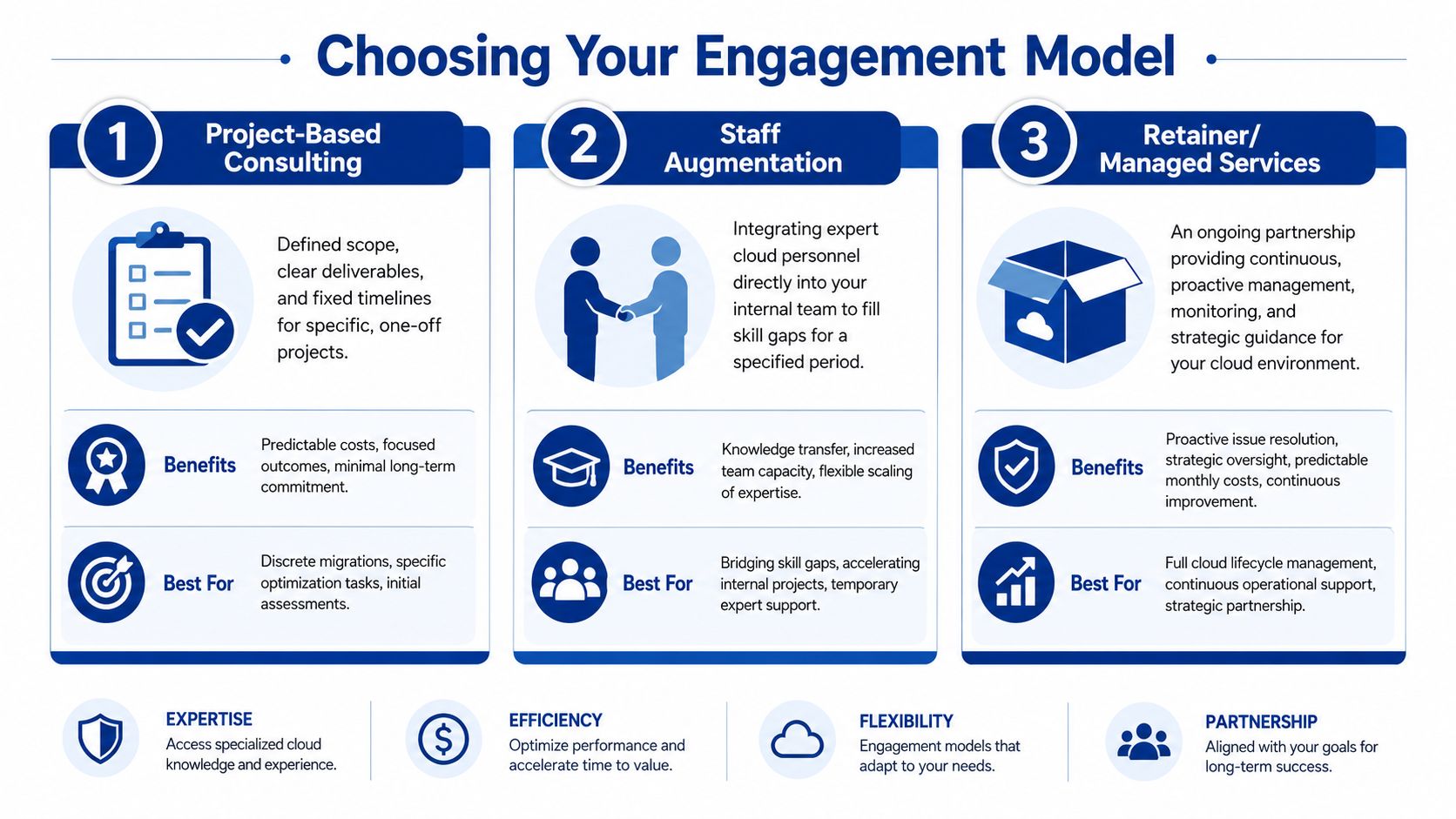
The wrong engagement model can make a capable consulting team look ineffective. Scope, budget, internal maturity, and urgency all influence what will work.
When project-based consulting works
Project-based consulting suits a defined outcome. Examples include a migration assessment, a landing zone build, an e-commerce replatform, or a cost optimisation review across an existing AWS estate.
This model works best when deliverables are clear, dependencies are known, and your internal stakeholders can make decisions quickly. It’s also the easiest model for procurement because scope, timeline, and acceptance criteria can be documented up front.
The limitation is obvious. Once the project ends, ownership shifts back to your team. If your environment still needs operational tuning, cost governance, or release discipline, the value can decay fast.
When staff augmentation is the better fit
Staff augmentation is useful when your team knows what it wants to build but lacks specialist capacity. You may need an AWS architect, Azure migration lead, DevOps engineer, or systems integration specialist embedded into an internal squad for a period.
This is often the right call for enterprises with internal product or platform teams. It can also work for startups with strong engineering leadership but temporary gaps in cloud maturity.
The trade-off is management load. Your team still needs to provide direction, prioritisation, and technical context. If internal ownership is weak, augmentation tends to expose that weakness rather than solve it.
A broader view of how these models fit into technology decision-making is covered in business IT consulting services, especially where architecture, integration, and operational planning overlap.
When managed services make sense
Managed services or a retainer model fit organisations that want continuity. This works well after a major migration, for environments with ongoing compliance needs, or where the internal team can’t justify a full in-house cloud operations function.
A managed arrangement typically suits:
| Situation | Better fit |
|---|---|
| One-off migration or audit | Project-based |
| Internal team needs temporary specialist help | Staff augmentation |
| Ongoing monitoring, optimisation, and support | Managed services |
If your cloud estate changes every month but your consultant engagement ends after delivery, don’t be surprised when cost, security, and documentation drift.
NGOs often benefit from a retainer because the same partner can support governance, platform reliability, and handover practices over time. Enterprises use it when uptime, observability, and vendor coordination need constant attention. Startups usually wait longer before adopting this model, unless the platform is customer-facing and downtime has a direct revenue impact.
The Phased Cloud Migration Checklist
A workable migration plan doesn’t start with moving servers. It starts with proving why each workload should move, when it should move, and what success will look like after cutover.
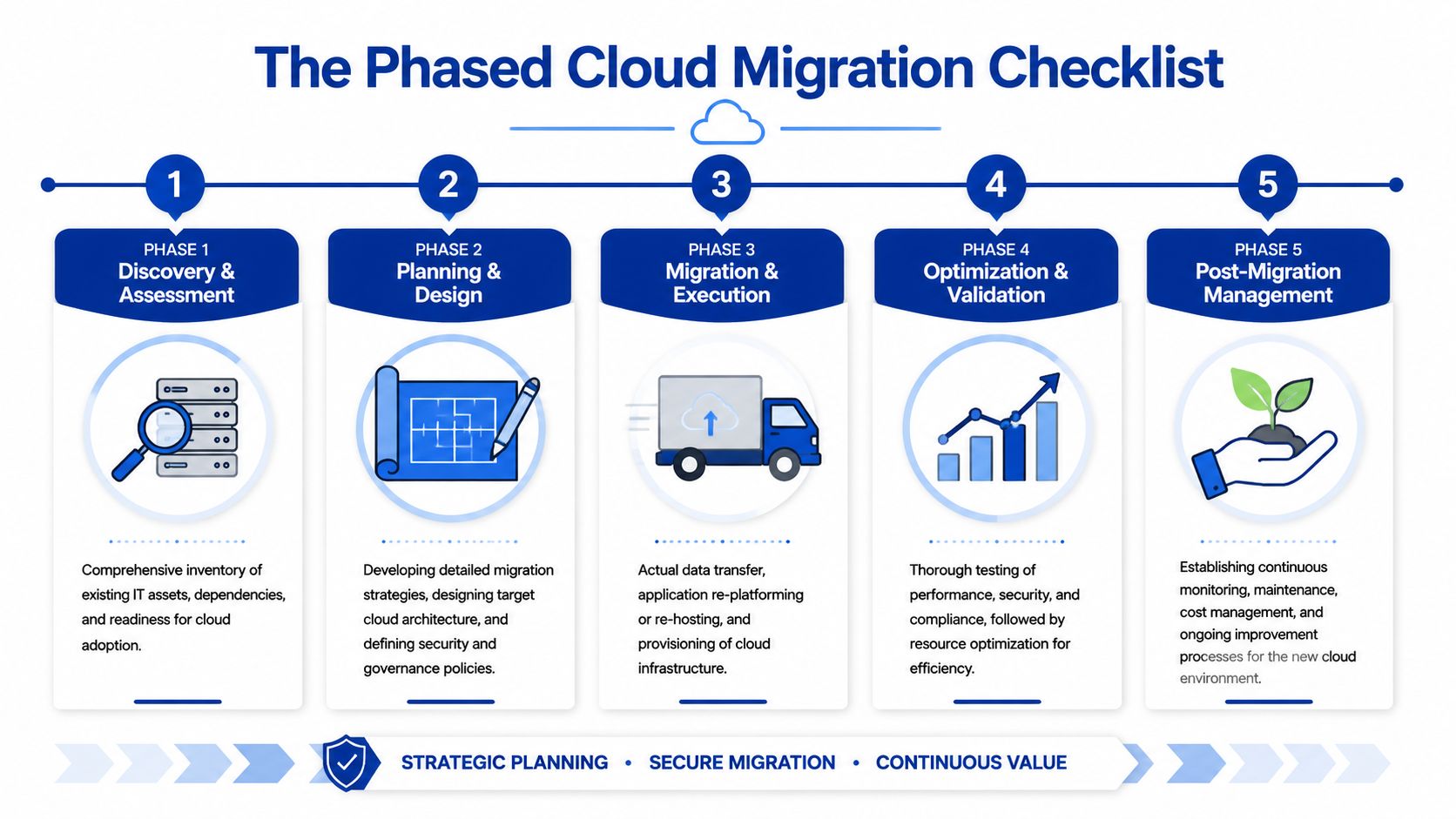
Phase 1 discovery and assessment
This phase is part technical inventory, part commercial review.
You need a dependency map of applications, databases, third-party services, file stores, user groups, and integration points. You also need to know which systems are business-critical, which are merely inconvenient, and which can be retired.
For Australian buyers, cost realism matters early. Cloud migration costs for mid-sized Australian businesses range from $100,000 to $300,000 for one-time migration, with ongoing annual costs between $40,000 and $100,000. That cost range is heavily influenced by legacy system complexity and data volume. If your assessment phase ignores either, your budget won’t hold.
Use this phase to produce:
- A workload inventory: What exists, who owns it, and what depends on it.
- A migration rationale: Why each system should move, stay, or be replaced.
- An initial risk register: Security, compliance, downtime, resourcing, and vendor risk.
- A budget view: Migration effort, likely support model, and post-move operating costs.
For a more detailed service view, this guide to cloud migration services is a useful benchmark for what should be included in a proper migration engagement.
Phase 2 planning and design
Many projects either become credible or start to unravel at this stage.
The target architecture should address network design, IAM, backup policy, observability, environment separation, security controls, CI/CD, and disaster recovery. If you’re choosing between AWS and Azure, this is also where workload fit matters more than vendor preference.
A planning document should also define migration waves. Don’t move everything at once unless your environment is unusually simple. Sequence by risk, dependency, and business tolerance for change.
Strong migration plans don’t just name target services. They define rollback conditions, testing ownership, and the point at which a failed cutover gets reversed.
Phase 3 migration and execution
Execution should begin with low-risk or high-learning workloads. That gives the team a chance to validate tooling, runbooks, access models, and support procedures before touching critical systems.
Typical tasks include provisioning cloud infrastructure, data migration, application rehosting or replatforming, integration updates, and validation in staging before production cutover. If the project includes custom software or mobile services, this is often where API compatibility and deployment discipline matter most.
A good execution phase also includes communication. Operations, finance, compliance, and end users should know what changes are occurring, what downtime windows exist, and who owns decisions during cutover.
Phase 4 validation and optimisation
Post-migration work is where the environment becomes maintainable.
Run performance validation, security checks, cost reviews, backup tests, alert tuning, and documentation handover. Confirm that dashboards, escalation paths, and ownership models are live. If you don’t, the business will experience the environment as unstable even if the migration technically succeeded.
A useful validation checklist includes:
- Performance testing against expected user behaviour
- Access review for least-privilege and admin control
- Backup and recovery verification
- Cost review against the original assumptions
- Support readiness including runbooks and monitoring alerts
The best migrations feel boring after go-live. That’s the result you want.
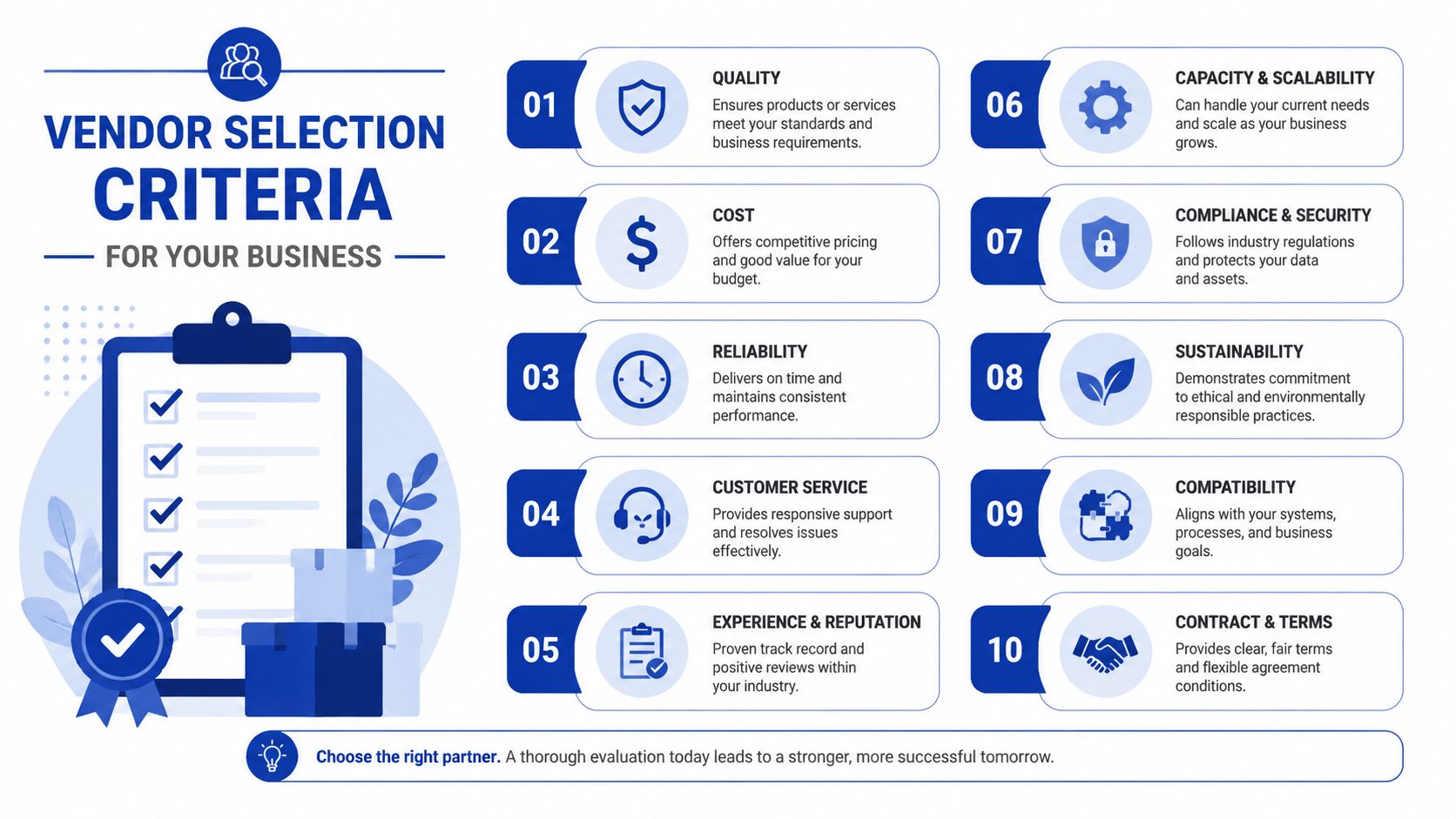
Vendor Selection Criteria for Your Business
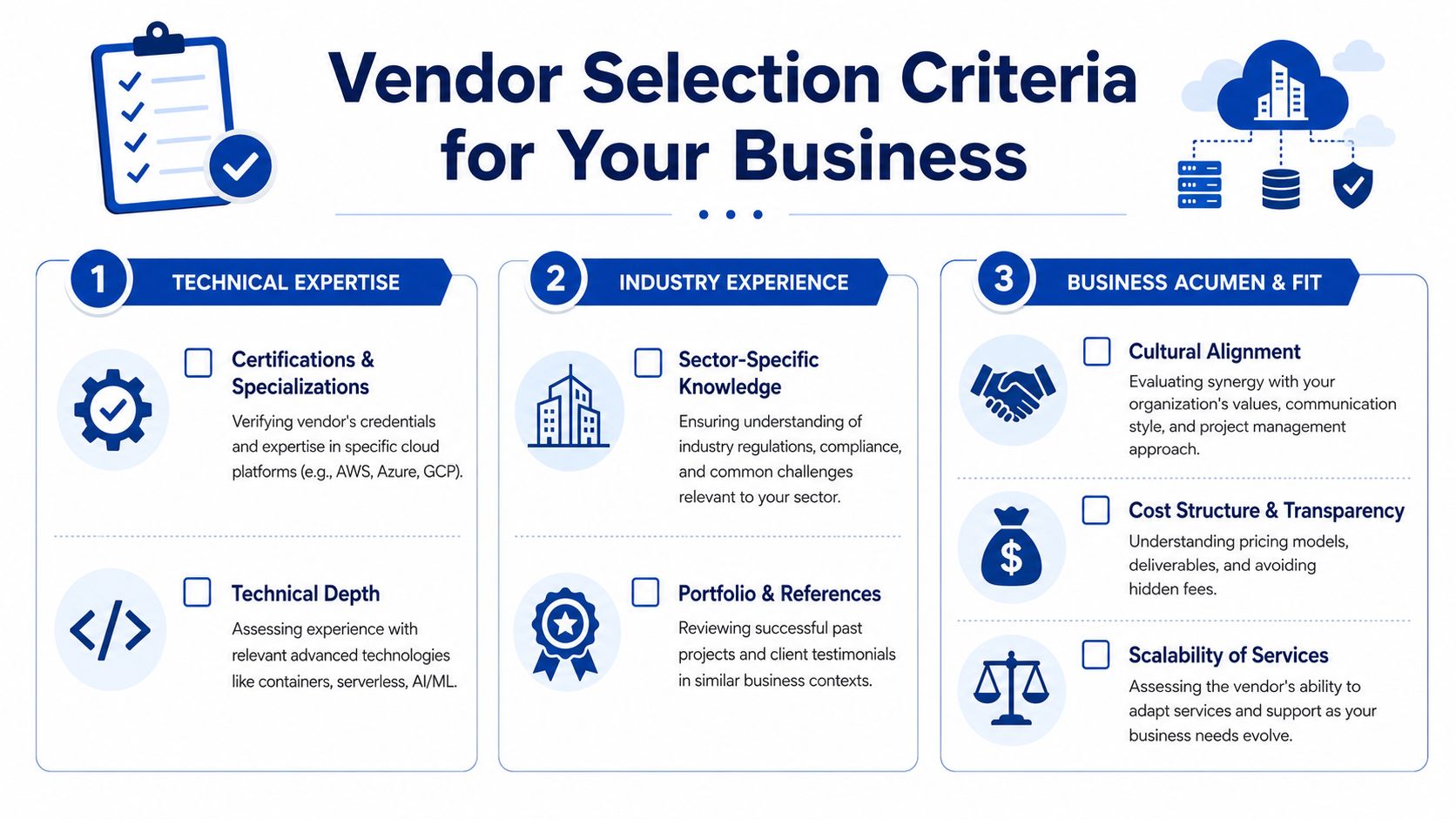
The best cloud consultant for your business is rarely the biggest firm or the cheapest proposal. Fit depends on your organisational shape, your governance maturity, and the consequences of getting the project wrong.
Enterprise selection criteria
Enterprises should select for complexity management, not sales polish.
A suitable partner should be comfortable with legacy system replacement, hybrid architectures, identity design, audit requirements, and integrations that span multiple business units. Ask how they document dependencies, how they manage change windows, how they structure environment access, and how they handle handover when internal operations teams take control.
A useful shortlisting lens for enterprise buyers is this:
| Criterion | What to test |
|---|---|
| Governance | Can they define ownership, approval flows, and guardrails clearly |
| Integration depth | Have they handled complex API and data dependencies before |
| Operational maturity | Do they build in observability, support paths, and rollback procedures |
| Commercial clarity | Are assumptions, exclusions, and post-launch responsibilities explicit |
Enterprise buyers should also pay attention to who will deliver the work. Senior pre-sales advice means little if the implementation gets delegated to a team with limited migration experience.
NGO selection criteria
NGOs need a different filter. Many don’t have deep internal IT capability, and that changes what a “good” partner looks like.
The underserved nature of this segment is well documented. Credence Research notes that 68% of Australian non-profits lack dedicated IT staff and face a 40% higher risk of migration failure due to governance gaps. That should change how NGOs buy cloud consulting services.
A suitable NGO partner should show they can work with constrained teams, phased budgets, donor or grant reporting realities, and practical governance. They should also explain systems in operational language, not just engineering language.
Questions NGOs should ask include:
- Can you phase the migration around cash flow and program delivery?
- How will you document the environment so non-specialists can manage it?
- What happens if the internal project owner changes mid-stream?
- How do you handle compliance, access controls, and approval records without overcomplicating the system?
NGOs rarely fail cloud projects because they lack ambition. They fail when the delivery model assumes enterprise governance that doesn’t exist.
The right consultant for an NGO is often the one who can simplify, sequence, and transfer knowledge without patronising the client.
Startup selection criteria
Startups should optimise for speed with discipline.
You want a partner who can work well with modern application delivery, API-first architecture, Docker, serverless patterns, mobile backends, and lightweight observability. You don’t want a team that insists on enterprise process overhead before product-market fit is even clear.
That said, startups still need guardrails. Good cloud consulting services for startups usually include a sensible AWS or Azure foundation, deployment automation, logging, environment separation, and cost visibility. Without those basics, speed turns into rework.
A startup vendor shortlist should favour partners who can answer practical build questions:
- How would you structure the first production environment?
- When would you choose AWS Lambda over containers?
- What monitoring would you put in place before launch?
- How would you design APIs so a web app and mobile app can share the same backend sensibly?
The strongest startup consultants don’t just move fast. They know where not to cut corners.
Decoding Cloud Consulting Pricing Models
Pricing models shape behaviour. If you don’t understand how a consultant gets paid, you won’t understand why scope expands, why timelines shift, or why post-launch support becomes awkward.
How pricing models behave in practice
Fixed price suits well-defined projects. If the scope is stable, deliverables are concrete, and dependencies are known, fixed price creates budget certainty. It works well for an assessment, a limited migration wave, or a platform audit. It works badly when requirements are still moving.
Time and materials is more flexible. It’s suitable for discovery-heavy work, legacy modernisation, or situations where architecture decisions depend on what the team uncovers. The downside is that buyers need tighter governance. Without active scope control, spending drifts.
Monthly retainer fits ongoing cloud operations, optimisation, and advisory support. It’s useful after migration, or when the internal team needs access to cloud architecture, DevOps, and systems integration expertise across multiple initiatives.
Outcome-linked commercial structures can work in narrow cases, especially when cost optimisation is the main goal. But be careful. If savings are poorly defined, disputes start quickly.
A concrete pricing example helps. For Australian organisations with 50+ Microsoft 365 users, migrating to Azure typically delivers 20-30% cost savings compared to AWS because of the Azure Hybrid Benefit. That doesn’t mean Azure is always the right platform. It means your pricing discussion should include licensing position, not just compute and storage estimates.
If you’re modelling an AWS move specifically, this guide on how much an AWS migration costs in Australia is the kind of commercial framing buyers should expect before approving a project.
What to ask before you sign
Ask these questions in writing:
- What is excluded from the quoted scope?
- Who owns third-party coordination and vendor communication?
- What assumptions are built into the estimate?
- What support is included after go-live, and for how long?
- How are change requests approved and priced?
The cheapest proposal often excludes the expensive parts. Testing, rollback planning, post-launch support, and documentation are common examples.
Real-World Scenarios and Risk Mitigation
A first cloud project usually starts with a business problem, not an architecture diagram. A regional enterprise needs to retire ageing SQL Server infrastructure before support risk turns into an outage. An NGO needs donor systems and reporting cleaned up without stretching a small internal team past breaking point. A startup needs to ship fast, but cannot afford a platform choice that creates avoidable rework six months later.
Those are three different buying decisions. They should not be treated as the same consulting engagement.
Three common situations
An enterprise with a large Microsoft footprint often has a narrower decision set than it first appears. Azure may be the better fit if identity, licensing, SQL Server workloads, and internal support skills already point in that direction. In some cases, SQL Server on Azure Virtual Machines performs up to 57% faster and costs up to 54% less than equivalent AWS EC2 instances. The key point is not vendor loyalty. It is whether your existing estate gives one platform a commercial and operational advantage.
For an NGO, the right outcome is usually stability and control. I would expect the consulting brief to focus on staged migration, access management, documentation, and support handover, not a broad transformation program with multiple workstreams running at once. A fixed-scope assessment followed by a tightly managed rollout often works better here than a large advisory retainer, because budget discipline matters and internal technical capacity is usually limited.
A startup faces a different trade-off. Speed matters, but so does keeping the environment simple enough for a small team to run. That often means choosing managed services selectively, accepting some vendor dependency where it buys release speed, and avoiding enterprise-grade patterns before there is a real compliance or scale requirement. The best engagement model is often short, hands-on, and architecture-led, with clear checkpoints rather than a long discovery phase.
Risks that deserve attention early
Three risks show up in nearly every first major cloud initiative.
- Scope creep: Define which applications, environments, and dependencies are included. Set a written change process before the first exception request arrives.
- Vendor lock-in: Decide where portability matters to the business. For many organisations, databases, identity, and observability deserve more scrutiny than stateless application components.
- Security drift: Set IAM standards, logging rules, backup policy, and environment guardrails at the start. Teams that build first and standardise later usually pay for it in rework.
The delivery model affects these risks more than buyers expect. Enterprises usually need stronger governance, formal sign-off, and integration accountability across multiple teams. NGOs often reduce risk with smaller phases and explicit documentation obligations. Startups can move faster, but they still need baseline controls for cost, access, and recovery.
Before committing to architecture or migration order, review the operational errors that show up after rushed planning. This guide to common AWS mistakes SMEs make during early cloud adoption is useful because it reflects the issues consultants end up fixing later, such as weak cost controls, poor permissions structure, and unclear environment boundaries.
If you’re planning a first major cloud initiative and want practical advice on architecture, migration, integration, or managed support, Continuum Solutions works with enterprises, NGOs, and startups across AWS, Azure, custom application development, and systems integration. The focus is straightforward: reduce delivery risk, keep the commercial model clear, and build an environment your team can run after launch.