
Australian organisations are projected to spend more than A$33.6 billion on public cloud in 2026, and an estimated 29% of that spend may be wasted, implying roughly A$9.7 billion in avoidable cost if idle and over-provisioned capacity remains unmanaged, according to Australian coverage of the Flexera 2026 benchmark. That isn't just an engineering inconvenience. It's a governance problem that affects product margins, migration decisions, reliability budgets and the pace at which teams can release software.
Cloud cost optimization shouldn't mean shutting down resources blindly or forcing every workload onto the cheapest service. The practical objective is to align capacity, architecture and commercial accountability with the way each workload behaves. In a mixed AWS and Azure estate, that requires more than cleaning up unused virtual machines. It requires workload-level visibility, controlled commitments, automated guardrails and architecture decisions that reduce waste without weakening uptime or compliance.
Table of Contents
- The Reality of Cloud Waste in Enterprise Estates
- Establishing Visibility and Cost Attribution
- Rightsizing and Architecture Optimisation
- Purchasing Strategies and Commitment Discounts
- Automation, Governance and FinOps Processes
- Measuring Success and Practical Next Steps
The Reality of Cloud Waste in Enterprise Estates
Cloud waste becomes expensive because it rarely arrives as one obvious mistake. It accumulates through test environments that never shut down, storage retained after a migration, databases sized for an old traffic profile, and production capacity reserved for peaks that rarely occur. Each decision may appear defensible in isolation. Together, they create a large recurring liability.
Australia's public cloud market was projected to reach A$33.6 billion in 2026, representing 17.9% growth from 2025, according to Australian cloud market analysis. The same local analysis places wasted cloud spend between 28% and 35%, depending on the benchmark used. For an organisation spending A$5 million annually, that range implies approximately A$1.4 million to A$1.75 million in avoidable cost. The commercial case for optimisation is therefore not limited to reducing a monthly invoice. It can materially change the economics of a platform or migration programme.
Why basic hygiene stops working
A spreadsheet of idle resources can help a small team, but it doesn't explain whether a resource is essential to a business process, protected by a recovery design, or safe to remove. In an enterprise estate, an apparently idle database might support a quarterly reporting process. A stopped virtual machine might retain attached storage, snapshots or a dependency that nobody has documented.
Mixed AWS and Azure environments add another layer of difficulty. AWS Cost Explorer, Azure Cost Management, account structures, subscriptions, regions, resource groups, reservations and Savings Plans all expose different parts of the commercial picture. Without a common taxonomy, finance sees invoices while engineering sees resources. Neither group sees the full cost of a product or transaction.
Practical rule: Never approve a cost reduction solely because utilisation is low. Confirm ownership, dependencies, recovery requirements and workload criticality before changing production capacity.
The common AWS mistakes SMEs make are useful reminders, but larger organisations need to go further than an annual checklist. A cleanup can remove obvious waste today while new environments, data pipelines and AI workloads recreate it tomorrow. The durable solution is a continuous FinOps discipline in which product owners understand the cost of the services they operate and engineers have safe, documented routes to improve them.
That discipline must protect three outcomes at once:
- Uptime: Optimise around service objectives, not averages alone. A low average CPU figure doesn't justify a change if the workload has short but consequential peaks.
- Compliance: Retain required data, logging and resilience controls. Cheaper storage or fewer replicas isn't a saving if it creates audit or recovery exposure.
- Release velocity: Build guardrails into infrastructure and delivery pipelines. Manual approvals for every resource change turn cost control into a delivery bottleneck.
Australian government policy already treats cloud cost management as an active management responsibility. The Whole-of-Government Cloud Computing Policy requirements call for cost identification, unit economics, FinOps practices, transparency and benchmarking. That direction reflects how cloud estates now operate. Cost is part of architecture, not an item finance investigates after deployment.
Establishing Visibility and Cost Attribution
You can't optimise a workload if you can't identify its owner, usage pattern and business purpose. The first useful deliverable isn't a dashboard filled with charts. It's a trusted baseline that connects cloud consumption to products, teams and financial responsibility.
Start by exporting 90 days of spend and usage from AWS Cost Explorer and Azure Cost Management. A shorter period can hide recurring workloads, release cycles and seasonal behaviour, while a much older period may describe an architecture that has already changed. Preserve both actual charges and usage dimensions so the baseline can distinguish a compute problem from a data transfer, storage or managed service problem.
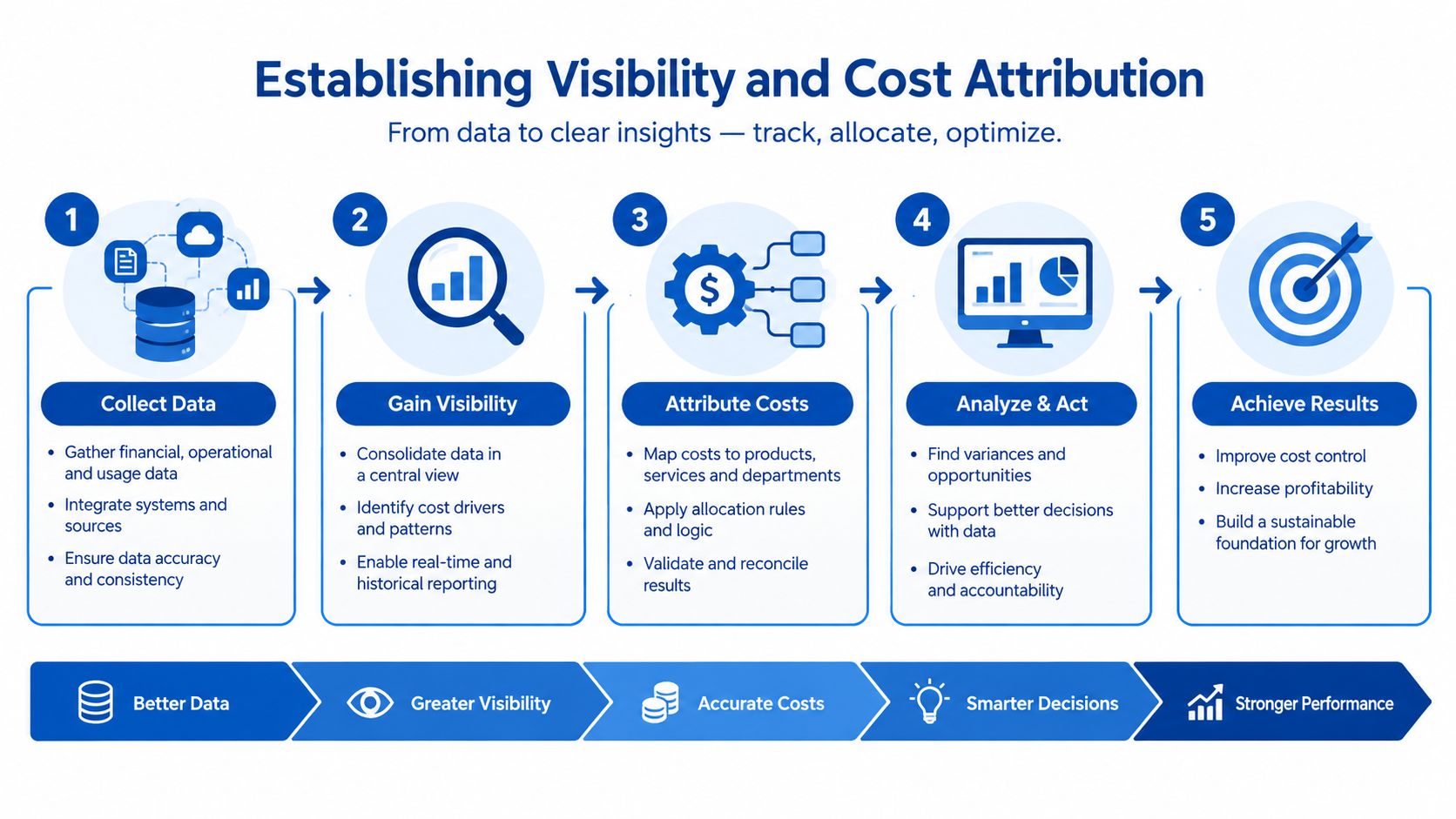
Build the baseline in five passes
- Collect provider data: Connect AWS billing data and Cost Explorer with Azure Cost Management exports. Keep the source data available for reconciliation, rather than relying only on a third-party summary.
- Segment by account and subscription: Separate production, development, testing, shared services and security estates. This prevents a central networking account from obscuring the products that consume its services.
- Segment by service and region: Group EC2, ECS, EKS, Lambda, RDS, S3, Azure Virtual Machines, Azure SQL, Blob Storage and other services independently. Region-level analysis often reveals unnecessary replication or data movement.
- Apply ownership: Map resources to a product, business unit, cost centre and accountable owner. A cost centre without a human owner creates reporting, not accountability.
- Reconcile and prioritise: Compare provider totals with finance records, then rank opportunities by spend, waste risk and operational sensitivity.
Tagging is the prerequisite for the final three steps. A practical minimum taxonomy includes environment, service, team, business unit, cost centre and workload owner. Add an expiry or review field for temporary environments. Enforce tags through infrastructure as code, AWS policies, Azure Policy and deployment templates instead of expecting developers to remember them during a busy release.
A tag policy should distinguish between resources that can be blocked and resources that need remediation. Blocking every untagged resource can interrupt incident response or migration work. Allowing every resource through leaves attribution permanently incomplete. A safer pattern is to permit creation for approved emergency roles, alert the owner immediately and require correction before the resource enters normal operation.
Turn invoices into unit economics
A product owner shouldn't have to ask finance what a service costs after the month closes. Define a unit that reflects the business, such as cost per transaction, cost per active account or cost per processed record. The correct unit depends on the product, but the principle is consistent: relate infrastructure consumption to an outcome that product and finance teams understand.
Application monitoring and debugging helps complete that link by connecting infrastructure usage with application behaviour, errors and performance. A cost spike alongside a query regression means something different from a cost spike caused by successful customer growth. Without application telemetry, teams can mistake a reliability problem for an optimisation opportunity.
Rightsizing and Architecture Optimisation
Rightsizing can deliver quick savings, but the correct target is the workload's operating profile, not the largest available resource. Reducing an EC2 instance, Azure Virtual Machine or managed database may remove idle capacity without changing application behaviour. Re-platforming to ECS, EKS, Lambda, Azure Container Apps or another managed service can align spending more closely with demand, but it also brings migration work, operational training and different failure modes.
For a mixed AWS and Azure estate, apply the same decision sequence across both clouds. Confirm that the resource is still required, then compare provisioned capacity with CPU, memory, network, storage and application latency. Test a smaller or newer instance family against representative peak and recovery scenarios. Architectural change should follow that evidence, with uptime and release velocity treated as constraints rather than afterthoughts.
Choose the smallest safe intervention
A continuously provisioned VM supporting an internal reporting service may only need rightsizing if its workload remains stable. An API with irregular demand is a stronger candidate for autoscaling or containers. A background image or document process may suit an event-driven function when execution duration, concurrency, observability and retry behaviour are understood.
The least expensive architecture on paper can create higher operational cost. Containers may improve packing efficiency and deployment consistency, but inflated pod requests, underused nodes and Kubernetes management overhead can make an EKS deployment more expensive than a well-sized VM. ECS or Azure Container Apps may fit better when the organisation needs container packaging without taking on the full operational burden of Kubernetes. The AWS Lightsail, EC2 and ECS comparison shows why the hosting choice should follow application requirements rather than the lowest advertised price.
Serverless removes much of the idle-capacity problem and changes the cost controls that matter. Review invocation volume, execution duration, memory allocation, cold-start behaviour, concurrency and downstream services. It often suits intermittent, event-driven workloads. Long-running processes, specialised runtimes and systems requiring predictable, continuously warm capacity may remain better suited to VMs or containers.
| Optimisation Strategy Decision Matrix | Implementation Effort | Risk to Uptime | Expected Savings |
|---|---|---|---|
| Remove confirmed idle resources | Low | Low after dependency review | Direct reduction in avoidable spend |
| Right-size VMs and managed databases | Low to medium | Medium if peak behaviour is ignored | Lower compute spend when demand and performance data support the change |
| Introduce autoscaling | Medium | Medium until scaling thresholds are tested | Less payment for unused peak capacity |
| Re-platform to containers | Medium to high | Medium during migration | Sustainable improvement for workloads with predictable runtime patterns |
| Rebuild as serverless components | High | Medium to high during redesign | Closer alignment with variable demand, subject to invocation and execution characteristics |
| Add storage lifecycle policies | Low to medium | Low if retention requirements are preserved | Lower cost for cold, obsolete or over-retained data |
Rightsizing needs a controlled rollout. Change one workload or service group at a time, monitor latency, error rates and queue behaviour, and retain the previous configuration through the agreed observation period. For production services, pair the change with a rollback trigger and an owner who can restore capacity without waiting for a monthly review.
Storage requires the same discipline. Move data to an appropriate tier only after confirming access patterns, retention obligations, restore requirements and retrieval charges. Delete orphaned volumes and obsolete snapshots through an approved lifecycle process. A lower storage bill is not a success if it weakens recovery or creates an expensive emergency retrieval.
Purchasing Strategies and Commitment Discounts
Commitments are a financial tool, not a substitute for architecture analysis. Buying a reservation before removing idle resources or rightsizing workloads can lock the organisation into paying for capacity it never needed. The reliable sequence is to establish visibility, remove waste, validate the new baseline and then commit only the stable portion.
AWS offers Savings Plans and Reserved Instances, while Azure provides Reserved Virtual Machine Instances and savings plans. The mechanisms differ in scope and flexibility. A Compute Savings Plan can provide broader flexibility across eligible compute usage, while an instance-specific reservation may offer stronger economics when the family, operating system, region and workload profile are stable.
Azure's Australian pricing information states that savings-plan eligibility depends on the selected instance family, size and region. Azure Reserved Virtual Machine Instances advertise estimated savings between 36% and 72% versus pay-as-you-go pricing, with the 72% example tied to a three-year commitment, as shown on the Azure savings plans pricing page. Those figures are illustrative pricing offers, not a reason to commit without a workload forecast.
Layer commitments around a stable baseline
Separate usage into three bands:
- Foundation capacity: Services that run consistently and are unlikely to change provider, region or instance family soon. This is the natural candidate for a longer commitment.
- Expected growth: Capacity the business expects to add, but hasn't yet proven in production. Keep this flexible until usage patterns become credible.
- Volatile demand: Batch processing, migration activity, testing, seasonal workloads and interruptible jobs. Use on-demand capacity or suitable discounted options where interruption can be handled.
AWS Savings Plans and Azure savings plans can suit organisations that expect technology changes but still have a dependable level of compute consumption. Reserved Virtual Machine Instances can be appropriate where the workload's machine characteristics and region are well established. Neither option should cover capacity that belongs in an experimental environment.
Model commitment coverage against actual usage rather than total theoretical capacity. Review utilisation, expiries, workload movement and forecast demand together. A commitment can appear highly utilised at the account level while leaving a particular product exposed to a poor fit. Product-level attribution therefore remains important even after procurement has secured a discount.
The cloud computing consulting service approach is relevant when the commercial decision is inseparable from migration and architecture planning. A commitment that looks attractive before a re-platforming programme may become a constraint after the programme changes instance families, regions or operating models.
Commercial test: Commit only to the capacity you can explain, attribute and defend if the product roadmap changes.
The main disadvantage of commitment discounts is reduced flexibility. The main disadvantage of staying entirely on-demand is that predictable baseline usage remains exposed to standard pricing. The right answer is usually a deliberate mix, reviewed as part of architecture governance rather than purchased as a one-off procurement exercise.
Automation, Governance and FinOps Processes
A successful cleanup decays when teams continue provisioning resources without ownership or review. FinOps becomes useful when it assigns financial responsibility to people who can change architecture, deployment patterns and product behaviour. Finance validates the commercial picture, engineering controls the technical levers and product owners decide whether a feature justifies its consumption.
The Australian Government Architecture Cloud FinOps Standard sets out this division clearly. Finance teams should identify budget owners, forecast costs and monitor actual spending against predictions. Product owners should track product cloud costs in profit and loss, while engineering teams should receive alerts for anomalous or unplanned spend and define technical routes for optimisation.
Put controls inside delivery workflows
Start with non-production scheduling. Development and test environments should have explicit operating hours, an owner and an exception process. A scheduled shutdown is safer than an informal request to remember turning resources off, but it must preserve required databases, persistent volumes, test data and integration dependencies.
Add anomaly alerts at several levels. A sudden increase in query volume, data transfer, autoscaling activity or GPU use needs a technical alert with enough context to identify the affected service. A finance alert alone is too late. Route the notification to the product owner and the engineering team that can investigate.
Infrastructure as code should create resources with approved tags, sensible defaults and lifecycle settings. AWS Control Tower controls, Service Control Policies, AWS Budgets, Azure Policy and Azure budgets can provide provider-level guardrails. Terraform or another infrastructure-as-code system can make those controls repeatable across accounts and subscriptions.
CI/CD pipelines should include cost awareness without turning every deployment into a finance approval. A pipeline can compare a proposed infrastructure change with the existing baseline, flag unusually expensive additions and require review for defined risk categories. The review should focus on the reason for the cost, the expected business outcome and the planned rollback, not just whether the number is higher.
Make accountability operational
Use a recurring forum with engineering, finance and product representation. Review changes in spend, unexplained anomalies, optimisation actions, commitment utilisation, service performance and upcoming releases. Assign each action to a named owner with a due date. A meeting without ownership becomes another reporting ritual.
A practical operating model includes:
- Finance ownership: Maintain forecasts, budget structure, chargeback or showback and reconciliation with provider invoices.
- Product ownership: Define unit economics, approve trade-offs and include cloud cost in product planning.
- Engineering ownership: Investigate waste, implement architectural changes and protect reliability during remediation.
- Platform ownership: Provide templates, policies, dashboards and safe automation so teams don't solve the same problem repeatedly.
- Security and compliance ownership: Confirm that lifecycle changes, data movement and retention policies remain acceptable.
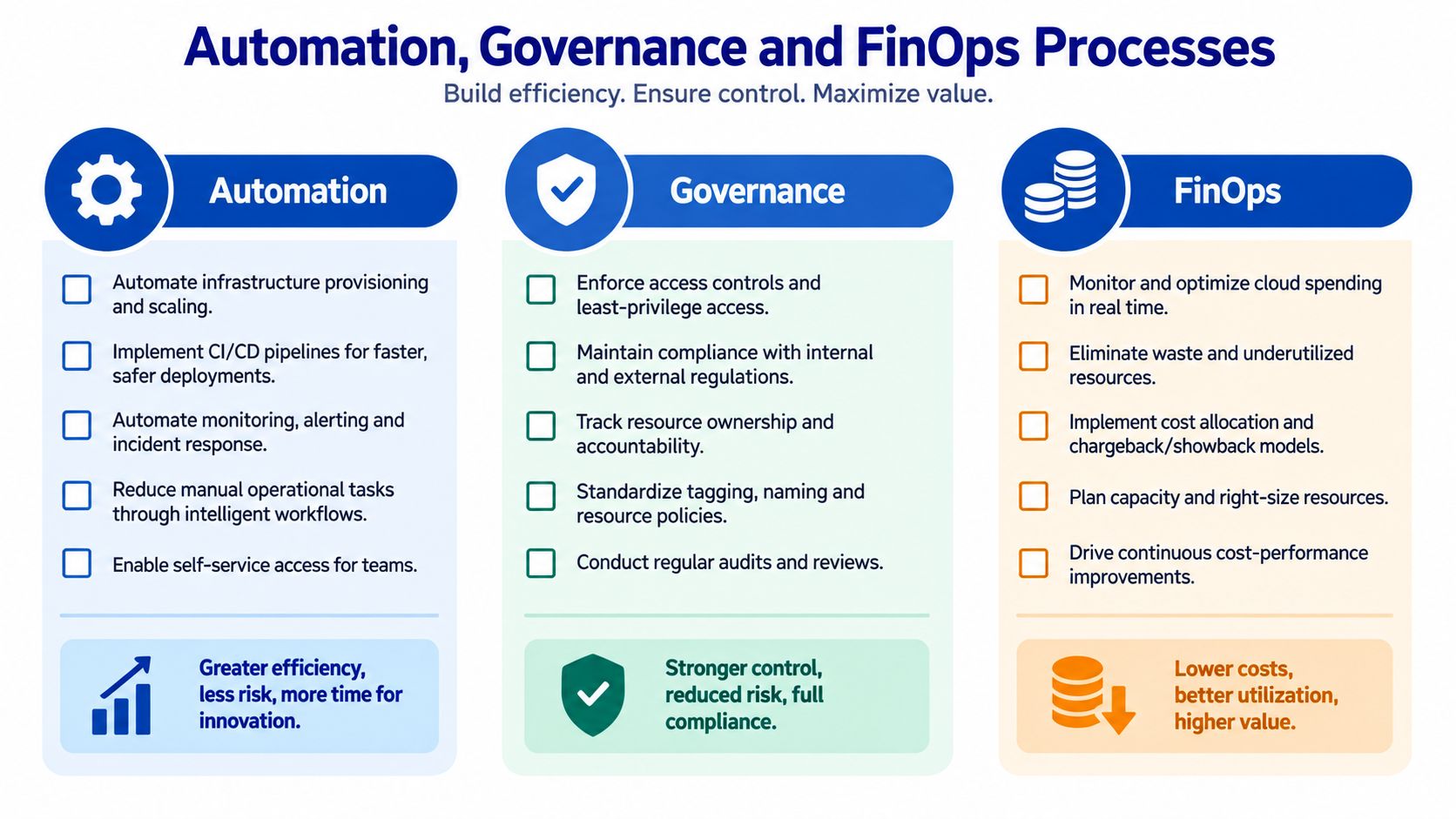
Automation carries risks of its own. An overly broad shutdown rule can interrupt a critical service. An aggressive rightsizing action can create latency during a peak. Use allowlists, maintenance windows, approval paths and rollback automation. The cloud migration services model should include these controls before workloads move, not after the first unexpected invoice or production incident.
Measuring Success and Practical Next Steps
Cloud cost optimisation is successful when the organisation can show lower waste without weakening the outcomes customers and internal teams depend on. Total spend is only one signal. A growing product may consume more resources for valid commercial reasons, while a lower invoice can conceal slower releases, reduced resilience or maintenance that has merely been postponed.
Use a scorecard that links finance, engineering and product results:
- Attribution coverage: Track the share of spend assigned to a product, owner, business unit and cost centre. Untagged usage is a visibility defect, not neutral overhead.
- Unit cost: Select a business measure such as cost per transaction, account or processed record. Review it alongside service quality and product growth.
- Commitment coverage: Measure predictable usage covered by AWS Savings Plans, Reserved Instances or Azure reservations. Check utilisation, flexibility and expiry exposure rather than treating coverage alone as a saving.
- Waste backlog: Record idle compute, orphaned storage, oversized databases and unexplained data transfer as prioritised work, with evidence for each proposed change.
- Reliability guardrails: Pair cost changes with latency, error, availability, recovery and security indicators. A saving that breaches a service objective is not a successful optimisation.
- Forecast accuracy: Compare predicted and actual spend by account, subscription and owner. Unexplained variance points to weak attribution, changed workload behaviour or an outdated baseline.
A structured FinOps engagement in Australia and New Zealand commonly reports 20% to 40% cloud cost savings within 60 days when teams connect native cost tools, analyse 90 days of spend and enforce rightsizing, commitment and placement governance, according to local FinOps implementation guidance. Treat this as an engagement benchmark, not a promised result. Outcomes vary with estate maturity, workload mix, contractual commitments and whether responsible teams can make changes without compromising uptime or release velocity.
A practical 60-day execution plan
Days 1 to 10, establish control. Connect AWS Cost Explorer and Azure Cost Management. Verify billing administrators, account and subscription ownership, data access and invoice reconciliation. Restrict creation of unowned production resources, while retaining an emergency path for incident response.
Days 11 to 20, create the baseline. Analyse the previous 90 days by account, subscription, service and region. Separate shared platform costs from product costs, document critical workloads and rank opportunities by value and operational risk. The largest safe opportunity deserves attention before an easy but immaterial cleanup.
Days 21 to 35, remove confirmed waste. Retire resources with verified ownership and no business dependency. Schedule non-production environments, delete obsolete storage and correct tagging gaps. Record the starting cost, selected action, performance checks and rollback method for every change.
Days 36 to 48, test architecture decisions. Review high-cost workloads with product and engineering representatives. Evaluate rightsizing, autoscaling, storage tiering, container placement, serverless candidates and data-transfer paths. In mixed AWS and Azure estates, compare the operational effect of changing placement or service design, not only the provider rate.
Days 49 to 60, make the process routine. Forecast the next period, assess commitment options against validated usage and publish unit economics. Set anomaly alerts, schedule recurring reviews and add cost checks to delivery workflows. Each priority action should finish with a measurable result, such as lower unit cost, improved utilisation or confirmed avoidance of unnecessary spend.
The first reduction is a baseline, not the finish line. Migrations, integrations, new products and data growth continually change workload behaviour. Revisit architecture choices and commercial commitments during normal operations, keeping cost, uptime and delivery capacity visible in the same decision.
Continuum Solutions helps organisations assess AWS and Azure estates, plan phased migrations, modernise workloads and connect cloud costs with application performance and business ownership. Visit Continuum Solutions to discuss a cloud cost optimisation review focused on reliability, architecture and governance.