The popular advice is simple: move to the cloud, standardise on SaaS, and call the result a technology strategy. That approach usually produces a collection of subscriptions, integrations and security exceptions rather than a coherent operating model. Cloud adoption is an architecture decision, not a strategy on its own.
For an Australian CTO, operations manager or NGO director, the harder questions are more practical. Who owns the data after implementation? Which system is authoritative? Can the organisation detect an identity compromise? What happens when a vendor changes its API, an integration fails or the person who configured the platform leaves?
Effective IT strategy consulting connects cloud architecture, application modernisation, cybersecurity, integration, funding and operational ownership. It turns technology investment into a governed portfolio with measurable outcomes. The sections below focus on the decisions that matter before migration work begins, including costs, delivery risks, commercial models and the questions buyers should ask prospective consultants.
Table of Contents
- Why Cloud Adoption Is Not a Complete IT Strategy
- Core Components of a Modern Technology Roadmap
- The Four Phases of a Strategic Consulting Engagement
- Aligning Technical Deliverables with Business KPIs
- Evaluating Consulting Pricing and Delivery Models
- Real-World Scenarios in Cloud and Integration Strategy
- Selection Criteria and RFP Questions for Buyers
Why Cloud Adoption Is Not a Complete IT Strategy
Cloud adoption can improve infrastructure and procurement while leaving data ownership, integration and security operations unresolved. For Australian organisations, the real strategy begins after the subscription is signed.
Australian businesses already operate connected technology estates. ABS data records that 85% of Australian businesses used ICTs in 2022, while 63% used cybersecurity software and 59% used cloud technology. Cloud, identity, cybersecurity, internal platforms and data flows now affect one another, so each decision carries governance consequences.
A business might run finance in the cloud, store customer records in a CRM, manage access through a separate identity provider and rely on spreadsheets for operational reporting. Each tool can appear sensible on its own. Together, they may produce duplicated records, unclear ownership and manual reconciliation that another platform purchase will leave intact.
Adoption without operating discipline
The not-for-profit sector illustrates the gap. The 2025 Digital Technology in the Not-for-Profit Sector report found that four out of five surveyed organisations use subscription cloud tools, while only 23% had a documented cybersecurity plan and 14% had an AI policy or governance framework.
Subscription platforms can give a small organisation capabilities it could not sensibly build itself. They still require a data catalogue, access rules, an integration register, a vendor exit plan and a named incident-response owner. Without those controls, convenience becomes operational dependency.
Practical rule: Treat every SaaS purchase as a change to your operating model, one that deserves the same governance as an infrastructure decision.
Cloud errors become expensive when adoption outpaces control. Overlapping services, weak identity settings, untagged resources and untested recovery procedures can undermine a sound migration. Teams reviewing AWS environments can use this guide to common AWS mistakes SMEs make when checking whether governance has kept pace with cloud use.
What a strategy must establish first
Before migration code is written, establish four points:
- Authoritative data: Which application owns customer, member, donor, product or financial records?
- Operational accountability: Who approves access, monitors integrations and responds when a service fails?
- Technology dependencies: Which workflows rely on APIs, scheduled exports, manual uploads or undocumented scripts?
- Maintainability: Can the internal team operate, patch, monitor and recover the proposed environment after the engagement ends?
Cloud architecture remains part of the answer, alongside security controls, integration design and ownership. A sound roadmap may migrate one workload, retain another, replace a legacy application or simplify a process before integration. The strongest option is the one the organisation can secure, fund and maintain over time.
Core Components of a Modern Technology Roadmap
Cloud adoption is only one layer of a usable technology roadmap. The roadmap must connect cloud architecture, cybersecurity, applications, data and operations, because delivery exposes the dependencies between them. Separate plans create late changes, unclear accountability and higher implementation effort.
Australian organisations increasingly operate across cloud services, digital platforms and security tools. That operating model makes coordination a governance issue. A roadmap should show which systems exchange data, who owns each decision and how the organisation will monitor and support the result.
Start with the current estate
Begin with an application and integration inventory, then test it against real business workflows. A system diagram that excludes spreadsheets, manual exports or re-entry points describes an aspiration, not the current state.
The assessment should identify:
- Applications and ownership: Record each system's purpose, owner, users, vendor, contract constraints and replacement status.
- Data movement: Document APIs, file transfers, scheduled jobs, webhooks and manual re-entry.
- Identity boundaries: Map administrators, privileged accounts, service accounts, multi-factor authentication and joiner-mover-leaver processes.
- Operational signals: Confirm where logs, alerts, backups, deployment records and incident history are stored.
- Commercial exposure: Separate licence fees, implementation work, cloud consumption and ongoing support obligations.
This inventory often reveals constraints that a product review misses. A CRM may function adequately while staff copy membership data into another platform because no owner has approved an integration pattern. That manual step becomes a control, quality and continuity risk.
Design the target architecture as a system
The target state should define more than an AWS account structure or preferred framework. It should explain how users authenticate, how services communicate, where sensitive data resides, how teams deploy changes and how operators detect and recover from failure.
An AWS hosting decision affects identity, network boundaries, observability, backup design and support effort. Serverless services can reduce infrastructure administration, but they create dependencies on managed services, event flows and disciplined monitoring. Containers can provide portability and control, while requiring operational skills and tooling that a small organisation may lack.
These trade-offs belong in the roadmap. Cloud computing consulting should produce documented decisions on suitability, ownership, support capability and lifecycle. The provider choice follows those decisions.
Make security and data governance design inputs
Security requirements belong beside architecture. Define identity, logging, patching, privileged-access and recovery controls before selecting migration waves.
Data governance needs the same level of specificity. Assign owners for critical entities, document retention and access rules, and define how integrations handle duplicates, failed messages and schema changes. Without those controls, a project can deliver software while leaving the organisation with an unreliable operating capability.
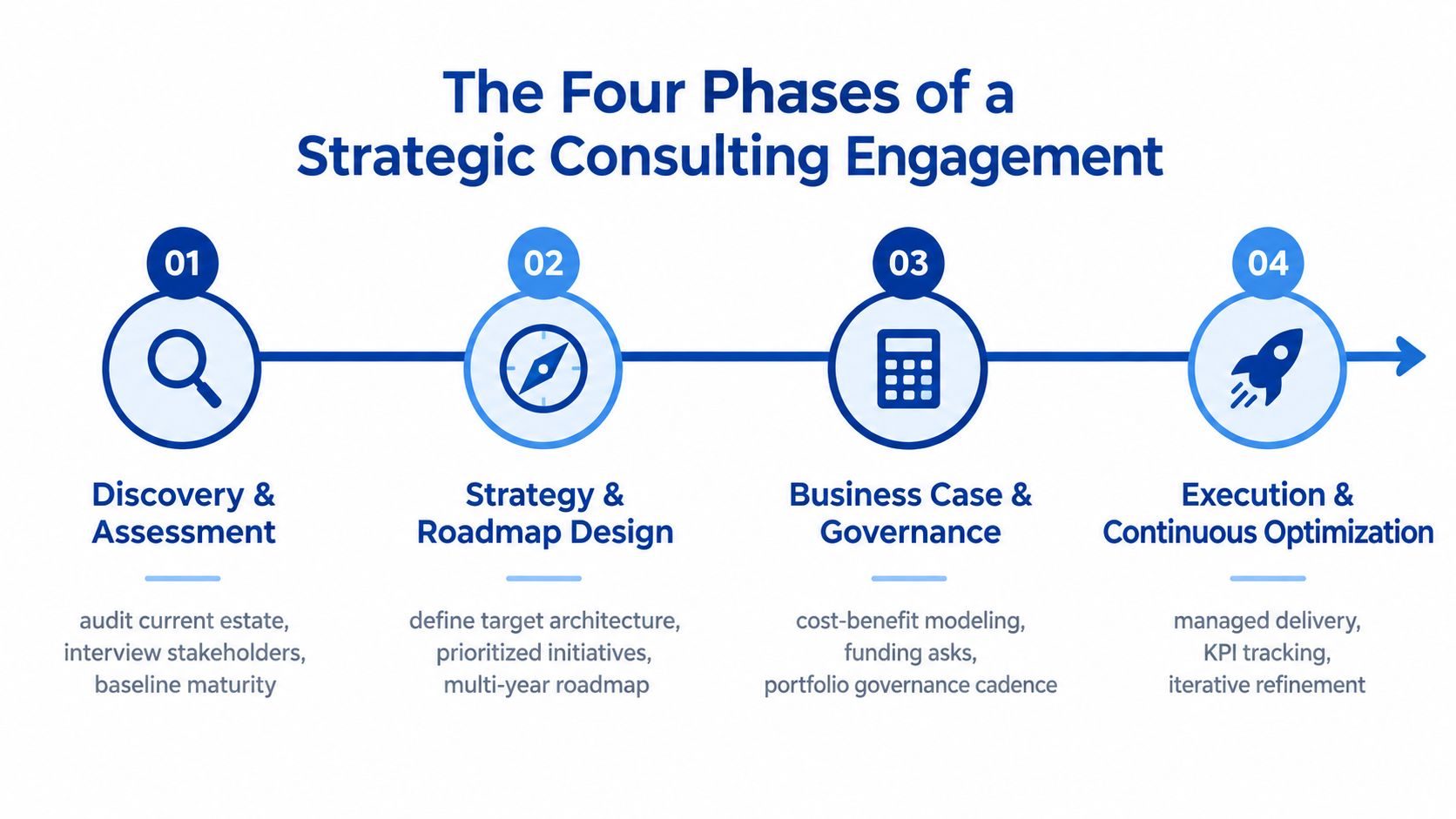
The Four Phases of a Strategic Consulting Engagement
Large technology programs need investment gates. Australia's Major Digital Projects reporting covers 110 strategically significant projects with combined investment of AUD 12.9 billion, illustrating why portfolio governance matters when multiple systems, suppliers and business units depend on one another.
I use four phases, with a decision point at the end of each. The phases aren't a rigid template. They create a disciplined way to stop, test assumptions and redirect funding before a weak workstream becomes embedded.
Discovery and assessment
The first phase establishes the evidence base. It combines stakeholder interviews, application discovery, workflow mapping, security assessment, cloud-cost review and data-quality analysis.
The deliverable shouldn't be a long catalogue of problems. It should identify the decisions leadership needs to make, such as whether to modernise, replace, integrate or retire a system. Each recommendation needs a rationale, dependency, risk and rough implementation path.
The gate is simple: do decision-makers agree on the current state and the priority problems? If not, architecture design is premature.
Strategy and architecture design
Next, define the target architecture and sequence initiatives around business constraints. A migration plan may begin with a low-dependency workload, a controlled pilot or an integration that removes a known manual bottleneck.
I normally test the design against:
- Security: identity, privileged access, logging, backup and recovery.
- Reliability: availability expectations, failure modes and operational ownership.
- Cost: implementation effort, recurring cloud consumption, licences and support.
- Capability: skills required to deploy, monitor and maintain the result.
- Adoption: process changes, training needs and user acceptance.
The gate is approval of the target architecture, delivery sequence and business case for the first release. A minimum viable product can help validate assumptions without committing the organisation to a full platform build. For teams evaluating this approach, MVP development services can form part of a staged delivery discussion, provided the pilot has clear evidence criteria.
Production-wave migration
A pilot is useful only if production delivery learns from it. Production waves should have defined entry conditions, cutover plans, rollback procedures, data reconciliation and named operational owners.
The most common mistake is treating migration as a technical weekend rather than a business transition. Users need to know what changes, support teams need runbooks, and executives need a clear view of residual risk. Each wave should report cost, reliability, security findings, data quality and user adoption before the next wave proceeds.
Benefits realisation
The final phase prevents strategy from ending at go-live. Measure whether the new environment reduces manual processing, improves incident response, supports reliable reporting or enables a business capability that the old estate couldn't provide.
Retire unused systems and contracts where appropriate. Review cloud consumption after workloads settle. Update documentation as the architecture changes. If benefits aren't visible, investigate whether the design, adoption, process or measurement is at fault.
Aligning Technical Deliverables with Business KPIs
Executives rarely fund centralised logging because they want more log data. They fund it because they need faster incident diagnosis, stronger evidence of control operation and less disruption to customers or staff.
The same principle applies to integration registers, monitoring, automated deployment and identity controls. Each technical deliverable should have an operational owner and a business measure. Without that connection, a project can report completed tickets while the organisation continues to experience the same delays and risks.
| Technical Deliverable | Business KPI Impact | Measurement Method |
|---|---|---|
| Centralised logging | Faster incident triage and clearer accountability | Track time from alert to diagnosis, log coverage for critical services and unresolved event volume |
| API and integration register | Fewer failed handoffs, duplicate records and undocumented dependencies | Record integration failures, reconciliation effort and owner response time |
| Application monitoring | Earlier detection of performance and availability issues | Review alert quality, incident duration and recurring fault patterns |
| Identity and privileged-access controls | Lower exposure to unauthorised access and clearer joiner-mover-leaver handling | Measure privileged accounts, access review completion and response to access exceptions |
| Infrastructure as code | More consistent environments and safer change management | Compare deployment repeatability, rollback frequency and configuration drift |
| Tested backup and recovery design | Better continuity during service interruption or data loss | Run recovery exercises and record achieved recovery-time and recovery-point objectives |
| Data catalogue and ownership matrix | More reliable reporting and less manual reconciliation | Track data-quality exceptions, duplicate records and report correction effort |
Define the baseline before delivery
A KPI only helps if someone records the starting position. For a membership organisation, that might mean documenting how staff currently reconcile CRM and payment data. For an enterprise application, it could mean capturing deployment frequency, incident patterns and the manual effort required to investigate failures.
Avoid vanity measures such as the number of cloud services deployed or dashboards created. Those figures describe activity. They don't prove that the organisation operates more safely or efficiently.
Make the measure survive the handover
The person who builds a dashboard may not be the person who owns the result. Assign every measure to a business or operational owner, define its reporting cadence and document what action follows a deterioration.
A good governance pack includes a KPI dictionary, data source, calculation method, owner, target direction and escalation path. That level of detail makes board reporting more credible and gives delivery teams a practical definition of success.
Evaluating Consulting Pricing and Delivery Models
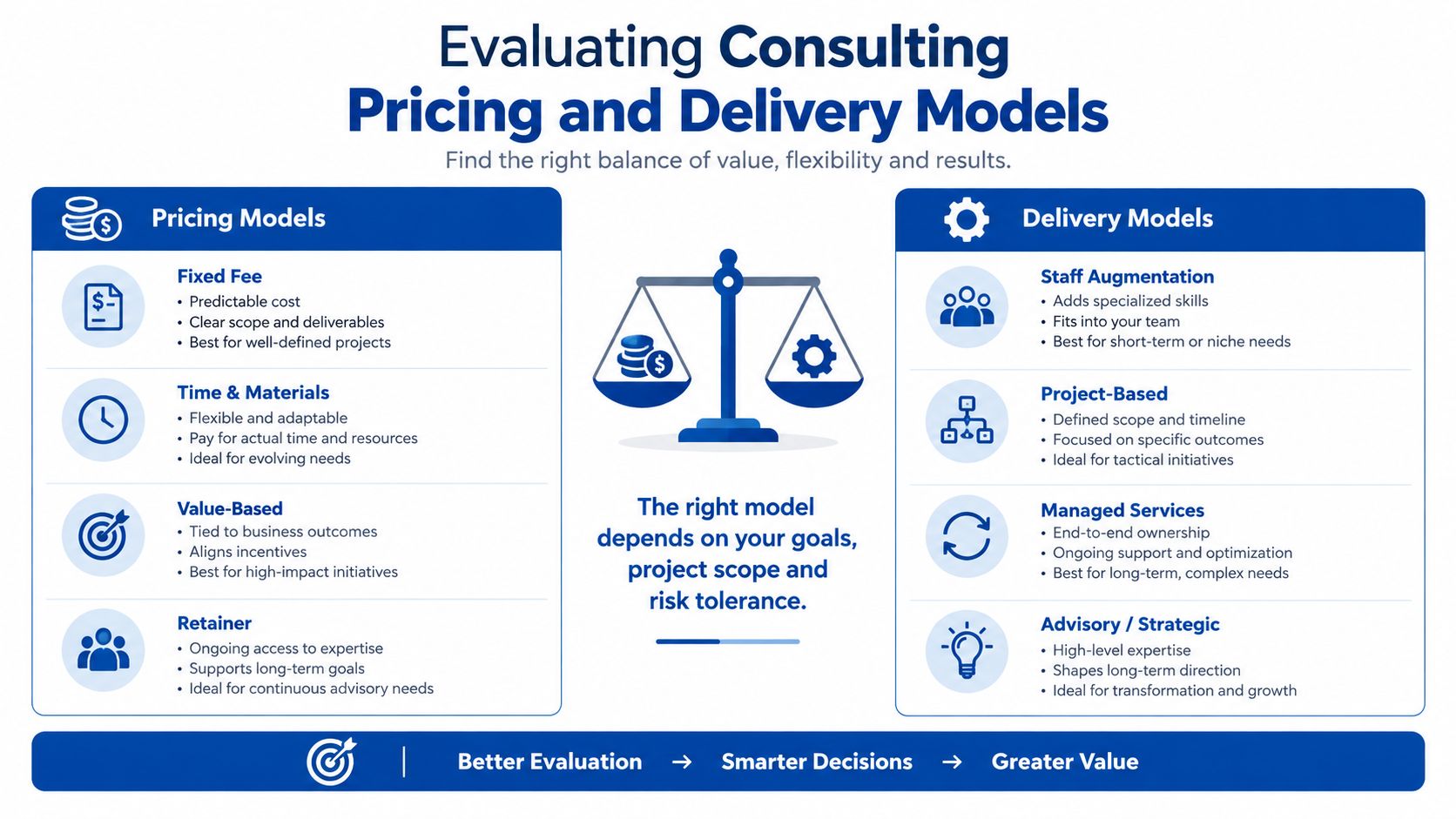
The commercial model shapes behaviour. A fixed-fee engagement encourages scope discipline, while an open-ended time-and-materials arrangement can accommodate uncertainty but requires stronger client governance.
Fixed fee for a defined discovery
A fixed-fee discovery phase works well when the outputs are clear: current-state assessment, risk register, target options, prioritised roadmap and business case assumptions.
The advantage is cost certainty and a defined decision point. The disadvantage is that a consultant may protect scope too aggressively when discovery reveals an undocumented legacy dependency. The contract should state how new evidence is handled and what constitutes a change request.
Time and materials for uncertain implementation
Time and materials suits migration and integration work where the final effort depends on data quality, vendor behaviour or legacy code. It provides flexibility, but the buyer must manage burn rate, acceptance criteria and reporting.
I recommend weekly delivery reporting that shows work completed, remaining assumptions, risks, decisions required and forecast effort. “We worked the hours” isn't a sufficient outcome.
Retainer for ongoing advisory and managed operations
A retainer can reserve access to architecture, security and delivery expertise when an organisation has a small internal team. It works best when the agreement defines response expectations, meeting cadence, deliverables and escalation boundaries.
The risk is paying for availability without a meaningful backlog. Use a prioritised work register and review it regularly. A retainer shouldn't become a substitute for deciding which initiatives deserve funding.
Outcome-based structures need careful definitions
Outcome-based fees can align incentives, but technical programs often depend on factors outside the consultant's control, including user adoption, internal process changes and vendor availability. Define outcomes that the supplier can influence and verify, rather than promising a broad transformation result.
For buyers comparing implementation economics, this guide to AWS migration costs in Australia is useful as a starting point for thinking about discovery, delivery complexity, recurring consumption and post-migration operations. The important point is not a universal price. It is the need to separate one-off delivery from ongoing run costs.
Real-World Scenarios in Cloud and Integration Strategy
A strategy becomes credible when it survives operational constraints. Two common situations show why architecture, security and governance must be designed together.
Replatforming a monolith to AWS
An enterprise may want to move a monolithic application to AWS because its existing hosting arrangement limits release confidence and makes scaling difficult. The tempting answer is to rebuild everything as serverless services immediately. That can create a large dependency graph, unfamiliar operational responsibilities and a long period before users see value.
A safer path may begin with a workload assessment, dependency mapping and a contained migration wave. The team could first improve deployment automation, centralise logs, protect administrative access and establish backup and recovery evidence. It can then decide which application boundaries justify decomposition and which are better retained temporarily.
The security target must be explicit. The ACSC Essential Eight Maturity Model defines four levels of security control implementation, giving the program a practical way to assess identity, patching, application control, administrative privileges and recovery objectives.
The trade-off is clear. A gradual replatform may preserve continuity and build internal confidence, but it can leave temporary complexity in place. A full rewrite may produce a cleaner end state, but it carries greater delivery and adoption risk. The investment gate should require evidence from the pilot before the organisation commits to the larger modernisation path.
Unifying an NGO's CRM and membership data
A mid-sized NGO may operate a CRM, membership platform, payment service and email system with overlapping records. Staff manually correct names, statuses and renewals because no system has been designated as authoritative.
The first intervention isn't necessarily a new CRM. It is a data stewardship decision. Define the member record, assign ownership, document matching rules and create an integration register that records direction, frequency, failure handling and support responsibility.
An API-led integration can reduce manual movement, but it also creates new operational duties. Someone must monitor failed messages, handle duplicates, review vendor changes and reconcile records after an outage. A smaller NGO may need managed escalation because it doesn't have a dedicated integration operations team.
A phased cutover protects continuity. Run the new flow alongside the old process for a controlled period, reconcile results, train staff and retire manual steps only when the evidence is acceptable. Cloud migration services can support this kind of sequencing, but the organisation still needs to own its data definitions and acceptance decisions.
Selection Criteria and RFP Questions for Buyers
A strong RFP tests how a consultant thinks, not how many services appear on its website. Ask for evidence of architecture decisions, delivery controls and post-launch ownership.
Use questions such as:
- Current-state depth: How will you discover undocumented integrations, manual workarounds and technical debt?
- Architecture trade-offs: Which criteria will determine whether a workload is rehosted, replatformed, refactored, replaced or retired?
- Security ownership: How will identity, privileged access, logging, patching, backups and incident response map to named owners?
- Delivery gates: What evidence is required before pilot, production migration and benefits realisation?
- Cost transparency: How will you separate discovery, implementation, cloud consumption, licences, support and future change?
- Capability transfer: What documentation, runbooks, training and handover artefacts will the internal team receive?
- Observability: Which services, integrations and business workflows will be monitored after launch?
- Failure handling: What is the rollback approach if data reconciliation, user adoption or reliability falls below acceptance criteria?
Ask suppliers to show a sample roadmap structure, risk register and operational handover pack with sensitive client information removed. You want to see whether they document assumptions and unresolved decisions, not just polished diagrams.
Also check the proposed team. The person selling the strategy should be clear about who designs the architecture, who performs the migration, who owns testing and who supports the environment afterwards. A strategy that can't be operated by the client is an expensive presentation.
Continuum Solutions helps Australian organisations assess cloud architecture, plan AWS and Azure migrations, modernise applications and connect CRM, membership, authentication and internal systems through documented integrations. Visit Continuum Solutions to discuss a practical IT strategy built around security, maintainability, phased delivery and measurable business outcomes.