
Your ad platforms are reporting a strong month. Your CRM disagrees, finance disagrees with both, and nobody can say which campaign produced a paid member, a donation, or a settled invoice. That's not a media problem you can fix with a bigger budget. It's a systems problem in the path between a click and money in the bank, and it's the problem a marketing technology consultancy should be hired to fix, measure, and hand over in working order.
Table of Contents
- What a Marketing Technology Consultancy Actually Owns
- Engagement Types and Australian Cost Ranges
- Five Workstreams Inside the Martech Stack
- Privacy-Resilient Measurement as Architecture
- How to Evaluate a Marketing Technology Consultancy
- A Phased Playbook with KPIs and Scenarios
- Book a Scoping Conversation Before You Buy Tools
What a Marketing Technology Consultancy Actually Owns
Say a membership organisation runs Google Ads and Meta campaigns for a joining offer. The platforms show hundreds of conversions. The CRM shows far fewer new members, and Xero shows fewer paid memberships again. Each report may be internally consistent, yet they can't all describe the same outcome.
The gap usually sits in duplicated events, a thank you page firing before payment clears, offline joins never reaching the ad platform, or a CRM import that overwrites the original source. A marketing technology consultancy owns that data path. It designs event capture, consent handling, integrations, cloud hosting, and reconciliation so a reported conversion can be traced to revenue, a subscription, or a donation that finance accepts.
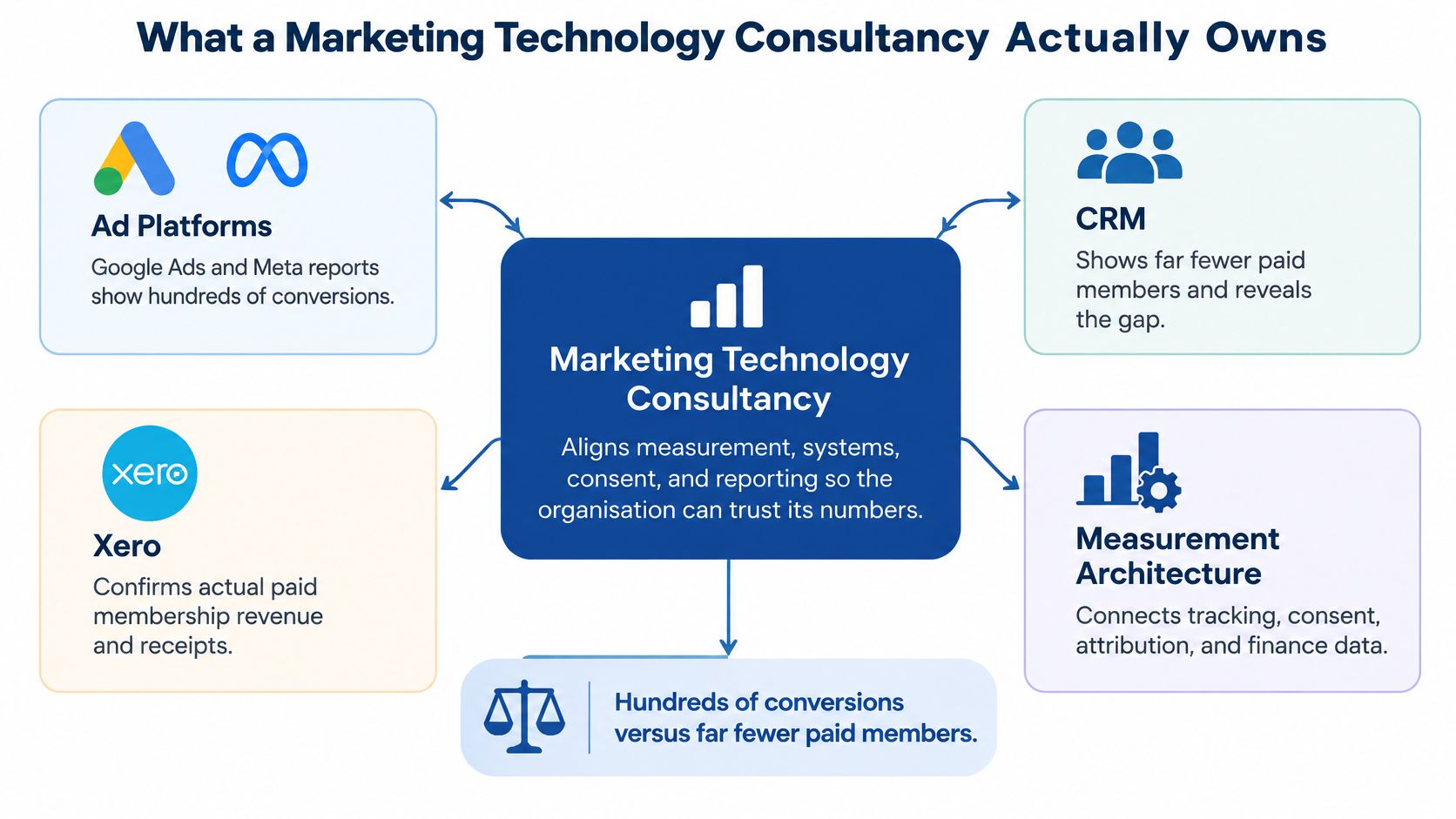
Three Roles Buyers Mix Up
- Media buyer: Spends channel budgets, tests audiences, and optimises within Google Ads, Meta, or LinkedIn.
- In-house marketer: Owns the offer, audience, message, and campaign calendar.
- Marketing technology consultancy: Builds and governs the systems those campaigns depend on, from the website or app through the CRM to reporting.
I use a pipes and meters analogy with clients. Media is the tap. The consultancy designs the pipes, meters, and shut-off valves, then proves the meter reading matches what was delivered. If you need that ownership clarified before you brief anyone, our business IT consulting services page sets out where general technology advice ends and build accountability begins.
That work falls into five areas, stack selection, API and CRM integration, cloud hosting, tracking and attribution, and the apps events come from. You don't need all five on day one. You do need to know which one is broken.
If platform conversions and the finance system disagree, don't brief another campaign. Fix the measurement path first.
Engagement Types and Australian Cost Ranges
The commercial pressure is real. The IAB Australia Internet Advertising Revenue Report prepared by PwC Australia put Australia's internet advertising market at A$16.4 billion in calendar year 2024, an 11.1% increase from 2023. At that scale, a small attribution error misallocates serious money, and channel reports that can't be reconciled to a CRM or finance system aren't a reporting nuisance. They're a budget governance failure.
The ranges below are indicative Australian professional services budgets for senior delivery. They aren't media spend, licence costs, your internal staff time, or a fixed price list. Use them to choose a first purchase and to test whether a proposal is in a plausible band.
Marketing Technology Consultancy Engagements and Indicative Australian Fees
| Engagement | Elapsed time | Main cost driver | Best fit |
|---|---|---|---|
| Discovery and stack audit, A$8,000 to A$25,000 | 2 to 4 weeks | Number of systems | Undocumented tools, unclear ownership, no event map |
| Tracking and attribution rebuild, A$25,000 to A$75,000 | 4 to 10 weeks | Event volume and systems | GA4, ads and revenue or donations do not reconcile |
| CRM and API integration, A$30,000 to A$120,000 | 6 to 14 weeks | Systems and data cleaning | Duplicate records, CSV exports, broken lead handoff |
| Cloud hosting for martech workloads, A$20,000 to A$90,000 to establish | 4 to 10 weeks | Workload size and baseline | Shared hosting, legacy servers or unpredictable cloud bills |
| Managed measurement retainer, A$3,000 to A$10,000 per month | Ongoing after baseline | Scope of monitoring | Stable stack that still needs monitoring and change control |
A discovery and stack audit is the right first buy when nobody can list every tag, integration, owner, and renewal date. You should receive a system map, an event inventory, access risks, and a priced next step. It excludes rebuilding anything, and that's the point. I wouldn't approve a large build until that map exists.
A tracking and attribution rebuild covers the event taxonomy, GTM and GA4 configuration, conversion definitions, and reconciliation checks. Cost rises with multiple domains, apps, call tracking, and offline conversions. A CRM and API integration is dearer when records need deduplication before syncing, because automating dirty data just spreads duplicates faster.
A cloud move makes sense when collectors, APIs, or member apps sit on shared hosting or an ageing server with no reliable monitoring. Our cloud computing consulting work starts from workload and baseline cost, not from a preferred instance size. Budget separately for ongoing AWS or Azure consumption, and insist on alerts before launch.
Practical rule: Buy a fixed discovery before a large build. A cheap configuration-only job that leaves no documentation is usually the most expensive option at handover.
A retainer only earns its place after a baseline exists, with named monitoring, change control, and a monthly reconciliation task. Pick one row as your first purchase. Bundling all five hides which deliverable moved the number.
Five Workstreams Inside the Martech Stack
Treat the stack as five build areas. Each needs a concrete deliverable, a named owner, and a test that proves it's working after the next website release, not just on launch day.
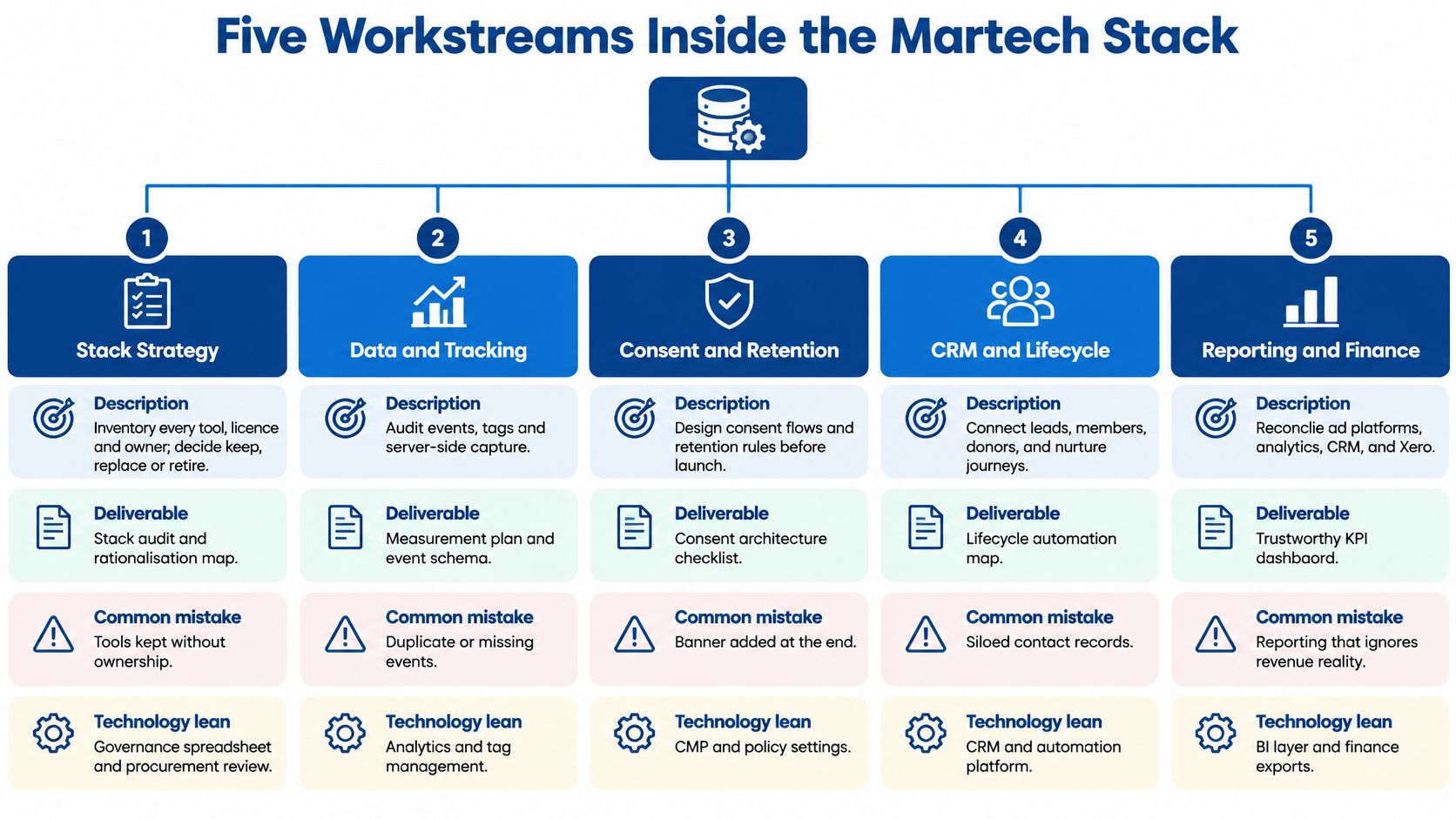
Stack Strategy and Integrations
Stack strategy starts with an inventory of every tool, licence, contract, and owner, then a keep, replace, or retire decision. The deliverable is a rationalisation map your operations lead can maintain. The common mistake is buying a customer data platform before the CRM is clean. A new layer on duplicated contacts gives you faster access to the same unreliable records.
Integrations should use documented REST APIs between Salesforce or HubSpot, Shopify, Xero, Stripe, and internal tools, with idempotent sync, error queues, and retry logic. Idempotent means replaying the same event doesn't create a second order, member, or donation. Point to point automation zaps nobody documented are cheap until the person who built them leaves. Our custom integrations approach treats error handling and monitoring as part of the build, because a silent sync failure looks exactly like a sudden drop in leads.
Cloud, Tracking, and Apps
Cloud hosting covers tracking collectors, integration APIs, and member or subscription apps on AWS or Azure with a known baseline cost, logging, and backups. Lifting a plugin heavy site onto oversized instances isn't modernisation. It's the old reliability problem at a higher monthly price.
Tracking needs one event taxonomy across GTM, GA4, call tracking, SMS, and the CRM, plus a weekly reconciliation to revenue. Control the payload tightly. The OAIC report on 2025 data breach notifications recorded 1,205 data breach notifications in Australia during 2025, an 8% increase from 1,112 in 2024. That context is why I would prohibit raw email addresses, phone numbers, health information, and identity documents from analytics payloads, use allow-listed event schemas, hash identifiers only where the receiving platform explicitly supports that workflow, and fail a deployment when a banned field appears.
People are part of that control design. The OAIC statistics for January to June 2025 attributed 37% of notifications to human error, equal to 193 notifications. Each workstream therefore names who can change a tag, rotate a key, export an audience, or grant admin access, with least privilege service accounts and audit logging.
Cross-platform apps matter when conversion happens inside a product rather than on a landing page. Flutter, React Native, or a progressive web app should emit the same event names as the website, with the same order, member, or subscription identifiers. If the app team invents a second taxonomy, your funnel breaks at the exact point where users become customers.
Fix identity and events before buying another channel tool. A new platform connected to unreliable identifiers gives you one more dashboard that finance won't trust.
Privacy-Resilient Measurement as Architecture
Consent isn't a banner your developer adds in the final week. It's a state that must travel with every event, through every integration, and into every retention and deletion decision. If that sounds like architecture, that's because it is.
The 2025 IAB Australia Data State of the Nation survey of 103 Australian advertising decision-makers and influencers found 92% considered data usage critical or very important to commercial success, 74% reported privacy changes were affecting personalisation tactics, and 67% said their organisations were at least somewhat prepared for Australian Privacy Act reforms. Read together, those figures describe dependence on data without matching confidence in the controls around it.

What to Put in the Statement of Work
- Consent captured once: Record the consent state at source and propagate it with each event to GA4, ad platforms, the CRM, and call tracking.
- A non-email CRM identifier: Use an internal identifier in the browser and data layer, not an email address or phone number.
- Server-side collection for money events: Collect purchases, memberships, subscriptions, and donations through controlled APIs where browser loss would distort the result.
- Retention rules per system: Write down how long each platform and vendor keeps event, call, and audience data, and how deletion is executed.
- A refusal fallback: Keep contextual audiences, aggregated conversion reporting, and clean room compatible datasets available when consent is withheld.
Server-side collection costs more to engineer and adds a cloud bill for collection, logging, and monitoring. That's the disadvantage, and you should see it priced openly. The advantage is that your most important conversions don't disappear because a browser blocked a script, a consent choice removed a client side tag, or a platform identifier degraded.
Require an event dictionary, deduplication keys, data quality tests, and a monthly check against invoices, subscriptions, or donation records. The failure points I would test explicitly are consent state dropped in the app, the same purchase sent by browser and server without a shared key, and an audience exported to a vendor with no deletion path.
Start with the events tied to money. You can govern page scrolls later.
A narrow, well controlled set of revenue events is more useful commercially than hundreds of clicks nobody can legally retain, match, or explain. Privacy-resilient measurement isn't about collecting more. It's about keeping the few events that justify spend lawful, deduplicated, and reconcilable when conditions change.
How to Evaluate a Marketing Technology Consultancy
Score proposals pass or fail. A polished channel case study doesn't prove a firm can design an API, secure a server-side collector, or reconcile Shopify orders to Xero. You're buying engineering judgement and operating discipline, so make the vendor show both in documents you can keep.
Vendor Scorecard for a Marketing Technology Consultancy
| Criterion | Pass looks like | Red flag |
|---|---|---|
| Engineering skills | Named integrations, event taxonomy and cloud diagram from a shipped project | Only channel case studies and no system map |
| Security baseline | Essential Eight target level with evidence of patching and MFA | No security plan and admin access shared by email |
| Partner credentials | AWS or Azure partnership when they host the workload | Badges unrelated to the systems in scope |
| Delivery approach | Phased scope, baseline metric, documented handover | Big-bang cutover and a slide deck as the only deliverable |
| Commercial terms | Fixed discovery, then a priced build; month-to-month support | Lock-in retainer before anyone has seen the data |
| Operating commitment | Named uptime target, on-call window and defect response | Best efforts with no owner after go-live |
Ask who will design the API contracts, identity model, GTM and GA4 events, and the reconciliation report. The answer should name senior people and shipped systems involving at least one relevant platform such as Salesforce, HubSpot, Shopify, or a membership system. Continuum Solutions is a Shopify Plus Partner, AWS Partner, Azure Partner and WP Engine Partner, and has Australian staff. That only matters where those platforms are in your stack, so score the evidence against your systems, not the badge count.
Delivery terms reveal risk quickly. A credible proposal follows discovery with a written scope, timeline, and cost, takes a baseline from recent production data before changing anything, and releases in phases. For support, require an uptime target, production defect response times, an on-call owner, and clear month-to-month terms where ongoing Google and Facebook ads agency management is bundled with measurement work.
Check adjacent operational competence too. If lifecycle email depends on the same CRM data, a deliverability check using the MailGenius email deliverability tool is a sensible acceptance step before blaming automation logic for messages that never reached the inbox. Small checks like that separate teams that debug whole systems from teams that only configure screens.
The red flags are consistent, a retainer with no metric, no data-flow diagram, shared admin access, or a promise to improve ROAS before anyone has audited tracking. A specialist systems firm has one clear advantage over a media agency. It should refuse work that's only creative. The disadvantage is equally clear. It won't run your campaign calendar.
I would walk away after two fails on the scorecard. One gap can be contracted around. Two usually mean you'll pay for discovery twice, once in the proposal and again during a difficult handover.
A Phased Playbook with KPIs and Scenarios
A phased engagement protects you from the most common martech failure, a large rebuild with no baseline. Follow the order. Each step produces evidence the next step depends on.
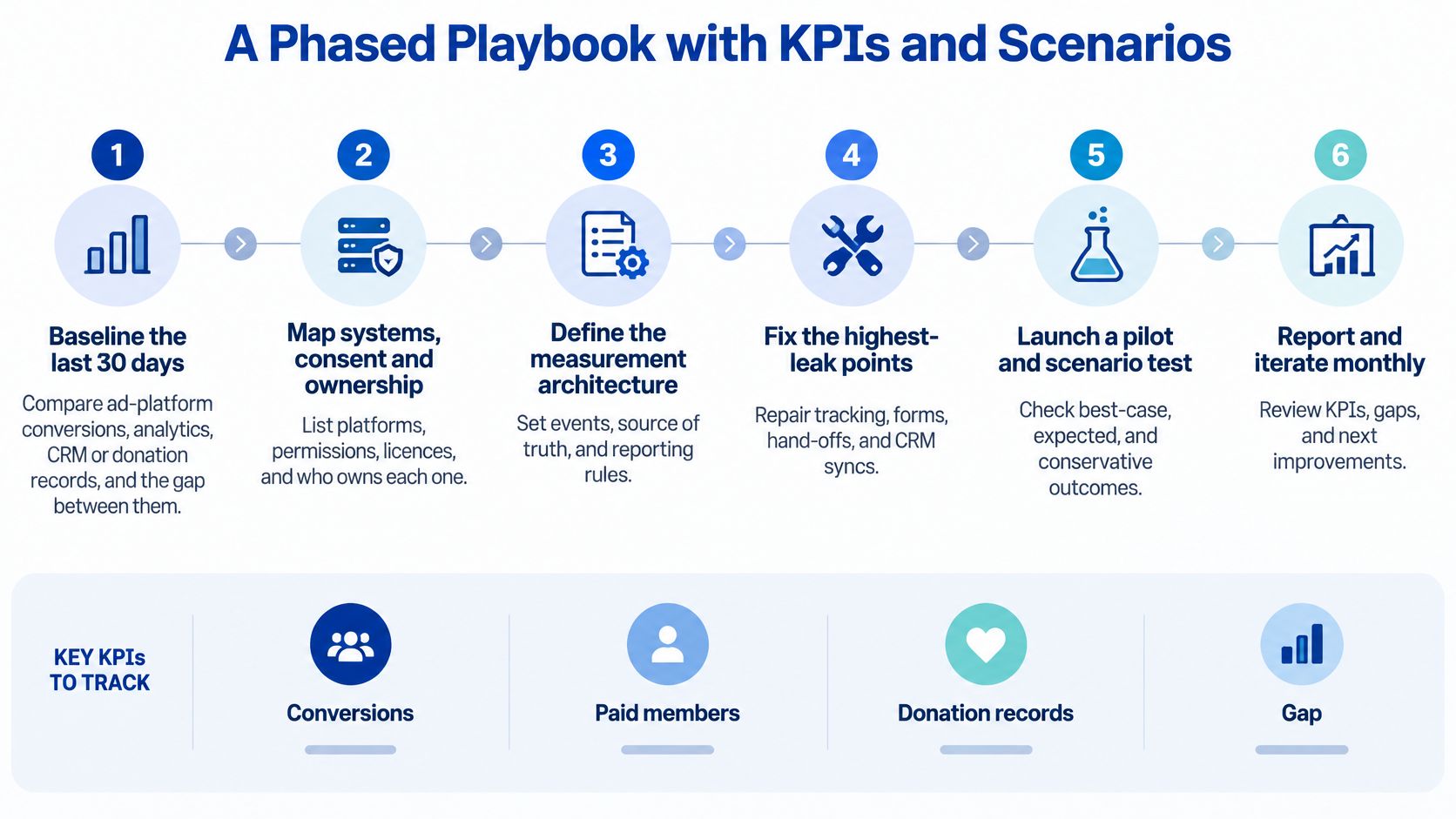
Six Steps in Sequence
- Baseline the last 30 days: Export ad platform conversions, analytics, CRM or donation records, and finance results. Quantify the gap before touching a tag.
- Map systems and personal data: List platforms, integrations, consent points, owners, admin users, and every destination receiving marketing events.
- Agree one target metric: Choose cost per qualified member, reconciled revenue, or another outcome finance recognises. Don't choose a click rate.
- Build the smallest useful path: Implement the event taxonomy, one priority CRM sync, and server-side collection only where the browser path is unreliable.
- Reconcile weekly, then widen: Compare platform, analytics, CRM, and finance figures every week. Add call tracking, SMS, or a second channel only after the first path holds.
- Hand over operations: Deliver runbooks, access registers, monitoring alerts, test cases, and a backlog your team can own.
Our published Google Ads results approach follows the same commercial logic. Establish the starting point, agree the metric, then judge changes against production data rather than platform enthusiasm.
Two Scenarios Through the Same Playbook
Say an ecommerce brand on Shopify with Stripe payments sees Meta reporting more purchases than Xero can match to settled revenue. Step one quantifies the variance by order and date. Step four adds the Shopify order ID as the deduplication key across browser and server events, then step five runs a nightly revenue check. I'd set the initial acceptance target as a worked example, variance under 5%, then tighten it once refunds and partial payments are handled consistently.
Now say a charity with fewer than 150 staff wants appeal automation and AI assisted content. The 2025 Digital Technology in the Not-for-Profit Sector research from Infoxchange, drawing on more than 800 organisations across Australia and New Zealand, found 67% were using generative AI but only about 23% had a documented cybersecurity plan. For that charity, I wouldn't start with a new AI platform. I'd start with CRM deduplication, role-based access, multi-factor authentication, an approved use rule for donor data, and documented automations that survive staff turnover.
That sequence may feel slower. It prevents a familiar outcome where an appeal workflow sends from duplicated records, a former staff account still owns the integration, and nobody can audit what donor information entered a general purpose tool.
Measure either scenario with four KPIs, match rate between platform and finance, duplicate record rate, time to publish a tracked change, and hosting cost against the pre-project baseline. Skip the baseline and every later improvement claim becomes unverifiable.
Book a Scoping Conversation Before You Buy Tools
If your platform numbers and your CRM or finance system disagree, don't buy another ads tool and don't sign a management retainer yet. Bring the last 30 days of ad, analytics, and revenue or donation exports, plus a list of systems, owners, and admin users. Ask for the engagement row that matches your gap, a data-flow sketch, and one agreed metric.
We respond to contact form enquiries within one business day with an honest assessment of whether and how we can help. After that enquiry process, we provide a clear proposal with scope, timeline, and cost. You can book a consultation, call (03) 6468 9126, or email info@continuumsolutions.au.
The useful outcome is a go, a no, or a smaller discovery. If the answer is a tool demo with no baseline, stop. You don't need a pile of licences. You need a measurement path your finance team can trust.
If your ad platforms, CRM, and finance system still tell different stories, Continuum Solutions can audit the stack, rebuild the measurement path, and integrate the systems behind it in a phased, documented engagement. Bring your last 30 days of exports and we'll give you an honest view on the smallest useful first step. Start the conversation at Continuum Solutions.