A lot of teams ask the same question at the same point in their growth: should I use AWS Lightsail or EC2 for my business application? It usually comes up when a website, SaaS platform, internal tool, or customer portal has moved beyond basic hosting, but the business still wants cost certainty.
The tension is real. Lightsail looks tidy, easy to explain to finance, and quick to launch. EC2 looks more complex, but it gives you the controls that matter once uptime, integrations, security boundaries, and scaling stop being theoretical concerns and start affecting revenue, operations, or donor experience.
I’ve seen this decision framed badly as a simple price comparison. That’s where businesses make expensive mistakes. The better frame is this: Lightsail is managed simplicity. EC2 is granular control. The right choice depends on your application’s behaviour, your team’s operational maturity, and how much architectural flexibility you’ll need once the platform grows. If you’re weighing that decision now, proper cloud computing consulting support can save a lot of rework later.
Table of Contents
- The Strategic Choice Beyond Simple Hosting
- Understanding the Core Concepts of Lightsail and EC2
- A Business-Focused Comparison of Core Attributes
- Operational Overhead and Security Considerations
- Use Case Recommendations for Your Business
- Planning for Migration and Future Integration
- Your Final Decision Checklist
The Strategic Choice Beyond Simple Hosting
A Melbourne business launches a client portal, an ecommerce backend, or a membership platform. The first priority is speed. The second is not blowing up the monthly infrastructure bill. Lightsail often enters the conversation because it makes AWS feel approachable. You get a bundled server, a cleaner interface, and a monthly plan that looks easy to govern.
That works for a while. Then the business adds a mobile app, introduces API integrations, runs campaign traffic through the platform, or needs stricter uptime discipline. At that point, the original hosting choice starts shaping far more than hosting. It affects deployment workflows, support burden, resilience under load, and how easily the application can connect to the rest of the AWS stack.
Why this decision becomes commercial, not just technical
Most buyers don’t regret choosing a platform because of a bad dashboard. They regret choosing one that no longer fits the business six months later. If your application is tied to customer transactions, donor campaigns, subscriptions, field operations, or internal automation, the hosting layer becomes part of operational risk.
That’s why the Lightsail versus EC2 question should be treated as a total cost of ownership decision. Monthly infrastructure is only one line item. You also need to account for:
- Support effort: Who diagnoses incidents, applies changes, and handles scaling events.
- Architecture flexibility: Whether the environment can support new requirements without a redesign.
- Performance stability: Whether the application behaves consistently under normal and peak usage.
- Future integration: Whether adding services like object storage, managed databases, load balancing, or automation will be straightforward or awkward.
Cheap to launch isn’t the same as cheap to operate.
What usually works
Lightsail works best when the application is relatively contained, the traffic pattern is stable, and the business wants a simpler operational model.
EC2 works best when the application matters enough that control, scaling options, and broader AWS integration justify the extra engineering discipline.
If you’re asking “Should I use AWS Lightsail or EC2 for my business application?”, the answer usually becomes clear when you stop comparing product pages and start mapping the platform to the business model.
Understanding the Core Concepts of Lightsail and EC2
Lightsail and EC2 both give you compute inside AWS, but they’re built around different assumptions.
Lightsail as the all-in-one option
Lightsail is best understood as a bundled virtual private server. It packages compute, storage, and networking into a simpler monthly plan. For many teams, that’s the appeal. You don’t need to assemble each AWS building block individually, and you don’t need deep platform knowledge to get a basic environment online.
Think of Lightsail like a furnished apartment. The essentials are already there. You can move in quickly. You don’t spend much time choosing every fixture, but you also accept the layout as it is.
That model suits businesses that want to host a modest web application, a small customer-facing site, a proof of concept, or an internal tool without introducing a lot of cloud engineering overhead.
EC2 as the foundational building block
EC2 is different. It’s a core infrastructure service. You choose the instance type, networking model, storage approach, scaling method, and security design. That gives you much more freedom, but it also means the platform expects more from the team operating it.
The better analogy is buying land and designing the building around how the business works. That can be more effort at the start, but the result fits your application, traffic behaviour, governance model, and integration requirements more precisely.
The practical difference in mindset
The key difference isn’t just simplicity versus complexity. It’s abstraction versus control.
A useful way to separate them is this:
| Service | Best thought of as | What it optimises for | Where it starts to strain |
|---|---|---|---|
| AWS Lightsail | Bundled VPS inside AWS | Speed, simplicity, predictable setup | Applications that need deeper scaling, tuning, or AWS-native integration |
| Amazon EC2 | Core compute building block | Flexibility, control, architecture choice | Teams that lack the time or capability to manage infrastructure properly |
For a business leader, that distinction matters because your cloud platform isn’t only a hosting decision. It determines how much technical judgement your team needs every time the application changes.
If your team wants fewer knobs to turn, Lightsail is attractive. If your business needs those knobs, EC2 is the safer decision.
A Business-Focused Comparison of Core Attributes
The commercial difference shows up quickly once an application moves beyond a simple launch.
A small internal tool, brochure site, or low-traffic client portal can run comfortably on a bundled platform for quite a while. A revenue-generating app with variable traffic, stricter uptime expectations, or growing integration needs usually exposes the limits faster. That is why this decision should be framed around total cost of ownership, not just the first monthly invoice.
Early comparison table
| Attribute | AWS Lightsail | AWS EC2 |
|---|---|---|
| Setup model | Bundled and simplified | Granular and modular |
| Best fit | Small, steady applications with limited complexity | Business-critical systems that need flexibility |
| Performance model | Can be affected by burst-credit behaviour on smaller plans | Broad range of consistent compute options |
| Scaling approach | Simpler, more limited | Stronger horizontal scaling patterns |
| AWS integration | More constrained | Native fit with wider AWS services |
| Operational effort | Lower upfront effort | Higher design and management effort |
| Cost feel | Easier to predict at first glance | Better optimisation options for sustained workloads |
This visual summary helps frame the trade-off.
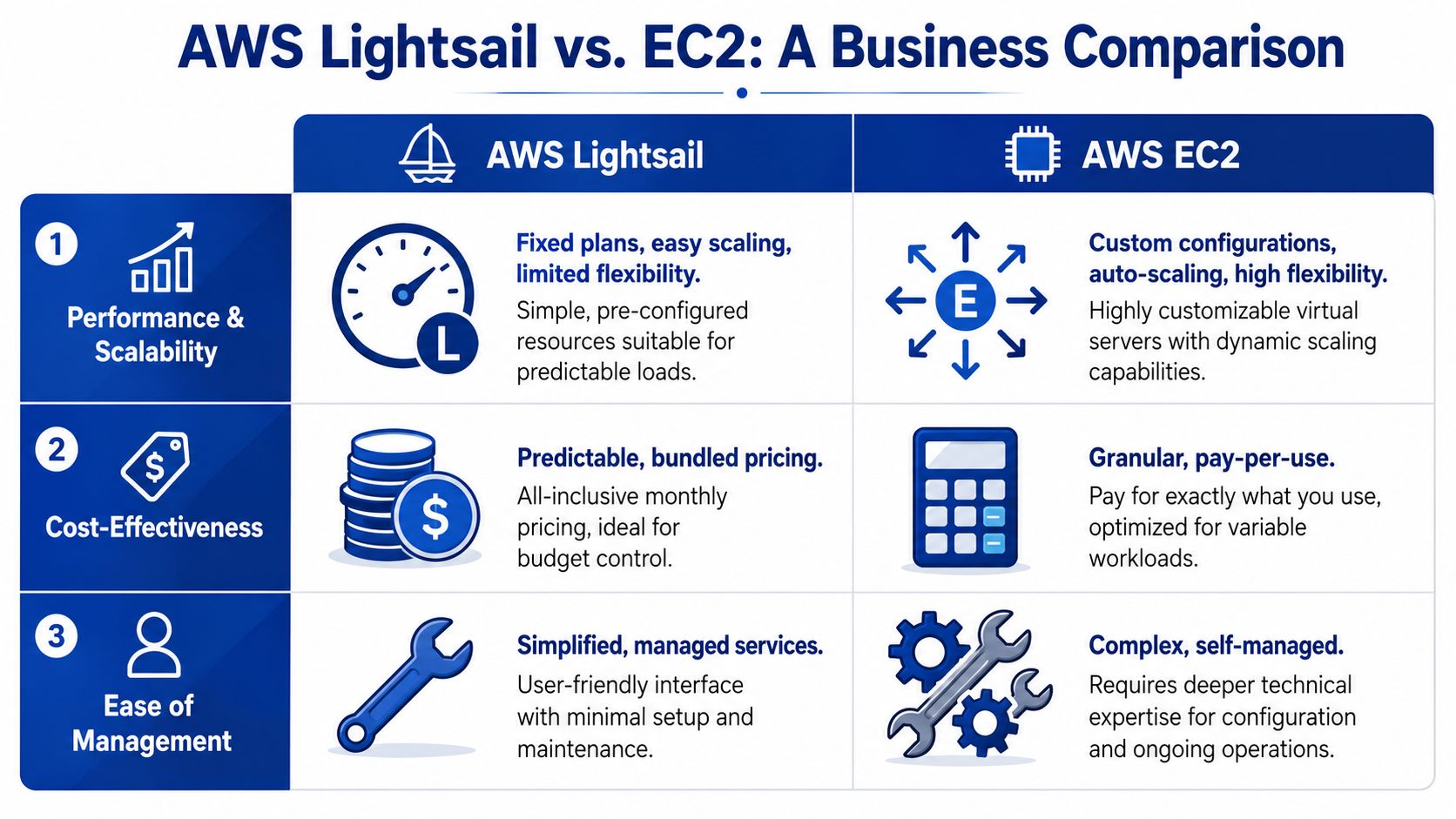
If you’re budgeting for both platform choice and the work required to get there, this guide on AWS migration cost in Australia is useful context because infrastructure spend and migration effort usually affect the same business case.
Performance and reliability
Performance is where a cheap-looking option can become expensive.
Lightsail keeps the buying model simple, but some smaller plans rely on burstable CPU behaviour. That can be perfectly fine for a quiet site with predictable demand. It becomes a business risk when the application faces sustained load, because response times can degrade at the exact point customers, donors, or staff need the system most.
AWS documents this directly in its Lightsail instance plan details, including the burstable design of smaller bundles. For decision-makers, the practical point is straightforward. If a traffic spike would affect revenue, service delivery, or customer confidence, baseline and burst mechanics need to be treated as operating constraints, not fine print.
EC2 gives far more choice in compute profiles, including instance families built for steady performance, memory-heavy workloads, or storage-intensive applications. That does not guarantee a well-performing system. Poor sizing and weak architecture still cause problems. But EC2 gives your team room to match the infrastructure to the workload instead of fitting the workload into a narrower bundle.
If peak-period slowdown has a commercial consequence, leave yourself headroom and control.
Scalability and flexibility
Scalability is not only about getting bigger. It is about how many future decisions your current platform makes easier or harder.
Lightsail is designed to reduce setup effort. That is useful for contained workloads. Once the application needs more customized networking, broader service integration, or architecture choices that differ from the default path, the simplicity starts to work against you. AWS’s own service comparison pages for Lightsail and EC2 make that distinction clear. Lightsail packages common infrastructure needs into a narrower operating model, while EC2 sits inside the wider AWS design space.
For businesses planning growth, that design difference matters in three areas:
- Scaling patterns: EC2 fits more naturally into architectures that use load balancing, autoscaling, and specialised instance choices.
- Integration depth: EC2 is a better fit when the application needs tighter alignment with broader AWS services and custom network design.
- Workload variety: EC2 supports unusual performance, memory, or storage requirements more comfortably than a standardised VPS-style bundle.
Lightsail still has a valid place. It works well where traffic is stable, the application boundary is clear, and the business accepts some manual intervention as part of keeping costs and complexity low.
Cost models and predictability
This is usually where teams make the wrong comparison.
Lightsail often looks better on day one because the pricing is bundled and easy to read. AWS publishes those bundle prices on its Lightsail pricing page. For a simple, low-risk workload, that clarity is valuable. A small business can forecast spend quickly without building a detailed infrastructure model first.
EC2 takes more work to price properly, but it gives you more ways to reduce long-term spend if the workload is stable and the team can manage the environment well. AWS’s EC2 pricing model includes options such as Savings Plans and Reserved Instances for predictable usage. That can materially change the economics of a production application that runs continuously.
The catch is operational maturity. Those savings only pay off if the business can size instances sensibly, commit to usage patterns with confidence, and maintain the environment without constant firefighting. If the internal team is lean and the application is straightforward, Lightsail can still produce the lower total cost because it reduces engineering overhead.
The right cost questions are practical:
- Will this workload run steadily enough to justify EC2 pricing commitments?
- How expensive would a performance shortfall be during peak demand?
- Does the team have the capability to design, monitor, and tune a more flexible platform well?
- How likely is it that the application will need deeper AWS integration within the next 12 to 24 months?
A low monthly server price is only one line item. Support effort, performance risk, design rework, and future migration costs usually decide which platform is cheaper over the life of the application.
Operational Overhead and Security Considerations
The platform choice also determines how much operational discipline your team needs day to day.
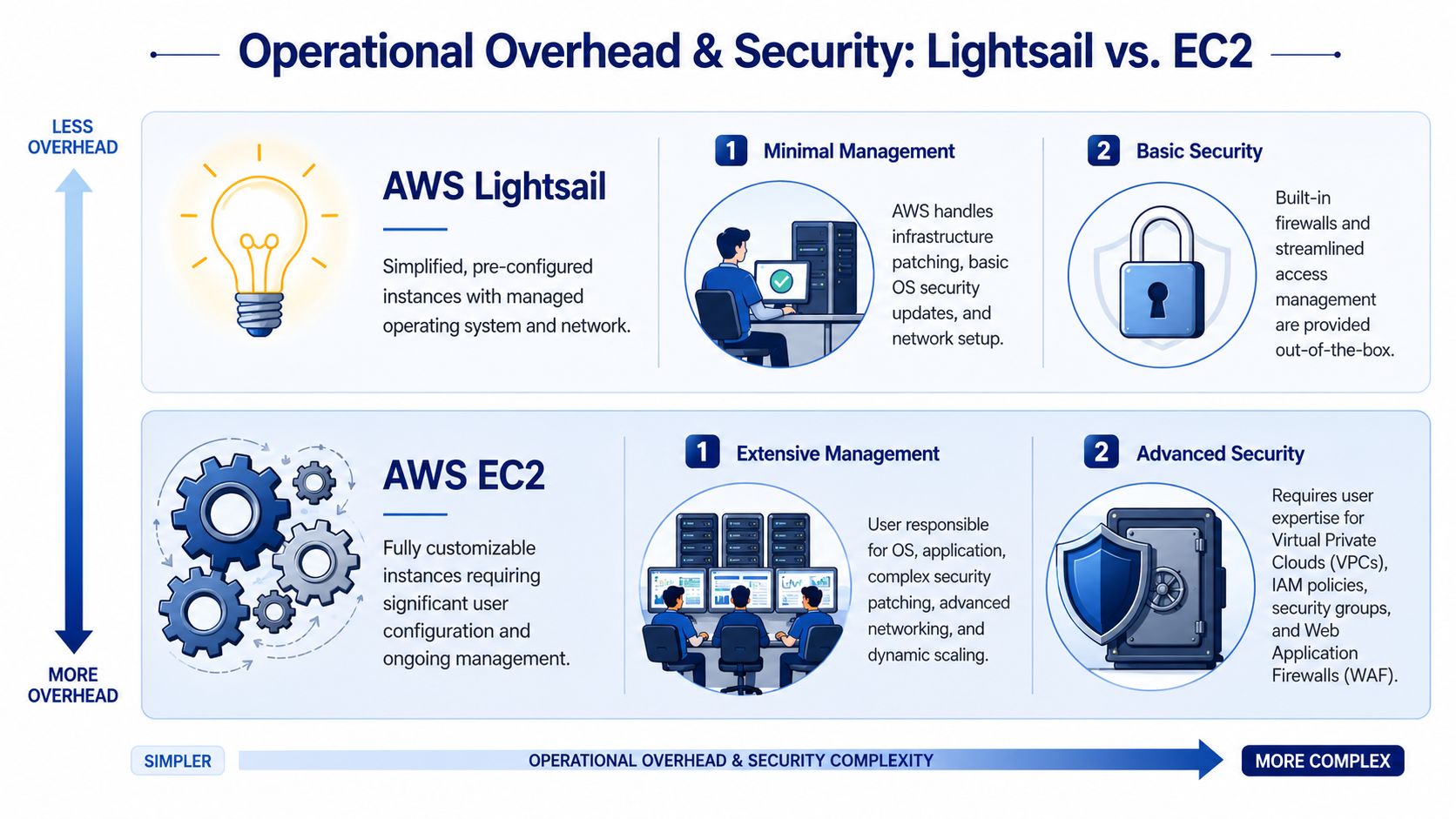
A lot of AWS problems aren’t caused by the platform itself. They come from choosing a platform that the team can’t realistically operate well. This roundup of common AWS mistakes SMEs make captures that pattern well.
What your team actually has to manage
Lightsail reduces cognitive load. The interface is simpler, and several decisions are abstracted away. That’s useful when the business has a lean internal team, limited DevOps capability, or a straightforward application that doesn’t justify full cloud engineering overhead.
In practical terms, Lightsail is often easier when you need to:
- Launch quickly: Small sites, basic APIs, and low-complexity tools can go live without building a larger AWS foundation first.
- Keep administration narrow: Fewer moving parts means fewer chances for accidental misconfiguration.
- Hand ownership to a generalist: A web developer or IT manager can usually operate it more comfortably than a heavily customised EC2 estate.
EC2 changes the operating model. You’ll usually think about VPC design, IAM structure, security groups, storage patterns, patching approach, monitoring, and scaling policies in much more detail. That’s not wasted effort if the application is important enough to need those controls. It is wasted effort if the workload is small and static.
Security control versus security convenience
AWS still operates on a shared responsibility model in both cases. The difference is how much of the environment you need to design and govern directly.
Lightsail gives you a simpler path. For some businesses, that’s an advantage because the risk of overcomplicating the platform is reduced. Simpler environments can be easier to keep tidy if the application itself is simple.
EC2 is the better fit when security requirements are more specific. If the business needs tightly managed network boundaries, formal IAM structures, layered controls, deeper logging, or stronger integration with broader AWS security services, EC2 gives you room to build that properly.
More control is only valuable when someone on the team knows how to use it well.
A commercially sensible security decision usually comes down to this:
| Question | Lightsail tendency | EC2 tendency |
|---|---|---|
| Do we want less setup work? | Strong fit | Often excessive for small apps |
| Do we need tailored network and access controls? | Can feel restrictive | Strong fit |
| Can our team manage cloud operations properly? | Better for lower maturity | Better for mature teams |
| Will compliance and governance tighten over time? | May become limiting | Easier to evolve |
If the application supports sensitive operational workflows, member data, customer transactions, or multi-system integrations, the hidden cost of “simple” can appear later as manual workarounds and inconsistent governance.
Use Case Recommendations for Your Business
Generic advice doesn’t help much here. The right answer depends on the organisation’s stage, risk profile, and technical depth.
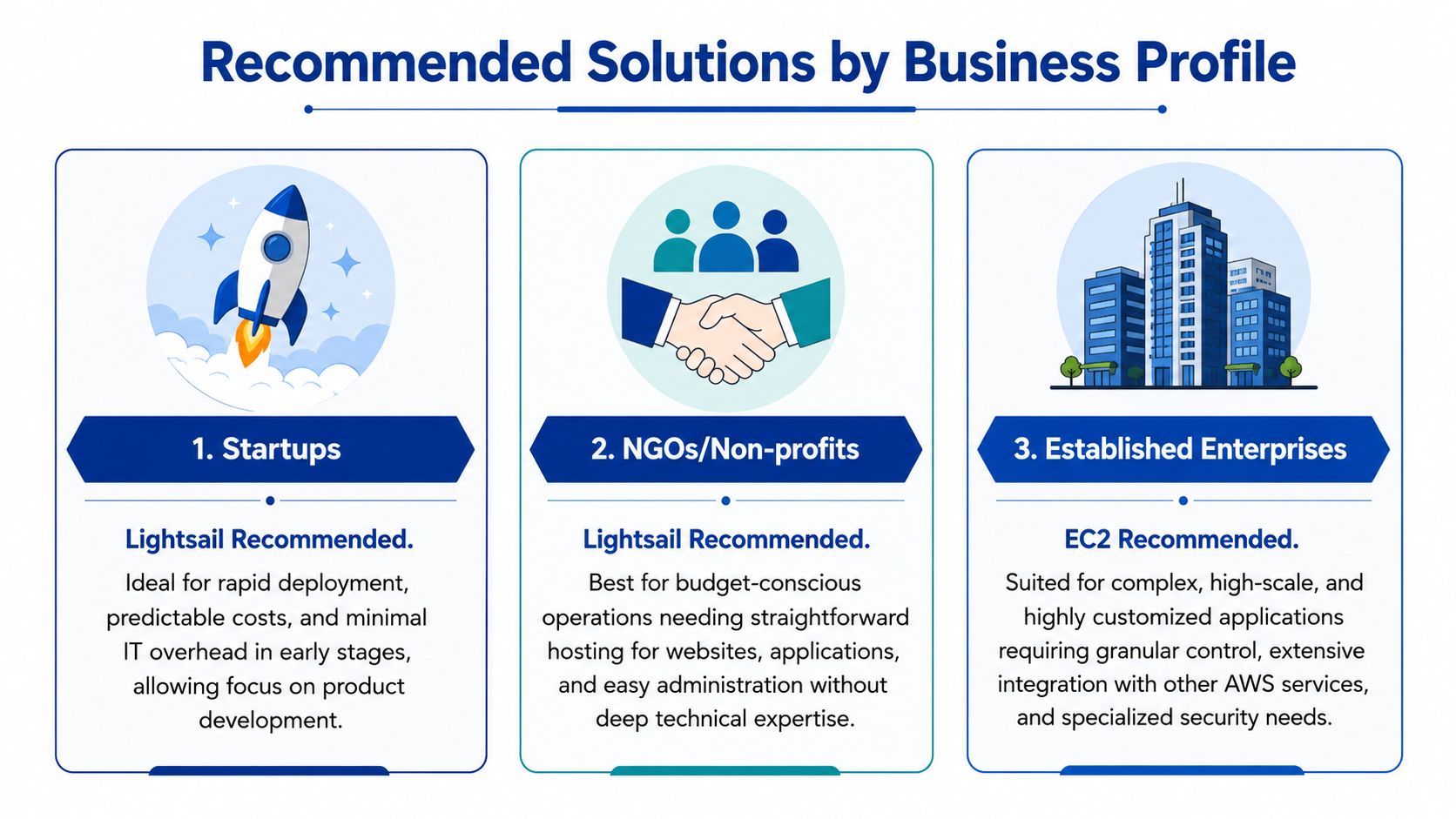
If your platform includes subscriptions, gated content, member journeys, or recurring logins, the architecture choices in this guide to AWS hosting for membership platforms are closely related.
Startups
For an early-stage startup, Lightsail is often the better starting point when the immediate goal is getting an MVP, admin portal, or lightweight SaaS environment into production with minimal friction.
That’s especially true when the team is small and the product is still proving demand. In that phase, reducing infrastructure decision-making can be more valuable than maximising architectural purity.
Lightsail is usually reasonable if:
- the application design is conventional
- the traffic pattern is expected to stay modest for a while
- the team wants one clear monthly hosting line item
- there’s a realistic plan to revisit the architecture once product-market fit is clearer
EC2 becomes the better startup option when growth could be sharp, the application is integration-heavy, or the product depends on scaling reliability from the start.
NGOs and non-profits
NGOs and non-profits often care about two things at the same time: operational predictability and budget control. That’s why Lightsail can be attractive for campaign sites, internal admin tools, and simpler applications with stable traffic.
But NGOs also run into periodic spikes. Fundraising appeals, event registrations, public announcements, and grants-related workflows can create pressure at inconvenient times. If the system must stay stable during those moments, simplicity alone isn’t enough.
My recommendation is usually conditional:
- Choose Lightsail for lower-complexity systems with steady usage and limited in-house technical support.
- Choose EC2 when the application underpins public campaigns, recurring donations, multi-system integrations, or operational services that can’t afford degraded performance during demand spikes.
Established enterprises
For established enterprises, EC2 is almost always the more defensible choice.
That doesn’t mean every workload needs a highly complex architecture. It means enterprise environments usually bring requirements that Lightsail isn’t designed to satisfy well over time. Governance, IAM boundaries, integration with existing AWS services, controlled scaling behaviour, and stronger security design all point toward EC2.
The same applies to enterprises running custom web platforms, mobile backends, SaaS products, internal workflow systems, or data-driven applications where infrastructure decisions affect uptime targets and support models.
If the business already knows the application will become strategic, it’s usually cheaper to architect for that reality early than to unwind a simplified hosting decision later.
Planning for Migration and Future Integration
A cloud decision only looks isolated on paper. In practice, it shapes the next set of technical decisions too.
For teams expecting platform growth, staged modernisation, or integration with other workloads, it helps to plan the path early. That’s where a structured cloud migration services approach becomes more useful than a simple lift-and-shift mindset.
When moving from Lightsail to EC2 makes sense
A move from Lightsail to EC2 is usually justified when the application starts needing things that are awkward to implement in a bundled environment. The trigger is rarely one dramatic event. It’s more often a build-up of friction.
Common signs include:
- Scaling pain: The app needs more than simple vertical resizing or starts behaving unpredictably under changing demand.
- Integration pressure: The platform now relies on deeper AWS-native components and cleaner service-to-service architecture.
- Operational constraints: Monitoring, deployment, security, or networking requirements outgrow what a simplified setup handles comfortably.
- Business criticality: The app has become too important to run on a platform selected mainly for convenience.
The migration itself should be treated like any production infrastructure change. Review dependencies first, separate stateful services carefully, test deployment patterns, validate backups, and avoid mixing infrastructure redesign with major application rewrites unless there’s a strong reason.
Why starting on EC2 can reduce future friction
Starting on EC2 makes sense when you already know the platform is heading toward a more complete AWS architecture.
That’s often the case for systems likely to integrate with S3 for object storage, RDS for managed databases, Lambda for event-driven tasks, or ECS/EKS for container-based deployment patterns. Even if those services aren’t part of the first release, the initial hosting choice can either support that evolution cleanly or force a redesign later.
A sensible planning approach looks like this:
- Define the likely future state. Not every detail, just the architectural direction.
- Choose the simplest platform that won’t block that direction.
- Keep deployment, monitoring, and security patterns consistent with expected growth.
- Set a review point. Reassess before the platform’s limitations start affecting customers or staff.
The best hosting decision is often the one that keeps your next decision easier.
Your Final Decision Checklist
If you’re still deciding between the two, use this as the practical filter.
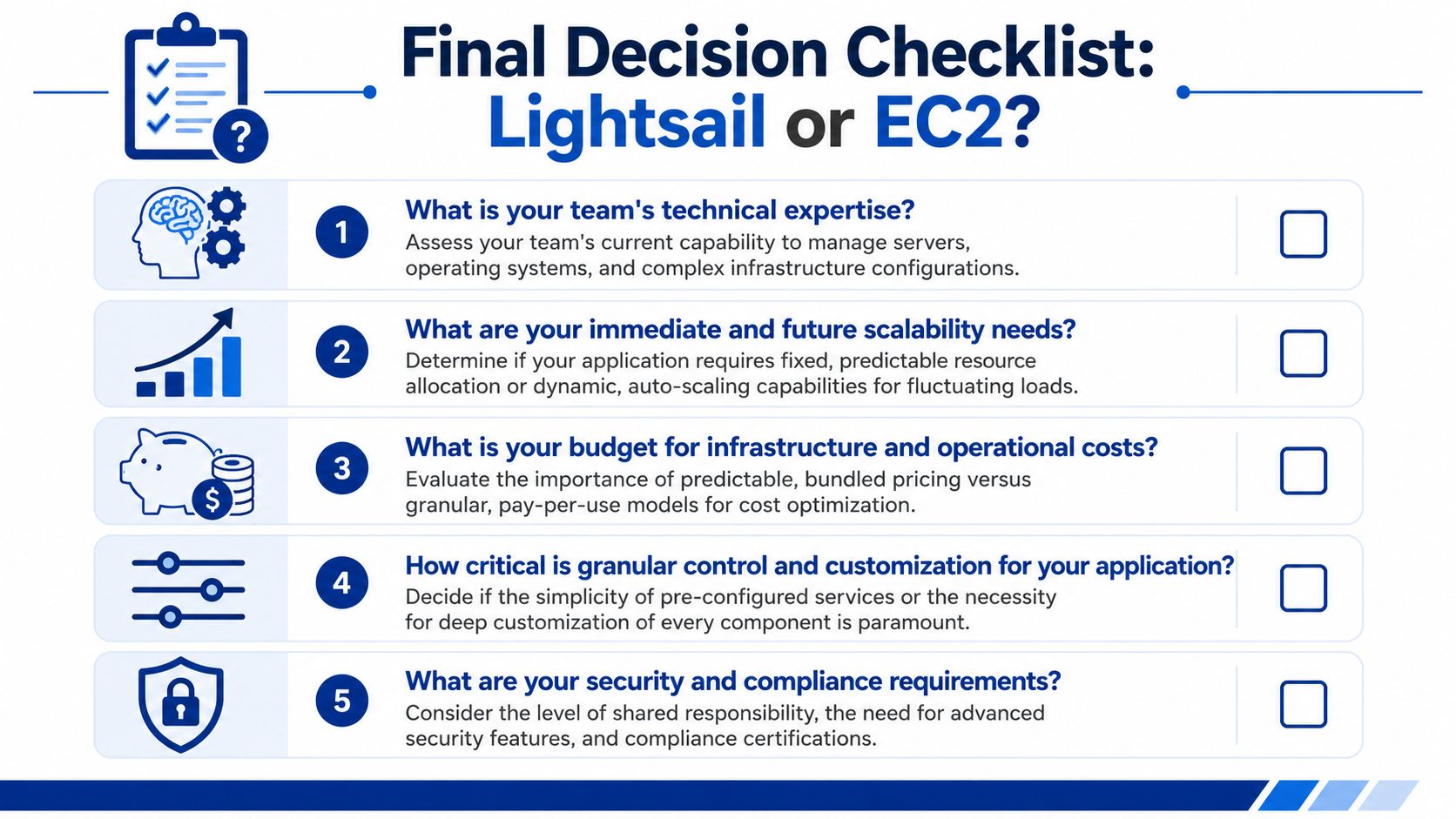
Ask these questions before you commit
- How strong is our internal AWS capability? If the team can’t confidently manage infrastructure, simpler may be safer.
- Is our workload steady or unpredictable? Stable usage leans one way. Peaks and bursts lean another.
- Will the application become business-critical? If the answer is yes, design for operational control early.
- Do we need granular security or network design? If governance matters, convenience shouldn’t decide the platform.
- Are we optimising for immediate simplicity or long-term flexibility? Those are different goals.
- Will this application need deeper AWS integration later? If that future is likely, factor it in now.
- Is monthly sticker price the actual issue, or is total cost of ownership the actual issue? Those answers often differ.
A simple decision rule
Choose Lightsail when the application is modest, the team wants low overhead, and the business accepts the limits that come with a bundled service.
Choose EC2 when the application needs stronger performance options, better scaling patterns, broader integration, or tighter operational control.
For most serious business applications, the better question isn’t “Which one is cheaper today?” It’s “Which one will still make sense once this platform matters more than it does right now?”
That’s the question that usually leads to the right answer.
If you’re weighing AWS Lightsail against EC2 and want a commercially grounded recommendation, Continuum Solutions helps Melbourne businesses, NGOs, startups, and enterprise teams assess architecture, migration risk, operating overhead, and long-term cost before they commit to the wrong platform.