57% of small-to-medium-business owners surveyed experienced cybercrime in the previous 12 months, according to the 2025 Australian Cybercrime Survey. That's a broader risk than WordPress alone, but it changes the buying question: when your website connects payments, memberships and personal information, who can contain a failure and recover the service?
I would evaluate WordPress support services as operational ownership, not a plugin-update subscription. The monthly fee matters, but the commercial value sits in tested recovery, clear incident authority and releases that don't block customers or members.
Table of Contents
- What WordPress Support Services Should Own
- Why Australian Sites Outgrow a Plugin Update Plan
- Monthly Cost Bands and What Moves the Price
- How to Assess a WordPress Support Provider
- Security Duties Under the Notifiable Data Breaches Scheme
- Accessibility and Performance After Every Release
- Support Scenarios and a Brief to Send
What WordPress Support Services Should Own
| Workstream | Inside the retainer | Stays with the client | If nobody owns it |
|---|---|---|---|
| Updates and regression | Core, theme and plugin updates on staging, then production | Editorial calendar and content approval | A routine update breaks forms or checkout |
| Backups and restore | Scheduled off-site backups and a timed restore test | Decision on how much data loss is acceptable | A backup exists but cannot be restored |
| Security response | Least-privilege admins, MFA, vulnerability action, log review | Legal decision on notifying people | A compromised plugin or admin account goes unnoticed |
| Monitoring | Uptime plus application errors and failed form or login events | Who is allowed to wake an engineer | The homepage loads while a critical journey is down |
| Small development | Capped hours for defects, performance and stated integrations | New features outside the hour cap | Fixes wait behind a separate sales cycle |
| Accessibility checks | Keyboard and screen-reader passes on priority journeys after release | Plain-language copy and policy exceptions | A plugin or template change blocks donors or applicants |
A support retainer should establish ongoing technical ownership of a live site. It isn't just page editing, and it isn't WordPress.com product help. Someone must own the hand-offs between the CMS, hosting, database, payment gateway and connected applications.
Read each row as an acceptance test. For updates, completion means the agreed journeys work after deployment, not that the dashboard shows no pending updates. For backups, completion means an engineer has restored the database, uploads and required configuration into a usable environment.
Make the boundaries explicit
Security and monitoring need separate definitions. An alert tells someone that a condition occurred; incident response authorises someone to investigate and act. Buying alerts without an accountable responder leaves the operations manager holding the problem.
The development allowance also needs boundaries. A payment callback defect might fit within maintenance, while replacing the checkout flow belongs in a separately scoped custom web development project. State which integrations are covered, how work is prioritised and what happens when the allowance is exhausted.
Practical rule: Every technical responsibility needs an owner, an output and evidence that the work happened.
Client responsibilities shouldn't disappear into the contract's exclusions. Your organisation still approves copy, campaign choices, business rules and legal decisions. The provider should identify when those decisions are blocking a safe release rather than leaving work unfinished.
Tick the rows your staff already perform reliably. Compare proposals against the remaining scope, not against the assumption that every provider's maintenance package buys the same service.
Why Australian Sites Outgrow a Plugin Update Plan
BuiltWith-based reporting identifies approximately 656,933 current WordPress websites in Australia, an independent estimate rather than an official count, while a separate scan found WordPress on 61% of 73,108 .au websites, according to ONext Digital's Australian WordPress review. The same review cites W3Techs figures placing WordPress at roughly 41.9% of all websites and 59.5% of websites with a known CMS.
Those Australian counts describe different populations. Broader technology datasets can include domains and subdomains beyond the national namespace; a .au scan captures a narrower group. They aren't competing inventories of exactly the same websites.
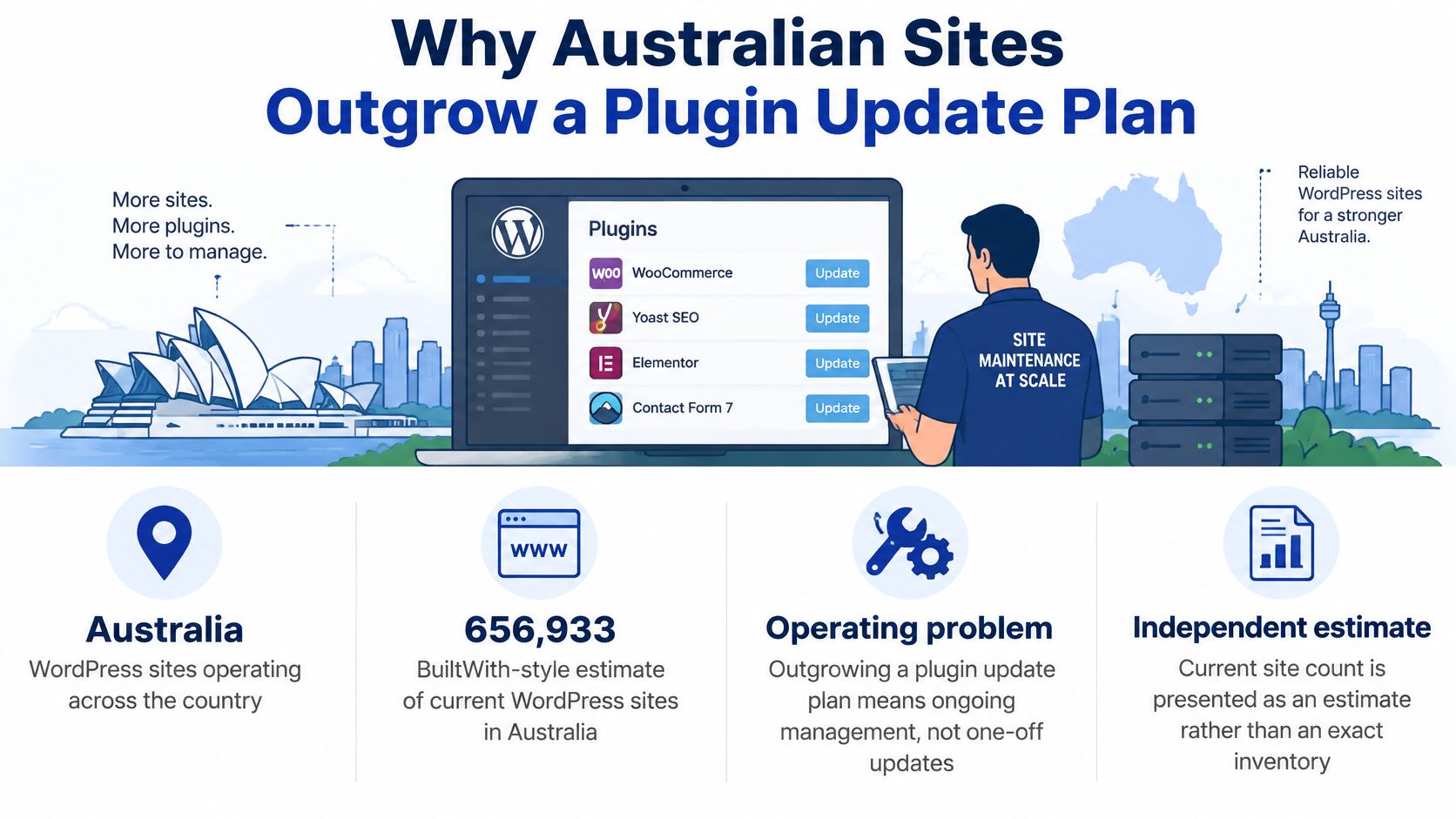
Widely deployed doesn't mean operationally simple
A membership body might use WordPress for public content, authentication, renewals and CRM synchronisation. An NGO might connect donation forms to payment processing and donor records. A neglected dependency can therefore disrupt more than publishing.
In a 2026 survey of 1,111 Australian landing pages, 92.9% used a web application firewall, but only 4.8% presented no detectable access barriers, according to Zyte's Australian web survey. These are findings about the sampled pages, not a WordPress-specific audit.
A firewall is useful protection, but it doesn't establish that application code is maintained, a restore works or a form remains accessible. Those responsibilities need separate checks.
A green hosting dashboard doesn't prove that a member can renew or a donor can complete a payment.
The practical decision is often whether to patch, replace or isolate a dependency. Patching preserves functionality but needs compatibility testing. Replacement can reduce exposure while introducing migration work, and isolation can interrupt a service the business needs.
Support must connect hosting, plugin decisions, security, performance, content workflow and recovery. For a site with authenticated users and renewal peaks, AWS hosting for membership platforms is an architecture decision, not a larger server purchase.
I would map the business-critical dependencies before changing the hosting platform. Otherwise, you risk moving the same application faults into a more expensive environment.
Monthly Cost Bands and What Moves the Price
| Model | Typical inclusions | Fits when |
|---|---|---|
| Ad hoc break-fix | Diagnosis and one-off fixes, no standing response target | Changes are rare and someone internal owns updates |
| Essential care | Scheduled updates, backups, uptime alerts, minor safe fixes | Brochure or campaign site with little personal data |
| Resilience retainer | Patch targets, restore tests, access reviews, monitoring, first response | Forms, members, donors, staff or ecommerce data |
| Platform retainer | Reserved hours, staging pipeline, integrations, performance work | The site behaves like an application and changes often |
Typical budgets run about $180–$350 an hour for ad hoc work, $250–$600 a month for essential care, $800–$2,000 a month for resilience support and $2,500–$8,000 a month for platform support, all excluding GST and hosting.
Two sites on the same band can cost a provider very different amounts of effort. A brochure site with stable templates needs a different service from a membership application with custom permissions, recurring billing and failed CRM synchronisations, so read the inclusion column before comparing the fee.
What moves the budget
- Code and dependencies: Custom plugins and abandoned extensions increase investigation and regression work on every release.
- Transactions and integrations: Payments, CRM connections and email delivery require end-to-end diagnosis across suppliers, and each extra supplier adds coordination time to an incident.
- Coverage: After-hours availability reserves people, even when no incident occurs. You are paying for the roster, not the call volume.
- Change volume: Frequent releases need review, testing, deployment and documentation, which is why an application-style site rarely fits a care plan.
- Client availability: Missing approval authority can turn a simple repair into prolonged coordination, and that waiting time still gets billed.
Essential care is predictable but narrow. It can suit a low-risk site, provided someone owns incident response and development outside the package. A cheap retainer becomes poor value when every meaningful fault triggers an unplanned procurement exercise.
A resilience retainer buys more deliberate readiness, but it still needs limits on incident labour and remediation, or a single bad release can exhaust the month. A platform retainer reserves engineering capacity. That is useful with a prioritised backlog and wasteful when nobody can authorise work.
Keep hosting separate
Shared WordPress hosting, managed WordPress and a custom AWS deployment have different operating costs and failure boundaries. Managed hosting can remove routine infrastructure work, while AWS can introduce separate responsibilities for databases, access, logging and deployment.
Separate the recurring support fee from hosting, licences, onboarding, remediation and usage-based services. Response time and restoration time are also separate commitments: a ticket can be acknowledged while checkout stays offline.
At Continuum Solutions, specific service deliverables, timelines, fees and responsibilities are set out in individual proposals, quotations, statements of work or service agreements. Equal monthly figures can therefore represent materially different commitments.
How to Assess a WordPress Support Provider
| Question to ask | Good answer | Red flag |
|---|---|---|
| Who answers a severity one call, and how fast? | Named escalation path with a response target in hours | Best effort with no target |
| Do you test updates on staging first? | Staging copy with a regression list for priority journeys | Updates applied straight to production |
| Who holds admin and payment credentials? | Client-owned, least-privilege accounts reviewed monthly | Shared login used by the provider's staff |
| Can you show a recent restore test? | Dated restore log with timed recovery | Backups described but never restored |
| How do you handle accessibility defects? | Defect register with keyboard and screen-reader retests after release | Accessibility excluded from scope |
| What happens to the site if we leave? | Handover documentation and credential transfer at exit | Platform locked to the provider's account |
Use the scorecard consistently rather than rewarding the most polished proposal. Mark each answer as evidenced, promised or absent. An evidenced answer includes a usable artefact, not merely a claim that the provider follows best practice.
Apply the contract checks
Start with evidence. Request an anonymised restore log, a staging test record and an accessibility defect register. Check whether failures were recorded and resolved, not just whether someone completed a checklist.
Read the operating terms. The statement of work should name the escalation path, response targets in hours, development allowance, rollover rules and exit process. It should explain how client-owned administrative and payment access is maintained without sharing unrestricted credentials.
Normalise the commercial comparison. Put each proposal against the ownership table and identify exclusions. A lower fee may leave your staff responsible for recovery, accessibility and integration faults.
Don't accept exclusive provider ownership of the accounts you need to operate or recover your platform.
A business with an internal technical owner can retain more responsibility and purchase specialist coverage around the gaps. An organisation without that owner needs a provider authorised to act through monitored, client-owned accounts.
I would disqualify a proposal with no written response commitment, no restore evidence or no practical route to regain administrative control. These aren't cosmetic weaknesses; they affect whether you can recover and change suppliers.
A business IT consulting review can help settle the ownership model before procurement. Our custom development work includes documented, maintainable code, and our integration services include data migration with documentation, useful foundations when support crosses application boundaries.
Security Duties Under the Notifiable Data Breaches Scheme
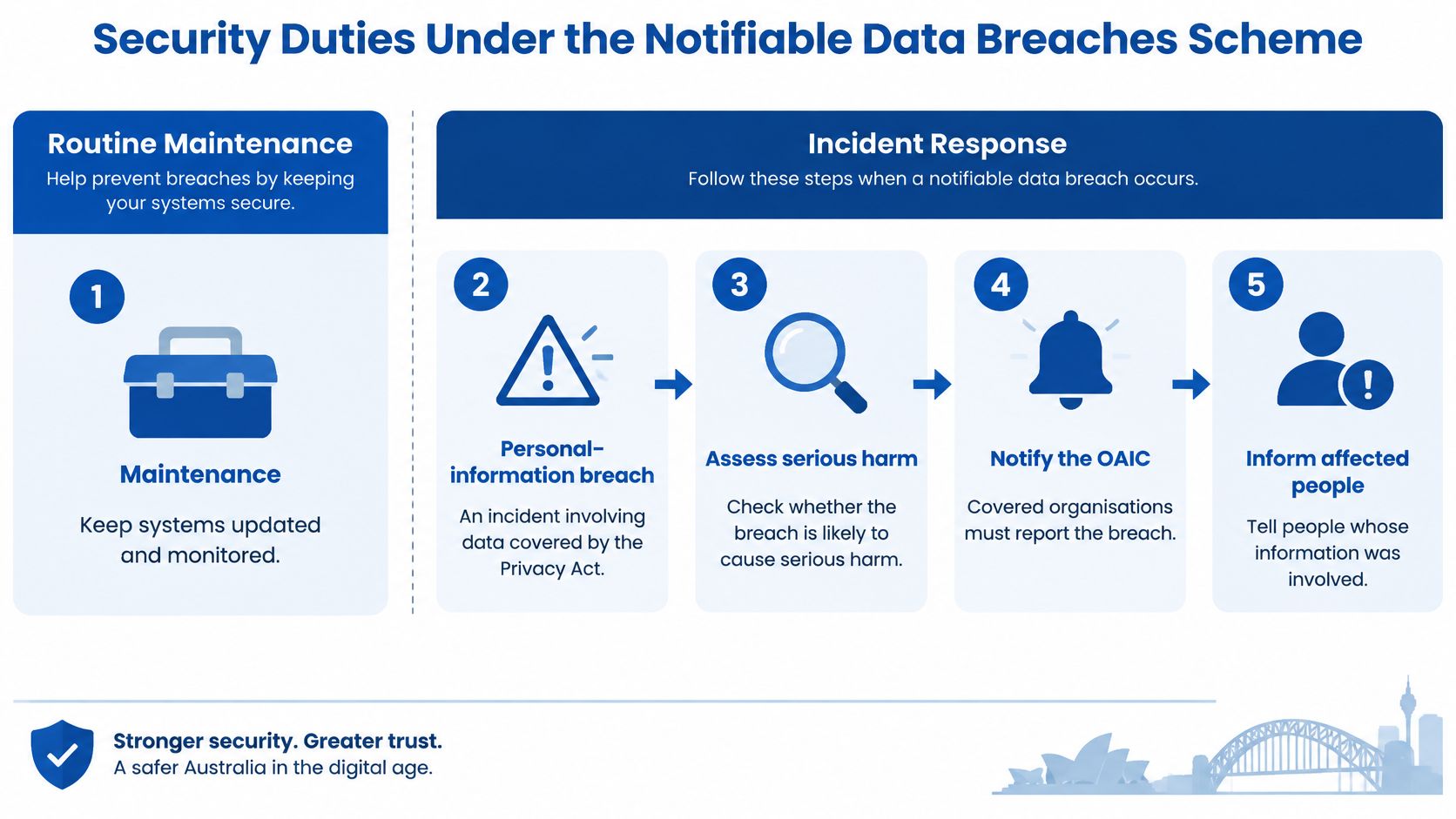
Organisations covered by the Privacy Act must notify the OAIC and affected individuals when an eligible personal-information breach is likely to cause serious harm; the OAIC's Notifiable Data Breaches guidance also reports 532 notifications in January–June 2025, including 308 attributed to malicious or criminal attacks. Routine maintenance and incident response therefore need distinct responsibilities.
An exposed administrator account or vulnerable plugin can provide access to form submissions, customer records or member information. Delayed detection leaves the organisation with a harder task establishing what happened and who was affected.
Turn the response sequence into authority
The OAIC's breach-response guide sets out contain, assess, notify and review. Apply that sequence to the actual WordPress environment:
- Contain: Authorise a named engineer to isolate an affected plugin or host, preserve logs and restrict compromised access.
- Assess: Identify affected forms, exports, database records and connected CRM systems. Record uncertainty rather than assuming no data left the system.
- Notify: Give the organisation's authorised privacy or legal decision-maker the evidence needed to determine notification obligations.
- Review: Correct the failed control and update the recovery procedure.
The runbook should identify who can take the site offline, who rotates connected email and payment credentials, and who communicates with members. Technical staff shouldn't have to negotiate emergency authority during an active compromise.
Measure recovery rather than reassurance
Specify an asset inventory, risk-ranked patching, least-privilege access, multifactor authentication where feasible, protected backups and audit logging. Contract measures should include critical patch time, vulnerability remediation time, backup restoration time and access-review completion.
Record detection and containment times, restore-point age and staging test outcomes. Role separation, unused-account removal, publishing checks and staff training address administrator mistakes alongside technical vulnerabilities.
For service-desk coordination, GoSafe Dark Web monitoring's resource on helping service desks handle client breaches offers supplementary context, but its GDPR focus doesn't replace Australian legal assessment.
Infrastructure ownership needs the same clarity. The risks discussed in common AWS mistakes SMEs make matter when nobody has explicitly accepted responsibility for cloud access, logging or recovery. Low perceived risk isn't a recovery strategy.
Accessibility and Performance After Every Release
Treat WCAG 2.2 Level AA as a release check, not a theme setting. The Australian Human Rights Commission's digital accessibility guidance identifies WCAG 2.2, released in October 2023, and recommends targeting at least Level AA while considering relevant AAA criteria across pages, documents and other digital interfaces.
The stakes extend beyond compliance. About one in five Australians remain digitally excluded, including 66.5% of people aged 75 and over, according to the 2025 Australian Digital Inclusion Index summary, which also describes government accessibility requirements applying to new and replacement services from 1 January 2025 and broader legacy services from 1 January 2026.
Those government requirements don't automatically define the obligations of every private membership site. Nevertheless, a blocked application or donation form prevents someone from completing the task.
Test the task, not just the template
- Baseline priority journeys. Include login, password recovery, payment and application submission where relevant.
- Maintain a defect register. Record the affected task, severity, owner and retest result.
- Retest changed interfaces. Check keyboard operation, labels, focus movement, validation messages and screen-reader flow after releases.
- Prioritise blocked tasks. Repair an unusable submission control before a cosmetic inconsistency.
Performance testing should use those same journeys. Agree baselines for largest contentful paint, interaction delay, time to first byte and error rate, then investigate changes rather than chasing an isolated homepage score.
Choose hosting after diagnosis
Check caching rules, image weight, unused plugins and object-cache behaviour on staging. Use Sentry for application exceptions and New Relic for transaction and infrastructure investigation where appropriate; enterprise application monitoring and debugging should connect symptoms to causes.
Managed WordPress is usually simpler when the site is mainly content and the team wants platform-managed caching and backups. An AWS application platform makes more sense when custom services, queues or substantial integrations need independent control, but flexibility adds operating responsibilities and opportunities to overspend.
Continuum Solutions is a Shopify Plus Partner, AWS Partner, Azure Partner and WP Engine Partner. I would choose the platform from the operating requirements, not from the partnership badge.
Support Scenarios and a Brief to Send
A donation form fails after an update
Say an NGO's donation form stops submitting after a plugin update applied directly to production. The inexpensive plan included updates but no donation-journey test.
The support change is a protected staging copy, a short transaction regression list and a documented rollback path. Releases take longer, but the organisation reduces the risk of discovering the fault during a donation drive.
An application keeps crashing
Consider a business application that repeatedly crashes while the host recommends more capacity. Another restart restores access temporarily without explaining the failure.
Useful support adds error tracking, root-cause analysis, source-code review of high-impact faults and a change log. For Pangolin Associates, our work included root-cause analysis of recurring application crashes and source-code review of high-impact issues; that isn't a claim that its application was WordPress.
The trade-off is investigation cost before the solution is certain. I would fund diagnosis before committing to a larger hosting bill.
A membership platform moves hosting
A membership platform needs to remain operable after migration, not merely pass a launch-day check. Support must connect infrastructure monitoring, recovery planning and documentation to the client's operating team.
Our ClubScout project included infrastructure monitoring, backups and disaster recovery planning, alongside documentation and knowledge transfer for long-term ownership. Cloud services include on-call support, but effective on-call arrangements need a monitored signal and a named escalation path.
The trade-off is continuing operational effort after cutover. Treating migration as finished at deployment leaves unresolved questions about failure handling.
Send a brief that exposes the gaps
Human error represented 193 notifications, or 37% of reported breaches, in January–June 2025, according to the OAIC's breach-statistics update. Your brief should therefore describe decision-making and access, not just software.
Include:
- Environment inventory: Live and staging environments, hosting provider and technical owner.
- Sensitive dependencies: Plugins and connections handling payments or personal information.
- Critical journeys: The tasks customers, donors or members must complete.
- Recovery objectives: Acceptable restore-point age and recovery time, expressed in hours.
- Emergency authority: Who approves urgent changes, decides on notification and communicates externally.
- Accessibility scope: Which journeys must be checked and how blocking defects are prioritised.
Don't compare an update-only package with an incident retainer as though they buy the same outcome. Don't assume the host's backup proves restoration, or leave CRM, email and payment credentials outside the runbook.
Choose essential care for a straightforward brochure site, resilience support for donations, memberships or orders, and platform support for frequently changing custom code. Start with a short technical review of hosting, plugins, backups and priority journeys, ending in a written scope and fee range.
Continuum Solutions offers cloud consulting, custom development, integrations and application monitoring to support WordPress sites that operate as business systems. Visit Continuum Solutions to discuss a technical review and a written support scope covering recovery, incident ownership and release checks.