
You're probably not looking for another agency that can adjust a theme, install an app and hand over a polished storefront. You're trying to decide whether Shopify Plus will remove operational friction, whether a partner can integrate it with the systems that run your business, and whether the investment will produce a maintainable commerce platform rather than a more expensive template.
That distinction matters in Australia. One 2026 market snapshot records 152,323 active Shopify stores and 3,653 Shopify Plus stores locally, putting Plus at about 2.40% of Australian Shopify stores, slightly above the reported global Plus share of 2.10%. The concentration suggests a broad Shopify market with a smaller group of merchants facing the complexity that justifies specialist development, including integrations, multi-store operations, headless storefronts and measurement infrastructure. The Australian Shopify landscape snapshot provides that market context.
The right buying question isn't “Which agency has the most features?” It's “Which technical and operational constraints make Plus worthwhile for our business, and can this partner remove them without creating a new layer of unnecessary complexity?”
Table of Contents
- Is Shopify Plus the Right Move Before You Hire an Agency
- What a Shopify Plus Development Agency Actually Does
- Engagement Models and Pricing Realities in Australia
- Technical Capabilities Worth Vetting on Every Shortlist
- RFP and Vetting Checklist for Shortlisting Partners
- Timelines and Deliverables From Discovery to Optimisation
- Choosing the Right Agency and Next Steps
Is Shopify Plus the Right Move Before You Hire an Agency
Start with the platform decision, not the partner shortlist. Shopify Plus can support more complex commerce operations, but a Plus licence won't fix weak product data, poor fulfilment processes, unreliable integrations or an unclear ownership model.
For a merchant below enterprise complexity, Advanced Shopify may be enough. A capable Shopify agency can often deliver a strong theme, sound analytics and standard API integrations without introducing the cost and governance burden of a Plus programme. I'd challenge any agency that recommends Plus before documenting the specific operational constraint it will solve.
The business case becomes stronger when your roadmap requires capabilities such as B2B workflows, checkout extensibility, multiple storefronts, advanced automation or a headless architecture. The question isn't whether those features sound useful. It's whether they remove a measurable bottleneck in your current operation.
Australia's platform mix supports that distinction. One benchmark records 235,621 active ecommerce stores, including 153,140 on Shopify and 3,592 on Shopify Plus. Shopify therefore accounts for roughly 65% of active Australian ecommerce stores in that dataset, while Plus represents about 1.5% of all active Australian ecommerce stores. The market is broad, but the enterprise audience is concentrated. The Australian ecommerce KPI benchmark supports this interpretation.
| Criterion | Shopify Advanced | Shopify Plus |
|---|---|---|
| Storefront complexity | Strong for conventional custom theme work | Suitable for advanced and multi-store architectures |
| Checkout requirements | Standard extension options may be sufficient | Appropriate when checkout extensibility is central |
| B2B operations | May require additional applications and workarounds | Better fit for native B2B workflows |
| Automation | Standard integrations may cover routine processes | Better fit for complex automation and governance |
| Commercial case | Lower platform commitment | Requires a clear operational or growth rationale |
Before requesting proposals, document your annual commercial objectives, order and fulfilment constraints, regional requirements, B2B needs, checkout limitations and integration failures. If the only reason for upgrading is that a competitor uses Plus, stop the process.
Practical rule: A credible Shopify Plus development agency should be willing to tell you when Plus is unnecessary.
Your evaluation should also include the broader technology questions covered in business IT consulting services, particularly ownership, integration risk and long-term operating cost.
What a Shopify Plus Development Agency Actually Does
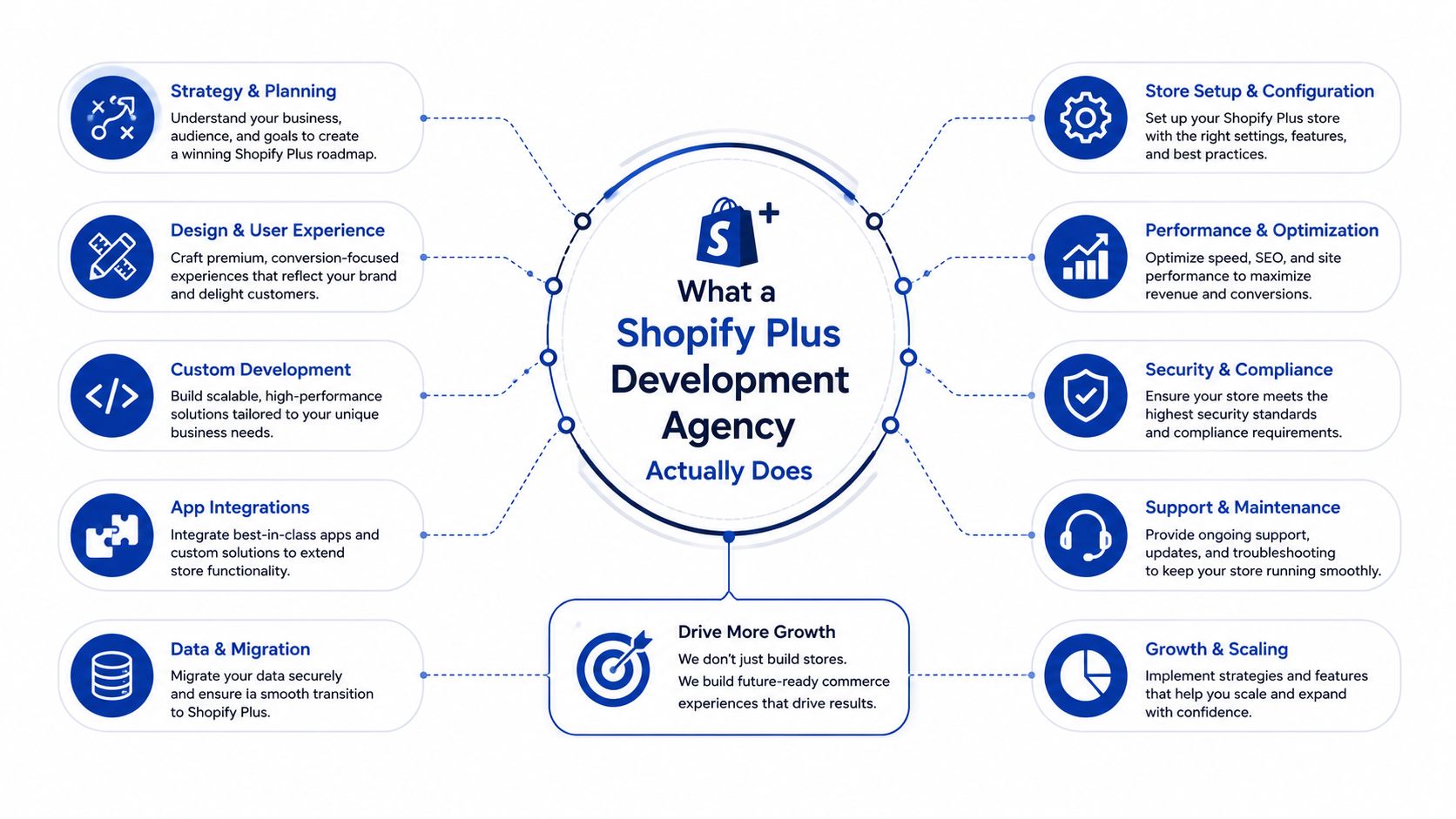
A Shopify Plus development agency should sit between your commerce leadership and the engineering detail. It translates commercial requirements into storefront architecture, integrations, automation, release controls and measurable operational outcomes.
The work normally falls into four distinct streams. Treating them as one generic “Shopify build” makes it difficult to compare proposals or control scope.
Storefront and theme engineering
Theme work covers custom Liquid development, Online Store 2.0 structure, reusable sections, design-system implementation and product detail pages. The agency should build a storefront that your team can operate, not a collection of hard-coded pages that requires a developer for every merchandising change.
Ask how the team handles content modelling, theme version control, accessibility, responsive behaviour and regression testing. A technically attractive design can still fail if it slows publishing or makes catalogue management painful.
Headless and composable commerce
Headless architecture separates the customer-facing frontend from Shopify's commerce backend. Hydrogen, Remix, Next.js, the Storefront API and Oxygen may be appropriate for performance-critical, content-rich or highly differentiated experiences.
They aren't automatically the right choice. Headless introduces more application code, deployment responsibility, caching decisions, testing requirements and failure points. I recommend it only when a conventional Shopify theme cannot satisfy a documented requirement.
Integration and automation
The agency may connect Shopify with an ERP, CRM, PIM, OMS, WMS, payment provider or customer-data system. That work includes data ownership, synchronisation rules, retry behaviour, error handling, webhooks, GraphQL and workflow automation.
The integration design should explain what happens when an order fails to sync, a product is updated in two systems, inventory arrives late or an external service is unavailable.
Ongoing optimisation
Post-launch work can include Core Web Vitals tuning, conversion analysis, controlled experimentation, release management and platform upgrades. It should be scoped separately from implementation, with a clear backlog, reporting model and approval process.
For broader application requirements, compare the agency's Shopify capability with its approach to custom web development. That helps reveal whether it can manage the surrounding application layer rather than only the storefront.
Engagement Models and Pricing Realities in Australia
The right commercial model depends on the operational threshold your business needs to cross. A fixed migration, a standing optimisation team and an embedded engineer address different risks, so do not compare them through one headline price.
The figures below are the budget bands specified for this buying guide. Treat them as planning ranges, not a replacement for discovery.
| Engagement Model | Best-Fit Scenario | AU Price Band |
|---|---|---|
| Fixed-scope project | Defined replatform, theme migration or headless launch | AUD $40K to $150K, depending on complexity |
| Monthly retainer | Ongoing optimisation, CRO and platform maintenance | From about AUD $8K per month for a senior engineer to $30K+ per month for a multidisciplinary squad |
| Staff augmentation | An internal product team needs temporary execution capacity | Typically AUD $150 to $220 per hour |
Choose a fixed project only when the catalogue, integrations, environments, acceptance criteria and launch boundary are documented. The model becomes risky when discovery is buried inside an optimistic estimate and unknown integration behaviour is treated as included scope. Ask the agency to price discovery separately where requirements remain unclear.
A retainer fits a merchant with a continuous delivery backlog. Performance work may take priority one month, checkout changes the next, followed by integration maintenance. The agreement should specify capacity, response expectations, reporting, technical ownership and the treatment of unused time. Without those terms, a retainer can become an expensive queue with limited accountability.
Staff augmentation gives your internal product team additional implementation capacity while it retains product direction and architecture ownership. It works well when the team already understands Shopify and can make technical decisions quickly. It fails when responsibility for those decisions is left vague, creating rework between the agency and internal staff.
A low quote isn't necessarily economical. Compare the cost of delay, rework, data errors and operational support after launch.
Build the budget in separate lines for the platform licence, agency delivery, applications, middleware, analytics, migration, QA and ongoing support. Require assumptions beside every item, including exclusions and client responsibilities. If a vendor will not show what it has left out, the proposal is not ready for approval.
For wider software budgeting, custom app development costs offer a useful comparison point when a Shopify extension is becoming a standalone operational system. At that threshold, compare the cost of extending Shopify with the cost of owning a separate application, including maintenance and technical support.
Technical Capabilities Worth Vetting on Every Shortlist
Marketing language is easy to copy. Production evidence is harder to fake. I'd ask every shortlisted partner to explain how it would design, test, monitor and hand over the specific architecture your business needs.
| Capability | Signal of Competence |
|---|---|
| Headless architecture | Production experience with Hydrogen, Oxygen, Remix or Next.js, plus disciplined Storefront API usage |
| Systems integration | Clear handling of ERP, OMS, WMS, CRM and payment workflows using webhooks, GraphQL and appropriate middleware |
| Performance engineering | Defined Core Web Vitals approach, image pipeline, edge-rendering strategy and Lighthouse budgets |
| Observability | Structured logs, real user monitoring, synthetic checks and alerts connected to commercial impact |
Headless architecture
Don't accept “we do headless” as evidence. Ask for an architecture decision record showing why headless was selected over a custom theme, how caching works, how preview environments operate and who maintains the frontend framework after launch.
The team should explain API boundaries, authentication, deployment, content publishing and fallback behaviour. If the answer focuses only on visual freedom, the assessment is incomplete.
Integration engineering
Request an integration map covering source systems, data entities, ownership, frequency, failure handling and reconciliation. Shopify Flow may be appropriate for some operational automation, while a dedicated integration platform or custom service may be needed for more complex orchestration.
For GraphQL Admin API work, ask how the agency handles rate limits, pagination, retries, idempotency and version changes. Ask to see a sample runbook for a failed order or inventory synchronisation.
Performance and observability
Performance work should start with a baseline and a budget. The agency should identify rendering strategy, JavaScript constraints, image handling, third-party scripts and device-specific risks.
Shopify's Australian reporting guidance prioritises sales and revenue, conversion and checkout, and sessions by device as reports to monitor regularly. Shopify's ecommerce reporting guidance for Australia supports an important engineering principle: instrumentation must help identify revenue loss at funnel steps, not just report traffic.
A partner offering custom integrations should also explain alert ownership, escalation, dashboards and post-release verification. If the team can't show how it detects a broken checkout or delayed order feed, it isn't ready to own a critical commerce system.
RFP and Vetting Checklist for Shortlisting Partners
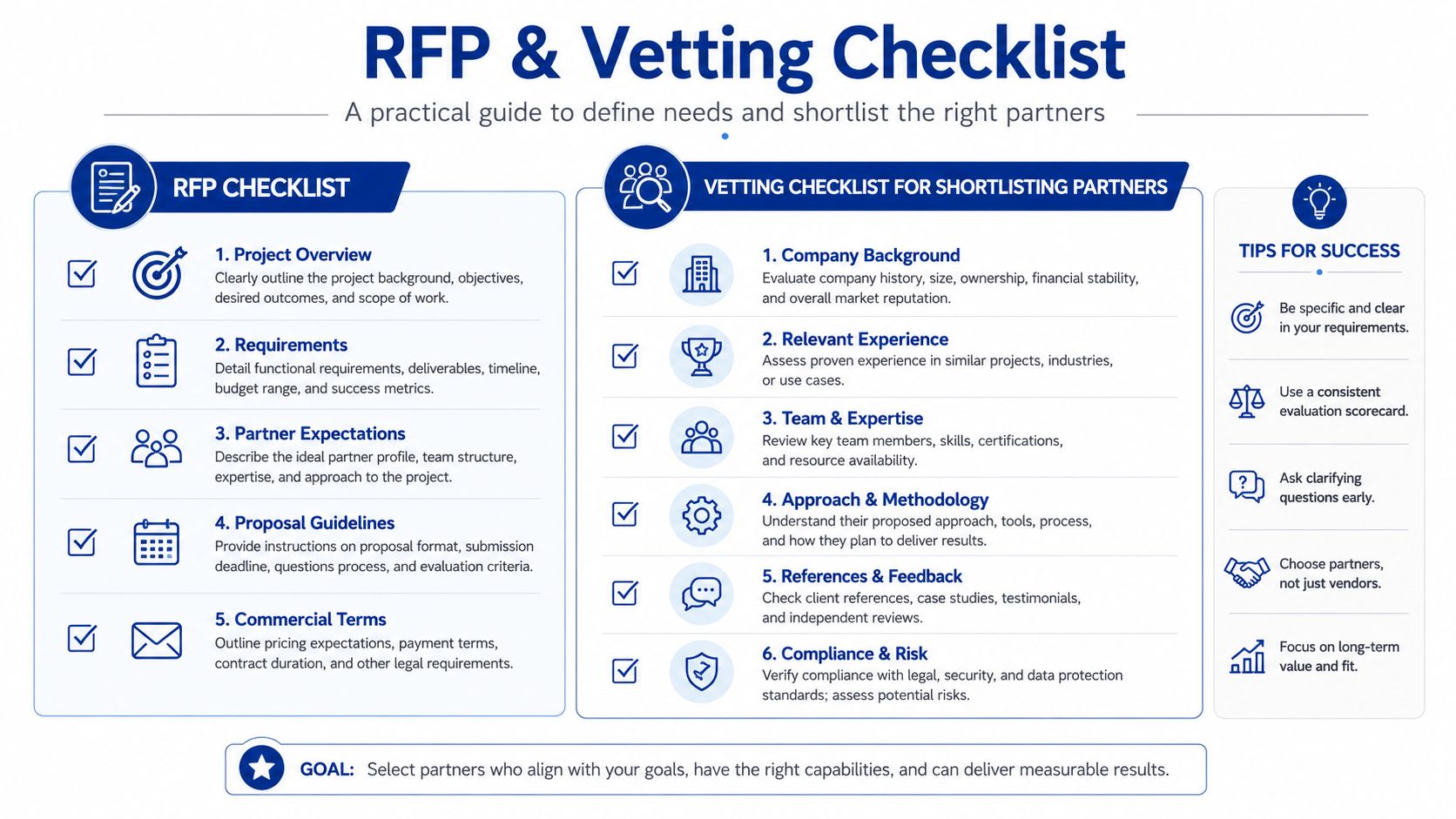
Your RFP should make agencies solve the same problem. Send each finalist the same business context, integration inventory, non-functional requirements and commercial assumptions. Otherwise, procurement compares different interpretations rather than different solutions.
Start with a short operational brief:
- Business context: Describe channels, markets, catalogue structure, B2B or DTC requirements and current platform limitations.
- Scope boundary: Separate migration, storefront, checkout, integrations, data work, analytics, QA, launch and support.
- Technical requirements: State expectations for environments, version control, deployment, security, accessibility, performance and observability.
- Integration systems: List ERP, CRM, PIM, OMS, WMS, payment and fulfilment systems, including known failure points.
- Data and governance: Identify customer data, permissions, retention, audit requirements and ownership of credentials.
- Commercial terms: Request assumptions, exclusions, milestones, payment structure, change control and post-launch support.
Score evidence, not presentation quality
Use a consistent scorecard covering Plus partner status, relevant project experience, proposed team, discovery quality, architecture, integration depth, delivery controls and references. Require named roles, not just agency departments. You need to know who will make decisions, write code, test integrations and support launch.
Ask for an integration inventory template and a non-functional requirements sheet covering uptime, latency, security and recovery expectations. These documents reveal whether the agency thinks in systems or only in screens.
Reference calls should focus on delivery behaviour. Ask how the agency handled scope change, production incidents, data defects, documentation, communication and the transition to internal ownership.
Include a red-flag appendix:
- Fixed price without discovery: Unknowns have probably been hidden rather than removed.
- Offshore-only delivery without local accountability: Time-zone coverage and escalation must be explicit.
- No repository or staging access: You may be buying dependency instead of capability.
- Unverifiable references: Treat portfolio language as unproven.
- Conversion guarantees: No ethical agency can guarantee a specific lift without controlling pricing, traffic, merchandising and customer demand.
If the project needs a narrow first release, MVP development services can inform a phased procurement approach, provided the first phase has production-quality standards rather than disposable code.
Timelines and Deliverables From Discovery to Optimisation
A Shopify Plus project becomes expensive in the gaps between phases. The storefront can be ready while product data remains unusable, ERP mapping is unfinished, or no one owns post-release monitoring. Set phase gates around operational readiness, not just frontend completion.
For an established Australian retailer planning a headless replatform, allow three to five weeks for discovery and solution design, eight to fourteen weeks for build and integration, and two to four weeks for launch and stabilisation. Use these as planning ranges for this scenario, not promises for every retailer.
Discovery should produce an architecture decision record, integration map, catalogue and data assessment, non-functional requirements, delivery plan and performance budget. Require the agency to record decisions that could change cost or schedule before development starts. If those decisions remain unresolved, the estimate is not ready for approval.
Build and integration
The build phase should deliver working increments throughout, rather than a final reveal. Expected outputs include version-controlled theme or frontend code, configured environments, tested APIs, mapped data transformations, automated workflows and a defect register.
For a growth-stage brand migrating to Plus with ERP and CRM integrations, a conventional storefront architecture may fit better than a headless build. That choice can reduce frontend work, while integration testing, customer migration, order reconciliation and operational training still need deliberate sequencing. Approve the simpler architecture when it meets the business thresholds, rather than paying for technical complexity that does not improve operations.
Launch and stabilisation
The launch plan must cover content freeze, data migration, redirects, payment checks, tax configuration, fulfilment testing, rollback decisions, communications and support escalation. A launch runbook should name each owner and define the decisions that trigger a pause or rollback.
Stabilisation validates production behaviour. Monitor checkout, conversion, device splits, order flow, inventory synchronisation and error rates. Device and funnel reporting helps identify mobile regressions and checkout friction before they become recurring operational problems.
Handover and optimisation
At handover, your team should own source code, repository access, credentials, deployment documentation, integration maps, data dictionaries, test evidence, dashboards and incident procedures. The support model must set response targets, escalation paths and boundaries between defects, enhancements and operational support.
Custom checkout extensions, complex ERP migrations and multi-region rollouts can extend the schedule. A partner that shortens the plan without stating which deliverables or risks it removed is presenting a sales timeline, not an implementation plan. Approve the schedule only after each phase has an owner, acceptance criteria and evidence of readiness.
Choosing the Right Agency and Next Steps
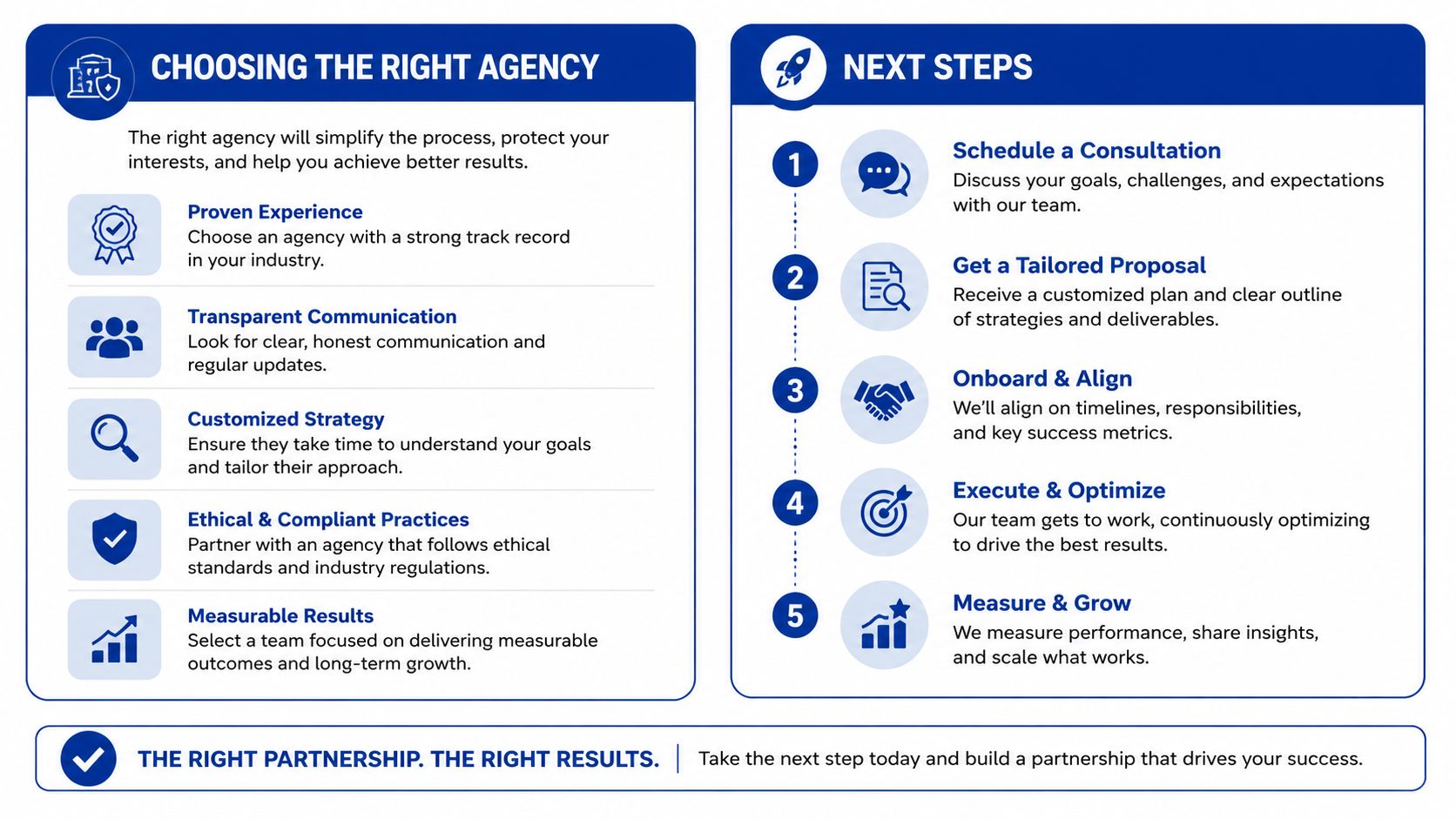
Choose the partner that fits your operating model, not the one with the most impressive gallery. I rank finalists across capability fit, commercial transparency and cultural alignment, in that order. A beautiful storefront won't compensate for weak integration engineering, and a technically capable team won't succeed if your business can't make decisions quickly.
| Buyer profile | Agency archetype to prioritise |
|---|---|
| Fast-growing DTC brand | Senior storefront and performance team with strong release discipline |
| B2B wholesale operation | Integration-led partner experienced with pricing, accounts, fulfilment and ERP workflows |
| International expansion | Multi-store and localisation capability, with reliable data and operational governance |
Ask each finalist these questions:
- Which requirements justify Shopify Plus rather than Advanced?
- What would you deliberately avoid building?
- Where does data ownership sit for products, customers, inventory and orders?
- How will you test checkout, integrations and device-specific performance?
- What will our team own at handover?
- Which assumptions could change the estimate?
- How will you detect and respond to a production incident?
Run a paid or capped-fee discovery sprint with two finalists. Give both teams the same constraints, then compare their architecture decisions, integration map, delivery assumptions, risk register and measurement plan. This is a better test than asking for another generic proposal because it shows how each partner thinks before it starts billing for implementation.
Reject agencies that won't provide references, submit vague scopes, offer fixed pricing without discovery or guarantee a specific conversion result. Also reject proposals that make headless architecture sound inevitable. A strong partner may recommend a conventional Shopify theme with carefully designed integrations because it is easier to operate and delivers the required outcome.
The Phase 1 statement of work should lock in scope, acceptance criteria, artefacts, ownership, change control, payment milestones and exit clauses. Request repository access, staging access, documentation standards and a support proposal before signing, not after launch.
Continuum Solutions can assess Shopify Plus architecture, build or modernise storefronts, connect Shopify with business systems and implement measurement and monitoring around the operational workflows that matter. Visit Continuum Solutions to start a structured conversation, and bring your current platform constraints, integration inventory and proposed roadmap so the first discussion can focus on decisions rather than sales claims.