
A product launch is ready, the mobile app works, and the finance team has approved the pricing model. Then payments become the bottleneck. The marketplace needs seller onboarding and split payouts, the SaaS platform needs recurring billing, and operations needs every payment, refund and fee to reconcile with the accounting system. A checkout form alone won't solve those problems.
That's why organisations searching for a Stripe developer are usually trying to reduce commercial risk, not just add a payment button. They need someone who can translate payment requirements into dependable APIs, asynchronous event handling, Australian payment methods, financial controls and maintainable cloud infrastructure.
A specialist can also identify where a general web implementation will fail in production. This is the same distinction between a working prototype and a production system discussed in why an app that was vibe coded isn't production ready. Payments expose weak architecture quickly because a missed webhook, duplicated request or incorrect refund state can affect revenue and customer access.
Table of Contents
- Introduction Why Payments Projects Stall Without a Stripe Developer
- What a Stripe Developer Actually Does
- Core Technical Skills Every Stripe Developer Needs
- Common Stripe Integration Patterns Explained
- Architecture and Scaling Considerations on AWS
- Testing Observability Compliance and Cost in Australia
- Hiring a Stripe Developer and Next Steps for Your Project
Introduction Why Payments Projects Stall Without a Stripe Developer
The common failure pattern starts with a narrow brief: “Integrate Stripe Checkout.” The delivery team builds a payment page, confirms a successful test payment and moves on to product features. Later, finance asks how failed payments will be reconciled, support asks why a customer retained access after a failed renewal, and operations discovers that marketplace payouts don't match internal records.
Those aren't front-end problems. They're systems integration and financial operations problems.
Stripe's API surface supports payments, billing and subscriptions, payouts and financial workflows through unified REST APIs, with both v1 and v2 namespaces documented in its API reference. A Stripe developer needs to understand how those capabilities connect to your application, CRM, accounting platform, customer identity system and cloud environment.
Australia adds another layer. Stripe launched locally in July 2014, after nearly a year of closed beta testing, making Australia its first official Asia-Pacific market and its fifth country overall. At launch, it supported AUD settlement, charged 1.75% + 30c for Australian cards and 2.9% + 30c for international cards and American Express, with volume pricing above AUD 40,000 per month. By 2024, Australian businesses had processed more than A$200 billion through Stripe, as reported in The Next Web's coverage of Stripe's Australian launch and growth.
The practical question for a CTO isn't whether Stripe can process a card. It's whether your team can build a payment system that remains correct when customers retry, banks delay confirmation, sellers change details, refunds arrive out of sequence and finance needs an auditable record.
A generalist developer may be capable of calling an endpoint. A specialist Stripe developer designs the surrounding controls, tests failure states and documents how the business should operate the integration after launch.
What a Stripe Developer Actually Does
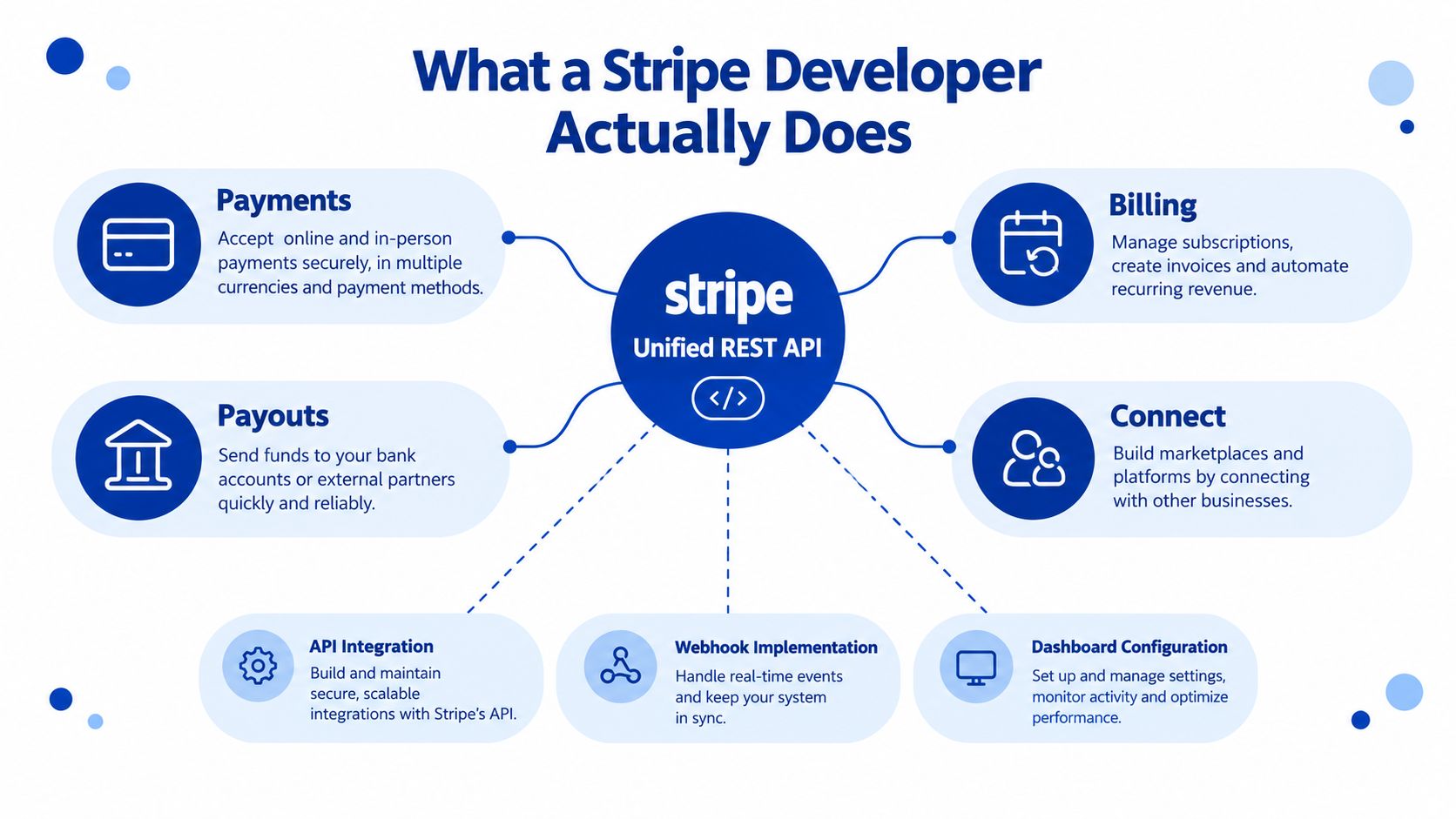
Think of Stripe as a set of financial capabilities and your application as the business process around them. A Stripe developer connects those two systems. They decide which Stripe object represents a customer, payment, subscription, invoice, mandate, connected account or payout, then make sure your internal records reflect the correct state.
The Stripe API documentation describes unified REST APIs for accepting payments, managing billing and subscriptions, sending payouts and building financial workflows. That breadth matters because payment code rarely remains isolated. A successful payment might create an order, activate a membership, issue an entitlement, notify a CRM and schedule a fulfilment task.
The work behind the payment button
A capable developer usually owns several connected responsibilities:
- API integration: Building server-side calls that create customers, payment intents, invoices, subscriptions and refunds without exposing secret credentials to browsers or mobile apps.
- Webhook implementation: Receiving Stripe events, verifying signatures, storing event identifiers and updating internal state safely when notifications arrive later.
- Business rules: Translating payment outcomes into access, fulfilment, seller balances, commissions and customer communications.
- Back-office integration: Connecting Stripe data with accounting, CRM, ERP, support and reporting systems.
- Operational handover: Documenting retries, reconciliation, refunds, disputes, failed renewals and manual recovery procedures.
Webhooks are particularly important because the browser response isn't the final authority for every payment process. A customer can close a browser after authorisation, a bank debit can remain pending, or a subscription can change state after a scheduled retry. Your application needs a durable event-driven process rather than trusting one synchronous request.
Stripe Connect changes the operating model
For a marketplace or platform, the developer also works with Stripe Connect, which is available in Australia according to Stripe's Connect availability documentation. The implementation must cover connected-account onboarding, seller verification, application fees, payment splitting, refunds and payouts.
That's a different problem from charging your own customers. It introduces responsibilities for seller lifecycle management, permissions, reporting and support workflows. A developer who has only built one-off card payments may not recognise those requirements until the platform is already committed to a flawed data model.
Practical rule: Treat payment status as a business state machine, not as a message displayed on a checkout screen.
Core Technical Skills Every Stripe Developer Needs
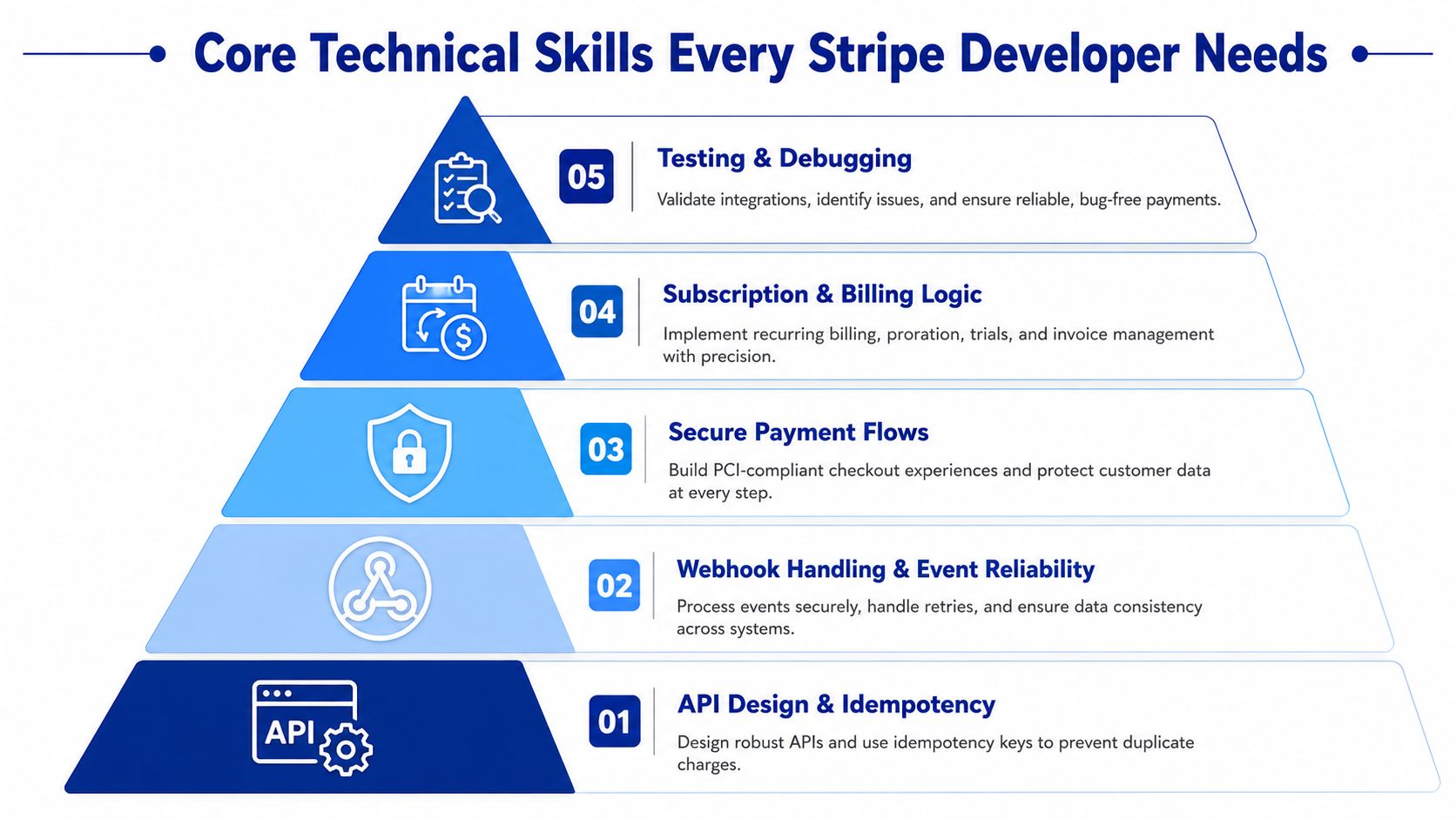
The right candidate should demonstrate production habits, not just familiarity with Stripe's SDKs. I assess the integration in layers, because a developer who is strong at API calls but weak at event reliability can still create a costly failure.
API design and idempotency
The first test is whether the developer understands idempotency. A mobile connection can fail after the server creates a payment but before the client receives the response. If the client retries without protection, the system may create duplicate business actions.
The implementation should generate stable idempotency keys for operations that must not run twice, store the relationship between the internal request and Stripe object, and define what happens when a retry receives an ambiguous response. This applies to payment creation, refunds, fulfilment triggers and payout-related actions.
Webhook reliability and security
Webhook handling needs more than an endpoint that returns a successful HTTP response. The service should verify signatures, persist the event, acknowledge quickly and process the business action asynchronously where appropriate. Duplicate delivery, out-of-order events and temporary downstream failures need explicit handling.
Authentication design also matters. Secret keys belong on trusted server-side infrastructure, while the application should minimise its PCI exposure by using Stripe-hosted or Stripe-controlled collection components where they fit the user experience. If your organisation uses a provider such as MiniOrange for authentication or SSO, the payment identity model must still map consistently to Stripe customers and internal accounts.
Cloud integration and observability
AWS gives teams several viable deployment choices:
| Pattern | Strength | Trade-off |
|---|---|---|
| Lambda and API Gateway | Useful for event-driven handlers and variable workloads | Requires careful timeout, retry and logging design |
| ECS | Suitable for containerised services with consistent runtime needs | Adds service and deployment management |
| EC2 | Flexible for existing server-based applications | Places more operational responsibility on the team |
| AWS Amplify | Practical for selected web and mobile application workflows | Shouldn't replace server-side controls for sensitive payment operations |
Observability completes the skill set. Sentry can capture application exceptions and payment-flow context, while New Relic can help teams examine service performance and dependencies. The developer should define correlation identifiers so finance, support and engineering can trace one transaction across the application, Stripe and downstream systems.
A Stripe integration isn't production-ready until the team can explain what happened to a payment that partially succeeded.
Common Stripe Integration Patterns Explained
Most Australian projects fit one or more of four patterns. The mistake is selecting a product because it's quick to demonstrate rather than because it matches the operating model.
| Pattern | Best For | Complexity | Key Consideration |
|---|---|---|---|
| Checkout and Payment Intents | One-off purchases and straightforward digital services | Moderate | The server must confirm the final payment state and fulfil only once |
| Billing and subscriptions | SaaS, memberships and recurring services | Moderate to high | Entitlements, failed renewals, invoices and cancellations need defined rules |
| Connect | Marketplaces, platforms and seller ecosystems | High | Onboarding, verification, split payments and payouts affect finance and support |
| Terminal | Retail, events and in-person service payments | High when mixed-country operations exist | Reader location, account country, currency and local hardware support must align |
One-off payments
Checkout can reduce the amount of custom payment UI your team maintains. Payment Intents provide more control where the application needs a customized flow, additional payment methods or a custom mobile experience.
Neither option removes the need for server-side order management. The application should create an internal order, associate it with the Stripe payment object and make fulfilment idempotent. A “success” page can help the customer, but it shouldn't be the sole trigger for dispatching goods or activating access.
Recurring billing
Subscriptions suit SaaS and membership platforms, but the difficult work begins after the first invoice. Your system needs policies for failed renewals, grace periods, plan changes, prorations, cancellations and access removal.
A common failure is tying access directly to the existence of a subscription record. Payment state, invoice state and entitlement state can diverge, so the integration should model each explicitly and process relevant events through a durable workflow.
Platforms and in-person payments
Connect supports a platform model, but it creates a larger compliance and operational surface. Seller onboarding isn't a formality. It affects who receives funds, how fees are represented, what support can change and how reconciliation works.
Terminal requires regional discipline. Stripe's regional guidance says the account receiving funds and reader location must be in the same country, transactions must be in AUD for Australian in-person payments, and supported cards include Visa, Mastercard, American Express and eftpos. The Stripe regional payments guidance also highlights SDK and reader-firmware requirements for Australian eftpos, as well as evolving Tap to Pay support.
For broader application and systems work, custom integrations should be scoped around the complete transaction lifecycle, not just the payment screen.
Architecture and Scaling Considerations on AWS
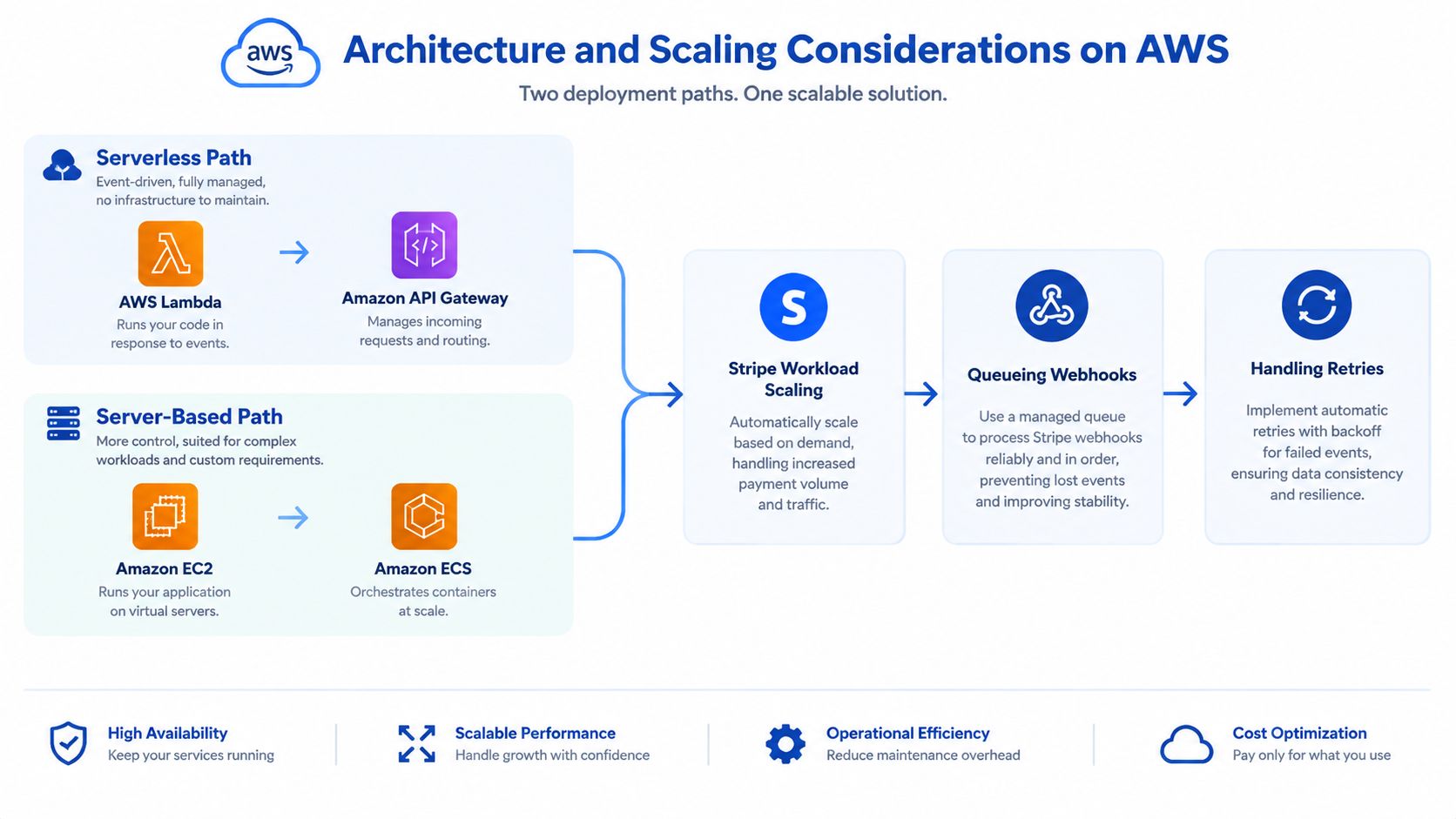
Payment systems need a clear separation between the request that starts a transaction and the events that confirm what happened. On AWS, that often means a synchronous API for creating the payment object, a webhook endpoint for receiving Stripe events and a queue for reliable business processing.
Choosing the runtime
Lambda and API Gateway suit small, event-driven handlers where the team wants limited server administration. They work well for webhook ingestion, lightweight payment orchestration and asynchronous processing, provided the developer handles retries, execution limits and duplicate events carefully.
ECS is a stronger fit when the application already runs as containers, needs longer-lived processes or has shared runtime dependencies. EC2 may be appropriate during a migration from an existing application, but it can preserve operational overhead that a new service doesn't need.
The choice should follow workload and team capability. A serverless design isn't automatically cheaper, and a container platform isn't automatically more reliable. The cost includes engineering time, monitoring, deployment controls, incident response and future change.
Designing for failure
A typical flow usually follows this sequence:
- Create an internal transaction record before calling Stripe.
- Send a request with an idempotency key tied to the business operation.
- Persist the Stripe object identifier and current status.
- Receive the webhook through a protected endpoint.
- Store the event before processing it.
- Push business work to a queue when downstream actions can fail or take time.
- Retry safely and expose a replay process for operational recovery.
Orders, entitlements and payment states need deliberate consistency rules. If Stripe confirms payment but the fulfilment service fails, the transaction should remain visible for retry rather than disappearing into an application log.
For AWS-hosted membership products, the architecture should also account for access revocation, scheduled renewals and support workflows. The AWS hosting guidance for membership platforms provides a useful context for considering those dependencies alongside hosting decisions.
Testing Observability Compliance and Cost in Australia
A payment can appear successful while fulfilment, settlement, or reconciliation remains incomplete. Australian payment architecture adds further states when a business uses local rails, recurring bank debits, or multi-currency funds management. A card-only test plan will miss those operational differences.
Test the states that affect revenue
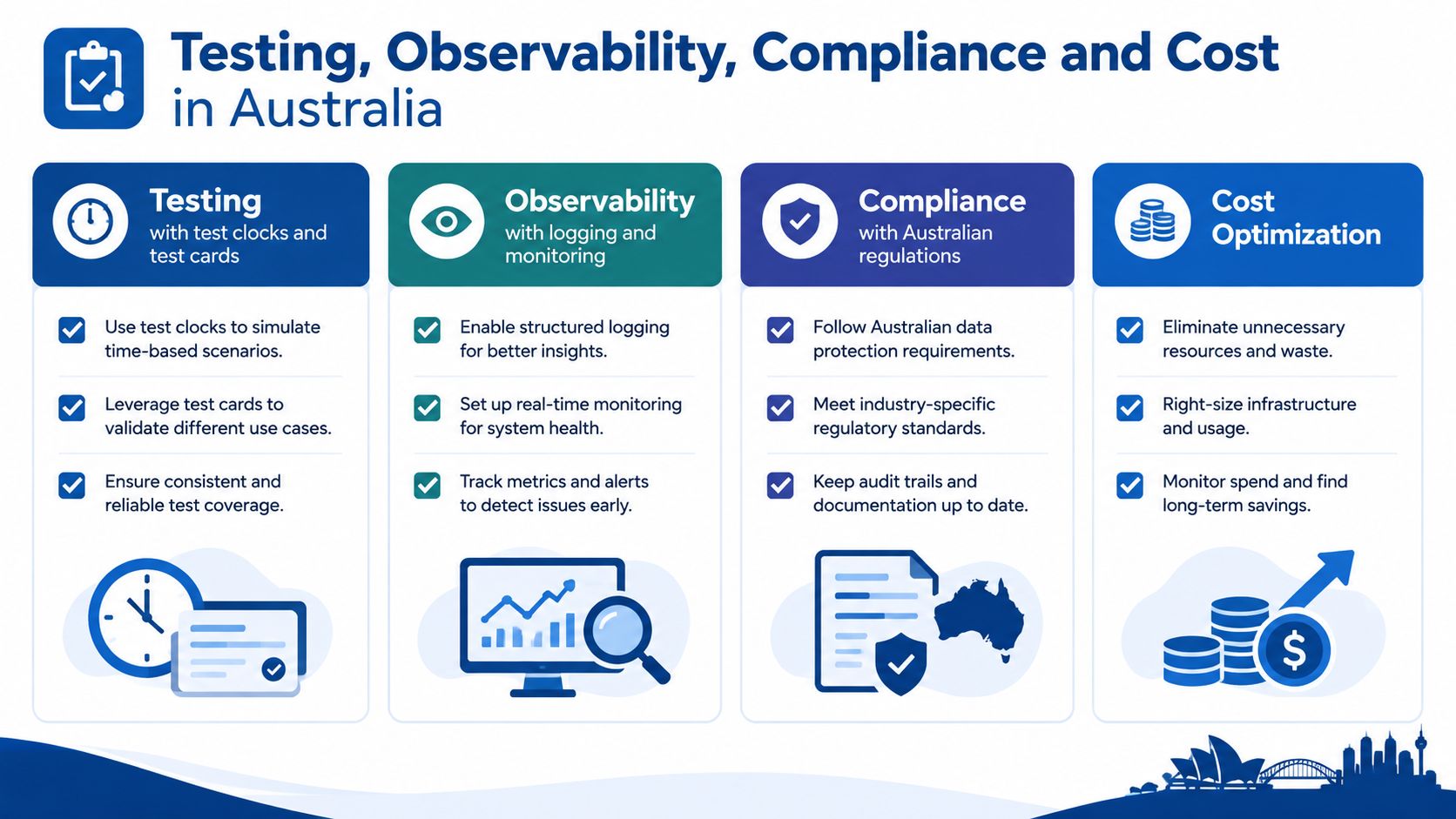
Use Stripe test mode and test cards for successful payments, authentication challenges, declines, duplicate submissions, refunds, and dispute-related workflows. For subscriptions, test clocks can exercise renewals, trial transitions, and cancellation logic without waiting for real calendar events.
Tests should assert business outcomes, not only API responses. Confirm that an order is fulfilled once, a membership changes state correctly, a failed renewal starts the agreed customer journey, and a refund reaches the internal ledger. Include delayed webhooks, repeated events, and interrupted downstream processing so the team can verify recovery behaviour before release.
Australian rails require different controls
Stripe's Australian payment stack includes eftpos, BECS Direct Debit, PayTo, Apple Pay, Google Pay, and BNPL options such as Zip and Afterpay/Clearpay. Eligible dual-network debit transactions can be automatically routed over EFTPOS using least-cost routing. Payment-method configuration therefore affects processing economics as well as customer choice. The Stripe overview of Australian payment systems describes support for legacy BECS and the newer PayTo framework.
BECS is a reusable method with delayed notification. Confirmation can take up to three business days, and new accounts have a default limit of AUD 10,000 per transaction and AUD 10,000 per week, as specified in Stripe's BECS documentation. Treat “submitted” and “settled” as separate states, update records from webhooks, and apply risk controls before recognising revenue as final.
Reconciliation and treasury
Finance needs a ledger covering gross payment, Stripe fee, refund, dispute, payout, and internal allocation. Dashboard exports should not be the sole accounting record. Store stable references, then reconcile them with the accounting system on a scheduled basis.
Stripe has been rolling out Treasury in Australia. Confirm current availability, supported currencies, and account capabilities on Stripe's Australian Treasury information before designing funds flows for marketplaces, NGOs, or SaaS platforms with international operations. Treasury and Connect decisions can affect account structure, money movement, reconciliation effort, and operating cost.
GST-inclusive fees for Australian payment methods, plus separate pricing for BECS and PayTo, belong in pricing and reconciliation rules. Sentry and New Relic can help technical teams diagnose failures, while enterprise application monitoring and debugging supports the operational discipline required after release. Define alert ownership, escalation paths, and reconciliation checks before production.
Hiring a Stripe Developer and Next Steps for Your Project
Evaluate a Stripe developer by asking for evidence of the failure paths, not a polished checkout demo. The person or team should be able to explain how they handled duplicate requests, delayed bank confirmation, failed subscription renewals, refunds, disputes and reconciliation.
A practical hiring checklist includes:
- Relevant architecture: Ask whether they've delivered subscriptions, Connect marketplaces, Terminal or Australian bank-payment flows similar to yours.
- Operational ownership: Confirm who monitors webhooks, investigates failed events and performs reconciliation after launch.
- Security boundaries: Ask where secret keys live, how access is controlled and how the design limits unnecessary PCI exposure.
- Cloud competence: Review whether Lambda, ECS or EC2 is justified by the workload and your team's support capability.
- Documentation: Require sequence diagrams, event mappings, runbooks, test evidence and a handover plan.
- Commercial clarity: Separate Stripe fees, cloud hosting, development, monitoring, support and future change requests in the cost model.
A phased delivery reduces risk. Start with discovery and payment-method decisions, then produce an architecture review and event model before building the first checkout. Follow with a staging integration, failure-state testing, reconciliation prototype and controlled production release. This sequence makes expensive assumptions visible early.
Build in-house or engage a specialist
In-house development can work when the organisation already has payment, cloud and finance systems expertise, plus capacity for ongoing support. A specialist partner is more sensible when the project combines marketplace payouts, local payment rails, mobile applications, legacy integration or an AWS migration.
The same assessment applies to mobile delivery. Teams choosing a mobile-focused implementation should review the relevant mobile app development capability in Melbourne alongside payment architecture, because a mobile payment flow still depends on secure server-side controls and reliable webhooks.
Continuum Solutions offers Stripe integration, cloud architecture, custom application development and systems integration, including staging builds, testing, documentation and handover. Whether you choose an internal team or an external partner, insist on an implementation plan that treats payment processing, reconciliation and operational support as one system.
Continuum Solutions can help design and implement Australian Stripe integrations across payments, subscriptions, Connect, cloud infrastructure and back-office systems. Visit Continuum Solutions to discuss your payment architecture, integration risks and a practical delivery plan.