
Your offshore team’s demos look good, the backlog is moving, and the renewal is approaching. Then someone asks who can export the customer database, where the support engineers work, and whether your local team could recover production without them. You’ve got a contract and a vendor presentation, but not a defensible answer.
That’s where I’d start a vendor review. How to audit an offshore development team: a practical checklist should be a question about evidence, accountability and operational control, not whether the supplier presents well.
Table of Contents
- The Offshore Audit Most Teams Get Wrong
- The Australian Governance Frame for an Offshore Team
- Mapping People, Locations, and Data Flows
- Auditing Delivery, Code Quality, and Security Controls
- Testing Subcontractors and Human Resilience
- Scoring the Audit Green, Amber, or Red
- Closing the Audit and Setting the Next One Up
The Offshore Audit Most Teams Get Wrong
Consider a hypothetical NGO modernising its membership platform. The offshore developers deliver useful features, the account manager attends every steering meeting, and procurement has collected security certificates. Nobody has reconciled the people listed in the contract with the identities accessing donor records through support tickets.
At renewal, I wouldn’t start by reviewing sprint velocity. I’d ask the CTO to demonstrate who can reach sensitive systems, which legal entity employs them, and how the organisation would contain an incident without waiting for the vendor’s account manager.
Start with the service, not the supplier’s address
APRA’s CPS 230 commenced on 1 July 2025, and its offshoring treatment depends on the physical location of the service. An Australian-incorporated vendor can therefore still deliver an offshore service when its personnel or delivery operate overseas, as explained in APRA’s operational risk management response paper.
Don’t turn that into a blanket claim that every Australian business is APRA-regulated. Instead, use the distinction to challenge an assumption that also matters commercially: an Australian invoice doesn’t establish where work happens.
My opening evidence requests would be:
- Service boundaries: Identify the applications, integrations and operational activities the vendor controls.
- Business ownership: Name the Australian executive accountable for accepting the engagement’s risks.
- Independent operation: Demonstrate what the client can operate, recover or transfer without the supplier.
Separate promises from proof
A contractual control says access must be removed when someone leaves. An operational control includes the termination record, identity-provider event and repository audit trail showing that removal happened.
Practical rule: A certificate is supporting context. It isn’t proof that your production environment follows the certified process.
For organising the review, the checklist from Freeform Company is an optional planning resource. I’d still make the engagement’s actual systems, obligations and evidence requirements determine the checklist, rather than treating any template as an assurance standard.
Offshore delivery can provide useful engineering capacity and specialist skills. The disadvantage is the additional oversight you must fund across organisational boundaries. Assess the commercial model with that work included, not just the developer rate.
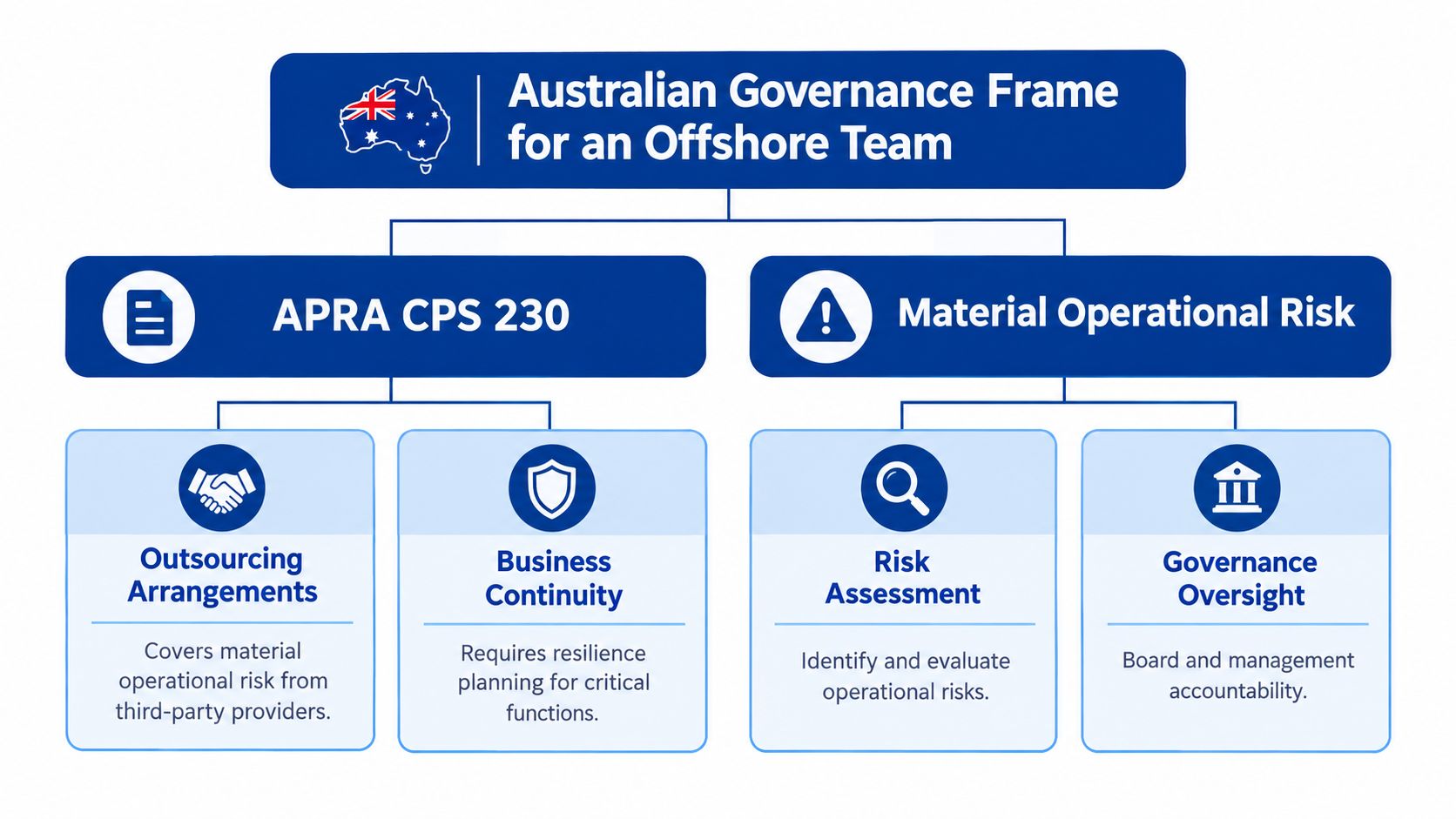
The Australian Governance Frame for an Offshore Team
Establish which obligations apply before asking engineers to export logs. Have legal, risk and technology owners agree on the engagement’s regulatory scope, business criticality and personal-information exposure.
The governance structure should distinguish operational resilience from privacy accountability.
Establish the operational obligations
For an APRA-regulated entity, apply the CPS 230 framework described earlier. Assess whether the engagement supports critical operations and whether it constitutes a material arrangement, rather than assuming every development contract has the same significance.
Material offshoring arrangements require APRA notification before entry or significant change. Internal audit must review proposed material arrangements involving outsourced critical operations and report regularly to the board or board audit committee on compliance with the service-provider management policy.
Translate that governance into reviewable deliverables:
- Contract coverage: Identify critical services, service levels, access rights and incident obligations.
- Continuity arrangements: Establish how the organisation will maintain the relevant operation during disruption.
- Exit authority: Check termination provisions, step-in procedures and the approvals needed to activate them.
Don’t accept an engineering sign-off as a substitute for the required governance process.
Establish the privacy obligations
Under the Privacy Act 1988, an APP entity must take reasonable steps before overseas disclosure to ensure the recipient doesn’t breach the APPs, other than APP 1. The Australian entity generally remains accountable under section 16C for relevant overseas-recipient acts or practices, subject to the framework’s exceptions, under the Privacy Act’s cross-border disclosure provisions.
I’d ask legal to document the applicable basis and exceptions, not have the development manager decide informally. Customer records, employee information, donor details and support exports belong in that assessment.
Build a control matrix connecting each applicable obligation to a contract clause, technical control, evidence requirement and accountable owner. For organisations needing help coordinating that work, business IT consulting services can sit alongside internal legal and risk teams.
The audit’s authority should be explicit. Engineers need to know who approved the review, what evidence they may disclose, and who can accept unresolved risk.
Mapping People, Locations, and Data Flows
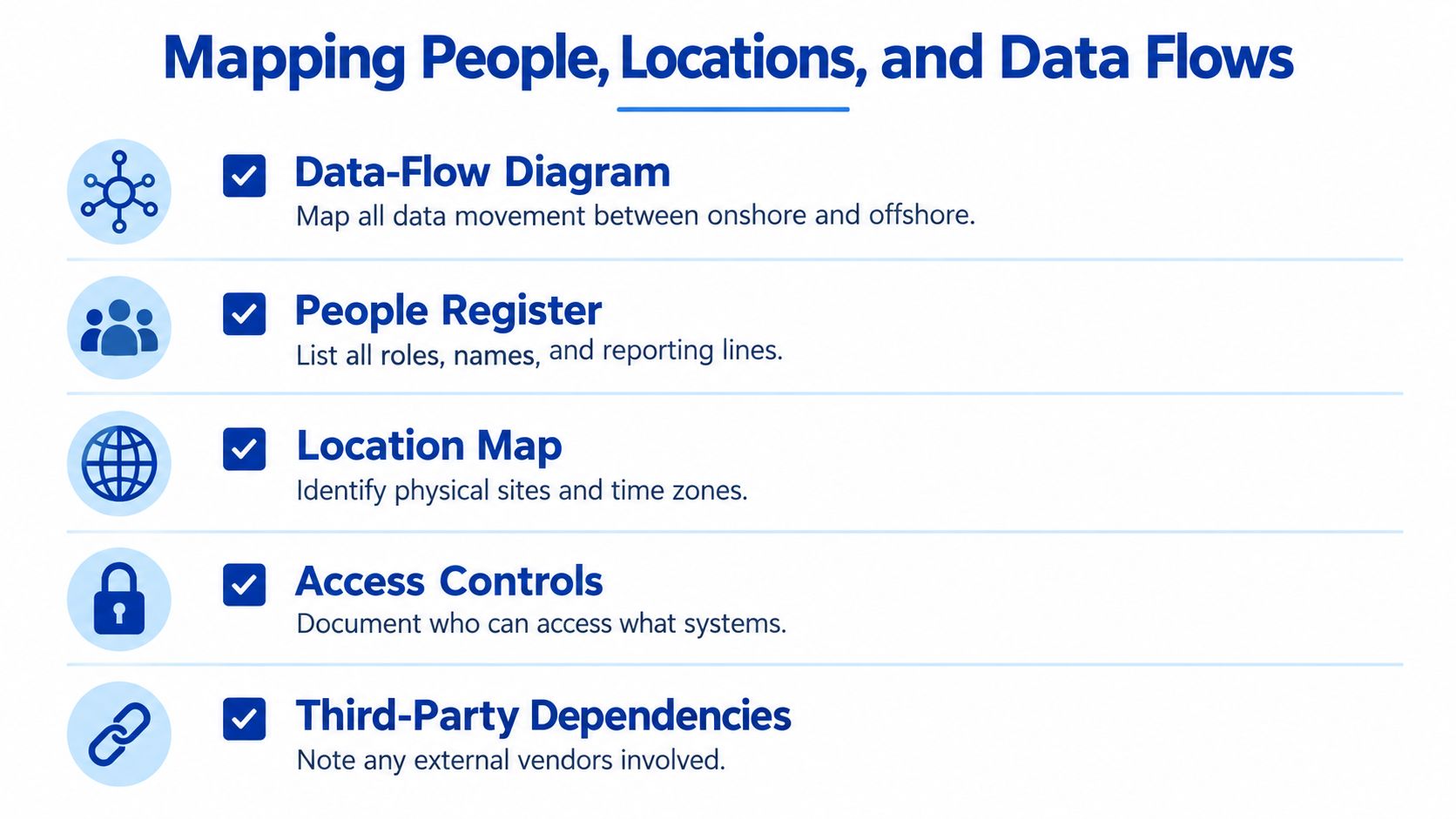
Ask the supplier to demonstrate a normal support task, not just send an architecture diagram. Follow an issue from the customer’s ticket through troubleshooting, development, testing and deployment. Record every place personal information becomes accessible.
The OAIC states that providing personal information to an overseas contractor will, in most circumstances, constitute a disclosure under APP 8, according to its guidance on cross-border disclosure of personal information. Calling the supplier an extension of your internal team doesn’t resolve that assessment.
Build an inventory that can be reconciled
Use a shared register with enough detail to compare the supplier’s declarations against system records.
| Inventory field | What I’d require |
|---|---|
| Person or service | Named identity, employer and accountable manager |
| Location | Actual access country and approved work locations |
| Environment | Repository, cloud account, support platform or deployment system |
| Information | Data categories, purpose and sensitivity |
| Permission | Role, approval, expiry and privileged capabilities |
| Evidence | Relevant configuration, log or access-review record |
Include developers, QA staff, administrators, support engineers and subcontractors. For services, include package registries, CI/CD runners, monitoring platforms, backup destinations and ticketing tools.
Don’t record only database access. A ticket attachment, application log or analytics export may be the more relevant route to personal information.
Classify the activity, then test the restriction
Have the privacy reviewer distinguish controlled use from disclosure. The OAIC describes disclosure as making information accessible to an overseas recipient outside the Australian entity’s effective control, and recommends considering whether the objective can be achieved without identifiable information in its APP 8 guidance on effective control and overseas handling.
For a hypothetical CRM migration, I’d prefer synthetic donor records for transformation testing. If production records are necessary, require a documented purpose, restricted access and an approved retention approach.
Put these questions directly to the vendor:
- Production access: Which named people can query, export or alter live records, and when does their approval expire?
- Onward movement: Can data enter local devices, support tools or unapproved environments?
- Offboarding evidence: What demonstrates return or deletion from developer devices, working copies and backups?
- Contract alignment: Do actual purposes and locations match the approved agreement?
For backups, inspect retention schedules, expiry mechanisms and restoration restrictions. Don’t accept an unqualified deletion statement that ignores retained copies or technical limitations.
Auditing Delivery, Code Quality, and Security Controls
The Australian Cyber Security Centre reported that 74% of Commonwealth entities performed supply-chain risk assessments during 2024 for applications, ICT equipment and services in its Commonwealth Cyber Security Posture report. Use that as a benchmark for documented assessment, not as evidence that your vendor is secure.
I’d test the build pipeline by tracing a production release backwards. The supplier should connect the deployed artefact to an approved change, reviewed code, successful tests and an identifiable deployment actor.
Inspect the engineering evidence
Request read-only access where practical. Screenshots can support a finding, but they shouldn’t replace records that reveal scope, timestamps and exceptions.
- Identity controls: Inspect multifactor-authentication coverage, privileged-account inventories and access-review records.
- Code review: Sample pull requests for meaningful review, unresolved comments and approval bypasses. Treat review metrics as context, not proof of quality.
- Dependencies: Compare scan findings with remediation dates, accepted exceptions and deployed versions.
- Pipeline permissions: Inspect Git permissions, CI secrets, runner access and deployment roles.
- Recovery: Review backup tests and demonstrate restoration into an isolated environment.
For the quality discussion, GoReplay’s guide to software quality control is a supplementary reading option. Your acceptance decision should still depend on the vendor’s own artefacts and witnessed tests.
Test behaviour, not configuration alone
Choose a departed developer and compare the departure approval with actual revocation across source control, cloud access and support tools. Check performance against your organisation’s stated target without substituting a target the vendor finds convenient.
Then rehearse revoking a compromised credential in a controlled environment. Require the team to explain how it would rotate dependent secrets and preserve critical operations.
Don’t ask whether the team has a rollback procedure. Ask an engineer who didn’t write it to demonstrate it safely.
For AWS, I’d inspect IAM policies and CloudTrail events. For Azure, I’d examine Entra ID assignments and activity records. Recommend short-lived credentials, managed secrets, protected branches and infrastructure changes through version-controlled review.
The trade-off is implementation effort and occasional workflow friction. Design an auditable emergency path rather than letting engineers bypass controls whenever a release becomes urgent.
A fast prototype deserves the same scrutiny. The questions behind why a vibe-coded app isn’t production-ready are relevant here: inspect authentication, error handling, integration behaviour and operational ownership, regardless of how the code was produced.
Testing Subcontractors and Human Resilience
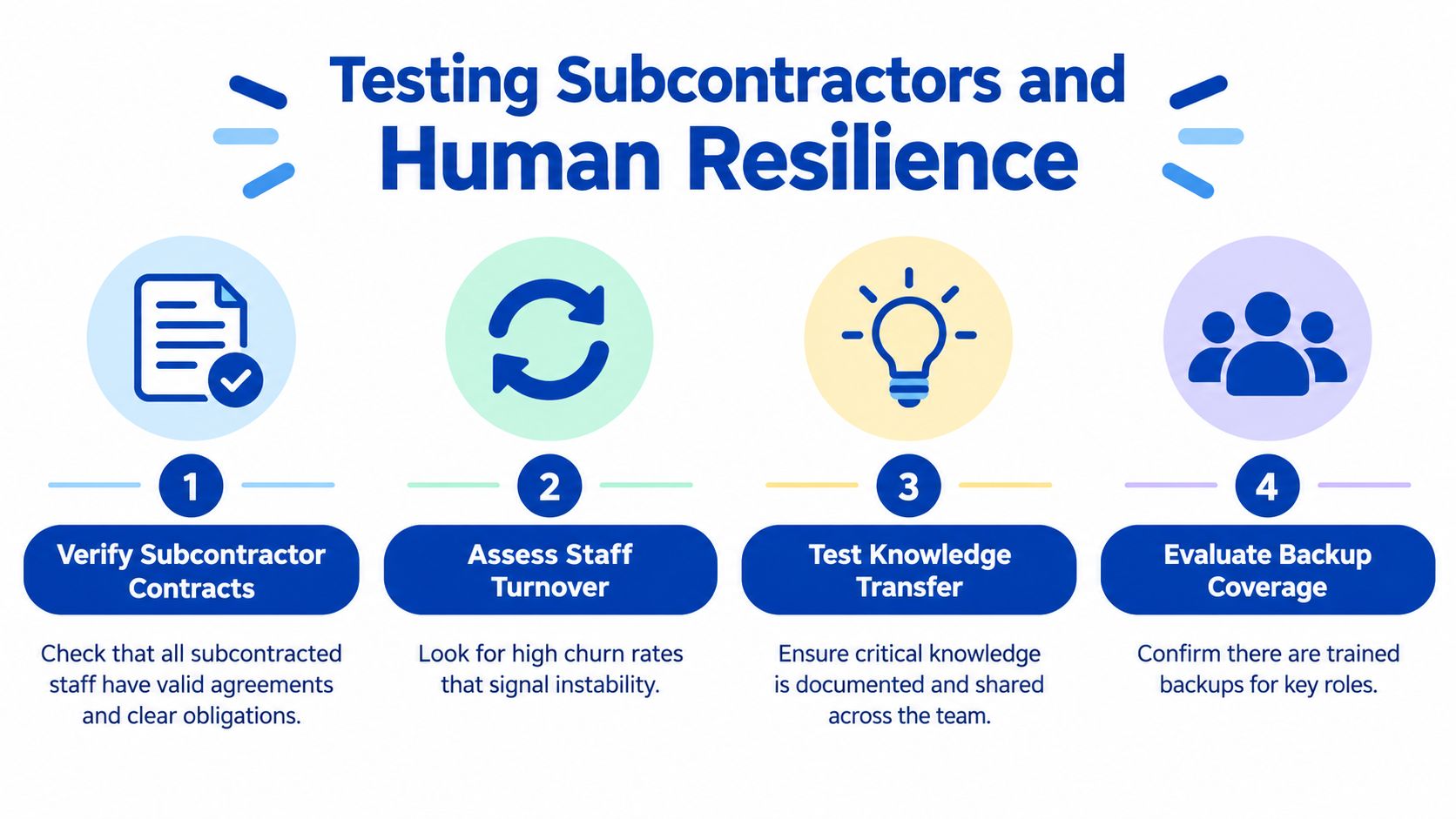
Architecture diagrams won’t show whether a support engineer can be persuaded to reset privileged access. I’d prioritise subcontractor visibility and human response alongside technical controls, not leave them for procurement to check later.
The OAIC recorded 532 notified breaches in January–June 2025 and described a government agency incident in which a contracted software developer ran an unauthorised script that exposed private documents publicly, in its notifiable data breach update. That’s a concrete reason to audit supplier actions, not just the client’s perimeter.
Challenge the subcontractor boundary
Reconcile the inventory against the people attending delivery meetings and performing deployments. Ask whether the primary vendor can produce evidence for subcontracted personnel as readily as for employees.
Require prior approval of subcontractors, flow-down obligations and an agreed incident-evidence process in the contract. The third party risk assessment guide from ThreatExploit AI is an optional resource for framing the wider supplier review, not a substitute for those checks.
In a hypothetical mobile application engagement, also inspect ownership of signing credentials, release permissions and backend administration. An engagement with mobile app developers in Melbourne still needs scrutiny of subcontracted access and release dependencies.
Rehearse the human failure modes
The 2025 MinterEllison Australian cyber-risk survey found that 50% of respondents reported a supplier or vendor cyberattack or data breach during the preceding year. The same MinterEllison cyber-risk report discusses the Qantas incident, which affected about 5.12 million Australians after social engineering against an overseas provider, while noting the OAIC inquiry found no indication that Qantas had failed to take reasonable protective steps.
The lesson isn’t that assessments are pointless. It’s that reasonable controls don’t eliminate the need to test people under pressure.
Ask for:
- Social-engineering evidence: Training completion and authorised phishing and vishing simulation results.
- Incident performance: Acknowledgement records, escalation timing and decisions made during tabletop exercises.
- Coverage: Staff-turnover records, key-person dependency maps and replacement arrangements across time zones.
- Handover capability: A local-team exercise using documented runbooks, tested backups and approved emergency access.
Include an unplanned absence in the exercise. If only the vendor’s lead engineer can restore service, record a continuity failure even if the recovery documentation looks polished.
Scoring the Audit Green, Amber, or Red
Don’t average serious failures into a reassuring overall score. An unverified route to sensitive production data deserves its own decision, regardless of how many lower-risk controls passed.
I’d use the following bands as an editorial decision framework, not a regulatory scoring system. Apply them to individual findings and then assess the engagement’s overall acceptability.

Audit Findings Scoring Framework
| Finding Band | Evidence Available | Control State | Escalation Path |
|---|---|---|---|
| Green | Current, traceable evidence with named owners | Implemented and tested within scope | Service owner approves ongoing monitoring |
| Amber | Partial records or unresolved inconsistencies | Present but incompletely demonstrated | CTO and risk owner approve a remediation plan |
| Red | Missing, contradictory or inaccessible critical evidence | Absent, failed or unsafe to rely on | Executive escalation, with legal and board involvement as appropriate |
Green isn’t a permanent clearance. Record the systems sampled, exclusions and evidence dates so the next reviewer understands what was established.
Amber might cover incomplete review records or insufficient replacement coverage. I’d permit continued delivery only where the exposure is understood, interim controls are credible and a named owner accepts the residual risk.
Red includes unverified processing locations, unexplained privileged access, unsupported deletion claims or inability to rehearse incident containment. Don’t expand sensitive access while those questions remain unresolved.
Compare remediation with replacement
Price the decisions separately:
- Retain and remediate: Include engineering work, legal amendments, access redesign and retesting.
- Restrict the scope: Assess whether offshore development can continue with synthetic data and client-controlled production releases.
- Replace the supplier: Include knowledge transfer, environment reconstruction, parallel operation and exit assistance.
Retaining the vendor preserves context but requires confidence it can execute the fixes. Replacement offers a different delivery arrangement but creates transition work and continuity exposure.
For AWS findings, distinguish vendor-governance gaps from platform configuration issues using common AWS mistakes SMEs make as a related review topic. The accountable owner should follow the cause, not whichever team receives the report first.
Escalate according to business criticality and the governance obligations established earlier. A colour alone doesn’t justify accepting material operational or privacy exposure.
Closing the Audit and Setting the Next One Up
Close with a decision record, not a catalogue of observations. For every finding, capture the affected service, tested contract clause, evidence item, business consequence, accountable owner, remediation date and residual-risk acceptance decision.
The OAIC notes that organisations may generally remain accountable when overseas recipients mishandle information in its privacy guidance on third-party and overseas arrangements. Keep the evidence and acceptance record accessible to the Australian organisation, not solely in the vendor’s workspace.
Make the next review easier
I recommend an annual full review as a default, with targeted reassessment after subcontractor changes, production-access changes, incidents or material service changes. That’s a proposed operating cadence, not a universal legal deadline.
- Legal: Resolve location restrictions, subcontracting permissions, deletion terms and evidence rights.
- Executive oversight: Escalate material unresolved risks and required acceptance decisions.
- Engineering: Put fixes into the delivery backlog with explicit acceptance tests.
- Operations: Connect findings to enterprise application monitoring and debugging so ongoing checks support the next audit.
Don’t approve a fixed review price or duration before scoping the environments and evidence access. An internal exercise uses existing context but consumes delivery capacity; an external review adds independent scrutiny but requires onboarding and carefully controlled access.
Next week, nominate the audit sponsor, send the evidence request and book a witnessed recovery exercise. Put recurring evidence delivery and remediation verification into the next statement of work.
Continuum Solutions provides cloud architecture, application development and systems integration services that can support an offshore-team review and the engineering remediation that follows. Visit Continuum Solutions to discuss your vendor arrangement, production-access boundaries and continuity requirements before renewal or a major migration.