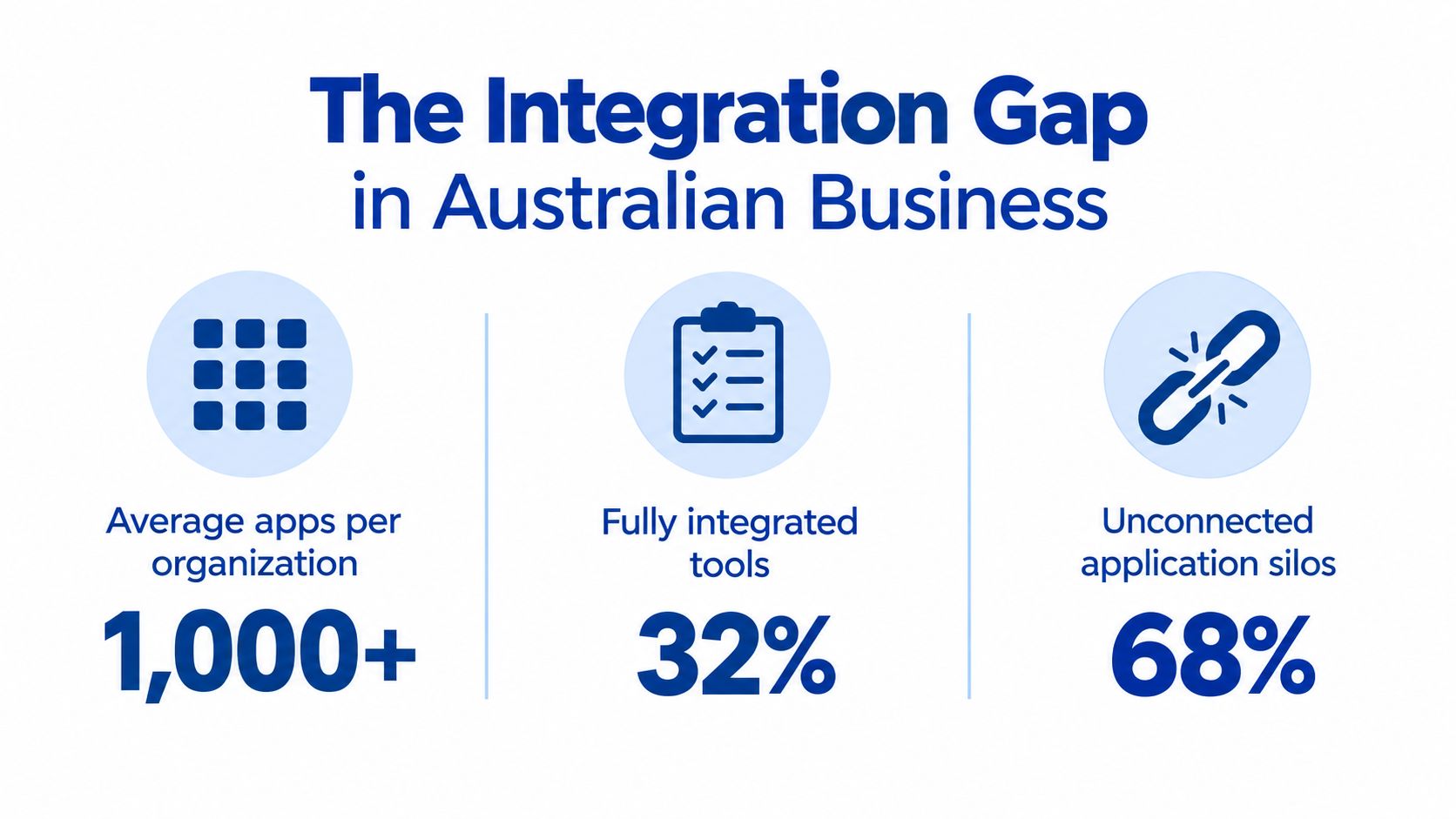
Australian organisations use an average of 1,032 applications, yet only 32% are integrated. Application to application integration is therefore not an optional technical upgrade, it's the operational bridge between software sprawl, reliable data and workable automation.
I've seen this pattern across Melbourne enterprises and NGOs. A CRM owns customer records, a fundraising platform holds donations, an identity provider manages access, and internal systems track fulfilment or service delivery. Each application may work well on its own, but staff still export spreadsheets, re-key records and reconcile conflicting information. The integration project succeeds only when it removes a business bottleneck without creating a new operational dependency.
Table of Contents
- The Integration Gap in Australian Business
- Core Architectural Patterns for Integration
- Security, Governance, and Data Mapping
- Cloud-Specific Considerations for AWS and Azure
- Why Integration Is the Foundation for AI
- Implementation Checklist and Best Practices
The Integration Gap in Australian Business
Australian businesses are managing an average of 1,032 applications per organisation, yet only 32% are integrated, according to Australian system integration market data. The result is a large operational gap between the software an organisation owns and the information its people can use.
The cost appears in routine work. A customer update entered in one platform may not reach the CRM. A donation can require manual verification before it appears in a supporter record. An employee may receive access to one system while a separate request remains in an inbox. Staff then export spreadsheets, re-enter records and resolve mismatched information instead of serving customers, donors or program participants.
In Melbourne NGOs, I often find that the problem is not a poor application. The CRM, fundraising platform and identity provider may each perform their assigned job well. The failure sits between them, where ownership, timing and data rules have never been agreed.
The same benchmark reports average custom integration labour of USD 3.6 million over the previous 12 months, and 98% of organisations said at least one department required both integration and automation (Australian integration labour and automation benchmark). This does not justify spending millions on middleware. It demonstrates how quickly manual coordination becomes a material operating cost in larger environments.
Integration is a business decision
I begin an integration engagement with the manual transaction, not the connector catalogue. Which process is expensive, slow or risky because two applications lack a reliable contract? That answer determines the first integration to fund.
For an NGO, the priority may be sending confirmed donor and transaction data from a fundraising platform to a CRM. For an enterprise, it may be an order, identity or claims workflow crossing several systems. Connecting every application creates maintenance work without necessarily improving service delivery. Start with the workflow carrying money, compliance responsibility, customer trust or significant staff time.
An updated Australian data set reports that average application count rose from 974 to 1,081 year over year, while only 22% of applications were integrated (updated Australian application integration data). Treat that gap as an architecture warning. Before approving another SaaS purchase, confirm its data contract, ownership model and failure-handling requirements.
Practical rule: Fund the workflow with the clearest operational cost, then design a reusable connection rather than another isolated script.
The market is moving towards governed connectivity
Australia's system integration market is forecast to grow from USD 10.61 billion in 2026 to USD 20.35 billion by 2031, representing a projected 13.92% CAGR (Australian system integration services forecast). Data integration is projected to grow at 14.25% CAGR through 2031, while infrastructure integration held 41.10% market share in 2025 and large enterprises represented 66.65% of demand in the cited analysis (Australian integration market segments).
The investment case is strategic, not cosmetic. A governed API, event stream or managed workflow can become a reusable business capability. A rushed point-to-point script becomes another asset to monitor, secure, document and repair.
Organisations assessing the problem should use business IT consulting services to establish an application inventory, process map, data ownership review and costed integration roadmap. That sequence keeps vendor connectors from dictating architecture and makes the return from each integration visible.
Core Architectural Patterns for Integration
Architecture determines whether application to application integration remains manageable as systems change. I don't recommend selecting an iPaaS, message broker or cloud service until the team understands the connection pattern it needs.
Point-to-point integration is the fastest route between two known systems. It works for a narrow workflow with stable ownership, such as sending a completed payment from one platform to another. Its weakness appears when more applications join the process. Each new connection adds another dependency, transformation rule and failure path, producing the brittle “spaghetti” architecture that makes change expensive.
An Enterprise Service Bus provides a central routing and transformation layer. It can suit legacy-heavy organisations where applications communicate through older protocols and central governance matters. The trade-off is concentration of complexity. The bus becomes a critical platform, and its team must manage capacity, deployment, monitoring and version compatibility.
API-led connectivity separates reusable interfaces from process orchestration. I prefer this pattern when an organisation expects new channels, partners or internal applications to consume the same capability. A customer API, identity API or order API can enforce a consistent contract instead of exposing database tables or embedding business logic in every connection.
Event-driven architecture is useful when systems need to react to changes without repeatedly polling each other. A published event, such as “member renewed” or “invoice settled”, can trigger several independent consumers. This improves decoupling, but teams must design for duplicate messages, out-of-order delivery, replay, monitoring and eventual consistency.
| Pattern | Scalability | Best use case | Complexity |
|---|---|---|---|
| Point-to-point | Low to moderate | A small number of stable connections | Low initially, high over time |
| Enterprise Service Bus | Moderate to high | Legacy estates needing central routing and transformation | High platform governance |
| API-led connectivity | High when contracts are well managed | Reusable capabilities across applications and channels | Moderate to high |
| Event-driven architecture | High for asynchronous workflows | Independent reactions to business events | High operational discipline |
Choose based on change, not fashion
A small NGO may sensibly start with a managed workflow for donation-to-CRM synchronisation. An enterprise replacing a legacy claims platform should avoid embedding new rules in a chain of fragile scripts. It may need an API façade, a message broker and a staged migration so the old and new systems can coexist.
The decision also affects delivery style. A narrowly scoped integration can be part of an MVP, but the interface still needs authentication, ownership and error handling. Teams building a new platform can review MVP development services with an API-first design in mind, rather than treating integration as a post-launch patch.
My recommendation
Use point-to-point only when the process is small and unlikely to expand. Choose API-led connectivity for reusable business functions. Use events where independent systems need timely notifications, and use an ESB when legacy constraints justify a central mediation layer.
Don't force every workflow into one pattern. Most mature estates use a combination, with clear boundaries between synchronous APIs, asynchronous events and analytical data movement.
Security, Governance, and Data Mapping
Every connection creates another place where data can be exposed, misrouted or altered. Security can't be added after the workflow works. It belongs in the interface contract, deployment pipeline and operating model from the first design review.
Use TLS for data in transit and an authentication model appropriate to the application and risk. OAuth 2.0 is commonly suitable for delegated access, but a token alone doesn't establish good governance. The team still needs defined scopes, expiry behaviour, secret storage, rotation ownership and a process for revoking access.
An API gateway should control entry to externally or internally consumed APIs where central policy is valuable. It can support authentication, rate controls, logging, version management and consistent routing. In Australian government architecture, the National API Design Standards apply to Experience level APIs, reusable Process level APIs and custom System level APIs intended to support future Process or Experience APIs. The standard is current, non-mandatory and led by the Digital Transformation Agency (National API Design Standards).
The Australian Government defines an API as a RESTful API in its National API Design Standards, while api.gov.au API definitions and guidance provides a central discovery point for government machine-to-machine services. The National Library of Australia describes an API as a broker that controls what data one application can share with another through requests (National Library of Australia interoperability guidance).
Map data before mapping workflows
A workflow can run successfully while moving the wrong data. I've seen integrations fail because one system treats a customer email as the primary identifier, another uses a membership number, and a third allows duplicate records. The interface returned a successful response, but the business outcome was incorrect.
Create a field-level mapping that records:
- System ownership: Identify which application is authoritative for each field.
- Identifiers: Define how records match across systems and how duplicates are handled.
- Transformations: Document date formats, status values, currency handling and required fields.
- Error behaviour: Decide whether invalid records stop the workflow, enter a queue or receive a controlled retry.
- Schema changes: Assign responsibility for reviewing vendor changes before production deployment.
Data ownership matters more than connector count. If two applications can both overwrite the same customer status, the integration has no reliable source of truth.
Protect the contract
Don't allow downstream systems to depend on undocumented database structures. Prefer versioned APIs or message schemas, validate payloads at the boundary and test representative records, including incomplete, duplicated and unusually large data.
For a Shopify and CRM workflow, the team should decide whether the commerce platform or CRM owns customer identity, which platform owns marketing consent and how refunds alter downstream status. For a legacy database migration, transformation logic should be tested against historical edge cases before the cutover.
A production-ready integration also needs audit records, correlation identifiers and access logs. If an operator can't trace one failed transaction from source event to destination action, support costs will rise regardless of how elegant the architecture looks. Teams considering a rapid prototype should also understand why an app that isn't production-ready can create security and reliability problems once it becomes part of a critical workflow.
Cloud-Specific Considerations for AWS and Azure
Cloud platforms provide strong building blocks, but they don't remove architectural responsibility. I choose services according to message behaviour, security boundaries, existing skills and the cost of operating the result.
On AWS, API Gateway is appropriate for managed API entry points, authorisation and throttling. EventBridge suits event routing between services and applications, while Step Functions makes multi-stage orchestration and state transitions visible. Lambda can handle focused transformations or lightweight business rules, but I avoid turning a large integration into an unstructured collection of functions with hidden dependencies.
Azure offers a comparable set of choices. Logic Apps can orchestrate connector-based workflows, Service Bus supports reliable messaging patterns, and Azure API Management provides a governed API façade. Azure Functions can handle custom processing where low-code actions aren't expressive enough. The right choice depends less on brand preference than on the system contracts and operating model the client can support.

Managed workflow or custom code
Managed iPaaS products reduce the time needed to connect common SaaS platforms. They suit predictable workflows where prebuilt connectors cover authentication, triggers and standard actions. Their commercial drawback is vendor pricing, connector limitations and the risk that critical business logic becomes difficult to test outside a visual designer.
Custom Lambda or Azure Functions code gives tighter control over transformations, tests and deployment. It also creates a larger engineering responsibility. The team must manage runtime updates, dependency vulnerabilities, retries, observability and on-call support.
I often use a hybrid model:
- Managed orchestration: Use Logic Apps or an equivalent service for standard connectors and visible workflow control.
- Custom processing: Isolate complex transformation or validation in tested functions.
- Durable messaging: Place Service Bus, EventBridge or another broker between systems when temporary outages must not lose transactions.
- Central policy: Put authentication, authorisation and traffic rules at the API gateway.
Hybrid estates need explicit boundaries
On-premise systems shouldn't be connected directly to every cloud service. Establish a secure network path, expose only the required interface and keep legacy-specific logic near the legacy boundary. That prevents old data models from spreading through new applications.
Cloud migration projects frequently fail operationally when integration is treated as a final workstream. Inventory every inbound and outbound dependency, test latency and failure behaviour, and plan parallel running where the business can't tolerate an abrupt switch. A phased cloud migration services engagement should include interface ownership, rollback conditions and post-cutover monitoring, not just infrastructure provisioning.
Why Integration Is the Foundation for AI
AI cannot repair unreliable operational data. If a model receives incomplete customer histories, conflicting statuses or stale transactions, changing the model will not fix the underlying workflow. Integration must establish trustworthy data before AI can produce dependable results.
A 2025 Australian report found that 68% of organisations reported less than partial data integration across sources for a wider AI strategy (Australian connectivity and AI readiness report). The same report found that 80% of organisations rated data integration as at least a high priority, while only 76% of surveyed Australian organisations described themselves as “very” or “extremely” integrated. Large data volumes affected 43% of organisations, security and privacy concerns affected 39%, and regulatory or compliance requirements affected 32%.
The operational gap is clear. Australian organisations want AI outcomes, yet many still lack dependable data movement, ownership and controls. Connecting more applications without fixing those weaknesses increases brittle dependencies and spreads poor-quality data through additional systems.
Separate operational integration from analytical readiness
Application integration keeps work moving. It can create a customer record, update an entitlement or trigger a notification after a transaction. Data integration prepares consolidated information for reporting, analysis and model development. These capabilities support each other, but they address different operating needs.
I recommend a staged AI-readiness roadmap:
- Define the decision first: Specify whether AI will classify service requests, forecast demand, detect anomalies or assist staff.
- Identify the evidence required: List the fields, history, consent and context that decision needs.
- Establish ownership: Assign authoritative systems and data stewards before records move between platforms.
- Improve data quality: Profile duplicates, missing values, inconsistent statuses and ungoverned access.
- Connect selectively: Build application workflows and analytical pipelines for the defined use case.
A CRM, marketing platform and service system do not need every field synchronised in every direction. They need dependable access to the fields supporting a business process or decision. That boundary lowers integration cost and makes governance practical. In client environments, it also prevents a narrow AI pilot from becoming an expensive enterprise-wide synchronisation project.
Build an AI-ready contract
AI workflows need structured inputs and controlled outputs. Define the schema, permitted actions, human approval points and audit requirements before an automated system can change records or communicate externally. The contract should also specify what happens when data is missing, delayed or outside the approved range.
Cloud coverage reflects this shift. Cloud held 57.8% of Australia's system integration market in 2025, and data integration is projected to grow faster than other service types in the cited analysis (Australian cloud and data integration market coverage). The practical priority remains clear: establish a governed data contract and observable workflow before attaching AI to additional endpoints.
Implementation Checklist and Best Practices
Integration projects should start with a business transaction and finish with an operating model. I use a short discovery phase to identify the systems, owners, data flows, failure consequences and measurable acceptance criteria before building anything.
A practical implementation sequence
- Choose one high-value workflow. Select a process with visible manual effort, customer impact or compliance risk. Don't begin with a vague goal such as “integrate the business”.
- Map the current process. Record triggers, approvals, data fields, hand-offs, exceptions and reconciliation tasks. Include spreadsheets and inboxes, because they often hide the underlying workflow.
- Assign system ownership. Decide which application owns each important record and prevent uncontrolled bidirectional overwrites.
- Select the pattern. Use a direct connection for a narrow need, APIs for reusable capabilities and events or queues where systems must remain decoupled.
- Design failure handling. Add retries with limits, dead-letter or exception queues, idempotency and a recovery procedure. A failed transaction must become visible to a person.
- Test bad data. Include missing identifiers, duplicate records, revoked credentials, changed schemas and unavailable destination systems.
- Measure operations. Track successful processing, failures, processing delay and unresolved exceptions. Don't rely on user complaints as monitoring.
- Document and hand over. Store interface contracts, mappings, credentials ownership, deployment steps and rollback instructions in a maintained repository.
For NGOs, I'd prioritise a low-complexity donation-to-CRM flow with clear consent and duplicate handling. The aim is to protect supporter data and reduce staff reconciliation without introducing a platform that requires specialist administration. For an enterprise, governance, legacy replacement sequencing and operational support deserve equal weight with delivery speed.
Startups should establish API boundaries early, even if the first implementation uses a simple managed service. They shouldn't over-engineer an event mesh before there are independent consumers, but they should avoid exposing database tables as the permanent integration contract.
Mistakes that create avoidable cost
The common failures are predictable. Teams connect systems before agreeing on data ownership, put business rules inside vendor-specific connectors, ignore vendor API limits, and treat observability as a later enhancement. They also underestimate change management. A workflow that alters how finance, service or fundraising staff work needs an owner, training and a clear exception process.
Use application monitoring and debugging practices that expose transaction-level failures, not just infrastructure uptime. Enterprise application monitoring and debugging can include structured logs, correlation identifiers, alert thresholds and a support runbook.
Continuum Solutions designs AWS and Azure architectures, custom APIs, CRM integrations, data migrations and monitored workflows for NGOs, enterprises and startups. If fragmented systems are delaying operations, Continuum Solutions can assess your application estate, define an integration architecture and deliver a phased implementation with documented ownership, testing and support.