
A technology leader in Melbourne is often asked to approve an AWS migration while facing three separate problems at once: fragmented applications, unclear ownership of data, and a monthly cloud estimate that doesn't resemble the original business case. Moving servers into AWS may solve the hosting problem, but it doesn't automatically solve resilience, Australian data residency, integration debt, or cost control.
AWS cloud architecture is the discipline that connects those decisions before they become expensive to change. It determines where workloads run, how applications communicate, what happens when a component fails, who can access sensitive information, and how finance teams can understand the bill. AWS opened its first Australian Region in Sydney in 2012 and launched a second Australian Region in Melbourne in January 2023, creating a local foundation for regional architecture decisions. AWS has also said it invested more than AU$8 billion in Australian infrastructure and jobs, while its Melbourne launch announcement projected an additional AU$6.8 billion investment by 2037. AWS's Melbourne Region announcement provides the context behind that local footprint.
This guide focuses on the decisions that affect Australian enterprises, NGOs and startups after the initial cloud proposal: Sydney versus Melbourne, sovereignty and residency, reference patterns, phased migration economics, security, observability and performance tuning. It's designed to help a CTO brief internal teams, challenge an oversimplified proposal, or assess whether a consulting partner has considered the operational consequences rather than just produced a service diagram.
Table of Contents
- Introduction Why AWS Cloud Architecture Decisions Matter Now
- What AWS Cloud Architecture Really Means
- Reference Architectures and Patterns for Real Business Workloads
- Planning Your Migration Without Disrupting Operations
- Security Networking and Observability Done Right
- Cost Optimisation and Infrastructure Performance Tuning
- Next Steps and Implementation Checklist for Decision Makers
Introduction Why AWS Cloud Architecture Decisions Matter Now
The first AWS diagram a business approves often becomes the operating model for years. A public-facing application might begin on a single EC2 instance because speed matters, then accumulate a database, scheduled jobs, third-party integrations, staff access and reporting requirements. Each addition is reasonable in isolation. The resulting system can still be difficult to secure, scale or recover.
That's why lift-and-shift is a migration technique, not an architecture strategy. A direct move can reduce immediate change, but it may preserve tightly coupled components, oversized servers, manual deployments and assumptions about a data centre that no longer apply. Teams then pay cloud pricing for an environment that still behaves like legacy infrastructure.
Australian buyers have a substantial local AWS ecosystem to evaluate. In January 2025, the Australian Government said more than 140 Commonwealth, state and territory public-sector agencies were using AWS across transport, health, education and tax services. The Digital Transformation Agency's announcement also sits alongside Australian business cloud usage of 55% in 2019–20, up from 42% in 2017–18. Those figures indicate that the question has moved beyond whether cloud is viable. The harder question is how to make the architecture accountable.
Commercial rule: approve the target operating model before approving the migration wave. A cheap first move can become an expensive permanent exception.
Good architecture gives decision makers a defensible answer to several questions:
- Resilience: Can the service continue if an Availability Zone or dependency becomes unavailable?
- Control: Can the business demonstrate who accessed data, where content is stored and how changes are approved?
- Economics: Can engineers explain the monthly bill in terms of workload demand and business value?
- Delivery: Can teams release changes without creating manual cutover risk?
- Continuity: Can another team operate the platform using documented procedures and observable systems?
The practical objective isn't to use every AWS service. It's to choose the smallest design that meets the business requirement, then leave room for controlled change. A structured AWS cloud consulting engagement can help turn that requirement into an architecture review, migration sequence and measurable handover plan.
What AWS Cloud Architecture Really Means
AWS cloud architecture defines how an application is placed, connected, operated and protected. The Region identifies the geographic location, Availability Zones provide separated infrastructure within that Region, and the VPC establishes the network boundary. Subnets, route tables and security groups control communication. Compute runs workloads, storage retains information, and managed services provide databases, queues, monitoring and identity.
Running an application on EC2 alone says little about its production readiness. The design still needs a network boundary, deployment process, data strategy, access model, backup method and failure response. Those choices depend on data sensitivity, traffic patterns, integration requirements and the team's ability to support the platform.
Build the mental model in layers
Start with placement. Sydney has 3 Availability Zones, and the Asia Pacific (Sydney) Region, ap-southeast-2, exposes 969 of AWS's 1,420 EC2 instance types, approximately 68% catalogue coverage. CloudPrice's Sydney Region comparison shows why teams should verify regional coverage instead of assuming every instance family is available. Sydney supports most mainstream production stacks, but a specialised instance dependency may require a regional availability review before migration. For Australian organisations, the Sydney versus Melbourne decision also involves residency, sovereignty, latency and service availability, not just proximity to users.
Separate application responsibilities next. A load balancer distributes requests, ECS runs containerised services, Lambda executes event-driven functions, and Amazon RDS provides a managed relational database. S3 can store documents or static assets, while SQS and SNS help prevent a slow downstream system from blocking a customer transaction.
Then assign ownership. AWS secures the underlying cloud infrastructure, while the customer remains responsible for configuration, identities, data protection, application security and operating procedures. The shared responsibility model reduces infrastructure administration through managed services, but it does not transfer accountability.
Use Well-Architected as a decision test
AWS's Well-Architected Framework guidance organises review around six pillars: operational excellence, security, reliability, performance efficiency, cost optimisation and sustainability. This gives a CTO a clearer test than asking whether a diagram “looks scalable”.
An EC2 design may perform well but fail operational excellence if deployments require manual connections. A multi-AZ application may improve reliability while carrying idle capacity costs. A Sydney-only design may support residency requirements while restricting access to a specialised service. Architecture is the set of trade-offs between control, compliance, performance and operating cost.
For a practical comparison of entry-level virtual servers, container hosting and EC2, see this AWS Lightsail, EC2 and ECS comparison. The choice should reflect operational maturity and the migration phase, rather than service popularity.
Reference Architectures and Patterns for Real Business Workloads
Reference architectures are useful when they shorten a decision without hiding the assumptions. I generally start with the business workload, then select the pattern that removes the most operational risk. A startup with a small engineering team doesn't need the same control plane as a public-sector integration platform, and an NGO may prioritise predictable administration over the widest service catalogue.
Five patterns worth comparing
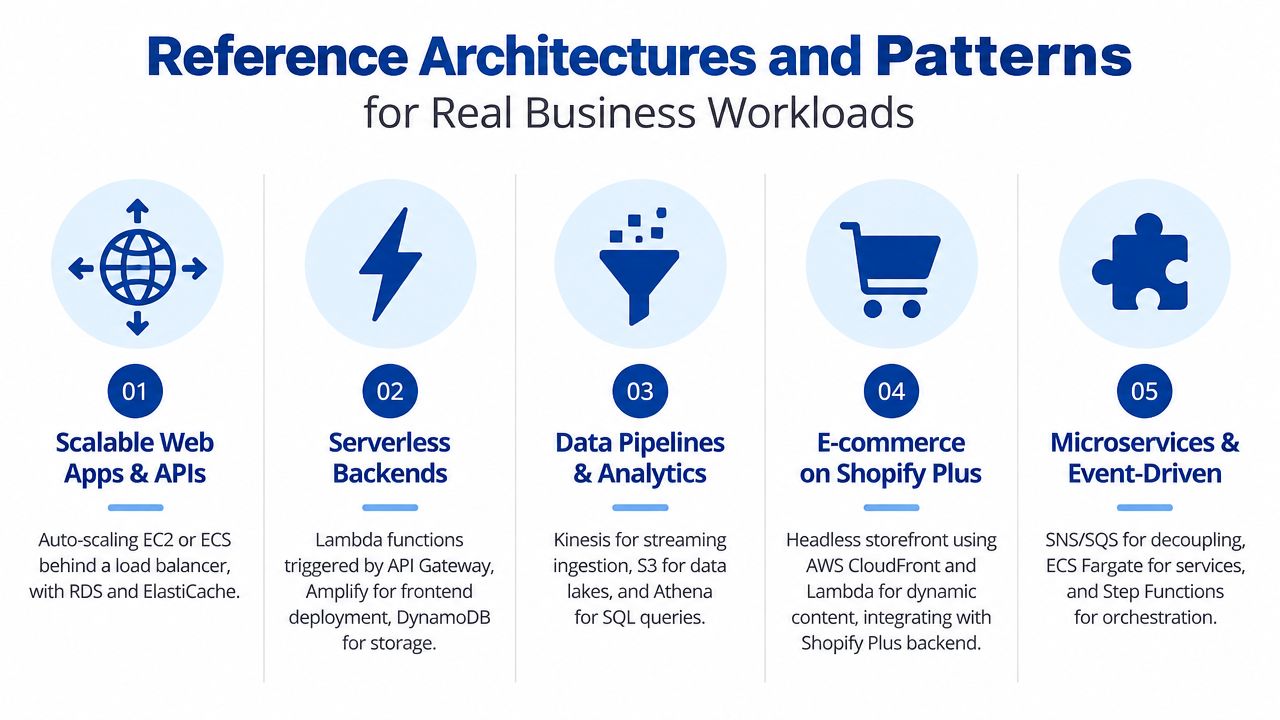
Scalable web applications and APIs commonly use an Application Load Balancer, EC2 or ECS, RDS and ElastiCache. This pattern suits a customer portal, membership service or transactional API that needs familiar runtime controls. Its advantages are broad ecosystem support and straightforward migration from existing applications. Its disadvantages include patching, capacity decisions and more responsibility for deployment operations.
Serverless backends combine API Gateway, Lambda, Amplify and DynamoDB. They fit event-driven workflows, mobile backends and workloads with variable demand. The model can reduce server administration, but teams must design around function boundaries, permissions, observability and service limits. It isn't automatically cheaper when inefficient queries, excessive invocations or poorly designed data access patterns remain unchecked.
Data pipelines and analytics can use Kinesis for streaming ingestion, S3 as a data lake and Athena for SQL queries. This is appropriate when operational systems need to feed reporting, compliance or forecasting without placing analytical load on the transactional database. Governance becomes the hard part. Data ownership, schema changes, retention and access policies need named owners.
Headless Shopify Plus commerce can place CloudFront and Lambda around a custom storefront while Shopify Plus remains the commerce backend. This works when a brand needs a custom experience but doesn't want to replace mature commerce capabilities. It introduces integration and cache invalidation complexity, so product, inventory, customer and order boundaries must be documented before build.
Microservices and event-driven platforms use SNS and SQS for decoupling, ECS Fargate for services and Step Functions for orchestration. This suits integration-heavy SaaS products and processes with independent release cycles. It can also become an expensive distributed system if a modular monolith would meet the same requirement with less operational overhead.
| Workload Scenario | Recommended Pattern | Key AWS Services | Best For | Watch Out For |
|---|---|---|---|---|
| Customer portal or API | Scalable web application | ALB, ECS or EC2, RDS, ElastiCache | Established applications with relational data | Server operations and capacity planning |
| Mobile backend | Serverless backend | API Gateway, Lambda, Amplify, DynamoDB | Variable demand and event-driven features | Permission sprawl and poor data modelling |
| Reporting platform | Data pipeline | Kinesis, S3, Athena | Operational analytics and data separation | Undefined ownership and weak governance |
| Custom commerce experience | Headless commerce | CloudFront, Lambda, Shopify Plus | Brand-led storefronts | Integration and cache consistency |
| Integration-heavy SaaS | Event-driven services | SNS, SQS, ECS Fargate, Step Functions | Decoupled workflows and independent services | Distributed tracing and message failure handling |
For a membership business, the architecture must also account for authentication, recurring payments, entitlements, CRM synchronisation and support workflows. A focused AWS hosting pattern for membership platforms is more useful than treating membership as a normal brochure website.
Planning Your Migration Without Disrupting Operations
A migration should be managed as a sequence of business risk decisions. The most dangerous plan is the one that lists servers but not dependencies, owners, rollback conditions or the point at which the old system can be retired.
Assess and mobilise before moving production
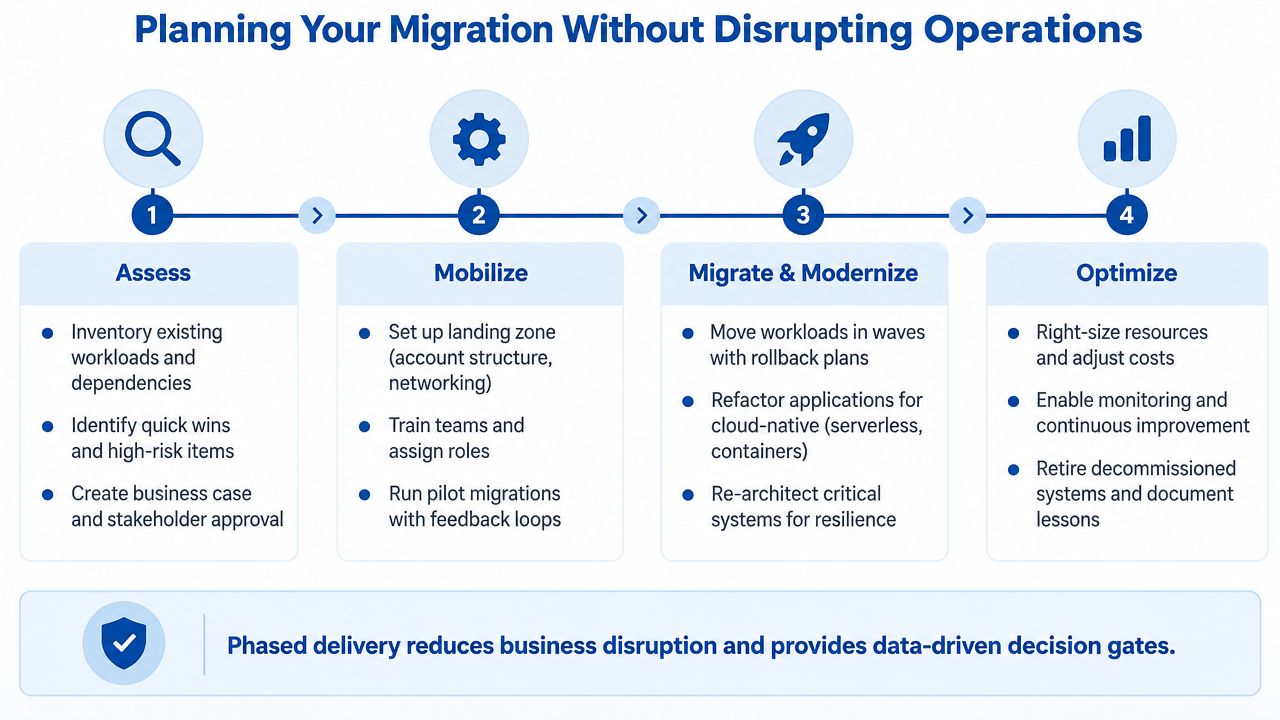
Assessment begins with an inventory of applications, databases, integrations, scheduled jobs, identities and data classifications. Interview operations staff, finance, customer support and application owners. They often know about manual exports, overnight processes and undocumented dependencies that discovery tools won't explain.
Use that inventory to separate quick wins from high-risk items. A low-dependency internal application may be a useful pilot, while a legacy system connected to payroll, CRM and reporting may need modernisation before cutover. The business case should include migration effort, temporary parallel operation, support coverage, data transfer, testing and the cost of leaving the old environment running.
Mobilisation establishes the landing zone. Set up account structure, networking, identity federation, logging, tagging, backup policy and deployment pipelines before production waves. Assign decision rights. If nobody owns DNS, data validation or rollback approval, the technical team will discover that gap during the cutover.
Migrate in waves, then optimise
A practical sequence usually looks like this:
- Pilot: Move a contained workload and record the operational lessons.
- Foundation wave: Establish shared services, connectivity and monitoring patterns.
- Application waves: Migrate according to dependency order, not organisational preference.
- Modernisation: Refactor components where the business case supports it.
- Cutover: Use rehearsed runbooks, validation checks and a rollback window.
- Optimisation: Right-size resources, retire duplicates and verify ownership.
Each phase carries different cost exposure. Assessment consumes specialist time before infrastructure spend begins. Mobilisation creates shared platform costs. Migration can temporarily require both old and new environments, while modernisation adds engineering effort before it reduces operational friction. Optimisation is where waste becomes visible, but it shouldn't be postponed until after the budget has been exhausted.
The common mistakes are predictable: starting with production, skipping dependency mapping, treating data validation as a user acceptance task, and assuming rollback means restoring a server snapshot. A rollback plan must define what happens to writes, integrations, queued messages and customer actions during the reversal.
A phased AWS cloud migration service should therefore produce decision gates, not just technical activity. At each gate, ask whether performance, data integrity, support readiness, security controls and cost assumptions have been evidenced.
Security Networking and Observability Done Right
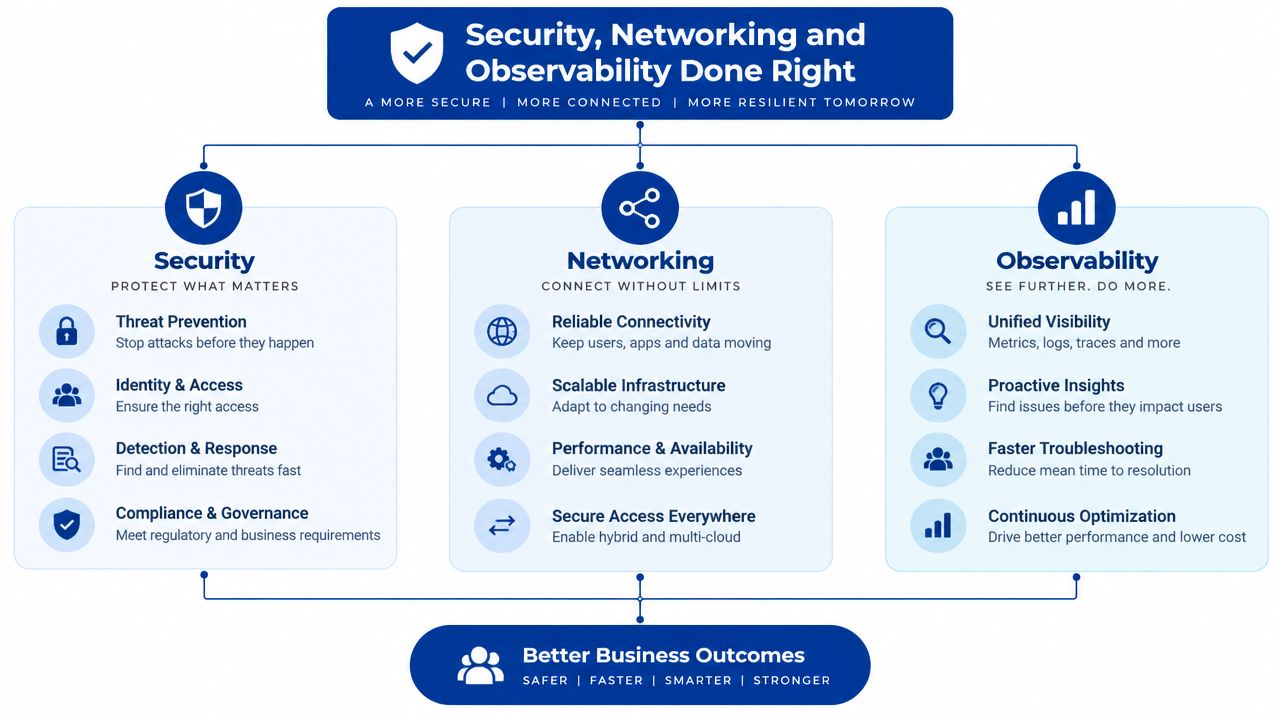
Production readiness depends on the interaction between security, networking and observability. A private subnet doesn't compensate for excessive IAM permissions. Encryption doesn't help an operations team that can't identify which deployment introduced an error. Monitoring without an incident process creates dashboards instead of control.
Start with boundaries and identity
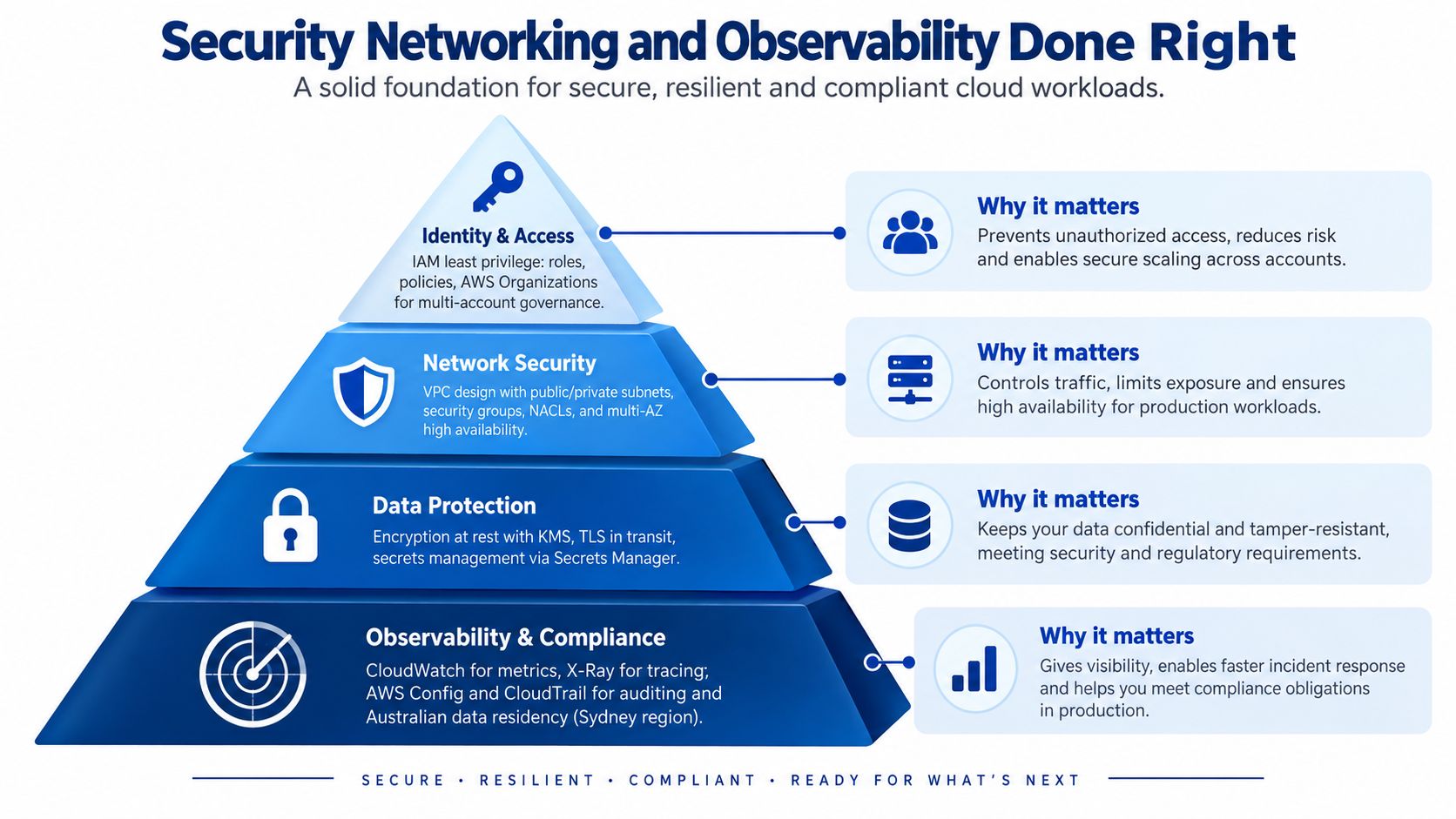
Use separate public and private network zones where the workload requires them. Keep databases and internal services away from direct public access, restrict traffic with security groups, and document routes between application tiers. Multi-AZ placement should support the actual failure model, including how sessions, queues and database connections behave when a component disappears.
IAM roles should grant the narrowest practical access to people, applications and deployment pipelines. Central account governance should make exceptions visible rather than allowing permanent administrator access. Secrets should live in a managed secrets store, and encryption keys should have ownership, rotation and recovery procedures.
AWS says Sydney gives Australian customers low-latency access to AWS infrastructure services, with Sydney edge infrastructure for Route 53 and CloudFront. The Melbourne Region adds another 3-AZ option, which can support performance, availability and regional flexibility decisions. AWS's Australia and New Zealand compliance guidance also describes Local Zones for applications needing single-digit millisecond latency to users or on-premises facilities.
Treat residency as an architecture choice
AWS states that customers can keep content in Australia by choosing the Sydney Region exclusively, and that AWS won't move or replicate content outside the chosen Region or Regions without customer agreement, except where required by law or a binding government order. AWS's Australian data privacy position should be read alongside your contracts, procurement conditions and regulatory obligations.
Residency isn't identical to sovereignty. Sovereign-cloud decisions also involve jurisdiction, operational control, procurement eligibility, service availability and the boundary between customer responsibilities and AWS responsibilities. The Digital Transformation Agency's hosting certification register is relevant to that discussion because it lists six providers meeting the whole-of-government bar, with AWS included. The architectural question is which workloads must remain strictly sovereign, which may use Australian regional services, and how the decision is documented for auditors.
Make telemetry actionable
CloudWatch should cover infrastructure and service health, while application tools such as Sentry and New Relic can help teams trace defects, regressions and user-facing failures. Logs need retention rules, access controls and useful correlation identifiers. Alerting should route to an accountable team with a runbook, not to an unattended inbox.
Operational test: if an engineer can't identify the affected customer journey, recent change and likely dependency from the available telemetry, the platform isn't observable enough.
Use the six Well-Architected pillars as an audit checklist. Review security and reliability first for critical services, then performance, cost, operations and sustainability. For a regulated or high-value platform, test failure scenarios rather than trusting the diagram.
Cost Optimisation and Infrastructure Performance Tuning
Cloud cost problems often start with an architecture decision that no one reviews. A team chooses an oversized EC2 instance to protect performance, leaves it running continuously, adds storage for convenience and treats data transfer as unavoidable. Finance then receives an invoice with little connection to customers, products or environments.
Sydney suits many Australian production workloads, but location affects more than residency. Melbourne may offer a better fit for latency, resilience or operational separation, while offshore regions can reduce some infrastructure costs at the expense of sovereignty and network performance. The decision should follow workload requirements, not a regional price comparison alone. Review instance families, deployment location and workload placement before approving a forecast.
Review the levers that affect the bill
- Right-size from evidence: Check utilisation, memory pressure, request volume and response time before reducing capacity.
- Use elasticity deliberately: Auto Scaling, ECS capacity controls and Lambda can match resources to demand. Set boundaries so a fault does not trigger uncontrolled scaling.
- Examine storage: Remove unattached volumes, define lifecycle policies and separate frequently accessed data from archives.
- Control transfer: Keep chatty services close together where practical. Measure cross-zone, cross-region and external transfer patterns.
- Tag ownership: Map every production resource to an application, environment and responsible team.
- Review managed-service settings: Databases, logs, snapshots and observability platforms can grow without an application deployment.
Graviton instances can reduce compute cost where application dependencies support the required architecture. The change still requires testing, build updates and performance validation. A lower unit price is poor value if it increases incidents or slows delivery.
Phased migration also changes the cost profile. Discovery, migration work, temporary parallel environments and post-cutover optimisation belong in the business case. The AWS migration cost guide for Australia provides a useful framework for assessing those categories instead of treating the AWS invoice as the project's full cost.
A useful review records the baseline, prioritised actions, owners and follow-up date. Separate permanent savings from temporary reductions, and test whether each change preserves service levels. For Sydney and Melbourne deployments, include replication, cross-region transfer and recovery requirements before declaring a regional move cheaper.
Next Steps and Implementation Checklist for Decision Makers
A sound AWS architecture decision should leave the business with evidence, ownership and an executable sequence. Before approving a migration or rebuild, ask the team to produce:
- Workload inventory: Applications, data stores, integrations, owners and dependencies.
- Region decision: Sydney, Melbourne, both, or an edge-aware design, with residency, latency and service-availability reasoning.
- Reference pattern: The selected architecture, rejected alternatives and the trade-offs behind the choice.
- Security baseline: Account structure, IAM roles, network boundaries, encryption, secrets and audit logging.
- Resilience plan: Availability Zone design, backups, recovery procedures, testing responsibilities and rollback conditions.
- Cost model: Resource assumptions, data transfer, temporary parallel environments, tagging and review cadence.
- Integration map: CRM, identity, payments, reporting, legacy systems and API ownership.
- Handover pack: Infrastructure as code, runbooks, diagrams, alerts, escalation paths and operational training.
Enterprises should prioritise governance, procurement evidence and integration sequencing. NGOs should focus on sustainable administration, clear ownership and avoiding unnecessary platform complexity. Startups should protect delivery speed by choosing managed services selectively and resisting microservices before independent scaling or team boundaries justify them.
Build versus buy should be decided by differentiation. Buy mature capabilities such as payments, identity or commerce where they meet the requirement. Build the workflows, integrations and customer experiences that create operational advantage, using APIs and documented interfaces to keep future options open.
Continuum Solutions provides AWS and Azure architecture advisory, phased migration delivery, custom applications, integrations, monitoring and structured handover through small senior teams. A partner is justified when internal teams need independent architecture review, migration control, legacy replacement planning or post-cutover governance, not another person to draw a diagram.
Prepare your application inventory, current hosting costs, compliance requirements, key integrations and preferred operational model before seeking proposals. Then measure success through agreed indicators such as service reliability, incident response, deployment confidence, data quality and explainable monthly spend.
Continuum Solutions can assess your AWS cloud architecture, design a Sydney or Melbourne deployment strategy, and plan a phased migration with security, integration, observability and cost controls included. Visit Continuum Solutions to discuss your current workloads and the next practical architecture decision.