
Most advice about choosing a Shopify Plus web design agency starts with the wrong question: which agency creates the most attractive storefront? In Australia, visual polish is only the entry point. The harder commercial problem is usually a mobile checkout that converts far below desktop, unreliable GA4 attribution, and integrations that corrupt customer, stock or order data.
Australia's Shopify market is substantial. A 2026 Australia-focused snapshot reports 152,323 active Shopify stores, including 3,653 Shopify Plus stores, with Plus representing 2.40% of the Australian Shopify base and sitting slightly above the global Plus density of 2.10% (Australian Shopify landscape data). The Plus tier is small compared with the broader ecosystem, but it carries more demanding requirements around architecture, operations and integration reliability.
Australian online retail spend reached A$82.6 billion in 2025, a 14% year-over-year increase, according to an AU online retail analysis drawing on Australia Post and NAB data (Australian online retail spend analysis). That growth makes specialist delivery valuable, but it also makes agency selection riskier. A generalist can produce a beautiful theme. A credible Shopify Plus partner must be able to protect revenue across checkout, analytics, data flows and post-launch operations.
Table of Contents
- What a Shopify Plus Web Design Agency Actually Does
- Defining Your Objectives Before You Brief an Agency
- Technical Requirements and Architecture Decisions
- Evaluating Shopify Plus Partners and Agencies
- Cost and Timeline Expectations for Australian Builds
- Onboarding and Phased Delivery in Practice
- Post-Launch Support, Measurement, and Common Mistakes
What a Shopify Plus Web Design Agency Actually Does
A standard Shopify design agency usually focuses on the storefront layer. It may customise a theme, create page templates, configure apps and hand over a functioning store. That can be perfectly adequate for a straightforward catalogue, but Shopify Plus work is a broader technology engagement, not merely a larger design project.
I look for six capabilities in a Plus engagement:
- Solution architecture: The agency maps commerce requirements, data ownership, integrations, markets, permissions and operational dependencies before anyone starts styling pages.
- Checkout engineering: The team understands checkout extensibility, payment flows, validation rules and the points where customisation can create friction.
- Workflow automation: Shopify Flow, Launchpad and other Plus capabilities should support promotions, launches, approvals and operational hand-offs rather than sit unused.
- B2B commerce: Wholesale catalogues, buyer permissions, company accounts and negotiated pricing require a different information architecture from direct-to-consumer retail.
- Multi-store planning: International or brand-specific storefronts need consistent governance, localisation and reporting without creating duplicated maintenance work.
- Integration ownership: Xero, HubSpot, Klaviyo, point-of-sale systems, 3PLs and ERPs need defined data contracts, error handling and monitoring.
Shopify's Australian pricing information lists fully customisable checkout, unlimited staff accounts, unlimited B2B catalogues, priority 24/7 phone support, and up to 200 POS Pro locations with Shopify Payments as Plus capabilities (Shopify Australia pricing). Those features only create value when the delivery team knows how they fit your operating model.
The qualification gap
A frequent mistake is treating a general Shopify Partner and a Shopify Plus specialist as interchangeable. Ask an agency to show recent work involving the Plus features your business needs, not merely a visually impressive storefront. A single Plus project completed years ago isn't enough evidence for a complex migration, B2B rollout or integration-heavy build.
The agency should also explain what it won't build. If the checkout is the bottleneck and a well-structured Online Store 2.0 theme can solve it, headless architecture may add cost without addressing the core issue. If your requirements extend into custom applications, API orchestration or operational automation, custom web development services may form part of the wider solution rather than treating the storefront as an isolated asset.
Practical rule: Buy Plus expertise for the operational complexity you have, not for the prestige of the platform tier.
Defining Your Objectives Before You Brief an Agency
The fastest way to lose control of a Plus project is to send an agency a mood board before agreeing on commercial outcomes. Your first document should be a concise decision brief that explains what must improve, what must remain stable and what the agency is explicitly not being asked to change.
Start with the current baseline. Record conversion rate, average order value, revenue by device, checkout completion, payment failures and the key acquisition channels. Australian ecommerce benchmarks place average conversion around 1.78% to 1.9%, with a defensible operating band of roughly 1.5% to 2.5%, while 3% or higher is considered strong (Australian ecommerce conversion benchmarks). Use these figures as context, not as a target copied into a contract.
The device split deserves special attention. One AU benchmark cites approximately 1.1% mobile conversion compared with 2.9% desktop conversion (Australian ecommerce conversion statistics). That gap tells me to investigate mobile navigation, product discovery, payment choice, form length, address entry and checkout latency before approving a wholesale visual redesign.
Write the brief around decisions
Include the following questions in the first version of the document:
- What commercial result matters: Is the priority mobile checkout completion, average order value, wholesale efficiency, international expansion or reduced manual processing?
- What must survive migration: List Xero, HubSpot, Klaviyo, POS, 3PL, ERP, PIM, subscriptions and customer service tools. For each, identify the data that must flow in both directions.
- What performance means locally: Define how you'll assess Core Web Vitals, time to first byte, checkout response and real-user performance in Australian conditions.
- What analytics must be trusted: Specify GA4 events, enhanced ecommerce coverage, consent handling, channel attribution and reconciliation with finance data.
- What isn't included: State non-goals such as a headless rebuild, a rebrand, a new ERP or an international rollout if those aren't required now.
The ACCC's Measuring Broadband Australia programme used SamKnows to measure actual web browsing performance on Australian broadband connections (ACCC web performance report). That supports a practical approach: test with real devices, Australian locations and representative network conditions rather than relying only on a developer's office connection.
An agency that asks about these baselines during the first serious conversation is showing useful judgement. An agency that jumps straight to fonts, animations and a headless recommendation hasn't understood the buying decision. For complex operational requirements, business IT consulting services can help frame the commerce project alongside the systems and governance decisions surrounding it.
Technical Requirements and Architecture Decisions
The first serious architecture decision is whether you need a headless storefront. I don't recommend headless because it sounds advanced. I recommend it only when the business can identify a requirement that a conventional Shopify theme can't meet efficiently.
A traditional Liquid theme built on Online Store 2.0 is usually the more disciplined choice for a catalogue-led retailer. It has a shorter path to launch, fewer moving parts and a lower ongoing engineering burden. If mobile checkout friction, app weight or poor merchandising is the main problem, a carefully engineered theme can address the commercial issue without introducing a separate frontend stack.
Headless becomes more defensible when the brand has unusually complex product detail pages, a large catalogue, demanding content experiences or a continuous experimentation programme. Hydrogen with Next.js can provide deeper frontend control, but it also requires frontend specialists, deployment governance, observability and a clear ownership model after launch. Treat the extra engineering as a long-term operating cost, not just a project line item.
Headless versus traditional architecture
| Dimension | Headless, Hydrogen and Next.js | Traditional, Liquid and Online Store 2.0 |
|---|---|---|
| Primary strength | Frontend control and custom experience design | Faster delivery and native Shopify alignment |
| Cost profile | Higher build and ongoing engineering cost | Lower complexity and easier maintenance |
| Launch path | More architecture, deployment and testing dependencies | More direct path from design to production |
| Team requirements | Frontend, backend, DevOps and integration capability | Shopify theme, UX, QA and integration capability |
| Best fit | Complex catalogues, unusual PDPs and intensive experimentation | Most conversion-led redesigns and standard commerce journeys |
| Main risk | Teams underestimate hosting, monitoring and release ownership | Teams over-customise the theme or overload it with apps |
The integration design matters more than the label. Define which system owns customers, inventory, orders, pricing and fulfilment status. Use documented APIs, idempotent jobs, retry handling and an operational queue for failures. A connector that works in a demonstration can still fail when an order is edited, a payment is declined or an ERP is unavailable.
Performance should be a budget, not a vague aspiration. Track JavaScript weight, third-party scripts, image behaviour, render-blocking resources, checkout latency and real-user results by device and region. If the store also needs broader application infrastructure, AWS hosting for membership platforms illustrates the kind of hosting and reliability discussion that should happen before a team commits to a decoupled build.
Evaluating Shopify Plus Partners and Agencies
Agency selection should be based on evidence that procurement can verify. A polished sales deck proves that an agency can present a polished sales deck. It doesn't prove that the team can recover a failed integration during a trading event or identify why GA4 revenue doesn't reconcile with Shopify.
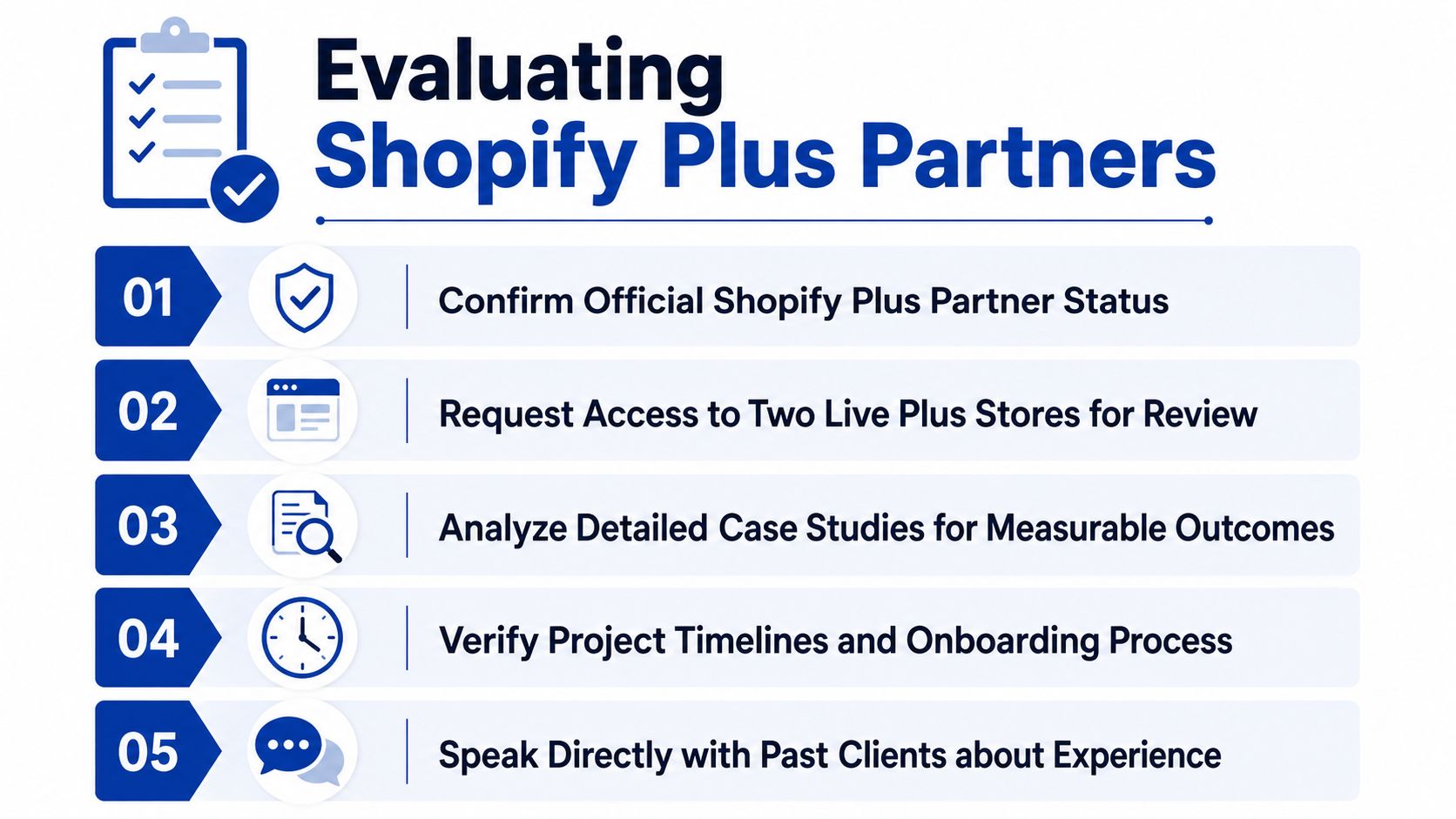
Use this checklist during due diligence:
- Confirm official status: Verify the agency's Shopify Plus Partner credentials through Shopify's own partner ecosystem, then ask which named team members hold relevant delivery responsibility.
- Inspect live stores: Request access to two live Plus stores the proposed team built. Review navigation, mobile behaviour, checkout flow, content management and signs of excessive app dependence.
- Interrogate case studies: Look for the merchant name, business context, scope, responsibilities, delivery constraints and measurable outcome. Anonymous screenshots aren't enough.
- Test senior access: Ask to meet the lead developer, technical architect and delivery lead before signing. If only sales staff attend, assume the delivery model will change.
- Check retention and support: Ask how many clients remain with the agency after launch, what the support queue looks like and who handles incidents outside normal project work.
The strongest procurement questions are specific:
- Which Plus-exclusive capabilities have you implemented in production?
- How do you approach checkout extensibility and Shopify Functions?
- How do you validate GA4 server-side tracking and enhanced ecommerce events?
- How do you monitor third-party integrations and replay failed jobs?
- What happens when a release causes a conversion or performance regression?
- Which work is performed by your employees, and which is subcontracted?
- What documentation and handover material will we own at launch?
Read the contract as an operating model
The proposal should identify environments, approval gates, QA responsibility, data migration ownership, incident escalation and post-launch support. It should also state what happens when Shopify changes an API, an app vendor alters behaviour or your internal team delays content.
An agency that can't explain its testing and incident process is a risk, even if its portfolio looks strong. Use documented case studies as a starting point, but validate claims directly with references and live systems.
Cost and Timeline Expectations for Australian Builds
Cost discussions need to separate platform fees, agency delivery and integration work. Shopify Plus in Australia starts at A$3,700 per month on a three-year term or A$4,000 per month on a one-year term, with higher-volume businesses potentially moving to a variable platform fee based on revenue and business model (Shopify Plus Australia pricing). That is the platform commitment before design, development, migration, analytics or support.
The supplied Australian project ranges below are useful as planning assumptions, not universal quotations. A proposal should explain its scope, dependencies and acceptance criteria rather than hide uncertainty behind a single fixed figure.
| Build type | Agency fee, AUD | Timeline | Best for |
|---|---|---|---|
| Focused Liquid redesign | A$60,000 to A$100,000 | 10 to 16 weeks | Established stores with contained UX and integration work |
| Complex Plus theme build | A$100,000 to A$250,000 | 10 to 16 weeks | Brands needing custom journeys, B2B features or substantial migration |
| Headless Hydrogen or Next.js | A$250,000 to above A$350,000 | 18 to 30 weeks | Complex frontend requirements, experimentation or multi-region delivery |
Integration-heavy projects require a separate allowance. The planning guidance for Australian Plus builds adds 15% to 25% for integrations involving Xero, HubSpot, Klaviyo, NetSuite or a PIM. Don't allow an agency to bury that work inside a generic “app setup” line. Integration mapping, transformation rules, monitoring, reconciliation and failure recovery are engineering deliverables.
Use milestones instead of hours
I prefer phased commercial gates:
- Discovery approval: requirements, architecture, risks and migration plan accepted.
- Design approval: design system, mobile journeys and content model accepted.
- Build approval: functional storefront and integration interfaces pass agreed tests.
- Migration approval: trial migration reconciles products, customers, orders and inventory.
- Launch approval: release checklist, rollback plan, monitoring and support roster confirmed.
- Hypercare review: production defects, analytics discrepancies and priority optimisation work documented.
A proposal below A$50,000 or shorter than eight weeks should trigger a scope review for a serious Plus migration, particularly when integrations and content migration are involved. If you need an incremental first release, MVP development services can support a deliberately bounded delivery, but the MVP must still protect checkout, data integrity and operational continuity.
Onboarding and Phased Delivery in Practice
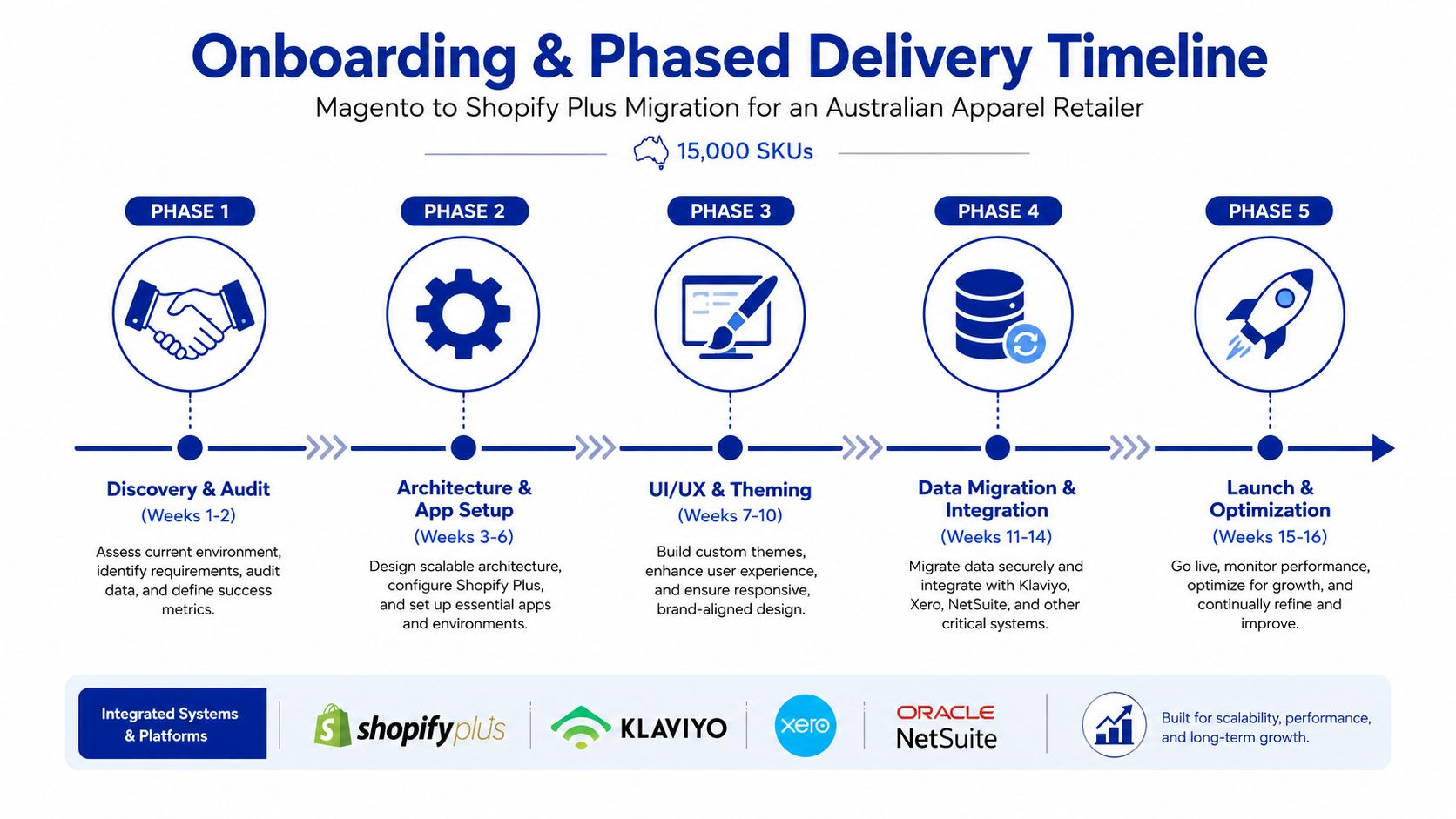
Consider a representative Australian apparel retailer moving from Magento to Shopify Plus. The retailer has 15,000 SKUs, Klaviyo for lifecycle communication, Xero for finance and NetSuite as its ERP. The project isn't a theme exercise. It is a controlled replacement of the storefront and several critical data flows.
The first two weeks are discovery and audit. I want the agency to produce a source-of-truth map, integration inventory, catalogue rules, customer migration approach, checkout requirements, redirect strategy, analytics plan and risk register. The retailer's operations team should confirm how stock, refunds, fulfilment status, discounts and customer accounts work before design begins.
Sequence the work around proof
Discovery and audit ends with an approved architecture decision, migration specification, analytics measurement plan and delivery backlog. The team should also identify data that won't migrate cleanly, such as obsolete variants, duplicate customer records or Magento-specific attributes.
Design system and UX follows with mobile-first journeys for collection, product detail, cart and checkout. The deliverables should include component rules, content requirements, accessibility decisions, responsive states and an explicit list of conversion hypotheses. Don't approve a design that only works in a presentation file.
Build and integration runs in two-week sprints. The agency creates the theme or frontend, configures Shopify Plus features, implements APIs and sets up observability. Each sprint should end with a demonstration against acceptance criteria, not a subjective statement that the work is “nearly done”.
Migration and QA requires trial imports and reconciliation. The QA team tests real devices, browsers, payment methods, discount combinations, refunds, stock changes, customer account states, fulfilment updates and failure scenarios. Third-party delays are managed through contract test data, mocks and a clearly documented cutover dependency list.
Launch with controlled exposure
The retailer should use a staging environment for functional and integration testing, then conduct a soft launch with internal or controlled traffic before the public release. The launch checklist should cover DNS ownership, redirects, payment configuration, analytics validation, customer service scripts, fulfilment monitoring, rollback decisions and named escalation contacts.
A short hypercare period gives the delivery team time to resolve defects while context is fresh. The project shouldn't end when the storefront becomes publicly accessible. It ends when the retailer can operate the new stack, reconcile orders and revenue, and make routine changes without depending on undocumented agency knowledge.
Post-Launch Support, Measurement, and Common Mistakes
Go-live is the start of the measurement period, not the end of the project. The first 90 days should have a defined support model, a baseline report and a prioritised optimisation backlog. Without those controls, teams often mistake normal launch noise for success or miss a small tracking defect that invalidates every later decision.
A credible agency should document its support model in operational terms:
- Service levels: State uptime expectations, severity definitions, response targets and escalation contacts.
- Observability: Monitor storefront errors, integration failures, checkout issues, third-party scripts and performance regressions.
- Release governance: Use staging, peer review, release notes and a rollback or remediation procedure.
- Optimisation capacity: Reserve time for mobile UX fixes, experiment implementation, content improvements and analytics corrections.
- Shopify coordination: Define how incidents are escalated through your Shopify Plus Merchant Success Manager and other platform contacts.
The measurement stack needs more than a GA4 property installed in the theme. Validate enhanced ecommerce events, checkout steps, purchase revenue, refunds, consent handling and the relationship between Shopify, GA4, Klaviyo, Meta, Google and finance systems. Server-side tracking may be appropriate for parts of the architecture, but it still needs reconciliation against an agreed source of truth.
Mistakes that keep recurring
Launching without a mobile checkout audit leaves the largest conversion opportunity untouched when desktop performance masks mobile friction. Benchmark by device, browser, payment method and customer type rather than relying on an overall average.
Adding heavy apps without a performance budget creates JavaScript and rendering problems that a visual redesign can't fix. Review every app's purpose, loading behaviour, data access and removal plan before it reaches production.
Treating consent mode as optional undermines attribution and creates governance risk. Document the consent experience, test regional behaviour and make sure analytics events respect the organisation's privacy requirements.
Using Plus scripts as fire-and-forget customisations creates fragile dependencies. Record ownership, test triggers, monitor failures and review scripts whenever checkout or operational workflows change.
Run structured reviews at 30, 60 and 90 days. The first review should catch launch defects and tracking discrepancies. The second should examine integration drift, mobile friction and performance trends. The third should decide which experiments, application changes or architecture improvements deserve investment.
Continuum Solutions works across Shopify Plus development, cloud infrastructure, custom applications, API integrations, monitoring and GA4 implementation. If your commerce project needs more than a storefront refresh, visit Continuum Solutions to discuss the architecture, integration and measurement work that should be resolved before you appoint a delivery partner.