
You're probably looking at an app proposal that promises a fast launch, a modern framework and a clean interface. The difficult questions sit underneath: who owns the architecture, how will the app behave on unreliable mobile networks, what happens when your CRM changes, and who fixes production defects after launch?
That's why mobile app development in Melbourne should be treated as an operational decision, not a technology shopping exercise. The right partner must connect product scope, cloud architecture, integrations, accessibility, privacy, quality assurance and long-term support into one delivery model.
Table of Contents
- Why Choosing a Melbourne App Partner Is an Operational Decision
- Discovery and Scoping Before You Talk to Vendors
- Native, React Native, Flutter or PWA
- Cloud, Backend and Integration Architecture
- QA, Performance and Observability as Release Criteria
- Accessibility and Privacy as Competitive Advantages
- Evaluating Vendors, Cost Benchmarks and Next Steps
Why Choosing a Melbourne App Partner Is an Operational Decision
A Melbourne CTO rarely chooses an app partner in isolation. The app may need to authenticate members, update Salesforce, trigger Shopify Plus orders, expose data from Xero, support field workers, or give an NGO's users reliable access to essential services. A framework decision made without understanding those dependencies can create years of avoidable cost.
Australia's mobile audience is already mature. In 2025, 98% of Australian adults used a mobile phone for calls and 96% used one for SMS during the previous six months, while 83% used at least one messaging, voice-call or video-call app. Among metropolitan users, app-based communication reached 88%, up from 85% in 2024, according to the ACMA communication findings. Your users already understand mobile products. They'll judge yours against the reliability, accessibility and speed of the apps they use every day.
My practical rule: choose the delivery system before you choose the framework.
Four questions should guide the decision:
- Can the partner define a measurable business outcome? An internal operations app might need to reduce manual re-entry. A member app might need to improve service access. A startup product might need to validate a revenue model.
- Can the proposed architecture survive real operating conditions? That includes mobile network variability, device diversity, identity management, backend failures and third-party outages.
- Can the commercial model handle change without hiding risk? A low initial quote means little if scope gaps, integration work and post-launch support appear later.
- Can your organisation operate the product after handover? You need documentation, monitoring, deployment access, ownership of source code and a support arrangement that matches business criticality.
Victoria's technology economy provides a substantial local context. The Victorian Government reported that the ICT sector contributed $34.1 billion to the state economy in financial year 2022–23, equal to 5% of Victorian value added in its Digital Technology Sector factsheet. Melbourne app projects therefore belong in a wider technology estate, not in a disposable prototype category.
Discovery and Scoping Before You Talk to Vendors
Don't start by asking three vendors for a quote on “an app for customers”. Start with a short internal decision document that defines what the app must change operationally.
Define the outcome and the users
Write one primary outcome in business terms. For example, a membership organisation might need users to renew without calling support, while a field-service business might need technicians to capture job information once, at the point of work.
Then identify the highest-value journeys. Avoid listing every feature anyone has mentioned. Select the journeys that justify the investment, describe who performs them, and record the systems involved. Include representative Australian users in the process, particularly where the audience includes older people, people with disability, regional users or people on constrained data plans.
Turn assumptions into acceptance criteria
Baseline the requirements before vendors price the work. Separate essential functionality from useful enhancements and future ideas, then place everything in a prioritised backlog. Each release should have signed acceptance criteria, an owner and a clear definition of what will be measured after deployment.
Australian research covering 400 projects identified requirements management and customer or user involvement as strong success factors. A requirements-and-management model correctly classified 83% of projects overall, including 93% of successful projects, while lack of user involvement, unstable requirements and weak project management appeared as recurring causes of troubled delivery. The findings are documented in this Australian project success research.
A workable discovery pack should contain:
- Outcome statement: What business result must improve, and how will the team observe it?
- Journey map: Which user actions create value, and where do users currently abandon or need staff assistance?
- System map: Which CRM, ecommerce, finance, identity and data services must exchange information?
- Prioritised backlog: What belongs in the first release, and what is explicitly excluded?
- Acceptance criteria: What must work on iOS, Android, web and constrained networks before approval?
- Measurement plan: Which product, operational, accessibility and reliability signals will be compared with the original business case?
Use this document to compare proposals, not just prices. Ask each vendor to identify assumptions, dependencies, risks and exclusions. If one proposal is cheaper because it ignores authentication, migration, analytics quality or release support, you're not comparing equivalent offers.
A fixed schedule also doesn't prove delivery confidence. The same Australian research found good schedule estimation in 60% of successful projects and 40% of failed projects, so track scope, risk and expected benefits alongside dates. A disciplined MVP development process should produce a thin release that can be tested with real users before the organisation commits to the entire product vision.
Native, React Native, Flutter or PWA
There's no universal winner. The correct choice depends on how much platform-specific behaviour you need, how quickly you must validate the product, and whether your team can support the codebase after the initial supplier engagement.
| Approach | Where it fits | Main advantage | Main disadvantage |
|---|---|---|---|
| Native iOS and Android | High-performance products with deep device integration | Maximum platform control | Two codebases and higher maintenance overhead |
| React Native | Teams with strong JavaScript capability and AWS Lambda services | Reuses much of the application layer across platforms | Native modules and upgrades still require specialist knowledge |
| Flutter | Design-heavy cross-platform products with a controlled product surface | Consistent UI from one primary codebase | Teams must assess ecosystem maturity and long-term ownership |
| PWA | Content-led, membership and service journeys | Browser access, simpler distribution and one web delivery path | Limited access to some device capabilities and platform behaviours |
Native development
Choose native Swift and Kotlin development when the product relies on advanced camera functions, Bluetooth, background processing, specialist accessibility behaviour or demanding animation. Native apps give engineers the clearest access to iOS and Android APIs, but you'll fund two implementation paths and need testing across both.
Native is also sensible when the app itself is a strategic differentiator and the business can support a larger engineering operation. It's a poor choice for a straightforward member portal that mainly displays content, accepts forms and calls existing APIs.
React Native
React Native suits organisations that already employ JavaScript engineers, use React elsewhere, or plan to connect the app to AWS Lambda and API services. It can shorten delivery by sharing application logic, but it isn't a way to avoid native expertise altogether. Platform permissions, push notifications, app-store changes and device-specific defects still need experienced engineers.
Flutter
Flutter is a strong candidate for a visually controlled iOS and Android product, particularly where the organisation wants a consistent experience and a small senior team. Evaluate the delivery partner's testing discipline, native integration capability and handover quality rather than accepting “single codebase” as a complete cost analysis. The practical trade-offs are set out in this Flutter and React Native comparison.
Progressive Web Apps
A PWA often wins for content-led services, membership experiences, internal workflows and products that benefit from a link-based onboarding path. It can reduce distribution friction and work across desktop, tablet and mobile, but it won't replace native development where you need deep device integration, intensive background processing or platform-specific interaction.
For three-year ownership, compare more than initial build effort. Include framework upgrades, device regression testing, app-store operations, observability, security patches, backend changes, analytics maintenance and the cost of finding engineers who can take over. A framework that launches quickly but leaves your team dependent on one supplier isn't cheap.
Fit test: if the core journey is forms, identity, content and API calls, assess a PWA first. If visual consistency matters across iOS and Android, assess Flutter. If your organisation already has JavaScript capability and AWS Lambda patterns, assess React Native. If the product depends on deep device behaviour, choose native.
Cloud, Backend and Integration Architecture
The visible app is only the client. The operational product is the combination of identity, APIs, databases, queues, integrations, monitoring, deployment controls and data governance behind it.
AWS and Azure can both support a sound Melbourne delivery. I'd start with existing capability rather than brand preference. An organisation with established Azure commitments, Microsoft identity and internal Azure operations may reduce risk by using Azure Functions and API Management. A team already running AWS services may prefer AWS Amplify, Lambda, managed databases and event-driven integrations. Confirm data residency, support responsibilities, security controls and any relevant NGO discount programmes before finalising the platform.
Design the backend around mobile behaviour
Mobile APIs should be resilient when connectivity disappears between a user's tap and the server response. Don't make the interface wait on a chain of synchronous calls to the CRM, finance system and notification provider. Return useful states, queue work that doesn't need an immediate response, cache non-sensitive data and give the client clear retry behaviour.
REST APIs should use consistent authentication, validation, error responses, pagination and versioning. Authentication can use native identity services or a platform such as MiniOrange where the organisation needs to connect existing identity sources. The decision should cover token expiry, account recovery, multi-factor authentication, role changes and offboarding, not just the login screen.
Integrate systems without copying everything
A member app connected to a membership platform should have a clear system of record. A Shopify Plus customer account shouldn't become a second customer database inside the app without a reason. Salesforce, HubSpot, Shopify Plus, Xero and membership platforms each have different data models and operational rules, so define ownership for every important field.
For a membership platform, the AWS hosting approach for membership platforms should be assessed against authentication, renewal transactions, content access, integration events, support load and data retention.
Buyer checks for a backend proposal
Ask the vendor to show:
- Data ownership: Which system owns each customer, member, order and payment record?
- Failure behaviour: What does the user see when an external API is unavailable?
- Security design: Where are secrets stored, and how are access rights reviewed?
- Operational access: Who can deploy, inspect logs, rotate credentials and restore data?
- Integration testing: How will changes in Salesforce, HubSpot, Shopify Plus or Xero be detected?
- Exit plan: Can another team understand and operate the APIs, infrastructure and release process?
A backend proposal that only shows a database and a few endpoints isn't an architecture. It's an unfinished risk register.
QA, Performance and Observability as Release Criteria
Reliability must be proven before release. It shouldn't be treated as a support ticket category after customers have already adopted the app.
Australia's mobile usage supports that standard. The ACMA reported that 97% of Australians used a mobile phone to access the internet, while 91% of adults accessed the internet through a mobile phone multiple times each day. App use for government services reached 75%, compared with 71% in 2024, according to the ACMA internet usage findings. For service, member and field-workforce apps, downtime can block an important task rather than merely inconvenience a casual user.
Build a device and network matrix
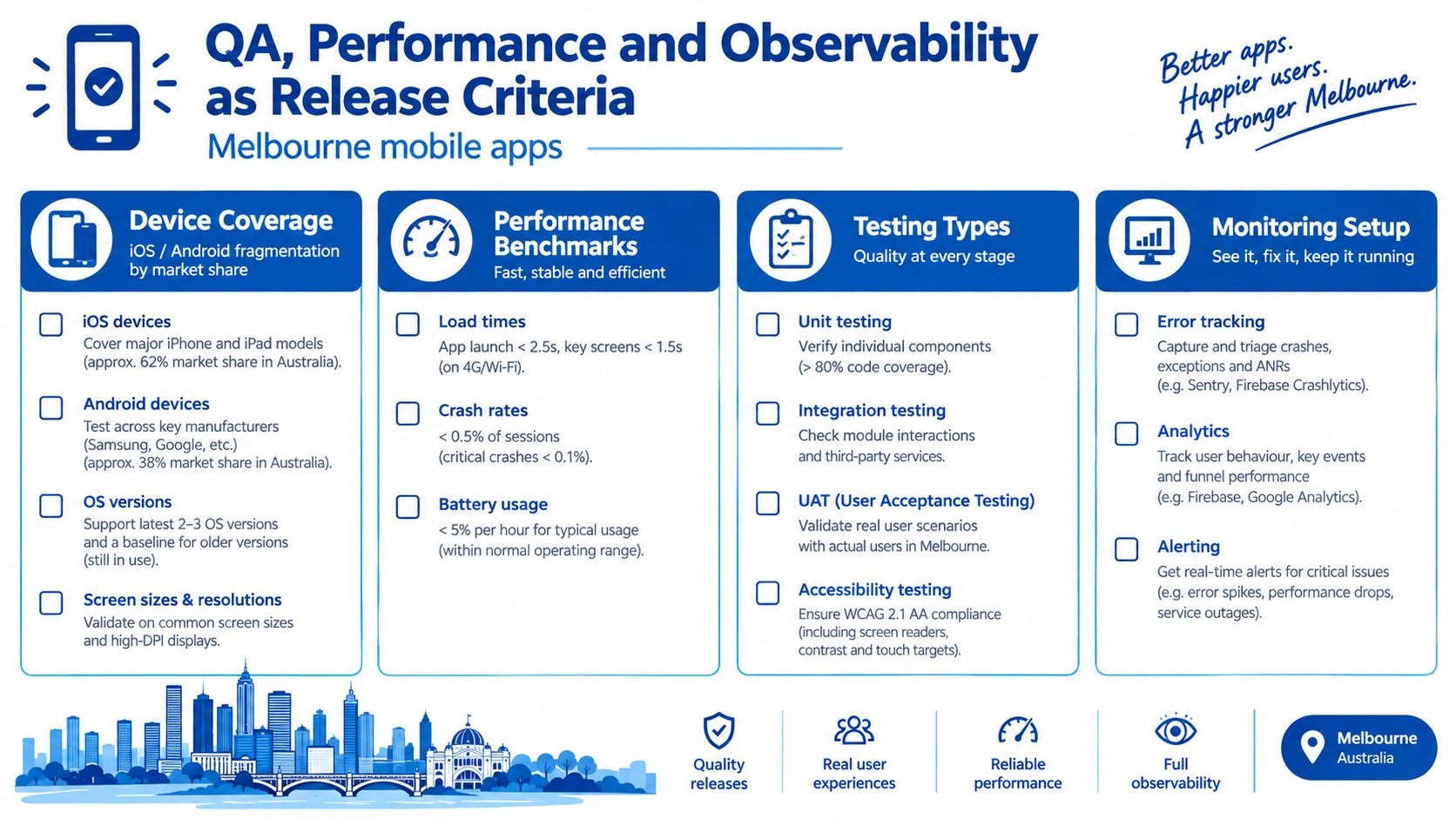
Use analytics to identify the devices and operating systems your audience uses. Test both ecosystems. StatCounter recorded iOS at 62.59% and Android at 37.4% of mobile operating-system usage in Australia for September 2026, as shown in its Australia mobile operating-system figures. Treat those figures as usage-based prioritisation, not a reason to abandon Android.
Test the highest-value journeys on real devices and under throttled 4G and rural-like conditions. Fast office Wi-Fi hides DNS delays, API timeouts, image-heavy screens and retry defects that users encounter elsewhere.
Track, at minimum:
- Cold start time: How quickly the first useful screen becomes available.
- Transition latency: Whether key screens respond promptly after a tap.
- API failure rate: Which endpoints fail, time out or return malformed data.
- Crash-free sessions: Whether a release introduces device-specific instability.
- Battery impact: Whether background work drains the device unnecessarily.
- Conversion and task completion: Whether performance affects the business journey.
Australian user-focused guidance recommends perceived loading below two seconds, reports that a one-second delay can reduce conversions by 7%, and notes that roughly 30% of users may encounter slow connections during peak periods. These figures and the related testing recommendations appear in the Australian mobile performance guidance.
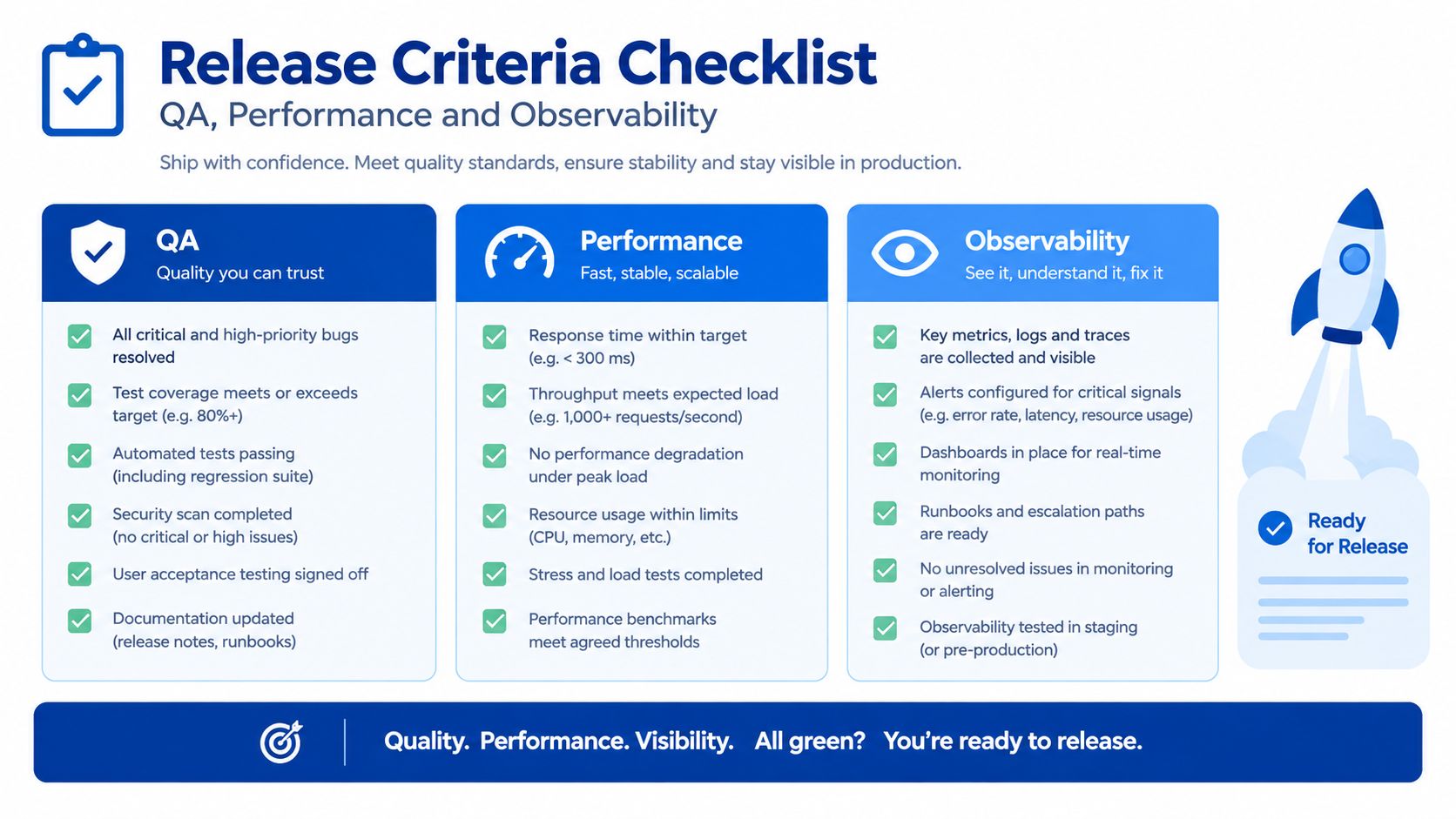
Instrument the release, not just the application
Use Sentry for client-side crashes, breadcrumbs and release tracking. Use New Relic to examine backend latency, dependency failures and service behaviour. Connect both to deployment versions so the team can compare a staged release with the production baseline.
Set rollback thresholds before deployment. A release should pause or reverse when crash behaviour, API failures, latency or critical task completion moves outside the agreed tolerance. Validate analytics events as part of QA, because an elegant dashboard built on missing or duplicated events creates false confidence.
The enterprise application monitoring and debugging process should include accessibility checks, integration tests, user acceptance testing and production alerts. Don't approve a build because it passed on a flagship phone in the office. Approve it because representative users can complete the important journeys under the conditions they face in reality.
Accessibility and Privacy as Competitive Advantages
Accessibility isn't a final compliance pass. It changes product reach, support demand, task completion and the quality of your operational data.
The 2025 Australian Digital Inclusion Index found that people with disability scored 11.4 points below people without disability, and 14.3% of people with disability relied solely on mobile access. Nationally, 20.6% of Australians were classified as excluded or highly excluded, while 9.7% had access only to a mobile connection, according to the 2025 Digital Inclusion Index findings.
That makes mobile-only and low-bandwidth design core infrastructure for some users. For an NGO, public service or member organisation, an app that assumes a new device, unlimited data and perfect vision is not merely inconvenient. It can exclude the people the service exists to support.
Test inclusion as a product requirement
Put representative users into usability testing before the backlog is locked. Test screen readers, text scaling, captions, colour contrast, keyboard alternatives, touch target size, error recovery and older devices. Test prepaid and low-data plans, not just the development team's broadband and current handsets.
Choose the delivery model around resilience:
- A native app may provide the deepest control over platform accessibility APIs.
- A cross-platform app can work well when the team validates accessibility on both operating systems rather than assuming parity.
- A PWA can remove installation friction and provide a useful browser fallback, particularly for content and service journeys.
Collect less, measure better
Privacy-by-design also improves operational discipline. Ninety per cent of Australians take steps to reinforce online privacy and data security, according to the Digital Lives of Australians 2025 report. ACCC consumer research recorded 65% concern about privacy of information in relation to generative AI and 65% concern about misuse by scammers, as reported in the same verified findings.
The Office of the Australian Information Commissioner recommends short, preferably single-screen notices explaining what information will be collected and whether it will be shared with third parties. Its mobile privacy guidance also recommends in-context disclosure, avoiding movement and activity data unless it directly relates to the app and the user has provided informed consent, and express consent before collecting sensitive information.
That guidance affects information architecture. Permission prompts need to appear when the user understands the feature, consent withdrawal must work across iOS and Android, and operational telemetry should remain separate from marketing attribution. Don't collect contacts, location or behavioural events because a vendor's analytics template includes them. Define the decision each event supports, the retention period, the deletion process and the vendor access controls.
Privacy is a measurement discipline: a smaller dataset with clear consent is easier to explain, govern and trust than a large dataset nobody can defend.
Evaluating Vendors, Cost Benchmarks and Next Steps
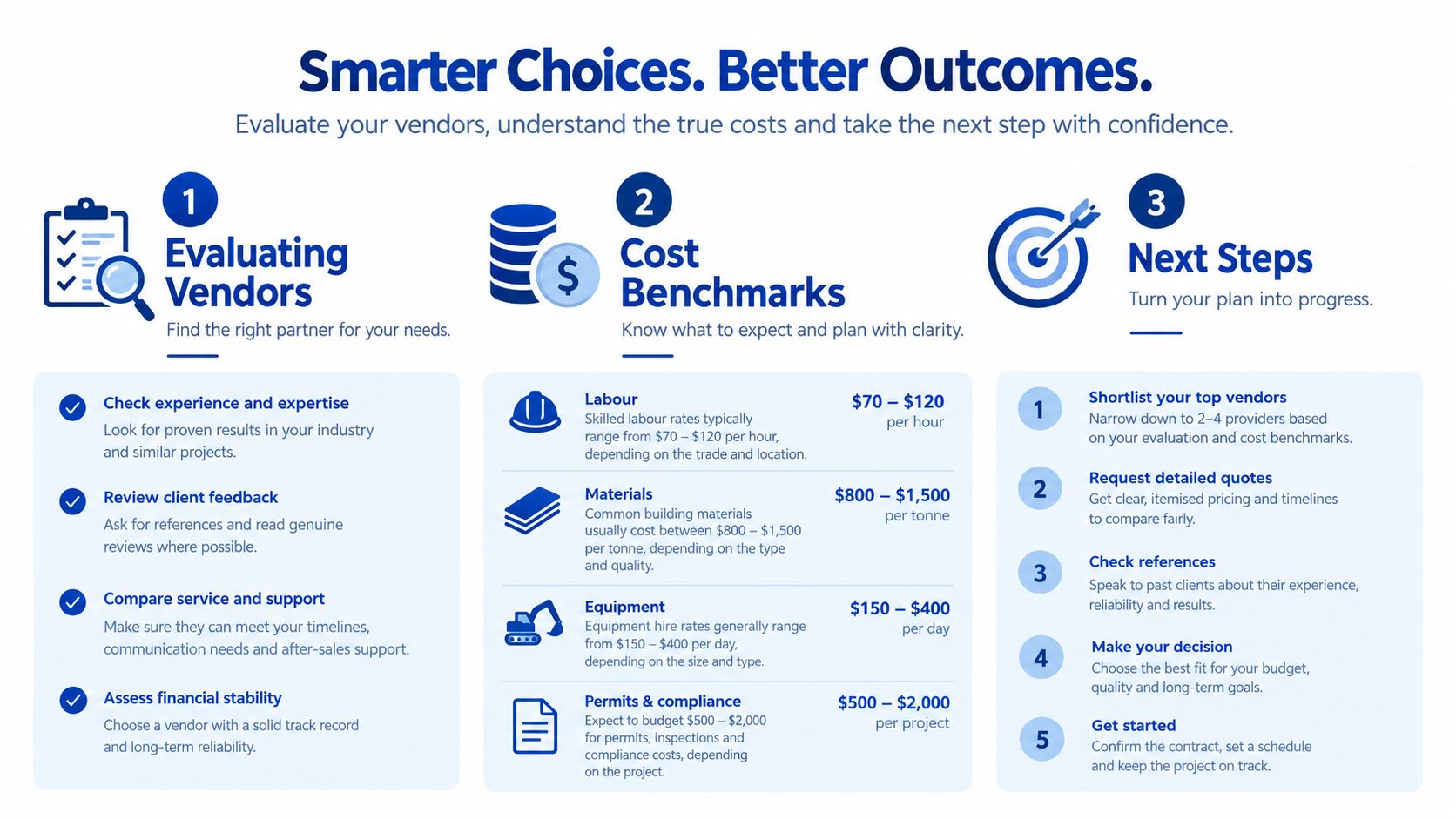
A credible vendor proposal should make risk visible. It should tell you what the team will build, what it won't build, how integrations will behave when they fail, how quality will be demonstrated and who will operate the product after handover.
Ask questions that expose delivery quality
Put these questions to every shortlisted partner:
- Delivery model: Who owns product decisions, backlog changes and release acceptance?
- Engineering team: Which work is performed in-house, and who will write and review the code?
- Credentials: What AWS, Azure or platform expertise supports the proposed architecture?
- Testing: Which real devices, operating systems, networks and accessibility scenarios are included?
- Security and privacy: How are consent, secrets, encryption, retention and access reviews handled?
- Support: What happens after release, and what response model applies to a production incident?
- Handover: Will you receive source code, infrastructure definitions, API documentation, runbooks and analytics specifications?
- References: Can you speak with a client whose integrations and operational constraints resemble yours?
Don't accept a portfolio of attractive screenshots as proof of delivery capability. Ask to see a release checklist, sample acceptance criteria, monitoring views and an example of how the supplier handled a scope change.
Treat cost as a range of decisions
The supplied evidence doesn't establish reliable Melbourne price benchmarks for discovery, MVPs, full releases or maintenance. Any vendor that gives you a precise figure before understanding users, integrations, security and support is expressing confidence, not providing a dependable estimate.
Use a cost model that separates:
- Discovery: user research, journey mapping, requirements, architecture and release planning.
- MVP delivery: the smallest production-capable product that tests the business outcome.
- First full release: additional roles, integrations, accessibility coverage, analytics, security hardening and operational tooling.
- Run costs: cloud services, third-party APIs, app-store operations, support, monitoring, security updates and future platform changes.
A fixed-bid model works when acceptance criteria are stable and the boundaries are well understood. Time and materials suits discovery and evolving product work, provided the supplier gives transparent burn reporting and backlog control. A hybrid model is usually more practical, with fixed discovery and gated releases followed by a controlled enhancement backlog.
Run the next two weeks properly
- Write the scope document: outcomes, users, journeys, integrations, exclusions and acceptance criteria.
- Shortlist partners: select vendors with relevant cloud, mobile and integration experience.
- Use a weighted scorecard: score architecture, delivery discipline, accessibility, privacy, QA, support and commercial clarity.
- Check references: ask about defects, scope changes, handover and post-launch responsiveness.
- Review the architecture: confirm identity, data ownership, failure behaviour, observability and rollback.
- Document handover before signing: define access, repositories, infrastructure, runbooks, dashboards and ownership.
Continuum Solutions is an AWS Partner, Azure Partner, Shopify Plus Partner and WP Engine Partner, with 50+ shipped projects and 90% client retention across corporate, NGO and nonprofit sectors. Its delivery approach uses small senior teams, phased releases and measurable performance baselines, with cross-platform work supported by tools such as Sentry and New Relic. You can assess its Melbourne app development services against the same criteria you apply to every shortlisted partner.
If you're planning an app in Melbourne, Continuum Solutions can help define the MVP, select the right delivery model, connect AWS or Azure services with your existing systems, and establish real-device QA and observability before release. Bring your current requirements, integration list or vendor proposal, and use the first conversation to expose the operational risks before they become build costs.