
Choosing a mobile application development company by its portfolio and headline quote is poor procurement advice. Attractive screens don't prove that a membership renewal survives a dropped connection, a payment reaches the correct account, or someone responds when the app fails after launch.
I would judge vendors on what they'll commit to in writing: a comparable scope, demonstrable task completion, transparent integration assumptions and enforceable post-launch responsibilities. For an Australian buyer, the commercial decision isn't who can build the app. It's who can deliver and operate the service without leaving your team dependent on undocumented systems.
Table of Contents
- Scope the Brief Before Vendors Quote
- Choose Native Flutter React Native or Web
- Set Requirements by Buyer Type
- Score Vendors and Write the RFP Questions
- Match the Engagement Model and Price the Extras
- Put Handover and Support in the Contract
Scope the Brief Before Vendors Quote
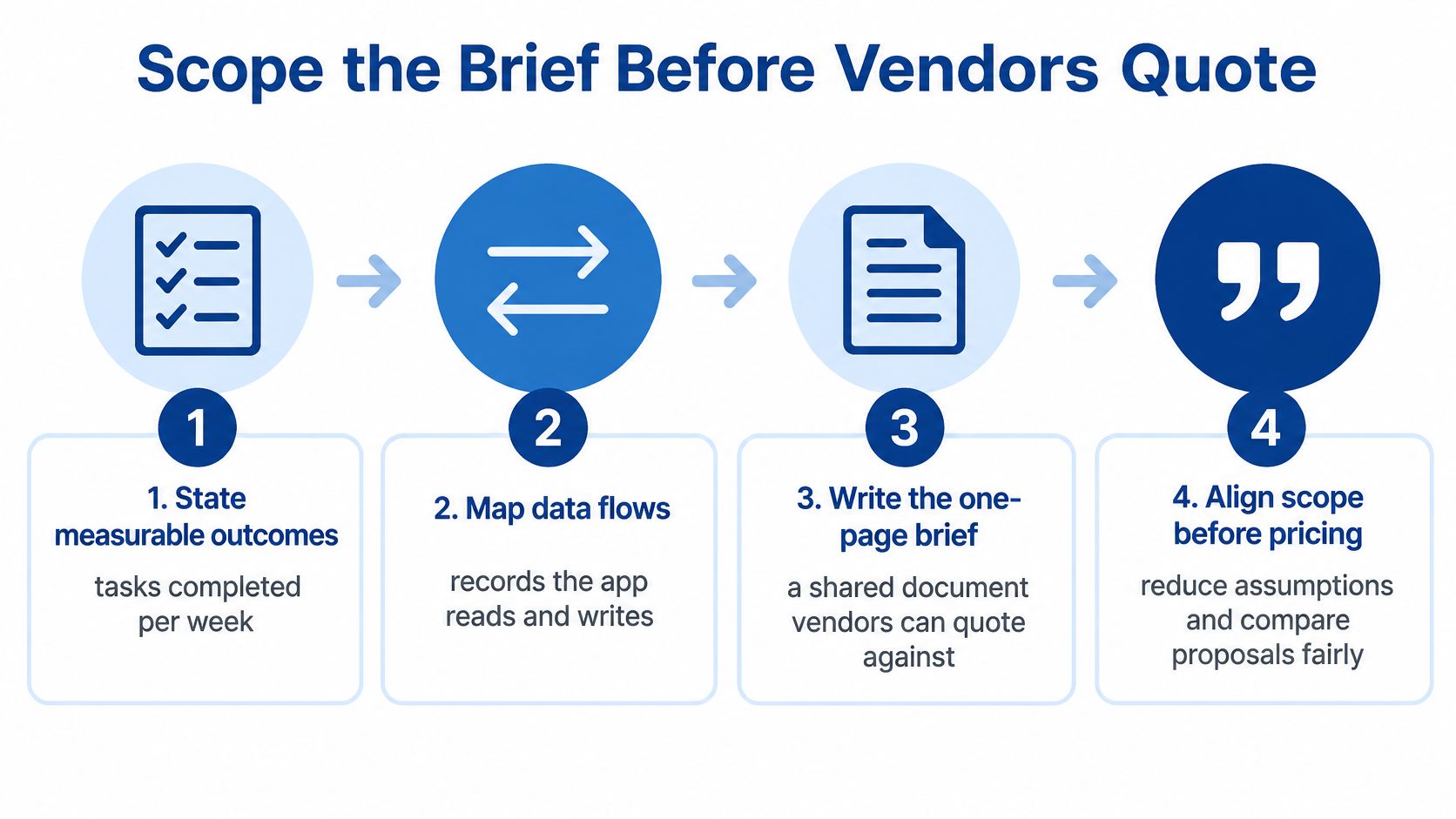
Write a one-page brief before requesting proposals. You don't need finished designs or a complete technical specification. You need enough shared information for vendors to price the same problem rather than make different assumptions.
Start with the business task. For a membership organisation, that might be renewing membership without staff re-entering payment details into the CRM. State the baseline, the desired tasks completed per week and who owns the outcome.
Give every vendor the same starting point
- Outcomes and acceptance: Choose three acceptance metrics, such as successful task completion, crash-free sessions and time to finish the main journey. Set targets against your operational needs, not a vendor's convenient benchmark.
- Data flows: Name the records the app reads and writes, their source systems and the destination of each update. Include the CRM, identity provider and payment service.
- Permissions and dependencies: List authentication, permissions, local storage, APIs and third-party software development kits, or SDKs. Assign each a purpose and flag unknowns for discovery.
- Device coverage: Specify current iOS and Android versions, plus at least one older handset. Identify any devices already used by staff or members.
The Australian Government's app-security discussion paper identifies that developers aren't currently required by Australian law to implement specific cybersecurity standards, while users generally can't assess how apps secure, store or share their data. Treat security evidence as a delivery requirement, not something implied by a polished interface.
Make delivery gates vendor commitments
Require six gates in the proposal: signed-off outcomes and data flows; a threat model before design; a working vertical slice; testing against the device matrix; progressive release with monitoring; and documented handover followed by a post-release security review.
A vertical slice is a complete narrow journey, such as login through membership renewal to payment confirmation and CRM update. Require representative real data under controlled access, not production records copied casually into a developer's laptop.
Monitoring should capture crashes, latency, adoption and retention from the first build. Dependency review, privacy transparency and incident-response ownership should also have named acceptance evidence.
Procurement rule: You shouldn't have to build the product to obtain a quote. You should have to describe the outcome and expose the uncertainties.
For an initial release, MVP development should narrow the business journey without removing the controls needed to operate it safely.
Choose Native Flutter React Native or Web
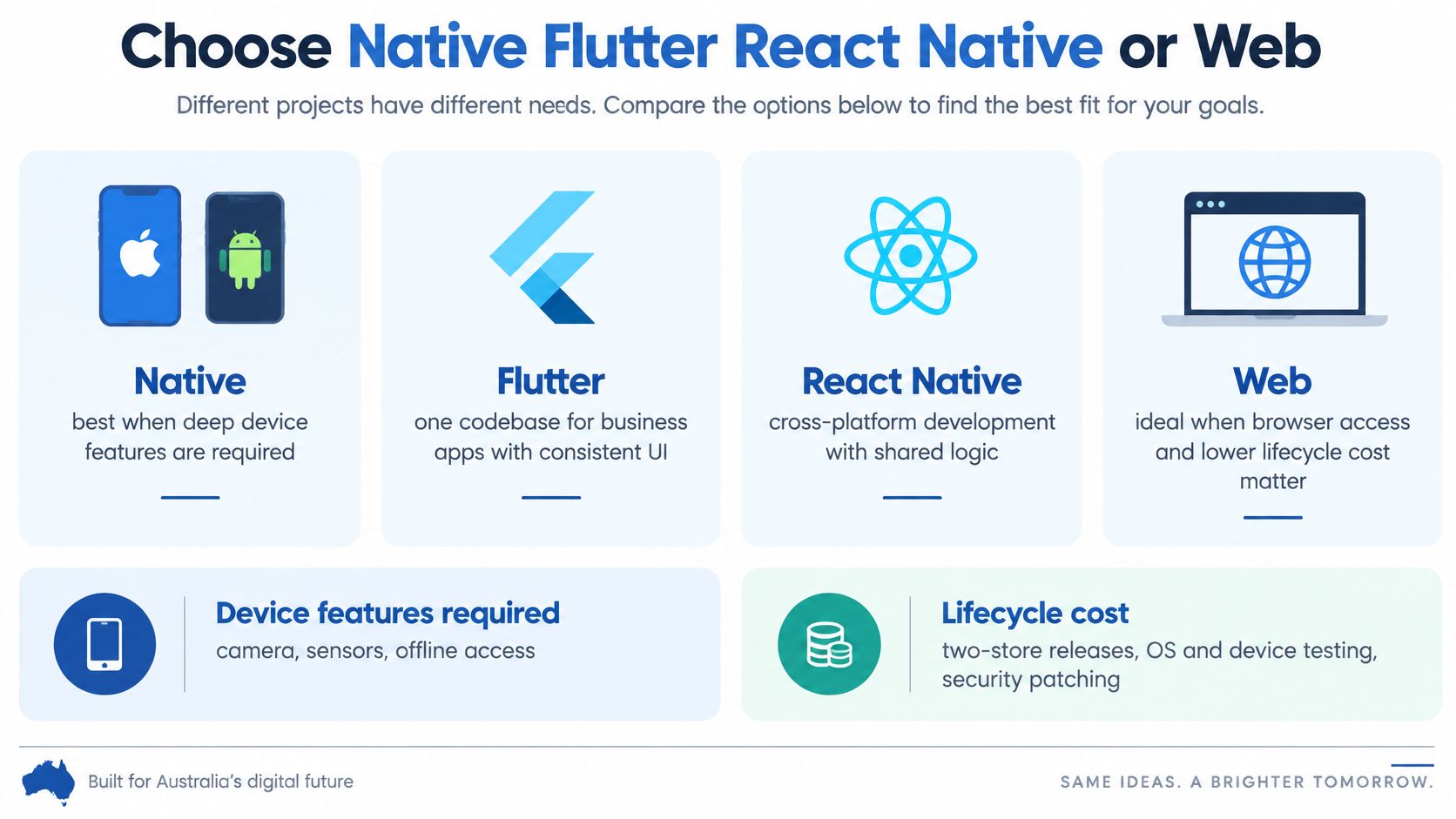
The right stack depends on what the service must do, not which framework a vendor prefers. Apps are widely used for government services in Australia, but that does not make installation the right starting point for every service.
Platform fit by option
| Option | Best fit | Where it struggles | Device feature access |
|---|---|---|---|
| Native (Swift and Kotlin) | Heavy background processing, specialist hardware or new platform APIs | Two codebases and two QA cycles for every release | Full access to platform APIs |
| Flutter | Customer-facing apps needing custom interfaces and one iOS and Android codebase | Some features need plugins; hiring pool is smaller than for JavaScript | Full access through plugins and native bridges |
| React Native | JavaScript or TypeScript teams sharing logic with a web app | Performance-heavy animation and some native modules need extra engineering | Full access through community and native modules |
| Progressive web app | Information, forms, donations, event registration and account lookups | Restricted iOS device features; installation requires users to add it to their home screen | Browser- and OS-supported APIs only |
A Progressive Web App uses one codebase across iOS, Android and desktop. It suits services that need broad access without a separate app-store installation. Store packaging can be considered later, but still requires platform-specific work and review.
For camera access, notifications and offline storage without specialist hardware, Flutter or React Native may fit. Continuum Solutions builds iOS and Android apps with both frameworks. For Moviesense, it built native iOS and Android apps with Flutter, using a single codebase for both platforms.
Compare ownership cost, not coding preference
Flutter can suit a consistent custom interface. React Native can suit teams with existing JavaScript or TypeScript skills, though shared logic does not mean every screen can be reused. The Flutter versus React Native comparison can help frame that technical choice.
For a React Native shortlist, LetsDeployIt's React Native review guide offers another perspective on assessing implementation quality beyond screenshots.
Include store releases, operating-system testing, security patches, analytics consent, crash monitoring, accessibility remediation and eventual decommissioning in the ownership estimate. A shared codebase reduces duplicated work, but it does not remove device and OS testing.
Before funding a permanent native build, define a pilot with measures for task completion, retention, support volume, Australian mobile-network performance and cost per active user. Write the measures into the vendor brief, then require the quote to show what testing and monitoring are included. List the three device features the service must support. If none requires native access, web-first is usually the lower-cost starting point.
Set Requirements by Buyer Type
A regional field worker, a donor and an enterprise administrator shouldn't inherit identical requirements because a vendor prefers one stack. The buyer's operating conditions determine the architecture.
The Australian Digital Inclusion Index reports that 9.7% of Australians have access only to a mobile connection, 15.9% say connectivity problems always or often affect their internet use, and 20.6% are digitally excluded or highly excluded; the latter figure is 40.9% for First Nations Australians, compared with 20% of other Australians. Don't write acceptance criteria that assume unlimited data, a current handset or continuous connectivity.
Priority requirements by buyer type
| Buyer type | Priority requirement | Usual platform path | Common risk |
|---|---|---|---|
| Enterprise | Single sign-on, audit logs and existing CRM and identity integration | Native or Flutter on a managed backend | Integration scope underestimated in the quote |
| NGO or membership organisation | Low-bandwidth use, accessibility and member or donor data protection | Progressive web app first; installed app where offline use or device features justify it | Excluding users on mobile-only or weak connections |
| Startup | A validated first release working on both platforms | Flutter or React Native in one codebase | Building separate native apps before demand is proven |
| Ecommerce brand | Reliable Stripe checkout and notifications tied to order events | Cross-platform app alongside a web store | Untested payment flows and peak trading loads |
Apply the same practical tests to every row. Set a maximum payload size, define offline retention, specify conflict handling and name supported older operating systems. Require readable text, accessible navigation and a non-app route for critical transactions.
Test the business failure, not just the screen
For an enterprise field app, test what happens when someone edits a record offline while an office administrator changes it in the CRM. The vendor must demonstrate a conflict rule, not overwrite whichever update arrives first without consideration.
For an NGO, keep donations, renewals and registrations available through a low-bandwidth web journey. For ecommerce, demonstrate interrupted checkout, duplicate payment prevention and delayed order notifications, then load-test before peak trading.
A successful screen transition isn't proof of a successful transaction. Verify the authoritative record and the user's confirmation.
We build cloud solutions, custom apps and integrations for NGOs, enterprises and start-ups. Our delivery scope includes custom development, progressive web apps, API and custom integrations, Stripe integration, and enterprise application monitoring and debugging.
Close the brief with one essential requirement, one acceptable trade-off and one journey that must work without the app. That gives vendors a commercial priority when cost and technical constraints collide.
Score Vendors and Write the RFP Questions
Portfolio quality is evidence of presentation, not delivery discipline. Shortlist three vendors and score each from one to five against the criteria below. Double-weight High priorities and reject any vendor scoring two or below on shipped apps or post-launch monitoring.
Those are recommended procurement rules, not industry benchmarks. Award points for downloadable products, named engineers and written artefacts, not confident answers.
Vendor evaluation scorecard
| Criterion | Strong evidence | Question to ask | Priority |
|---|---|---|---|
| Shipped apps | Live iOS and Android apps with documented outcomes | Which apps shipped in the past two years, and what did they achieve? | High |
| Cross-platform stack | Working Flutter or React Native knowledge | Which framework fits this product, and when would you recommend native? | High |
| Device and OS testing | Written matrix covering current and older versions | Which devices and OS versions are tested before release? | High |
| Monitoring after launch | Crash and performance monitoring from the first build | Which tools track crashes and latency, and who responds out of hours? | High |
| Security and privacy | Threat model, permission map and consent design before build | How does each permission map to a purpose and consent event? | High |
| Handover | Ownership, documentation and written transfer plan | Can our team operate the app without you? | Medium |
| Team continuity | Named senior engineers retained through release | Who remains after discovery? | Medium |
| Commercial clarity | Fixed phases or capped budgets with change control | How are scope changes priced and approved? | Medium |
Require live store links rather than a screenshot deck. Confirm that the engineers presented during selection will do the work. On reference calls, ask what broke after launch, how quickly the vendor responded and whether the buyer could understand the incident report.
Make privacy answers demonstrable
Under the OAIC's Australian Privacy Principles guidance, consent must be adequately informed, voluntary, current and specific, and given by someone capable of understanding and communicating it; entities should generally obtain express consent before handling sensitive information.
Require a permission map showing purpose, collection point, consent record and withdrawal behaviour. Bundling unrelated uses into a broad acceptance request undermines meaningful choice. A user declining optional location access shouldn't lose unrelated account functions.
The OAIC mobile privacy guide recommends targeted notices and explanations when photo, video, location or movement-sensor features are first activated. Request a working demonstration of these notices, not a privacy-policy document.
Add RFP questions about third-party SDK inventories, dependency review and what happens when a user withdraws consent. Require explicit answers about source code, store accounts and cloud-environment transfer. Our explanation of why a vibe-coded app isn't production-ready is relevant when a prototype is being presented as operational evidence.
We list app development services for Melbourne, including QA across devices and operating systems. Broad coverage commitments still need a finite written test matrix, with exclusions and regression responsibilities stated.
Reject a firm build quote before discovery where material unknowns remain. Other rejection signals include an unnamed team, a guaranteed date despite unknown integrations, or a claim to test every possible device without defining coverage.
Match the Engagement Model and Price the Extras
Technology-project uncertainty needs commercial controls, not optimism. The Queensland Audit Office's review of 118 technology projects found 47% tracking on time and 62% tracking on budget; departments expected 26% to run at least 50% longer than planned and 23% to cost at least 50% more, while research it cited found only 19% of organisations delivered successful technology projects most of the time and 80% of public-sector transformations failed to meet their objectives.
These aren't mobile-app pricing benchmarks. They support a practical purchasing approach: isolate uncertainty, fund evidence and avoid treating an evolving software product like fixed-scope construction.
Engagement models by project type
| Engagement model | Suits | Budget certainty | Main risk |
|---|---|---|---|
| Fixed-price project | Written scope signed before build | High once scope is locked | Scope disputes and rigid change control |
| Time and materials | Discovery or a product still being shaped | Low to medium, controlled through a cap | Overrun without sprint budgets and sign-off |
| Dedicated team | Long roadmap with steady releases | Medium, with predictable monthly cost | Team turnover when staffing changes |
| Phased discovery then build | Large or unclear projects with many integrations | High for discovery, medium for build | Build pricing relies on discovery quality |
Use fixed price only after scope and acceptance metrics are signed. Otherwise, apparent certainty may become exclusions and change requests.
For discovery, I would use time and materials with a monthly cap, visible outputs and sprint sign-off. For an ongoing roadmap, a dedicated team can preserve product knowledge, but the agreement should name senior engineers and govern replacements.
Integration-heavy projects suit priced discovery followed by a separately approved build. Discovery should produce a prioritised backlog, tested integration assumptions and a defensible estimate, not merely workshops and presentation slides.
Require an itemised ownership budget
A headline build quote can omit work your organisation will still need to fund:
- Release operations: Store submission for each release, approval responses and growing device and OS coverage.
- Maintenance: Library and SDK patches, deprecated dependency replacement and crash-monitoring subscriptions.
- Service obligations: Accessibility fixes after audit, cloud charges, payment-provider fees and other third-party subscriptions.
- Exit work: Data export, retention decisions, account closure and decommissioning.
We manage App Store and Google Play Store submission, testing and approval processes for apps we build. That responsibility should still appear explicitly in the commercial scope, including how subsequent releases are charged.
Use our custom app cost guide to frame the cost discussion, then request an itemised estimate against your brief. Don't substitute an unsupported market price range for project-specific discovery.
Reserve contingency for integration and device-testing uncertainty. Fund subsequent phases only when the vendor demonstrates a working increment, validated API contracts, tested analytics events, accessibility checks and operational monitoring.
Put Handover and Support in the Contract
Post-launch obligations belong in the agreement, not a proposal slide. An app can function at launch yet remain commercially unsafe if your organisation doesn't control its accounts, understand its infrastructure or know who handles an incident.
Clauses to settle before signing
- Client-controlled assets: Put repositories and cloud accounts in the client's name before the first commit. Grant the delivery team appropriate access rather than transferring ownership later.
- Store ownership: Keep Apple and Google developer accounts under client ownership, with the vendor added as a user. Record who holds administrative access and recovery credentials.
- Named continuity: Identify the client product owner and senior engineer who remain through release. Define approval for substitutions so discovery knowledge doesn't disappear during implementation.
- Operational handover: Include source code, API documentation, infrastructure notes and structured knowledge transfer. Require another engineer to demonstrate deployment and routine operation from the documentation.
- Response obligations: Name monitoring tools, on-call responsibilities, severity levels and response times. Cover crashes, latency, adoption and retention from the first build, with appropriate privacy controls.
- Priced maintenance: State how library and SDK patches are funded, including replacement when a dependency is deprecated. Distinguish defect correction from paid enhancement work.
- Recovery readiness: Require backups and a tested disaster-recovery plan where customer or member data is held. Specify who performs restores and verifies that recovered records are usable.
- Payment gates: Tie phase approval to the agreed working increment, API contracts, analytics tests, accessibility checks and monitoring evidence. Don't approve invoices solely because a sprint has ended.
Make the transfer executable
Our custom development includes full-stack builds, internal tools, an easy-to-use backend CMS, and API-first, documented, maintainable code. Those deliverables should let your team administer the service without asking a developer to change routine content or explain undocumented endpoints.
We offer enterprise application monitoring and debugging using Sentry and New Relic. Tool installation alone isn't a support arrangement: the contract must identify who receives alerts and what they must do next.
For ClubScout, our work included infrastructure monitoring, backups and disaster recovery planning. Apply that same operational distinction to procurement: a backup configuration isn't proof that restoration works.
Before signing: Have the person who'll operate the app review the support and recovery clauses, not just the person approving the build budget.
Choose the shortlist, send the shared brief and RFP, and buy a priced discovery phase. Release build funds against acceptance metrics only after these ownership and support obligations are agreed.
Continuum Solutions offers mobile application development, cloud architecture and systems integration, with monitoring and maintainable handover. Visit Continuum Solutions to discuss your written brief, integration uncertainties and a priced discovery phase before committing to the full build.