
Most production Australian apps cost A$80,000 to A$250,000 to build, then about 15%–20% of the build cost each year to maintain. Australian software and applications programmers earn a median full-time wage around 37% above the all-occupation median, which helps explain why a realistic local budget has to cover more than coding.
You’re a CTO or operations lead with an agency briefing due tomorrow. One proposal is tens of thousands of dollars; another is several hundred thousand. Those quotes may describe very different products, levels of assurance, and post-launch commitments, even if both are labelled “mobile app”.
I’d start with a defensible estimate, then test the scope behind it. Local labour costs, compliance requirements, total cost of ownership, and vendor model all shape the final number. The figures below help you identify a likely project band and ask the questions that separate a credible proposal from a dangerously incomplete one.
Table of Contents
- What App Development Really Costs in Australia Right Now
- Why Australian Labour Sets the Baseline Price
- Agency Versus Freelance Versus Offshore Compared
- Project Bands From MVP to Regulated Platform
- Scope Drivers That Quietly Double the Budget
- The Three-Year Cost Most Buyers Forget
- Building a Realistic Budget and Choosing a Vendor
- Frequent Questions About App Development Cost in Australia
What App Development Really Costs in Australia Right Now
Before approving an app budget, ask each vendor to price the same operational outcome. A demonstration that wins stakeholder approval and a service your staff can depend on require different work. Compare deliverables, exclusions and ongoing responsibilities before comparing totals.
Consider an illustrative A$45,000 prototype quote against an A$180,000 production quote. The prototype might cover screens and a limited user journey, with no production backend, release testing or support. The production proposal might include those workstreams, but still exclude integrations, compliance work or ongoing hosting. These are example quotes, not market benchmarks. Neither price proves completeness.
Australia-focused app development cost estimates provide a starting reference; your budget still needs a scope that matches the service you intend to run.
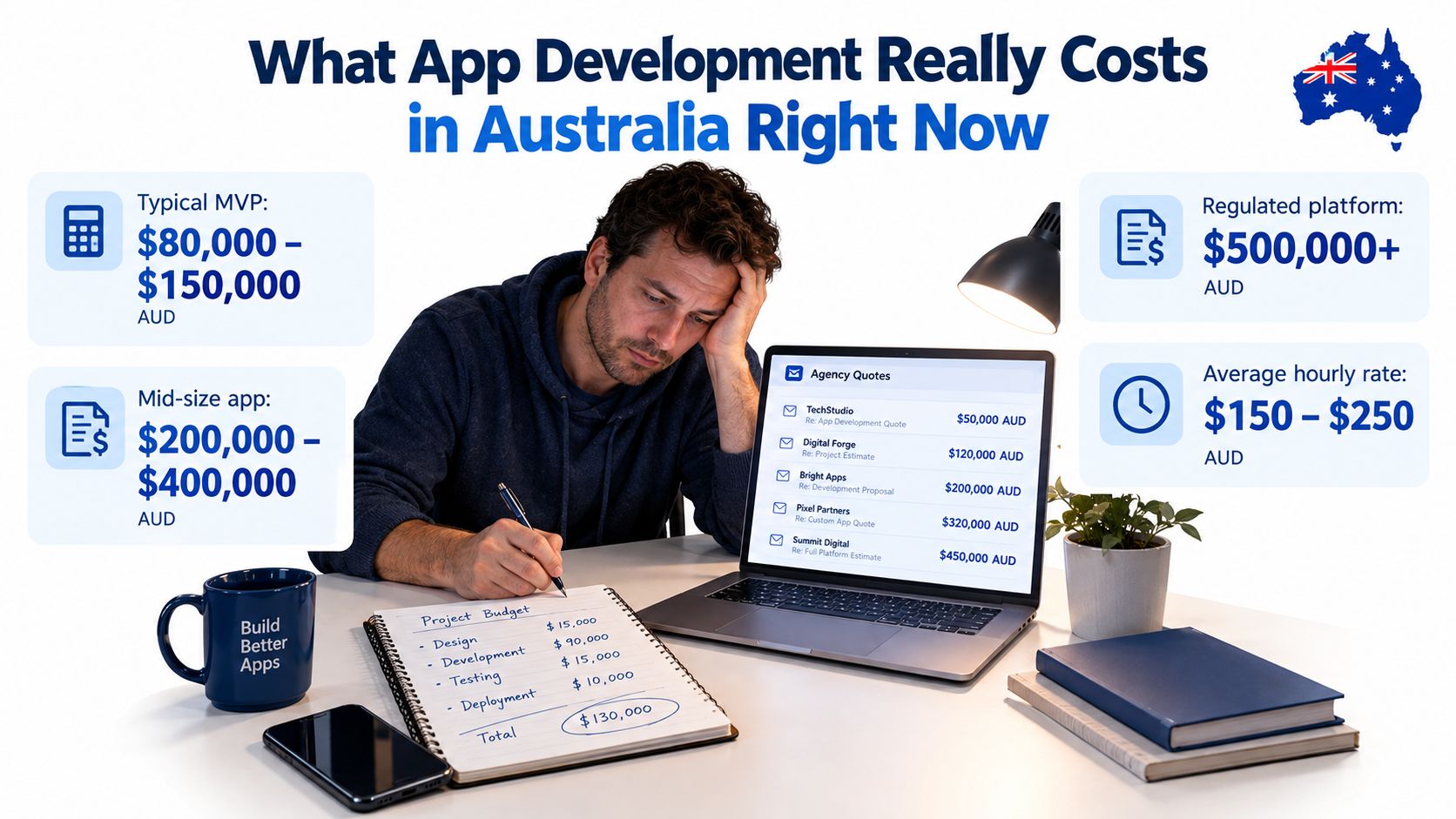
Reject “starts at $5,000” as a production budgeting shortcut.
For your business case, require explicit allowances for user accounts, backend services, administration, reporting and connections to existing systems. Sensitive information, accessibility requirements and security expectations need named deliverables and acceptance criteria. Ask who funds remediation if testing exposes gaps, and who responds when an integration fails.
Budgeting rule: Ask for the fully loaded three-year cost to launch, operate, support and change the app.
Keep delivery and operating costs visible separately, then assess them together. Local delivery capacity, compliance obligations and support commitments belong in that assessment. Require discovery, UX, architecture, development, quality assurance and release preparation to appear in the proposal. Record maintenance responsibilities alongside them. An omitted workstream is an unresolved budget exposure, even when the headline quote looks attractive.
Why Australian Labour Sets the Baseline Price
Australian app estimates reflect the cost of assembling a delivery team, not just the time a developer spends writing code. A typical project may need a senior engineer for technical decisions, a mid-level engineer for implementation, product or UX input, QA, release or DevOps support, and project management. A smaller project can combine some responsibilities, but it can’t make the work disappear.
Jobs and Skills Australia reports 203,200 software and applications programmers, or 1.4% of the national workforce, with annual employment growth of 13,700 positions. Median full-time earnings are A$2,537 per week, compared with A$1,852 across all occupations, a difference of about 37%; the same profile gives median hourly earnings of A$67 versus A$47 (Jobs and Skills Australia occupation profile). Those are employee-pay benchmarks, not agency rates. They do explain why local engineering capacity is a material project cost.
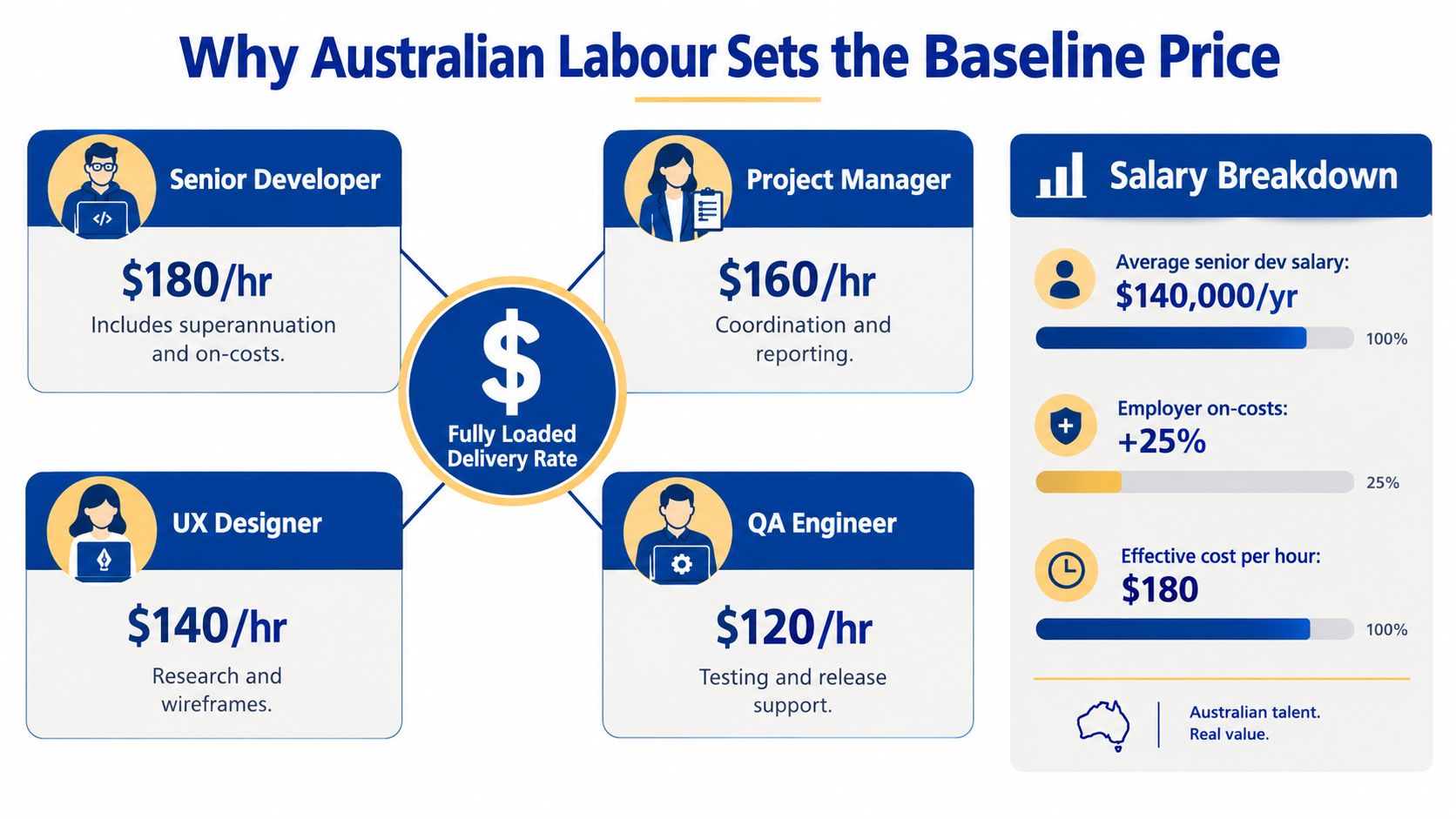
The Tech Council of Australia reported that average advertised salaries in the direct technology sector were about A$132,000 a year, roughly 1.5 times the average salary in other jobs, using SEEK data in its 2023 analysis (Tech Council of Australia technology jobs update). Treat that as historical context, not a current quotation. The practical point is that Australian project pricing must cover a specialist workforce and the overhead required to deliver reliable software.
A salary doesn’t translate directly into a billable rate. Employers and vendors also need to cover superannuation, leave, tools, management, non-billable work, and business overhead. Ask vendors for the roles and seniority behind their estimate, the effort allocated to each, and whether testing, documentation, deployment, and handover are included. If a quote appears far below its competitors, ask which of those responsibilities have been excluded.
Agency Versus Freelance Versus Offshore Compared
Vendor choice changes how delivery risk and coordination are handled. It doesn’t change the underlying scope. I wouldn’t trust a table of regional hourly rates unless it came with a defined measurement method, so I’m not going to invent rate bands for Melbourne, Sydney, Brisbane, freelancers, or offshore teams. Compare proposals on responsibilities, accountability, and the work your own team must absorb.
| Vendor Model | Indicative Hourly Band (AUD) | What Is Typically Included | Best Fit Project |
|---|---|---|---|
| Australian agency | Request a role-based or blended rate in the proposal | Cross-functional delivery, project coordination, QA, documentation, and handover, depending on the contract | Regulated, integration-heavy, or business-critical work |
| Senior freelancer | Request the rate and specify which duties are included | Direct access to an individual specialist; project management, QA, and continuity may sit with the buyer | A narrow, well-defined scope with an available technical owner |
| Offshore team | Request a rate alongside named roles, overlap arrangements, and quality responsibilities | Development capacity; Australian compliance review, coordination, and local handover may be additional | A budget-sensitive MVP when the buyer can actively manage delivery |
| Blended local and offshore team | Request separate rates and explicit ownership of each workstream | Local architecture or delivery oversight combined with offshore implementation capacity | Work that can be split cleanly, with integration and QA owned |
An agency generally costs more on the proposal’s face, but it can put design, engineering, testing, and delivery coordination under one accountable team. That only helps if the contract names the responsibilities and deliverables. “Full service” isn’t a substitute for a clear scope.
Freelancers can be a strong choice when you need a specific skill or a contained build. The buyer takes on more coordination, and continuity becomes a risk if that individual becomes unavailable. Offshore delivery can reduce the quoted development rate, but the savings can shrink when the Australian team has to resolve time-zone delays, rework, integration problems, documentation gaps, and local assurance needs.
My decision rule is simple: choose a local agency for sensitive or business-critical work; consider a blended team when you can manage coordination and the scope is separable; hire a senior freelancer for a small, tightly specified piece of work. In every case, price the buyer’s internal time as part of the decision.
Project Bands From MVP to Regulated Platform
Classify your app by the responsibilities it must support. Screen count is a poor budgeting shortcut: a small interface can still require substantial security, integration, and operational work. Use Australia-focused app project cost bands as an orientation, then ask vendors to estimate the capabilities below.
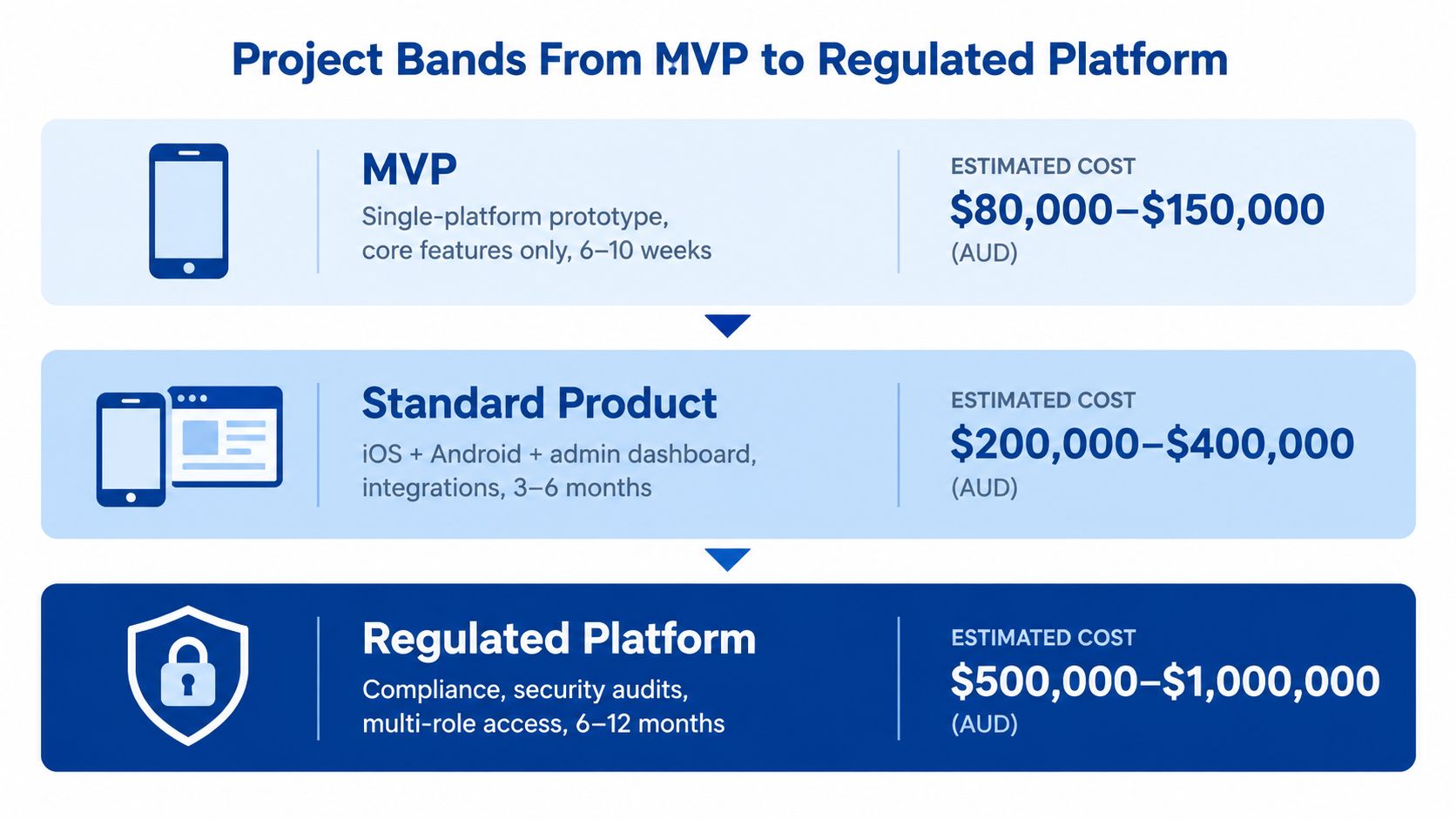
MVP: Keep the first release focused on testing the business proposition safely and usefully. Core user journeys, limited authentication, and a modest backend define a contained scope. Include discovery, UX, architecture, testing, and release preparation in the estimate.
Standard commercial app: User accounts, administration, payments, reporting, and connections to existing systems bring operational responsibilities. Staff need tools to manage the service after launch. Budget for those tools alongside the customer-facing app.
Complex or regulated platform: Identity management, offline workflows, accessibility assurance, auditability, and connections to Salesforce, HubSpot, or Xero can put a project in this category. Require explicit scope for security, data handling, evidence, and ongoing operations. These responsibilities belong in the delivery estimate.
Shared code does not remove platform ownership.
Flutter or React Native can share application code between iOS and Android. Device-specific testing, release management, store administration, and native integrations still need effort. Ask vendors to separate shared implementation from platform-specific work and support, so the proposal shows what must be maintained.
For a scoped first release, Continuum Solutions’ MVP development services provide a reference point for defining core business needs. Require any provider to separate discovery, implementation, testing, launch preparation, and support. Choose the project band against the service you must operate over three years, rather than the feature list you want at launch.
Scope Drivers That Quietly Double the Budget
Late scope changes are expensive when they add a new engineering problem, not merely a screen. A move from email-and-password access to single sign-on (SSO), multifactor authentication, and an identity-provider integration brings changes to authentication flows, session handling, error cases, and testing. Ask for those requirements during discovery, not after a fixed-price contract is signed.
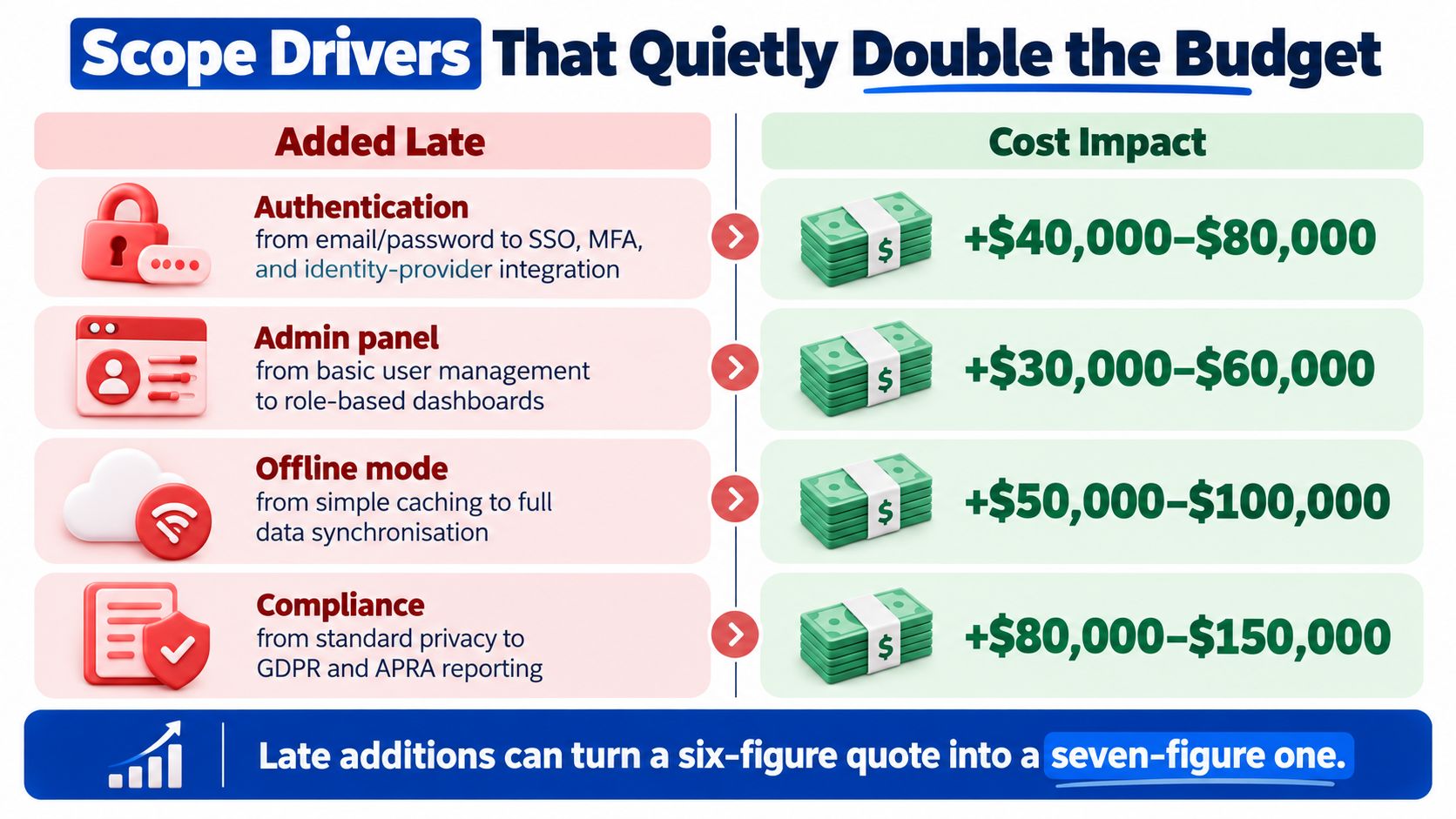
Offline mode is another common trap. Saving data on a device is only the start. The team must decide how the app handles synchronisation, conflicting edits, encryption, and interrupted connections. If staff rely on accurate information while offline, define the expected behaviour and recovery process before estimating the work.
Accessibility also needs engineering ownership. Meeting WCAG 2.1 AA expectations can involve semantic interface design, assistive-technology testing, and regression checks as the product changes. An Australian cost benchmark gives A$50,000–A$90,000 for a single-platform, accessibility-compliant app with an Australian-hosted backend, and A$100,000–A$160,000 for cross-platform delivery with offline support, SSO, and accessibility testing (Australian mobile app cost and compliance guidance). These are indicative examples, not universal quotes.
Practical rule: Put SSO, offline behaviour, accessibility, data residency, integrations, and security evidence into the acceptance criteria before you compare prices.
Integrations with CRMs, accounting products, and payment providers need API design, data mapping, error handling, monitoring, and ownership of failures. A connection that works in a demonstration may not be reliable enough for production. For a framework comparison, see Flutter versus React Native, but choose based on required device capabilities, team expertise, and long-term support rather than the promise of a single codebase.
Start with discovery and a threat model, then validate the riskiest workflow in a vertical slice. That sequence exposes hidden dependencies before the main build commits to them.
The Three-Year Cost Most Buyers Forget
The initial build is only one part of the business case. Australian pricing guidance lists hosting at about A$70–A$320 per month, Apple’s developer-program fee at US$99 per year, a US$25 one-time Google Play registration fee, and maintenance at roughly 15%–20% of the original build cost annually (Australian app development ownership-cost guidance). Treat these as planning benchmarks, not fixed prices: hosting depends on usage and architecture, while maintenance depends on the release cadence, integrations, and support expectations.
For an illustrative A$50,000 build, the stated annual maintenance benchmark alone equates to A$7,500–A$10,000 a year. Hosting and store fees sit alongside it. That still doesn’t account for any additional work on analytics, monitoring, incident response, security patches, operating-system changes, or enhancements. The example isn’t a quote; it shows why a build-only comparison understates the cost of keeping the product in service.
Mobile access is an ongoing product requirement. The Australian Bureau of Statistics reported that 93.2% of Australian internet users went online via a mobile phone in 2023–24, while 68.1% used a tablet (Australian mobile access figures and app cost considerations). For a broad consumer or member audience, that supports planning for device testing, accessibility, compatibility, and monitoring after launch, not treating mobile support as a one-off build task.
For NGOs and startups, a cheap MVP can become expensive if it lacks documentation, automated tests, monitoring, or a maintainable API foundation. Plan separately for delivery and operations, then compare the three-year cost of a maintainable first release with the likely cost of repair or replacement. If your product depends on member access and cloud services, factor in the operating model described in AWS hosting for membership platforms.
Building a Realistic Budget and Choosing a Vendor
Put four lines in the business case. This makes it harder for a proposal to hide essential work inside a vague “development” figure.
- Discovery and architecture: Scope user journeys, integration dependencies, security needs, and technical options. Agree on deliverables before committing to the main build.
- Build: Price the application, backend, administration tools, integrations, and automated tests against an agreed scope.
- Launch readiness: Include device and accessibility testing, deployment, store submission, documentation, training, and handover.
- First-year operations: Forecast hosting, monitoring, incident response, security and compatibility updates, and planned enhancements.
When you shortlist vendors, ask these five questions:
- Which architecture, QA, deployment, documentation, and handover tasks are priced separately?
- Which roles will work on the project, and what seniority do they bring?
- What is fixed-price, and what is variable?
- What do the warranty and incident-response commitments cover?
- What comparable Australian work can the vendor show, including its role and delivered scope?
A credible answer identifies named responsibilities, assumptions, exclusions, and measurable acceptance criteria. Put a proposal aside if it claims to cover everything but can’t explain its delivery team, testing approach, or handover.
Use a phased commitment: discovery, a vertical-slice prototype, controlled beta, then production hardening. That gives your team decision points before it commits the full budget. If you’re evaluating local delivery capacity, Continuum Solutions’ Melbourne mobile app development services describe work spanning iOS and Android apps, cloud backends, testing, and monitoring.
Frequent Questions About App Development Cost in Australia
Should I use fixed price or time and materials? Fixed price suits a well-defined scope with agreed acceptance criteria. If key requirements are still unknown, pay for discovery first, then price the build when the team understands the risks. For time and materials, set a budget ceiling and require regular delivery reviews.
What payment milestones are reasonable? Tie payments to accepted deliverables rather than calendar dates alone. A schedule such as 30/30/30/10 can link payments to project start, a working build, beta or acceptance, and final handover. Define what counts as acceptance, how defects are handled, and what happens if a milestone slips.
Can an offshore blended team deliver a regulated Australian app? It can, provided an accountable owner controls architecture, data handling, security evidence, integration testing, and release approval. Confirm where sensitive data is accessed and stored, and assign responsibility for local assurance before work starts.
Why do two similar-looking quotes differ so much? Compare the assumptions line by line: platforms, user journeys, integrations, environments, QA, launch, support, and exclusions. A lower estimate may omit backend work or production readiness, while a higher one may include assurance and operational handover. If you’ve built a prototype already, use this assessment of why a vibe-coded app may not be production-ready to frame questions about reuse, security, and maintainability.
Before asking for proposals, write down the business outcome, must-have workflows, existing systems, required devices, compliance needs, and post-launch support expectations. That gives each vendor the same problem to price.
Continuum Solutions scopes, builds, and maintains cross-platform applications, cloud backends, and systems integrations, with testing and monitoring included in its delivery work. If you’re preparing an Australian app budget, visit Continuum Solutions to discuss the scope, architecture, and operating costs before you commit to a build.