
A lot of teams start looking for a mobile app architect at the same point. The app is live, users are active, and the first release proved the concept. Then the strain starts. Login depends on a brittle API. Reporting doesn't match finance numbers. Push notifications work for some users and fail for others. AWS costs drift up each month, but nobody can point to the exact cause.
That search usually isn't about job titles. It's about finding someone who can stop the platform from becoming expensive, fragile and hard to change.
In Australia, the commercial stakes are real. The local app market generated US$2.6 billion in 2023, with 21.6 million active smartphone users and 1.1 billion app downloads according to IBISWorld's summary of Business of Apps market data. That scale changes the conversation. Small architectural mistakes don't stay small for long when your product sits on devices people use every day.
I've seen the same pattern across membership platforms, internal field apps, SaaS products and customer portals. Teams often think they have a development problem when they really have an architecture problem. More code won't fix weak service boundaries, unclear ownership of data, poor observability, or a release process that turns every update into a risk event.
Table of Contents
- Introduction Why Mobile Architecture Decides Success
- What a Mobile App Architect Actually Does
- Core Responsibilities and Deliverables You Should Expect
- Mobile Architecture Patterns Compared for Business Outcomes
- Essential Skills Tools and AWS Building Blocks
- How to Hire and Engage a Mobile App Architect
- Next Steps to De-Risk Your Mobile App Investment
Introduction Why Mobile Architecture Decides Success
A common scenario looks like this. A business launches a mobile app tied to a CRM, a payment platform and a few internal systems. The first phase works well enough to get traction. Then the product roadmap expands. New user roles appear, integrations multiply, analytics become contested, and support tickets start surfacing around login failures, sync gaps and inconsistent account data.
At that point, architecture stops being a technical preference and becomes an operating cost decision.
The app works, but the business model doesn't
An app can be functional and still be commercially weak. If each new feature requires backend rework, store release delays and manual QA across too many edge cases, delivery slows down. If infrastructure isn't designed with scaling in mind, monthly cloud spend rises faster than the value gained from it. If the data model is messy, every integration creates more duplication.
That's why a mobile app architect matters. The role exists to reduce rework, clarify system boundaries and make the mobile channel behave like a durable product rather than a sequence of rushed releases.
Poor architecture rarely fails all at once. Teams feel it first through missed delivery dates, disputed reporting and rising support effort.
Why this matters in Australia
Australia's app economy isn't niche. The Progressive Policy Institute estimated 182,000 app economy jobs in Australia as of August 2023, and the same market view cited by Business of Apps notes that IBISWorld projected the Australian Smartphone App Developers industry at A$2.8 billion in 2026 across 667 businesses, with 4.4% CAGR in business count from 2021 to 2026 according to Business of Apps market data on Australia. Businesses aren't experimenting at the edges anymore. Mobile is now part of core service delivery, customer engagement and operational workflow.
For a CTO or operations manager, hiring or engaging a mobile app architect is usually a buying decision about four things:
- Delivery certainty. Can the team release safely without creating rollback drama each sprint?
- Cost control. Is the app and backend stack efficient, or are AWS services being used without guardrails?
- Compliance exposure. Are privacy, retention and access controls embedded in the design?
- Long-term maintainability. Can another team inherit the platform without reverse-engineering it?
Those are the decisions that determine whether the app becomes an asset or a liability.
What a Mobile App Architect Actually Does
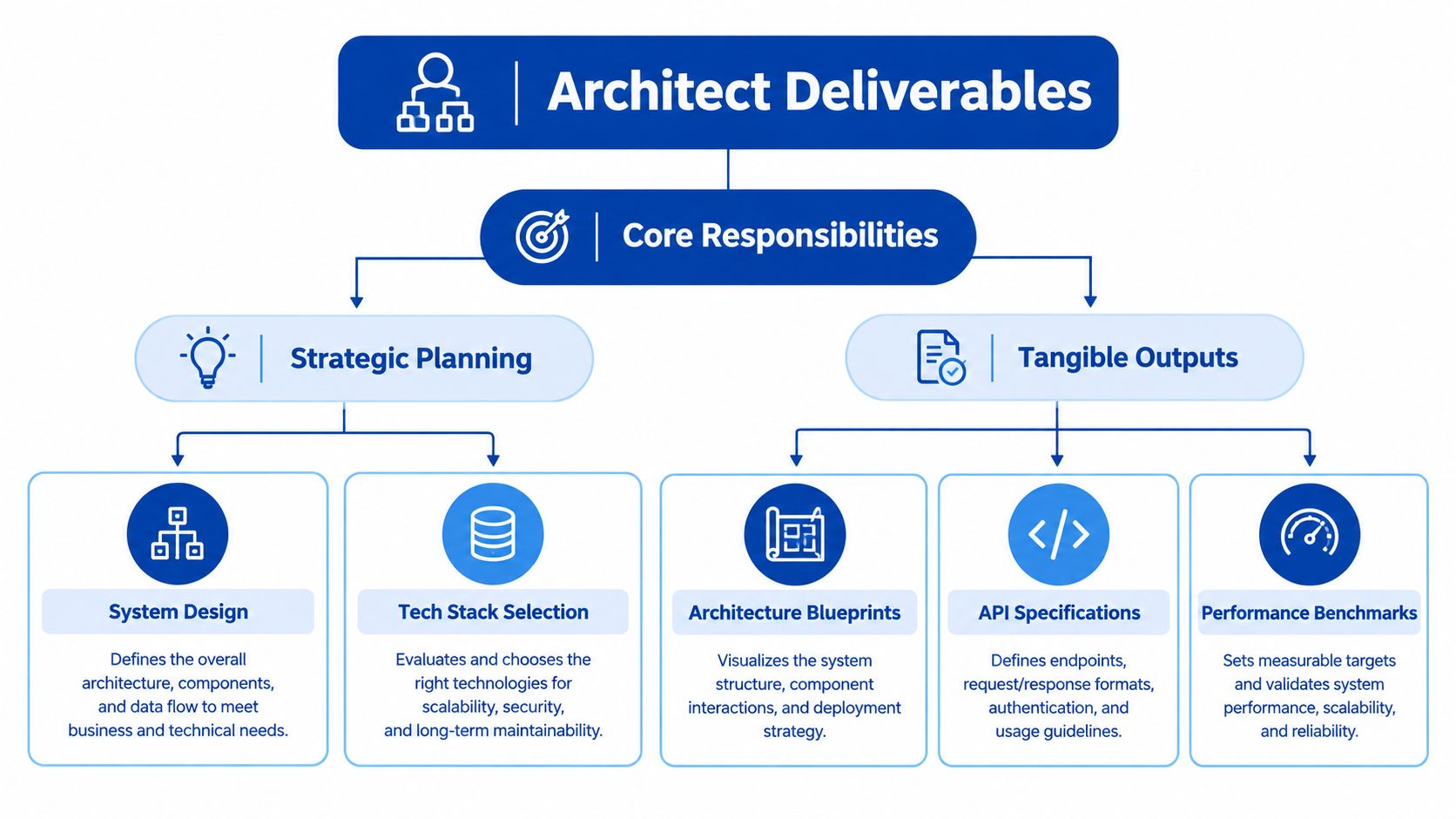
A mobile app architect is closer to a solution designer than a senior coder. Think of the role the same way you'd think about a building architect. The architect doesn't pour the concrete or wire the lights. They decide how the structure holds together, what connects to what, where future expansion is possible, and how to avoid expensive fixes after construction starts.
That same logic applies to mobile systems. The app on the phone is only one layer. The job is connecting mobile UX, backend services, APIs, identity, analytics, deployment and support into one coherent operating model.
The role sits above implementation
A strong developer can build features. A strong architect decides which features belong in the app, which belong in APIs, which should be handled by managed services, and which shouldn't be custom-built at all.
That distinction matters commercially. Australian pay benchmarks show the market prices architecture as a more senior risk-management function. Robert Walters lists mobile application developer pay at about AU$115k to AU$140k, while architect benchmarks are materially higher, with Robert Half putting Solutions Architects at a median AU$175k and Morgan McKinley listing Sydney Cloud or Solutions Architect medians around AU$190k to AU$195k, as cited in the Robert Walters Salary Guide 2026 for Australia. That gap reflects responsibility, not vanity.
What they own in practice
A mobile app architect should be making decisions like these:
- Platform choice. Native, Flutter, React Native, PWA, or a mixed approach.
- Backend structure. Monolith, modular API services, serverless functions, or integration-led architecture.
- Identity model. Token flows, session handling, passwordless options, step-up authentication.
- Data movement. What syncs to device, what stays server-side, what gets cached, and what needs offline support.
- Operational guardrails. Monitoring, release strategy, error tracking, rollback plans, and cost visibility.
How this reduces risk
Most costly app failures don't come from one bad line of code. They come from structural decisions nobody owned early enough. The wrong framework for the use case. Analytics added after launch. Security bolted on after third-party libraries are already embedded. A backend that can't support simple product changes without deployment friction.
Practical rule: if nobody can explain how mobile, cloud, integrations and analytics fit together in one page, you probably don't have architecture. You have implementation with assumptions.
That's why businesses searching for a mobile app architect are usually at an inflection point. They need someone who can make fewer things custom, more things observable, and all of it easier to govern.
Core Responsibilities and Deliverables You Should Expect
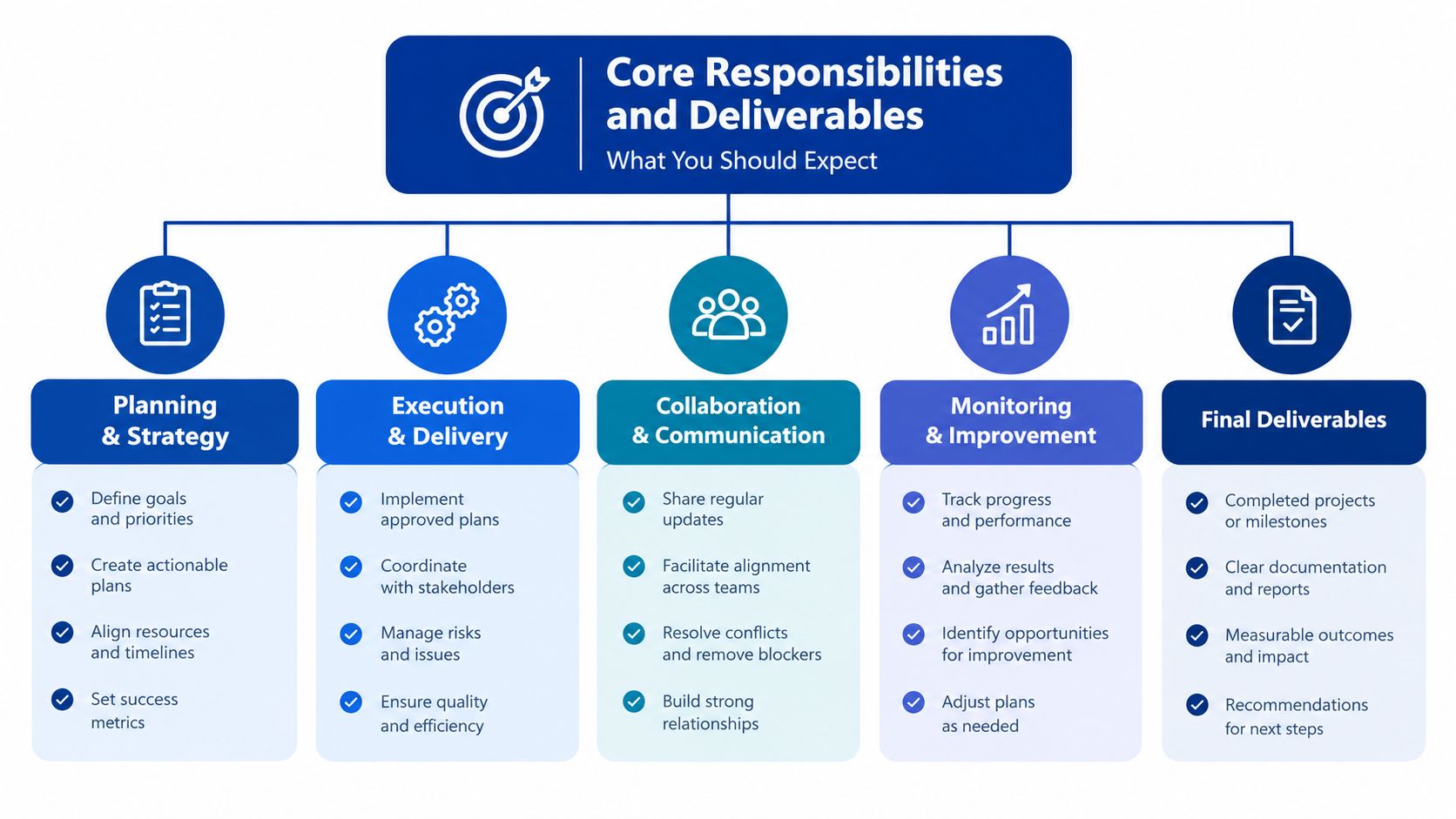
The simplest way to assess a mobile app architect is to ask what they leave behind. If the answer is only meetings and broad advice, that's not enough. A serious architect produces working decisions, written artefacts and operating standards that the delivery team can execute without guesswork.
The artefacts that matter
A competent architect should usually deliver a package that includes:
- Architecture blueprints showing the mobile client, backend services, identity provider, external systems and data flows.
- API and integration specifications that define contracts clearly enough for mobile and backend teams to work independently.
- Non-functional requirements covering performance, availability, device support, privacy, logging and release constraints.
- Operational documentation for deployment, rollback, alerting and incident response.
- Handover material that gives internal teams or future vendors a maintainable baseline.
If you're validating an early product concept, this often pairs well with a structured MVP plan rather than a full platform build. A practical reference point is MVP development services for staged product delivery, where the architecture decision is tied to what must be proven first and what can wait.
Security and privacy aren't side tasks
In Australia, privacy has to sit inside the architecture, not beside it. The Office of the Australian Information Commissioner advises teams to run a Privacy Impact Assessment during planning, assign clear responsibility for privacy and security, encrypt user data in transit and at rest, secure both device and backend systems, and perform due diligence on third-party libraries and code in its mobile privacy better practice guide for mobile app developers. The same guidance links these obligations to APP 11 and the need to take reasonable steps to protect personal information.
For an architect, that translates into design choices such as token-based authentication, scoped permissions, encrypted local storage, retention controls, deletion workflows and breach-response readiness.
Reliability and observability need to be designed in
Release quality has a direct commercial effect. A study cited in Australian coverage found 86% of 1,003 Australian respondents experienced app performance issues in the previous 12 months, 70% deleted or stopped using apps because of poor performance, and over half reduced the number of apps they used, according to IT Brief's reporting on the AppDynamics study. That's why architecture needs cold-start budgets, crash reporting, offline fallbacks and real-device QA before launch, not after support tickets pile up.
If login fails, sync stalls, or startup drags on mid-range devices, users don't care whether the root cause sits in the app, API gateway or analytics SDK. They just stop trusting the product.
Build versus buy is part of the job
One of the least appreciated responsibilities is restraint. An architect should stop the team from custom-building commodity functions when a managed option is safer and cheaper. That includes authentication, notifications, media handling, reporting layers and some integration paths.
The same discipline applies to technical debt. Not all debt is bad. Some debt is a deliberate speed trade-off. The architect's job is to document it, time-box it and stop it from spreading invisibly.
Mobile Architecture Patterns Compared for Business Outcomes
The right mobile architecture pattern depends less on ideology and more on where your business makes money, where your data lives and how often you expect the product to change. I wouldn't choose the same pattern for a customer membership platform, a staff field app and a high-growth SaaS product, even if all three ship on iOS and Android.
Australian teams also need to account for local market shape. Recent Australian coverage notes that around 54% of the Australian market uses Apple devices, and that custom mobile apps in Australia often cost AU$60,000 to AU$250,000+, while ACS has reported architects among the most in-demand tech roles in Australia, as referenced in ACS coverage on tech salaries and demand. That mix pushes many projects toward iOS-first quality standards, even when Android remains essential.
What usually works and what usually doesn't
Native remains the right answer when device-level performance, hardware access or platform-specific UX is central to the product. Cross-platform tends to win when speed, budget control and shared business logic matter more than deep hardware optimisation. PWAs can be a strong commercial fit where install friction needs to stay low and the product behaves more like a transactional portal than a sensor-heavy app.
Serverless-backed mobile systems are a separate layer of the decision. They're less about the front-end framework and more about how the backend scales, integrates and stays cost-aware.
| Architecture Pattern | Best For | Cost and Maintenance | Scalability and Risk |
|---|---|---|---|
| Native iOS and Android | Performance-heavy products, hardware-intensive workflows, polished platform-specific UX | Highest build and maintenance overhead because you support separate code paths and deeper specialist skills | Strong control and platform fit, but more release coordination and duplicated effort |
| Flutter or React Native | Membership apps, SaaS products, operational tools, products needing shared delivery across platforms | Lower duplication and usually more manageable maintenance if the app doesn't rely on highly platform-specific behaviour | Good scalability when backend design is clean. Risk rises when too many native workarounds accumulate |
| Progressive Web App | Portals, lightweight self-service journeys, low-friction access, browser-first use cases | Leaner delivery and simpler distribution, but capability trade-offs can appear around device features and app-store expectations | Scales well for content and workflow use cases. Risk sits in UX limitations and offline constraints |
| Mobile app with serverless AWS backend | Products with variable demand, integration-heavy workflows, startup to growth transitions | Can control operating cost well if usage patterns are understood and observability is in place | Strong elasticity and fast iteration. Risk comes from event sprawl, poor monitoring and weak API governance |
Native versus cross-platform
For many Australian businesses, the contest is native versus cross-platform. Flutter and React Native both reduce duplicated effort, but they don't remove architecture complexity. Shared UI code doesn't fix a messy identity model or under-specified API.
If you're weighing those options specifically, Flutter vs React Native for Australian app delivery decisions is the comparison I'd use as a starting point for capability and maintenance trade-offs.
Where PWAs fit
PWAs are often dismissed too quickly. For member dashboards, booking flows, self-service admin or B2B workflow tools, a PWA can be commercially smarter than a full native build. You avoid some store friction, simplify distribution and keep a web-first operational model.
The downside is expectation management. If stakeholders want rich offline behaviour, native-style device integrations and highly polished app-store positioning, a PWA may create more compromise than savings.
The pattern I'd choose by scenario
- Membership platform with CRM integration. Cross-platform mobile with a disciplined API layer usually gives the best balance of speed and maintainability.
- Legacy replacement for field operations. Offline support and device capability often push the design toward native or a carefully validated cross-platform build with stronger local storage strategy.
- New SaaS product with uncertain demand. Cross-platform front end plus AWS serverless backend is often the cleanest way to launch, learn and scale without overcommitting infrastructure.
- Customer portal with low device complexity. A PWA can be the most commercially sensible first phase.
The biggest mistake is choosing a pattern because a team likes the tool. The right choice should reduce support overhead, simplify future changes and match the product's commercial constraints.
Essential Skills Tools and AWS Building Blocks
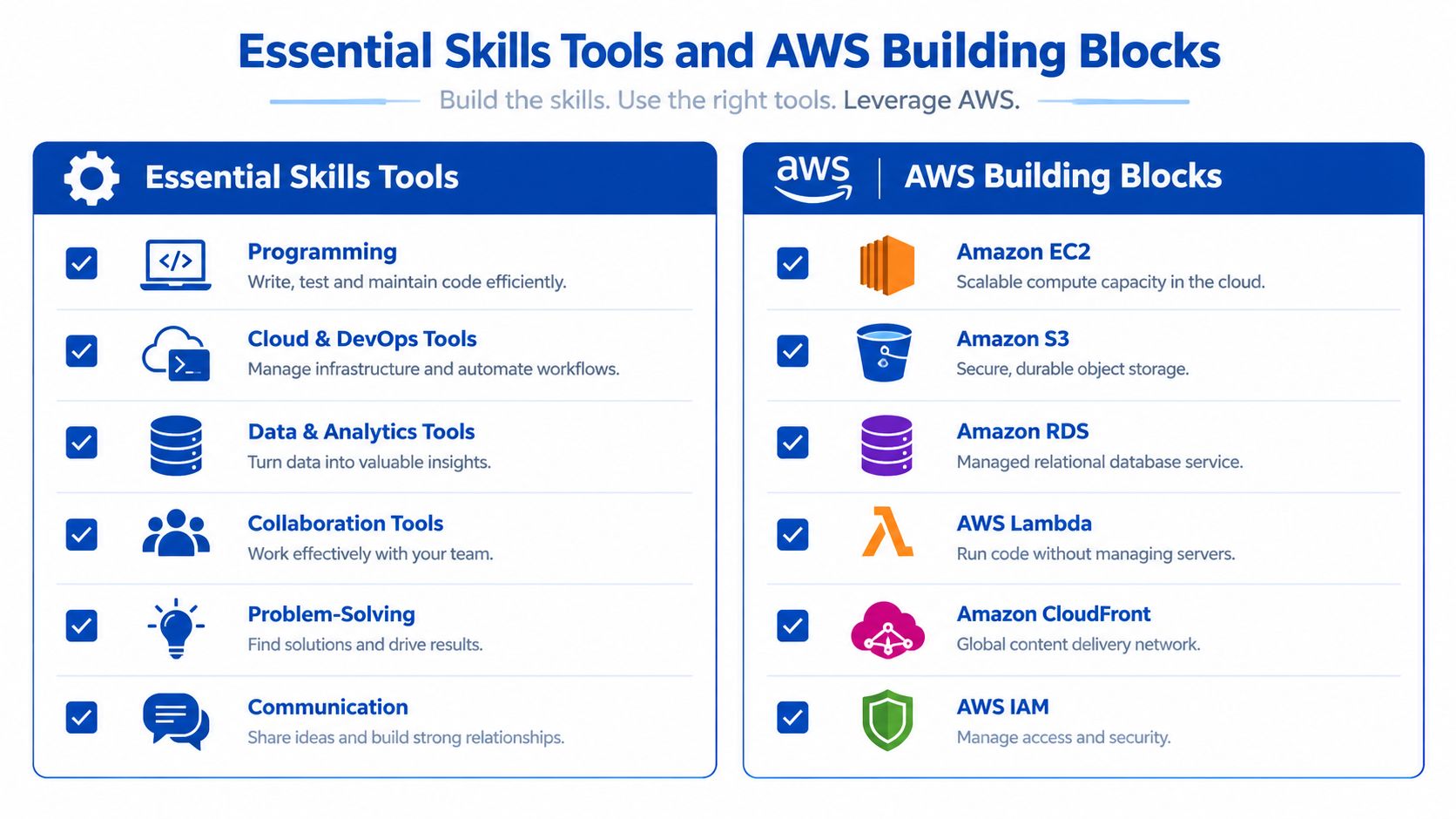
A mobile app architect needs a mixed skill set. Pure mobile knowledge isn't enough, and pure cloud knowledge isn't enough either. The role sits at the point where device constraints, cloud cost, security obligations and delivery processes all collide.
The commercial skill stack
The strongest architects I've worked with can move between boardroom and build pipeline without changing the underlying logic. They can explain why an identity decision affects support costs, why an analytics gap affects budget confidence, and why a noisy release process eventually slows product revenue.
The practical capability stack usually includes:
- System design. Clear boundaries between app, API, integrations and data ownership.
- API-first thinking. Mobile shouldn't depend on undocumented backend behaviour.
- Cloud cost awareness. AWS choices need to be efficient, not just convenient.
- Security framework literacy. Architecture should map to a recognised standard rather than ad hoc rules.
- Observability design. Error tracking, tracing and uptime visibility must exist before scale exposes defects.
The AWS building blocks that tend to fit well
For many mobile projects, AWS works best when the architect keeps the backend narrow and measurable. Common building blocks include Lambda for event-driven business logic, Amplify where it speeds up delivery, object storage for assets, managed identity services where appropriate, and API layers that keep contracts stable even when internals evolve.
For businesses running member systems or subscription products, AWS hosting patterns for membership platforms are a useful benchmark because they force the architecture discussion into access control, predictable cost and integration reliability rather than just app screens.
Security and observability need a framework
OWASP MASVS v2.1 gives architects a concrete structure across 8 control groups covering storage, cryptography, authentication, network communication, platform interaction, code quality, resilience and privacy in the OWASP Mobile Application Security Verification Standard. That matters because security reviews are far more effective when the architecture already aligns to a known model.
Authentication deserves separate attention. OWASP states that MASVS-AUTH requires secure authentication and authorisation protocols, secure local authentication according to platform best practices, and additional authentication for sensitive operations in the OWASP MASVS authentication controls. In plain terms, the architect should own the design for login, token refresh, step-up authentication and privileged actions.
What works in production: choose fewer moving parts, instrument them properly, and make sure every critical user action can be traced from device to backend response.
On the tooling side, I'd expect Sentry or a comparable error platform for crash visibility, New Relic or similar for performance telemetry, Docker-based delivery where supporting services benefit from reproducible environments, and structured documentation around release gates. Continuum Solutions also works in this model across cross-platform delivery, AWS-backed mobile apps, and observability-led support, particularly where mobile, integrations and cloud cost need to be managed together.
Skills should show up in outcomes
The easiest way to test architectural quality is to ask whether the stack makes future changes easier. Can you swap an integration without breaking the app? Can you identify which release caused a login regression? Can the business see which mobile workflows drive value? If the answer is no, the tools were chosen without enough architectural discipline.
How to Hire and Engage a Mobile App Architect
Most hiring mistakes happen because businesses confuse implementation depth with architecture judgment. A developer can be excellent and still be the wrong person to decide platform strategy, privacy controls, integration boundaries and long-term operating cost.
That's why I'd hire against evidence of decision-making, not just feature delivery.

Questions worth asking
A good interview or vendor evaluation should force the candidate to think in scenarios, not slogans.
- How would you structure the app if offline access became mandatory later? This tests whether they design for future constraints or only current screens.
- What would you keep out of the mobile app entirely? Strong architects know what not to place on-device.
- How would you control AWS cost drift after launch? They should talk about usage patterns, observability, right-sizing and avoiding unnecessary managed complexity.
- How would you handle analytics and attribution from day one? If they leave this until later, reporting disputes are coming.
- How do you assess whether Flutter, React Native or a PWA is the right choice? You want trade-offs, not ideology.
Engagement models that actually work
Not every business needs a full-time architect from day one. The sensible model depends on the maturity of the product and the capability of the internal team.
Fractional architecture engagement
Useful when an internal team can build, but needs someone to set direction, review decisions and define guardrails.Architecture plus delivery oversight
Suitable when the product is moving quickly and the business needs release governance, technical design and implementation alignment.Full project team with architecture leadership
Best for greenfield builds, replatforming, or legacy replacement where integration and cloud decisions are too interdependent to separate cleanly.
If you're comparing local delivery partners, mobile app developers in Melbourne with architecture capability is the kind of profile worth looking for. Local context matters when privacy expectations, stakeholder workshops and ongoing support all need continuity.
Red flags in proposals
I'd be cautious if a proposal does any of the following:
- Leads with framework preference before discussing business model, integrations or support constraints.
- Avoids operational detail around monitoring, releases, rollback or incident handling.
- Treats privacy as legal text instead of a design requirement.
- Promises speed without documentation because that usually creates lock-in and handover pain later.
- Prices only the first build without addressing maintenance, store release overhead and cloud spend patterns.
A mobile app architect earns their keep by making future change cheaper, safer and easier to understand.
The best engagements usually start with a short architecture review, a roadmap for phased delivery and a clear definition of which risks must be retired before scale.
Next Steps to De-Risk Your Mobile App Investment
If your app already exists, don't start with a rebuild. Start with an architecture review. Look at the current mobile stack, backend structure, identity model, analytics, AWS cost profile and release process as one system. Most businesses don't need a dramatic reset. They need clearer boundaries, better observability and fewer hidden dependencies.
If you're still planning the product, engage a mobile app architect before design and development lock in expensive assumptions. That's especially important when the app needs to integrate with CRM, payments, membership systems, donor records or internal operational workflows.
A practical next step is to prepare three things for review:
- Your current or planned system map including external platforms and data owners
- Your non-functional priorities such as privacy, offline use, device support and reporting accuracy
- Your cost and support concerns covering cloud spend, release confidence and maintenance risk
Many teams also benefit from reviewing whether the current build approach is production-ready at all. Why the app you vibe coded isn't production ready is a useful reality check when speed has overtaken engineering discipline.
The businesses that get the best long-term return from mobile aren't the ones that ship the fastest first release. They're the ones that make architecture decisions early enough to keep scale, compliance and cost under control later.
Continuum Solutions helps Australian organisations design, build and stabilise mobile platforms that connect cleanly with cloud infrastructure, APIs and business systems. If you need an architecture review, a phased app modernisation plan, or a delivery team that can tie mobile decisions back to AWS cost, privacy and observability, visit Continuum Solutions.